


Türkiye Kills 11 Kurdish YPG Members on Anniversary of Olive Branch Operation

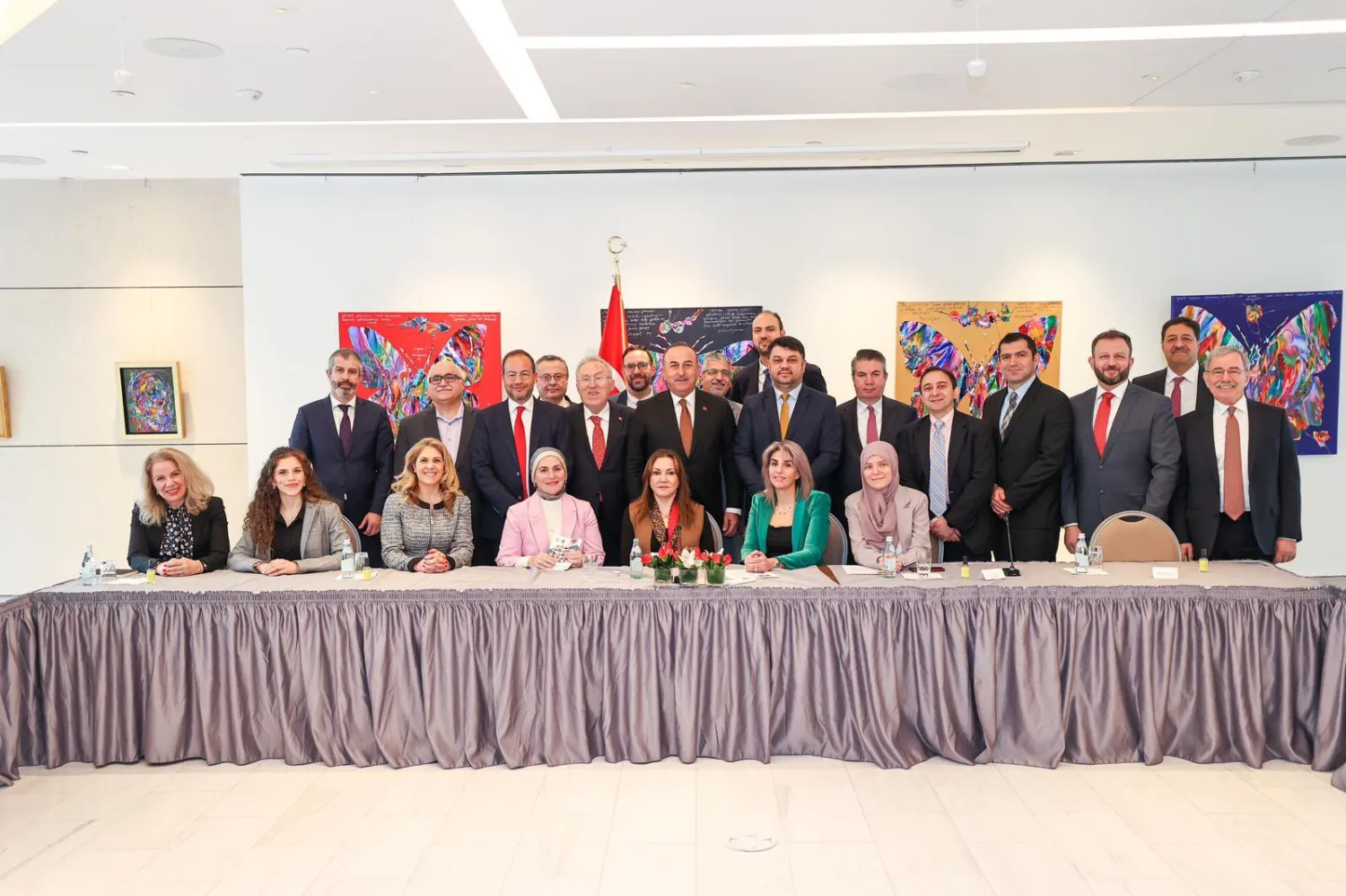
Caption: Turkish Foreign Minister Mevlut Cavusoglu met on Friday night with representatives of the Syrian diaspora in New York (Cavusoglu’s Twitter account)
TT

Türkiye Kills 11 Kurdish YPG Members on Anniversary of Olive Branch Operation

Caption: Turkish Foreign Minister Mevlut Cavusoglu met on Friday night with representatives of the Syrian diaspora in New York (Cavusoglu’s Twitter account)

Turkish-Syrian border areas witnessed this week a military escalation, marking the five-year anniversary of Türkiye’s Operation Olive Branch aimed to clear members affiliated with the Kurdistan Workers’ Party (PKK) from the Afrin region.

On Saturday, the Syrian Observatory for Human Rights said Turkish forces and their proxies shelled the vicinity of Abin village in Shirawa district, Maraanaz, Al-Malkiyah and Al-Shawargha in Shiran district in Afrin countryside north western of Aleppo. However, the extent of damage were not reported.

Also, violent clashes with heavy and medium machine guns erupted between members of the Turkish-backed Syrian National Army (SNA) and Syrian regime forces, following an attempt to infiltrate SNA positions on the frontline of Tadef town in Al-Bab countryside, east of Aleppo.

Meanwhile, commemorating the fifth anniversary of the Turkish Olive Branch military operation in Afrin, hundreds of displaced people from the city and from al-Shahba area in the northern countryside of Aleppo held a massive march in Tal Rifaat, chanting slogans denouncing the Turkish presence in the region. The demonstrators also raised pictures of the victims who were killed during the Turkish military operation, which began on January 20, 2018 and lasted 64 days.

According to the Observatory, the Turkish operation led to the displacement of a third of the indigenous inhabitants who sought shelter in refugee camps and almost-complete devastated houses in different Syrian areas, mainly Aleppo countryside.

Turkish forces and their proxy factions in Afrin are accused of seeking to change the demography of the region through housing the families of militiamen in residential villages established by Turkish-backed institutions.

Meanwhile, Turkish forces on Friday said they “neutralized” 11 members of the People's Defense Units (YPG) after the group fired rockets into the Türkiye-Syria border area, the Turkish Defense Ministry said.

“PKK/YPG terrorists carried out a multi-barrel rocket attack from Tel Rifat to the responsibility area of our Oncupinar Border Post. While there was no damage/loss in our units, the terrorist targets were hit strongly within the scope of self-defense,” the ministry said in a written statement.

Any attack by the terrorists will not remain unanswered, it reiterated.

Separately, Turkish Foreign Minister Mevlut Cavusoglu met on Friday night with representatives of the Syrian diaspora in New York.

In a tweet, the Minister said he reiterated Türkiye’s support to the political process in line with UNSC Res. 2254.

In a joint statement released by Ankara and Washington on the occasion of the Türkiye-US Strategic Mechanism, Cavusoglu and US Secretary of State Antony Blinken said they discussed all aspects of the Syrian crisis and reiterated the commitment of Türkiye and the United States to a Syrian-led political process in accordance with UN Security Council Resolution 2254.

These developments came while protests were held for the third consecutive week in the opposition-controlled areas in northern Syria, rejecting the rapprochement between Ankara and the regime of Syrian President Bashar Assad.

The protesters renewed their refusal to reconcile with the regime and they affirmed their rejection of all plans that aim to support Assad and his regime.

Hamas to Asharq Al-Awsat: Gaza Arms Are Light, Pose No Threat to Israel

Hamas fighters in Gaza (Reuters)
TT

Hamas to Asharq Al-Awsat: Gaza Arms Are Light, Pose No Threat to Israel

Hamas fighters in Gaza (Reuters)

Senior sources in Hamas have played down what they described as an Israeli “scare tactic” over the group’s weapons, rejecting Israeli demands to disarm as a condition for moving to the second phase of a ceasefire in the Gaza Strip.

The sources told Asharq Al-Awsat that Hamas possesses only light weapons in Gaza that have no real impact and pose no genuine threat to Israel, and are barely sufficient to confront Israeli forces. They said such arms could not be used to carry out large-scale attacks, such as the Oct. 7, 2023, assault.

They said fighters from armed factions mainly have Kalashnikov and M16 rifles and similar light weapons, along with a very limited number of anti-armor rounds and improvised explosive devices, most of them individual and small in size.

The sources added that the group has lost almost all of its rockets, mortars and similar weapons after the vast majority were used during two years of fighting, while Israeli forces destroyed stockpiles they uncovered.

The sources said Israel was using the weapons issue to avoid complying with the ceasefire agreement and moving to the second phase, in order to preserve long-term strategic security goals, including keeping its forces inside Gaza, particularly east of the so-called yellow line designated as a withdrawal line in the first phase.

Israeli Prime Minister Benjamin Netanyahu said in an interview with Fox News that there were currently 20,000 Hamas fighters in Gaza armed with Kalashnikov rifles and holding around 60,000 weapons. He said they also used them against civilians in Gaza who opposed their rule.

Disarmament means taking all their weapons and getting rid of them, and dismantling hundreds of kilometers of terror tunnels, Netanyahu said, adding that Hamas refused to do so.

According to Israel’s Channel 13, Netanyahu conveyed those figures to US President Donald Trump, who was said to be shocked by the numbers and stressed the need to dismantle the entire arsenal before any next steps.

Commenting on Netanyahu’s remarks, the Hamas sources said he was trying to influence US thinking on the second phase by making various claims, including about light weapons, in an effort to broaden the concept of disarmament in Gaza and force the resistance to hand over everything it has, even personal arms.

They said Israel’s insistence on stripping Palestinian factions of all weapons aimed to turn Gaza into a pacified area, raising a white flag and stripping it of the means of resilience and resistance that have long defined the enclave under occupation.

“Netanyahu will achieve nothing of the sort,” the sources said. “As he failed before, he and many Israeli leaders will fail again.”

Asked whether that meant Hamas rejected disarmament, the sources said discussions were ongoing with mediators and that a number of ideas were still being developed toward an agreement on weapons within the framework of a broad Palestinian national consensus.

On what remains of Hamas’ tunnel network, the sources said the issue was also under discussion and negotiation, adding that the movement was not seeking to obstruct the transition to the second phase or any of its provisions, but not at the expense of core Palestinian principles.

Israel’s Yedioth Ahronoth reported on Friday that Israeli military chief of staff Eyal Zamir expressed doubts in a security discussion held before Netanyahu’s trip to the United States about the ability of an international stabilization force to disarm Hamas.

Zamir said Israeli forces were operationally ready to carry out the task themselves through another military operation in Gaza, a view Netanyahu reportedly shares as the US administration seeks to exhaust all options for such a step.

The report came as Israel continues to discover more tunnels in Gaza despite the end of the two-year war. One discovery surprised officials due to its proximity to the border with the Kissufim area, east of central Gaza.

Yedioth Ahronoth said the tunnel was about 800 meters from the settlements, within the buffer zone between Gaza and Israel that Israel intends to keep under its control in any future scenario.

The Israeli army has opened an investigation into when it was dug and why it was not detected earlier, given the presence of permanent Israeli military sites on both sides of the border. The tunnel was exposed after heavy rainfall, the paper said.


Led by Al-Khanbashi, National Shield Forces Deploy in Yemen’s Hadhramaut to Retake Camps

Hadhramaut Governor Salem al-Khanbashi (Saba News Agency)
TT

Led by Al-Khanbashi, National Shield Forces Deploy in Yemen’s Hadhramaut to Retake Camps

Hadhramaut Governor Salem al-Khanbashi (Saba News Agency)

Eastern Yemen’s Hadhramaut province entered a critical phase on Friday as government-backed National Shield forces began deploying against an insurgency by the Southern Transitional Council (STC), seeking to regain control of military camps and restore the state’s grip over security and military institutions under the leadership of Governor Salem al-Khanbashi.

Field sources said National Shield forces advanced toward the al-Khasha area in Wadi Seiyun, where units affiliated with the STC are stationed.

The forces encountered ambushes and armed clashes during their advance, prompting direct intervention by aircraft from the Arab Coalition backing Yemen’s internationally recognized government.

The sources said National Shield forces succeeded in the early hours in seizing the headquarters of the 37th Strategic Brigade Camp in al-Khasha, while continuing their advance to tighten control over Seiyun, the largest city in Wadi Hadhramaut and home to the First Military Region command, ahead of moving toward other valley cities still under Transitional Council influence.

As ground operations unfolded, Arab Coalition spokesperson Brig. Gen. Turki al-Maliki stated that Saudi Arabia’s Royal Naval Forces had completed their deployment in the Arabian Sea, a move aimed at conducting inspection operations and combating smuggling.

The developments followed a decision by Yemen’s Presidential Leadership Council Chairman, Rashad al-Alimi, to appoint al-Khanbashi as the overall commander of the National Shield forces in the province, granting him full military, security, and administrative authority to restore security and order.

The decision stated that the mandate would end once its causes cease or upon the issuance of a subsequent presidential decision revoking the authorization. The last clause confirmed the decision would take effect from the date of issuance and publication in the official gazette and military bulletins.

The decision is widely seen as a decisive sovereign step reflecting al-Alimi’s approach to unifying military and security command in Hadhramaut and reinforcing state authority in one of Yemen’s most strategically and economically important provinces.

Observers said the decision provides legal and political cover for the “handover of camps” operation, placing it within a clear institutional framework and away from factional conflict, a point the governor emphasized in his address.

Saudi ambassador blames al-Zubaidi

Leaders of the Southern Transitional Council rejected handing over the camps or avoiding confrontation, with several figures calling for general mobilization. Field assessments indicate their forces’ capabilities have declined and may collapse, potentially forcing their withdrawal from Hadhramaut and al-Mahra by force.

In a clear Saudi stance, Saudi Ambassador to Yemen Mohammed Al-Jaber held the Transitional Council and its leader, Aidrous al-Zubaidi, directly responsible for the escalation, stating that the exploitation of the southern cause for personal gain had harmed it and stripped it of many of its political achievements.

In a series of posts on X, Al-Jaber stated that Saudi Arabia has supported and continues to support the southern cause as a just issue with historical and social dimensions, emphasizing that a genuine solution can only be achieved through political dialogue that meets the aspirations of all southern governorates.

He said al-Zubaidi had taken dangerous unilateral decisions, most notably leading a military attack on Hadhramaut and al-Mahra, resulting in security breakdowns, the intimidation of civilians, and the killing and wounding of Hadhramaut residents.

Al-Jaber stated that the Kingdom had exerted intensive efforts in recent weeks to persuade the STC to end the escalation and hand over the camps to National Shield forces, but faced continued rejection and intransigence.

This included refusing to issue clearance for a Saudi aircraft carrying an official delegation on Jan. 1, 2026, and shutting down air traffic at Aden airport, which he described as irresponsible behavior that harms Yemenis and undermines de-escalation efforts.

A peaceful operation

Al-Khanbashi confirmed the launch of the “camp handover” operation, stating that it is a peaceful and organized process targeting only military sites, without harming any political or social component, and without affecting civilians or their interests.

He stressed that the operation was not a declaration of war or a push for escalation, but a preventive measure aimed at neutralizing weapons and stopping chaos, thereby preventing the use of camps to threaten Hadhramaut’s security and protecting the province from dangerous scenarios.

Al-Khanbashi said Hadhramaut is going through a sensitive phase that requires courageous and responsible decisions.

He noted that local authorities, backed by the state and Saudi Arabia, had made significant efforts to open dialogue channels, but faced deliberate obstruction and systematic preparations to create chaos that could spiral out of control.

He stated that the operation is limited in scope, clear in its objectives, and guided by constitutional and national responsibilities to protect citizens’ lives and preserve civil peace.

Calls for calm and accountability

The governor called on Hadhramaut’s tribal leaders, elders, and social figures to play their national role during this critical phase and help shield society from being drawn into chaos or polarization, stating that Hadhramaut has always been and will remain a land of peace, wisdom, and statehood.

Al-Khanbashi held the United Arab Emirates responsible for what he described as chaos and looting targeting weapons and ammunition facilities at Riyan airport, due to their failure to hand the site over to local authorities upon withdrawal.

He rejected any attempt by forces or entities from outside the province to exploit the developments.

Al-Khanbashi stated that protecting Hadhramaut is a collective responsibility, warning that anyone attempting to undermine security or engage in looting will be held legally and judicially accountable.

He stressed that the state will remain aligned with citizens, peace, and the future.


8 Arab and Islamic Countries Deeply Concerned About Deteriorating Humanitarian Situation in Gaza

Nanaa Abu Jari cooks outside her tent after it was flooded by rainwater in Nuseirat, central Gaza Strip, Friday, Jan. 2, 2026. (AP Photo/Abdel Kareem Hana)
TT

8 Arab and Islamic Countries Deeply Concerned About Deteriorating Humanitarian Situation in Gaza

Nanaa Abu Jari cooks outside her tent after it was flooded by rainwater in Nuseirat, central Gaza Strip, Friday, Jan. 2, 2026. (AP Photo/Abdel Kareem Hana)

The foreign ministers of eight Arab and Islamic countries, including Saudi Arabia, Egypt and Qatar urged on Friday the international community to pressure Israel to lift constraints on the distribution of aid in the Gaza Strip.

In a joint statement the eight countries “expressed their deepest concern regarding the deteriorating humanitarian situation in the Gaza Strip, which has been exacerbated by severe, harsh, and unstable weather conditions, including heavy rainfall and storms, and compounded by the continued lack of sufficient humanitarian access, acute shortages of essential life-saving supplies, and the slow pace of the entry of essential materials required for the rehabilitation of basic services and the establishment of temporary housing.”

They "urged the international community to pressure Israel, as the occupying power, to immediately lift the constraints on the entry and distribution of essential supplies" to Gaza.

The statement also called for the immediate delivery of humanitarian aid in the Palestinian enclave through the UN and its agencies, the rehabilitation of infrastructure and hospitals, and the opening of the Rafah Crossing in both directions as stipulated in US President Donald Trump’s Comprehensive Plan.

The Rafah border crossing was set to be reopened under the ceasefire in effect in Gaza since October, but has so far remained closed.

Friday’s statement “commended the tireless efforts of all United Nations organizations and agencies, especially UNRWA, as well as humanitarian international NGOs, in continuing to assist Palestinian civilians and deliver humanitarian assistance under extremely difficult and complex circumstances.”

The eight countries “demanded that Israel ensure the UN and international NGOs are able to operate in Gaza and the West Bank in a sustained, predictable, and unrestricted manner, given their integral role in the humanitarian response in the Strip.”

“Any attempt to impede their ability to operate is unacceptable,” they added.