


Germany Clears Way for Scores of Tanks for Ukraine, US Also Poised

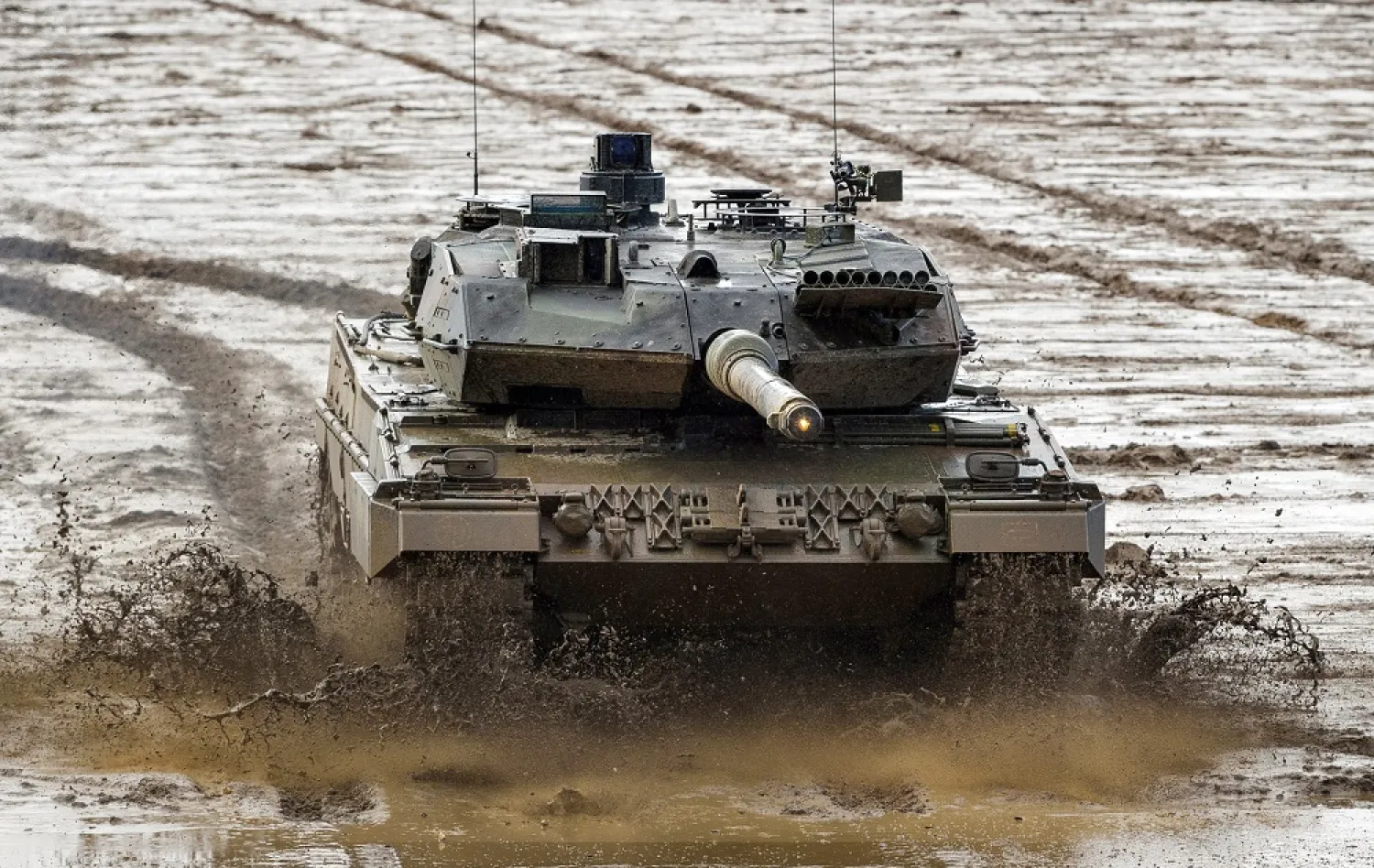
07 February 2022, Lower Saxony, Munster: A Bundeswehr Leopard 2A6 main battle tank drives across the training range during a combat demonstration in Munster. (dpa)
TT

Germany Clears Way for Scores of Tanks for Ukraine, US Also Poised

07 February 2022, Lower Saxony, Munster: A Bundeswehr Leopard 2A6 main battle tank drives across the training range during a combat demonstration in Munster. (dpa)

Germany cleared the way on Wednesday for Europe to send scores of battle tanks to Ukraine and the United States prepared to make a similar announcement, moves hailed by Kyiv as a potential turning point in the war, and condemned by Moscow as escalation.

Kyiv has been calling for months for Western main battle tanks that would give its forces greater firepower, protection and mobility to break through Russian front lines and potentially reclaim occupied territory in the east and south.

Germany, previously the West's holdout, said it would send an initial company of 14 of its Leopard 2 tanks from its own stocks, and also approve shipments by other European countries.

The eventual aim would be to supply Ukraine with two battalions of Leopards, typically comprising three or four companies each, the first to arrive within three or four months.

"Germany will always be at the forefront when it comes to supporting Ukraine," Chancellor Olaf Scholz told the German parliament, to applause.

He told a press conference later that Germany would send further military aid to Ukraine beyond the Leopards delivery, including for example air defense systems, heavy artillery and multiple rocket launchers.

Ukrainian President Volodymyr Zelenskiy thanked Scholz by phone and said he was "sincerely grateful to the Chancellor and all our friends in Germany".

The move lifts one of the last taboos in Western support for Ukraine against Russia's almost year-old invasion: providing arms that have a mainly offensive rather than defensive purpose.

"So the tank coalition is formed. Everyone who doubted this could ever happen sees now: for Ukraine and partners impossible is nothing," Ukrainian Foreign Minister Dmytro Kuleba said.

"I call on all new partners that have Leopard 2 tanks in service to join the coalition and provide as many of them as possible," he wrote on Twitter.

The Russian embassy in Berlin denounced Germany's "extremely dangerous decision" which, it said, "destroys the remnants of mutual trust" and could draw Germany into the war. Scholz pledged that no such thing would happen.

Others to follow

Berlin's move paves the way for pledges from other countries that field Leopards, which Germany made in the thousands and exported to allies in NATO.

Finland said it would send them, as did Poland, which has already sought Berlin's approval. Spain and the Netherlands said they were considering it and Norway was reported to be discussing it. Britain has offered a company of 14 of its comparable Challenger tanks and France is considering sending its Leclercs.

"At a critical moment in Russia's war, these tanks can help Ukraine defend itself, win and stand as an independent nation," NATO Secretary-General Jens Stoltenberg said.

Two sources in the United States said Washington would announce later on Wednesday that it would provide dozens of its own Abrams M1 tanks.

Ukrainian Defense Minister Oleksiy Reznikov said he spoke with US counterpart Lloyd Austin on Wednesday, promising "more good news to be announced soon".

Reznikov said they discussed "further strengthening of (Ukraine's army), including tank supplies and maintenance of the new armament."

Moscow says supplies of modern offensive weaponry to Ukraine will only postpone what it says will be its inevitable victory. Anatoly Antonov, Russia's ambassador in Washington, said deliveries of US battle tanks would be a "another blatant provocation".

Kremlin spokesman Dmitry Peskov said any US tanks sent to Ukraine would "burn like all the rest".

In the past week, Russia has ramped up threats, including comments from Dmitry Medvedev, an ally of President Vladimir Putin, that a nuclear state facing defeat could use nuclear weapons.

Western officials who support sending the tanks have dismissed Moscow's threats, arguing that Russia is already waging war at full tilt and has been deterred from attacking NATO or using nuclear arms.

Last week, allies pledged billions of dollars' worth of military aid including hundreds of armored fighting vehicles and troop carriers. Those are seen as more effective for attacking enemy lines when used alongside tanks.

Withdrawal from Soledar

Ukraine sees the weapons as restoring its momentum in a war that has lately become a bloody, deadlocked slog.

Kyiv acknowledged on Wednesday its forces had withdrawn from Soledar, a small salt-mining town in the east that Russia had claimed to capture more than a week ago, its biggest gain for more than half a year.

The town is close to Bakhmut, a larger city that has been the focus of an intense Russian assault for weeks.

The Russian-installed governor of Ukraine's Donetsk region said units of Russia's Wagner contract militia were now moving forward inside Bakhmut, with fighting on the outskirts and in neighborhoods recently held by Ukraine.

Reuters could not verify the situation there.

In the 11 months since it invaded, Russia has killed thousands of civilians, forced millions from their homes and reduced entire cities to rubble.

It says its "special military operation" was necessary to stem a security threat arising from Ukraine's ties to the West, which it now portrays as seeking to destroy it. Kyiv and its allies say Ukraine never menaced Russia and the invasion is a war of aggression to subdue a neighbor and seize land.

Ukraine defeated Russia's troops on the outskirts of Kyiv last year and later drove them out of swathes of occupied land.

But Moscow still occupies around a sixth of Ukraine, and has declared this territory part of Russia. Ukraine says it will not stop fighting until it retakes all its territory.



Army Chief Says Switzerland Can’t Defend Itself from Full-Scale Attack

Lieutenant General Thomas Suessli, Chief of the Armed Forces of the Swiss Army, attends a news conference on the outbreak of the coronavirus disease (COVID-19) in Bern, Switzerland, March 16, 2020. Picture taken March 16, 2020. (Reuters)
TT

Army Chief Says Switzerland Can’t Defend Itself from Full-Scale Attack

Lieutenant General Thomas Suessli, Chief of the Armed Forces of the Swiss Army, attends a news conference on the outbreak of the coronavirus disease (COVID-19) in Bern, Switzerland, March 16, 2020. Picture taken March 16, 2020. (Reuters)

Switzerland cannot defend itself against a full-scale attack and must boost military spending given rising risks from Russia, the head of its armed forces said.

The country is prepared for attacks by "non-state actors" on critical infrastructure and for cyber attacks, but its military still faces major equipment gaps, Thomas Suessli told the NZZ newspaper.

"What we cannot do is defend against threats from a distance or even a full-scale ‌attack on ‌our country," said Suessli, who is ‌stepping ⁠down at ‌the end of the year.

"It's burdensome to know that in a real emergency, only a third of all soldiers would be fully equipped," he said in an interview published on Saturday.

Switzerland is increasing defense spending, modernizing artillery and ground systems ⁠and replacing ageing fighter jets with Lockheed Martin F-35As.

But the ‌plan faces cost overruns, while ‍critics question spending on artillery ‍and munitions amid tight federal finances.

Suessli said ‍attitudes towards the military had not shifted despite the war in Ukraine and Russian efforts to destabilize Europe.

He blamed Switzerland's distance from the conflict, its lack of recent war experience and the false belief that neutrality offered protection.

"But that's historically ⁠inaccurate. There are several neutral countries that were unarmed and were drawn into war. Neutrality only has value if it can be defended with weapons," he said.

Switzerland has pledged to gradually raise defense spending to about 1% of GDP by around 2032, up from roughly 0.7% now – far below the 5% level agreed by NATO countries.

At that pace, the Swiss military would only be ‌fully ready by around 2050.

"That is too long given the threat," Suessli said.


Another 131 Migrants Rescued off Southern Crete

A dinghy transporting dozens of refugees and migrants is pulled towards Greece's Lesbos island after being rescued by a war ship during their sea crossing between Türkiye and Greece on February 29, 2020. Aris Messinis, AFP/File picture
TT

Another 131 Migrants Rescued off Southern Crete

A dinghy transporting dozens of refugees and migrants is pulled towards Greece's Lesbos island after being rescued by a war ship during their sea crossing between Türkiye and Greece on February 29, 2020. Aris Messinis, AFP/File picture

The Greek coast guard Saturday rescued 131 would-be migrants off Crete, bringing the number of people brought out of the sea in the area over the past five days to 840, a police spokesperson said.

The migrants rescued Saturday morning were aboard a fishing boat some 14 nautical miles south of Gavdos, a small island south of Crete.

The passengers, whose nationality was not revealed, were all taken to Gavdos.

Many people attempting to reach Crete from Libya drown during the risky crossing.

In early December, 17 people -- mostly Sudanese or Egyptian -- were found dead after their boat sank off the coast of Crete, and 15 others were reported missing. Only two people survived.

According to the UN High Commissioner for Refugees, more than 16,770 people trying to get to Europe have arrived in Crete since the beginning of the year, more than on any other Greek island.

In July, the conservative government suspended the processing of asylum applications for three months, particularly those of people arriving from Libya, saying the measure as "absolutely necessary" in the face of the increasing flow of migrants.


Thailand and Cambodia Sign New Ceasefire Agreement to End Border Fighting

A handout photo made available by the Defense Ministry of Thailand shows Cambodian Defense Minister Tea Seiha (L) and Thai Defense Minister Natthaphon Narkphanit attending a General Border Committee Meeting in Ban Pak Kard, Chanthaburi Province, Thailand, 27 December 2025. (EPA/Defense Ministry of Thailand/Handout)
TT

Thailand and Cambodia Sign New Ceasefire Agreement to End Border Fighting

A handout photo made available by the Defense Ministry of Thailand shows Cambodian Defense Minister Tea Seiha (L) and Thai Defense Minister Natthaphon Narkphanit attending a General Border Committee Meeting in Ban Pak Kard, Chanthaburi Province, Thailand, 27 December 2025. (EPA/Defense Ministry of Thailand/Handout)

Thailand and Cambodia on Saturday signed a ceasefire agreement to end weeks of armed combat along their border over competing claims to territory. It took effect at noon local time.

In addition to ending fighting, the agreement calls for no further military movements by either side and no violations of either side’s airspace for military purposes.

Only Thailand employed airstrikes in the fighting, hitting sites in Cambodia as recently as Saturday morning, according to the Cambodian defense ministry.

The deal also calls for Thailand, after the ceasefire has held for 72 hours, to repatriate 18 Cambodian soldiers it has held as prisoners since earlier fighting in July. Their release has been a major demand of the Cambodian side.

The agreement was signed by the two countries’ defense ministers, Cambodia’s Tea Seiha and Thailand’s Nattaphon Narkphanit, at a checkpoint on their border after lower-level talks by military officials met for three days as part of the already-established General Border Committee.

The agreement declares that the two sides are committed to an earlier ceasefire that ended five days of fighting in July and follow-up agreements and includes commitments to 16 de-escalation measures.

The original July ceasefire was brokered by Malaysia and pushed through by pressure from US President Donald Trump, who threatened to withhold trade privileges unless Thailand and Cambodia agreed. It was formalized in more detail in October at a regional meeting in Malaysia that Trump attended.

Despite those deals, the two countries carried on a bitter propaganda war and minor cross-border violence continued, escalating in early December to widespread heavy fighting.

Thailand has lost 26 soldiers and one civilian as a direct result of the combat since Dec. 7, according to officials. Thailand has also reported 44 civilian deaths from collateral effects of the situation.

Cambodia hasn’t issued an official figure on military casualties, but says that 30 civilians have been killed and 90 injured. Hundreds of thousands of people have been evacuated from affected areas on both sides of the border.

Each side blamed the other for initiating the fighting and claimed to be acting in self-defense.

The agreement also calls on both sides to adhere to international agreements against deploying land mines, a major concern of Thailand. Thai soldiers along the border have been wounded in at least nine incidents this year by what they said were newly planted Cambodian mines. Cambodia says the mines were left over from decades of civil war that ended in the late 1990s.

Another clause says the two sides “agree to refrain from disseminating false information or fake news.”

The agreement also says previously established measures to demarcate the border will be resumed and the two sides also agree to cooperate on an effort to suppress transnational crimes.

That is primarily a reference to online scams perpetrated by organized crime that have bilked victims around the world of billions of dollars each year. Cambodia is a center for such criminal enterprises.