

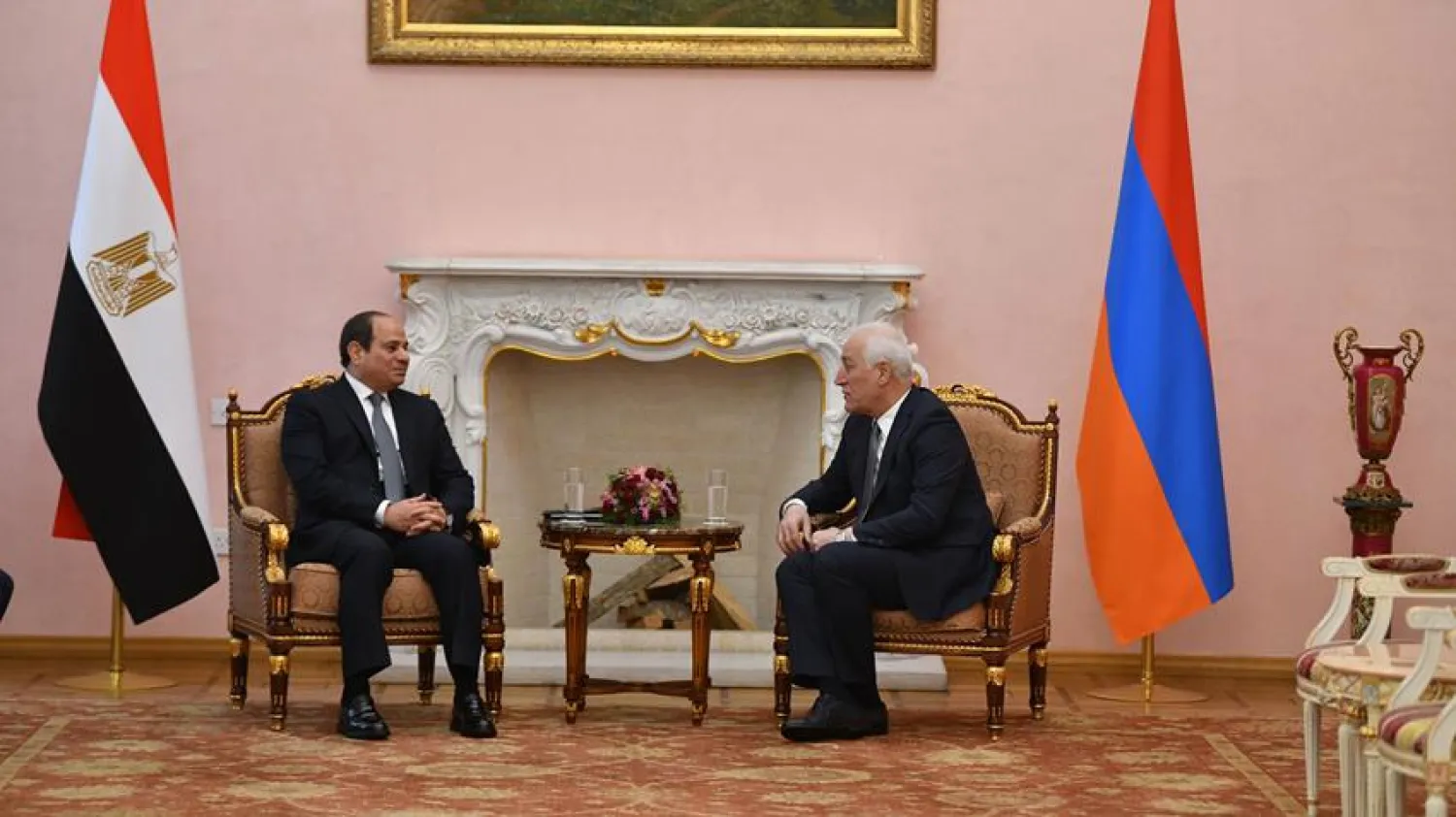

Sisi: First Egyptian President to Visit Armenia

President Abdel Fattah El-Sisi with Armenian President Vahagn Khachaturyan (Egyptian Presidency)
TT

Sisi: First Egyptian President to Visit Armenia

President Abdel Fattah El-Sisi with Armenian President Vahagn Khachaturyan (Egyptian Presidency)

Egypt and Armenia have agreed to enhance cooperation in various fields, especially in the economy and the exchange of expertise

On Saturday, President Abdel Fattah El-Sisi arrived in Yerevan on the first visit by an Egyptian President since Armenia's independence.

Sisi held closed talks with Armenian President Vahagn Khachaturyan at the Presidential Palace in Yerevan, followed by an expanded meeting that included the two delegations.

Egyptian Presidency Spokesman Bassam Rady said Sisi voiced happiness for being the first Egyptian President to visit the country since establishing diplomatic ties about 30 years ago.

In a joint press conference with his counterpart, Sisi said his visit to Yerevan reflects Egypt's interest and appreciation for Armenia and desire to develop relations with it in various fields.

The Egyptian President pointed out that his country has historically hosted tens of thousands of Armenians who have made political, economic, cultural, and artistic contributions.

In turn, the Armenian President welcomed the historic visit of the Egyptian President, expressing "his country's appreciation for Egypt at the official and popular levels, and his pride in the extended ties that unite the two countries."

Khachaturyan expressed his country's aspiration to exchange technical expertise with Egypt and collaborate in the implementation of projects in Armenia in several sectors where it has the successful experience, particularly infrastructure and transport.

The discussions touched on Egypt's achievements in energy production, making it a promising investment destination.

Sisi said that the two sides agreed on the importance of joint work to increase trade exchange between the two countries, commensurate with their promising capabilities and distinguished political relations.

He said this would require activating current economic cooperation mechanisms, including the joint committee for economic, scientific, and technical cooperation and the business forum.

The talks also tackled regional and international issues of mutual concern in the Middle East and South Caucasus.

The Egyptian President stressed the importance of dialogue, negotiations, and efforts to achieve peace and give a decent life for everyone, especially amid current economic issues resulting from the coronavirus pandemic and the Russian-Ukrainian crisis.

Khachaturyan commended Egypt's pivotal role in consolidating stability in the Middle East and Africa, particularly in combating illegal migration, achieving interfaith coexistence, and supporting peaceful solutions to crises within its regional surroundings.

The two leaders exchanged views on combating terrorism and extremism and joining forces to confront the global economic repercussions of the Russian-Ukrainian crisis.

They witnessed the signing of several joint agreements and memorandums of understanding between the concerned government agencies for cooperation in the scientific, technological, sports, and cultural fields.

Later, Sisi held talks with Armenian Prime Minister Nikol Pashinyan and exchanged views on several regional issues.

The two sides agreed on the need to intensify coordination and consultation on issues of common interest in Eastern Europe and the South Caucasus, especially developments of the Russian-Ukrainian crisis and its global economic repercussions.

They asserted the need to boost cooperation to combat illegal migration through a comprehensive approach and eliminate the leading causes that encourage this phenomenon.



Israel Permits 10,000 West Bank Palestinians for Friday Prayers at Al Aqsa

Palestinians attend Friday prayers in a mosque following an attack that local Palestinians said was carried out by Israeli settlers, in the village of Deir Istiya near Salfit in the Israeli-occupied West Bank November 14, 2025. REUTERS/Sinan Abu Mayzer
TT

Israel Permits 10,000 West Bank Palestinians for Friday Prayers at Al Aqsa

Palestinians attend Friday prayers in a mosque following an attack that local Palestinians said was carried out by Israeli settlers, in the village of Deir Istiya near Salfit in the Israeli-occupied West Bank November 14, 2025. REUTERS/Sinan Abu Mayzer

Israel announced that it will cap the number of Palestinian worshippers from the occupied West Bank attending weekly Friday prayers at the Al-Aqsa Mosque in east Jerusalem at 10,000 during the holy month of Ramadan, which began Wednesday.

Israeli authorities also imposed age restrictions on West Bank Palestinians, permitting entry only to men aged 55 and older, women aged 50 and older, and children up to age 12.

"Ten thousand Palestinian worshippers will be permitted to enter the Temple Mount for Friday prayers throughout the month of Ramadan, subject to obtaining a dedicated daily permit in advance," COGAT, the Israeli defense ministry agency in charge of civilian matters in the Palestinian territories, said in a statement, AFP reported.

"Entry for men will be permitted from age 55, for women from age 50, and for children up to age 12 when accompanied by a first-degree relative."

COGAT told AFP that the restrictions apply only to Palestinians travelling from the West Bank, which Israel has occupied since the 1967 Arab-Israeli war.

"It is emphasised that all permits are conditional upon prior security approval by the relevant security authorities," COGAT said.

"In addition, residents travelling to prayers at the Temple Mount will be required to undergo digital documentation at the crossings upon their return to the areas of Judea and Samaria at the conclusion of the prayer day," it said, using the Biblical term for the West Bank.

During Ramadan, hundreds of thousands of Palestinians traditionally attend prayers at Al-Aqsa, Islam's third holiest site, located in east Jerusalem, which Israel captured in 1967 and later annexed in a move that is not internationally recognized.

Since the war in Gaza broke out in October 2023, the attendance of worshippers has declined due to security concerns and Israeli restrictions.

The Palestinian Jerusalem Governorate said this week that Israeli authorities had prevented the Islamic Waqf -- the Jordanian-run body that administers the site -- from carrying out routine preparations ahead of Ramadan, including installing shade structures and setting up temporary medical clinics.

A senior imam of the Al-Aqsa Mosque, Sheikh Muhammad al-Abbasi, told AFP that he, too, had been barred from entering the compound.

"I have been barred from the mosque for a week, and the order can be renewed," he said.

Abbasi said he was not informed of the reason for the ban, which came into effect on Monday.

Under longstanding arrangements, Jews may visit the Al-Aqsa compound -- which they revere as the site of the first and second Jewish temples -- but they are not permitted to pray there.

Israel says it is committed to upholding this status quo, though Palestinians fear it is being eroded.

In recent years, a growing number of Jewish ultranationalists have challenged the prayer ban, including far-right politician Itamar Ben Gvir, who prayed at the site while serving as national security minister in 2024 and 2025.


EU Exploring Support for New Gaza Administration Committee, Document Says

Palestinians push a cart past the rubble of residential buildings destroyed during the two-year Israeli offensives, in Gaza City, February 17, 2026. REUTERS/Mahmoud Issa
TT

EU Exploring Support for New Gaza Administration Committee, Document Says

Palestinians push a cart past the rubble of residential buildings destroyed during the two-year Israeli offensives, in Gaza City, February 17, 2026. REUTERS/Mahmoud Issa

The European Union is exploring possible support for a new committee established to take over the civil administration of Gaza, according to a document produced by the bloc's diplomatic arm and seen by Reuters.

"The EU is engaging with the newly established transitional governance structures for Gaza," the European External Action Service wrote in a document circulated to member states on Tuesday.

"The EU is also exploring possible support to the National Committee for the Administration of Gaza," it added.

European foreign ministers will discuss the situation in Gaza during a meeting in Brussels on February 23.


Israel Military Says Soldier Killed in Gaza 

A drone view shows the destruction in a residential neighborhood, after the withdrawal of the Israeli forces from the area, amid a ceasefire between Israel and Hamas in Gaza, in Gaza City, October 21, 2025. (Reuters)
TT

Israel Military Says Soldier Killed in Gaza 

A drone view shows the destruction in a residential neighborhood, after the withdrawal of the Israeli forces from the area, amid a ceasefire between Israel and Hamas in Gaza, in Gaza City, October 21, 2025. (Reuters)

The Israeli military announced that one of its soldiers had been killed in combat in southern Gaza on Wednesday, but a security source said the death appeared to have been caused by "friendly fire".

"Staff Sergeant Ofri Yafe, aged 21, from HaYogev, a soldier in the Paratroopers Reconnaissance Unit, fell during combat in the southern Gaza Strip," the military said in a statement.

A security source, however, told AFP that the soldier appeared to have been "killed by friendly fire", without providing further details.

"The incident is still under investigation," the source added.

The death brings to five the number of Israeli soldiers killed in Gaza since a ceasefire took effect on October 10.