

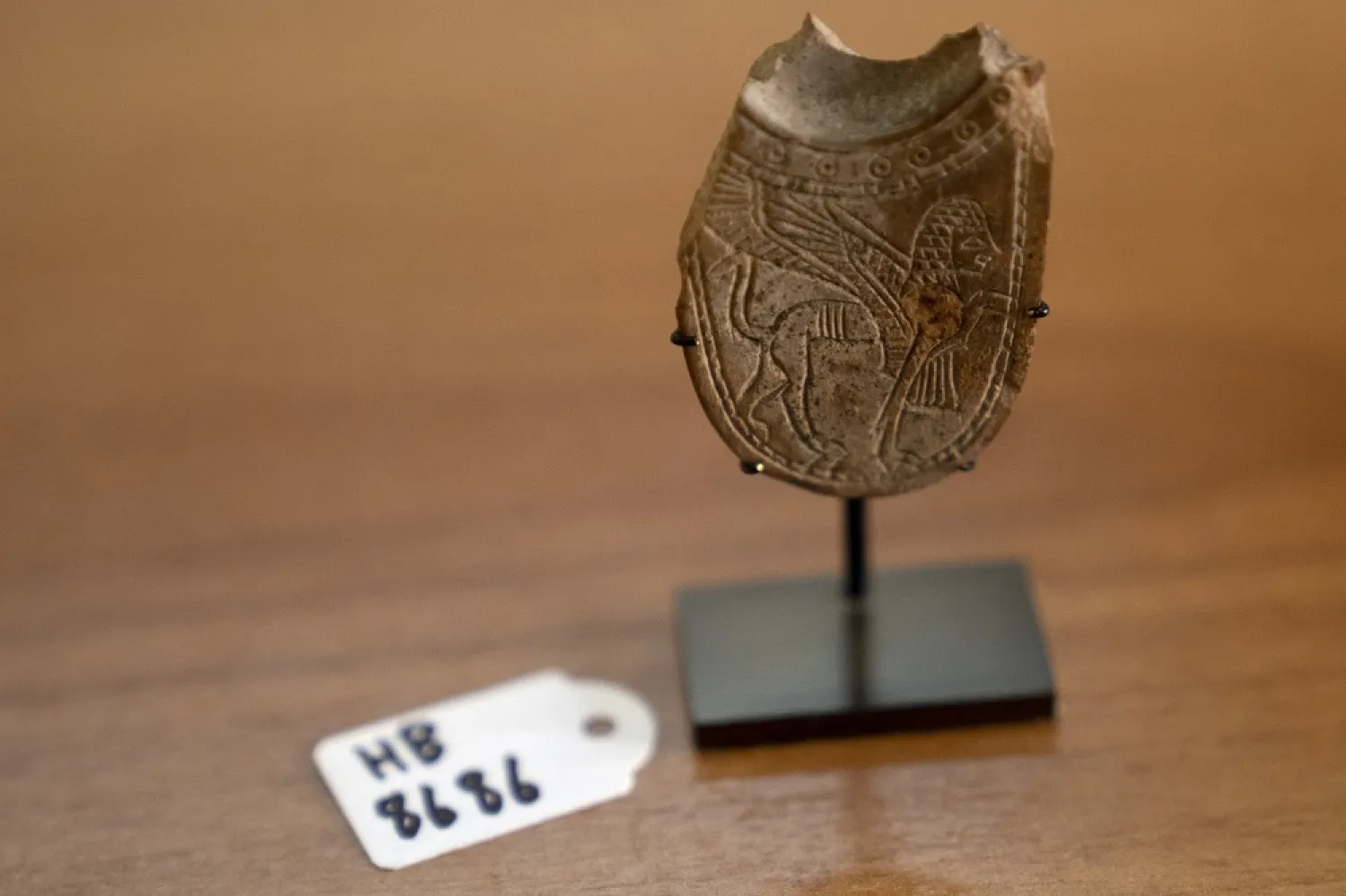

Israel Probes Legality of US Giving Artifact to Palestinians

A 2,700-year-old ivory incense spoon plundered from a site in the occupied West Bank — seized in late 2021 by the Manhattan District Attorney's office as part of a plea deal with billionaire hedge fund manager Michael Steinhardt, displayed at the Palestinian Ministry of Tourism and Antiquities in the West Bank city of Bethlehem, Thursday, Jan. 19, 2023. (AP)
TT

Israel Probes Legality of US Giving Artifact to Palestinians

A 2,700-year-old ivory incense spoon plundered from a site in the occupied West Bank — seized in late 2021 by the Manhattan District Attorney's office as part of a plea deal with billionaire hedge fund manager Michael Steinhardt, displayed at the Palestinian Ministry of Tourism and Antiquities in the West Bank city of Bethlehem, Thursday, Jan. 19, 2023. (AP)

An ivory spoon dating back 2,700 years that was recently repatriated to the Palestinian Authority from the United States has sparked a dispute with Israel's new far-right government over the cultural heritage in the occupied West Bank.

The clash brings into focus the political sensitivities surrounding archaeology in the Middle East, where Israelis and Palestinians each use ancient artifacts to support their claims over the land.

Israel's ultranationalist heritage minister has ordered officials to examine the legality of the US government's historic repatriation of the artifact to the Palestinians earlier this month, and is calling for annexing archaeology in the occupied West Bank.

The artifact — a cosmetic spoon made of ivory and believed to have been plundered from a site in the West Bank — was seized in late 2021 by the Manhattan District Attorney's office as part of a deal with the New York billionaire hedge fund manager Michael Steinhardt.

It was one of 180 artifacts illegally looted and purchased by Steinhardt that he surrendered as part of an agreement to avoid prosecution.

American officials handed an artifact over to the Palestinian Ministry of Tourism and Antiquities on Jan. 5 in what the US State Department’s Office of Palestinian Affairs said was "the first event of such repatriation" by the US to the Palestinians.

Dozens of Steinhardt’s surrendered artifacts have already been repatriated to Italy, Bulgaria, Greece, Türkiye, Jordan, Libya and Israel. This spoon was the first and only item ever to be repatriated to the Palestinians.

The repatriation coincided with the first weeks of Israel's new government, which is composed of ultranationalists who see the West Bank as the biblical heartland of the Jewish people and inextricably linked to the state of Israel.

Heritage Minister Amihai Eliyahu’s office said last week that the legality of the repatriation "is being examined by the archaeology staff officer with the legal counsel, which will examine all aspects of the matter, including the Oslo Accords that the US has signed."

The case underscores how archaeology and cultural heritage are intertwined with the competing claims of the Israelis and Palestinians in the decades-long conflict.

"Any artifact that we know that it comes out illegally from Palestine, we have the right to have it back," said Jihad Yassin, director general of excavations and museums in the Palestinian Tourism and Antiquities Ministry. "Each artifact says a story from the history of this land."

The ministry is part of the Palestinian Authority, the government established as part of the Oslo Accords in the 1990s that exercises limited autonomy in parts of the Israeli-occupied West Bank.

Those agreements between Israel and the Palestinians were supposed to include coordination on a raft of issues, including archaeology and cultural heritage.

But the agreements have largely unraveled. Yassin said that the archaeology committee has not met in around two decades, and that there is virtually zero coordination between Israel and the Palestinians concerning antiquities theft prevention in the West Bank.

"We try to do our best to protect these archaeological sites, but we face difficulties," he said.

Yassin said that around 60% of the West Bank's archaeological sites are in territory under complete Israeli military control, and that his ministry's theft prevention workers "manage to control in a high percentage the looting" in areas under Palestinian Authority control.

Nonetheless, many of the illicit artifacts that have made their way to Israel's legal antiquities market were looted from the West Bank, he said.

According to court documents, Steinhardt bought the ivory cosmetic spoon in 2003 from Israeli antiquities dealer Gil Chaya for $6,000. The artifact had no provenance — paperwork detailing where it came from and how it had entered the dealer's inventory — but Chaya said the object was from the West Bank town of El-Koum, which is under Palestinian Authority control.

Another artifact believed to have been looted from the same town, a "Red Carnelian Sun Fish amulet (that) dates to circa 600 B.C.E.," remains missing, according to the DA's office. Steinhardt has yet to locate the item, but if it is found, it will be repatriated to the Palestinians, the office said.

American authorities returned 28 objects to Israel last year, not including three that were seized in place at the Israel Museum of Jerusalem. Seven others meant to be returned to Israel have yet to be found. Several of the items returned to Israel are believed to have been looted from the West Bank.

The Israel Antiquities Authority declined comment on the artifact’s repatriation to the Palestinians.

Heritage Minister Eliyahu, a religious ultranationalist in Netanyahu's government now in charge of the country’s Antiquities Authority, denies the existence of a Palestinian people.

Since taking office, he has accused the Palestinian Authority of committing "national terrorism" and "erasing heritage" at an archaeological site in a Palestinian-controlled area near the West Bank city of Nablus.

It remains unclear what impact, if any, a review by the ministry's legal counsel could have. It appears unlikely Israel could confiscate the artifact from the Palestinians, but a legal opinion against the move could potentially complicate future repatriations.

Earlier this week, Eliyahu said he would be giving the Israel Antiquities Authority full control over archaeological sites, cultural heritage and theft prevention throughout the West Bank — a move that critics say would in effect apply Israeli law over occupied territory in breach of international law.

Currently, archaeological excavations and antiquities in the West Bank are managed by the Civil Administration's archaeology staff officer, which is part of the Defense Ministry. Israel has not formally annexed the West Bank, and the territory is treated as occupied and is governed under military law.

"All heritage on both sides of the green line will earn full protection, at an international and scientific standard," Eliyahu wrote in a Facebook post on Sunday. He said the state of Israel would "act in a uniform and professional manner from the (Mediterranean) sea to the Jordan."

Alon Arad, director of Israeli cultural heritage non-governmental organization Emek Shaveh, said that putting the Israel Antiquities Authority in charge of archaeology in the occupied territory was "activating Israeli law in the West Bank, which means annexation."

Eliyahu’s office declined repeated interview requests.

Yassin said that for the time being, the artifact will remain at the ministry, where it will be studied by one of its archaeologists. Then, he said, it will be displayed at one of the West Bank's museums.

"It's not the only one," Yassin said. "It is the beginning."


Hong Kongers Bid Farewell to 'King of Umbrellas'

Yau Yiu-wai, 73, one of the few remaining umbrella repairmen in Hong Kong, is closing his 183-year-old family-run business at the end of the year. Tommy WANG / AFP
TT

Hong Kongers Bid Farewell to 'King of Umbrellas'

Yau Yiu-wai, 73, one of the few remaining umbrella repairmen in Hong Kong, is closing his 183-year-old family-run business at the end of the year. Tommy WANG / AFP

Scores of residents flocked to a cramped shop in Hong Kong's old district to bid farewell to the city's "king of umbrellas", who is retiring after spending decades repairing umbrellas at his family business.

Established in 1842 during the Qing Dynasty, the Sun Rise Company was founded by the Yau family in the southern Chinese city of Guangzhou.

Current proprietor Yau Yiu-wai, 73, announced earlier this month that his 183-year-old family business would close its doors at year's end.

The family-run shop has been passed down through five generations, but due to shifting consumer habits towards online shopping and his advancing age, it has to cease operations, Yau told AFP on Friday.

"We've upheld our family's reputation, and this legacy has come down to me... It truly pains me to end it," Yau said. "I'm sorry to my ancestors."

After enduring wartime turmoil, the shop relocated to Hong Kong, eventually finding its place amid the bustling meat and vegetable vendors in Sham Shui Po district.

"(Today's) wheel of time rolled over me and crushed me beneath its weight," Yau said.

News of the closure spread across social media, with one user calling it "another loss of a wonderful community business".

"He genuinely cared about selling customers a good, practical umbrella," student Niki Lum told AFP, referring to Yau.

"I could tell he put his heart into running this shop," said the 20-year-old.

Resident Peter Tam, 60, said witnessing the disappearance of these classic shops felt like the end of an era.

"It's such a pity... These are all pieces of history," he said. "And we ourselves are becoming history too."

While most retailers rely on customers replacing damaged umbrellas with new ones, Yau said he aims for durability.

"This is for environmental protection. It's a social responsibility."

Those who brought umbrellas for repair included couples hoping to mend their relationships and married couples who had used umbrellas as tokens of affection.

Yau said fewer than five repairmen like him remain in Hong Kong practicing this "barely profitable" umbrella trade.

But now, Yau said he has no choice but to end the service he took pride in.

"I'm getting old. You have to forgive me, I just can't carry on any more," he said, adding he had suffered a stroke several years ago.

"The most important thing for you is to stay smart... and learn to be eco-friendly," he added.


Winter Storm Bears Down on US Northeast, Disrupting Airline Travel

 Workers clear snow from the ice rink at Bryant Park during a winter storm in New York City, US, December 26, 2025. (Reuters)
Workers clear snow from the ice rink at Bryant Park during a winter storm in New York City, US, December 26, 2025. (Reuters)
TT

Winter Storm Bears Down on US Northeast, Disrupting Airline Travel

 Workers clear snow from the ice rink at Bryant Park during a winter storm in New York City, US, December 26, 2025. (Reuters)
Workers clear snow from the ice rink at Bryant Park during a winter storm in New York City, US, December 26, 2025. (Reuters)

A winter storm packing a frosty mix of snow and ice bore down on the US Northeast early on Saturday, disrupting post-holiday weekend airline traffic and prompting officials in New York and New Jersey to issue weather emergency declarations.

The National Weather Service posted ice storm and winter storm warnings throughout New York state and Connecticut, forecasting some of the heaviest snowfall totals - up to a foot in localized areas - for Long Island and the Hudson Valley.

New York City could see its highest accumulations since 2022, with peak snowfall ‌rates of 2 ‌or more inches per hour, according to an ‌emergency ⁠declaration on Friday ‌from Governor Kathy Hochul, warning of treacherous road conditions.

In many areas snow was forecast to be mixed or glazed over with sleet and freezing rain.

"The safety of New Yorkers is my top priority, and I continue to urge extreme caution throughout the duration of this storm," Hochul said in a statement, admonishing residents to "avoid unnecessary travel."

Ice storm warnings and winter weather advisories were likewise posted for ⁠most of Pennsylvania, much of Massachusetts, and most of New Jersey, where a state of emergency ‌also was declared. High winds were forecast as part ‍of the storm.

Snow began falling ‍in western New York state and the New York City area on Friday ‍evening and was expected to intensify on Saturday.

More than 1,600 commercial airline flights within the United States and into or out of the country were canceled on Friday, and 7,800-plus were delayed as weather conditions began to worsen, according to the flight-tracking service FlightAware.

The three major airports serving the New York City area - John F. Kennedy, Newark Liberty International and LaGuardia Airport - accounted for ⁠the bulk of Friday's flight cancellations. All three issued alerts on social media platform X warning travelers of potential disruptions.

Another 650 flights that had been scheduled to depart or land in the US on Saturday were canceled, FlightAware reported.

Representatives from American Airlines, United Airlines and JetBlue Airways told Reuters those carriers had waived change fees normally charged to re-book for passengers whose travel plans may be affected by weather-related disruptions.

New Jersey and Pennsylvania issued commercial vehicle restrictions for some roads, including many interstate highways.

"This storm will cause dangerous road conditions and impact holiday travel," New Jersey's acting governor Tahesha Way said in a statement. "We are urging travelers to ‌avoid travel during the storm and allow crews to tend to roads."


Cypriot Fishermen Battle Invasive Lionfish and Turn Them into a Delicacy

 A cat stands next to a table with fried lionfish at Stefanos restaurant in Larnaca, Cyprus, in the eastern Mediterranean, Thursday, Dec. 18, 2025. (AP)
A cat stands next to a table with fried lionfish at Stefanos restaurant in Larnaca, Cyprus, in the eastern Mediterranean, Thursday, Dec. 18, 2025. (AP)
TT

Cypriot Fishermen Battle Invasive Lionfish and Turn Them into a Delicacy

 A cat stands next to a table with fried lionfish at Stefanos restaurant in Larnaca, Cyprus, in the eastern Mediterranean, Thursday, Dec. 18, 2025. (AP)
A cat stands next to a table with fried lionfish at Stefanos restaurant in Larnaca, Cyprus, in the eastern Mediterranean, Thursday, Dec. 18, 2025. (AP)

Photis Gaitanos’ rough fingers adroitly untangle the venomous spikes of a lionfish from a net, throwing the exotic-looking creature into an ice-filled rubber bin along with other fish from the day’s catch.

Unlike a few years ago when he would have mostly caught local staples as sea bream, red mullet or bass, the veteran fisherman now hunts for the invasive species that made its way from the Red Sea to the warming waters of the Mediterranean,

Lionfish, with their red and orange-hued stripes and antennae-like barbs that menacingly ward off enemies, threaten to decimate indigenous fish stocks, wreaking havoc on the livelihoods of the roughly 150 professional fishermen in Cyprus.

The prickly fish has even made its way as far north as the Ionian Sea, where Italian authorities have asked the public to photograph and report sightings.

The East Mediterranean has also seen another invasive Red Sea fish in the last decade: the silver-cheeked toadfish. Known as an eating machine whose powerful jaws cut through fishing nets, decimating fishermen’s catch, it has no natural predators off Cyprus, allowing its population to explode.

That toadfish also produces a lethal toxin, making it inedible.

Warmer waters are the culprit

Gaitanos, the 60-year-old fisherman, has fished for years in an area a few kilometers off the coastal town of Larnaca, once famous for its fishing bounty. Now, he says, it’s been more than two years since he’s caught a red mullet, a consumer favorite.

"I have been practicing this profession for 40 years. Our income, especially since these two foreign species appeared, has become worse every year. It is now a major problem (affecting) the future of fishing," he said. "How can it be dealt with?"

Europe’s General Fisheries Commission for the Mediterranean says with the sea warming some 20% faster than the global average, the presence of invasive species "is progressively increasing in the western basin."

Models show that warmer seas as a result of climate change could see lionfish swarm the entire Mediterranean by the century’s end. Warmer waters and an expanded Suez Canal "have opened the floodgates" to Indo-Pacific species in general, according to Cyprus’ Fisheries Department.

Lionfish, center, are seen at Stefanios restaurant in Larnaca, Cyprus, in the eastern Mediterranean, Thursday, Dec. 18, 2025. (AP)

The European Union’s Fisheries Commissioner Costas Kadis, a Cypriot himself, told The Associated Press that more frequent and intense extreme weather, often linked to climate change, could make the Mediterranean more hospitable to invasive species.

And that’s taking a heavy toll on Europe’s fishing industry as fishermen’s catches diminish while their costs shoot up as a result of repairs to fishing gear damaged by the powerful intruders.

"The native marine biodiversity of a specific region, as in the case of Cyprus, faces heightened competition and pressure, with implications for local ecosystems and industries dependent on them," said Kadis.

Fishermen cry for help

Gaitanos, who inherited his father’s boat in 1986, is not sure the fishermen’s grievances are being handled in a way that can stave off the profession’s decline.

"We want to show the European Union that there’s a big problem with the quantity of the catch as well as the kind of fish caught, affected by the arrival of these invasive species and by climate change," he said.

Some EU-funded compensation programs have been enacted to help fishermen. The latest, enforced last year, pays fishermen about 4.73 euros ($5.5) per kilogram (2.2 pounds) to catch toadfish to control their number. The toadfish are then sent to incinerators.

Another project, RELIONMED, which began in 2017, recruits some 100 scuba divers to cull lionfish around wrecks, reefs and marine protected areas. The Cyprus Fisheries Department says surveys show that frequent culls could buy time for native species to recover, but it’s not a permanent fix.

Some try eating the problem

What local fishermen are hoping will catch on with the fish-loving public is a new campaign to serve lionfish as a delicacy after its poisonous spines are carefully removed.

Kadis, the EU Fisheries commissioner, said a social media campaign that began in 2021, #TasteTheOcean, had top European chefs and influencers plugging invasive species as a tasty alternative to the more commonly consumed fish. Renowned Cypriot chef Stavris Georgiou worked up a lionfish recipe of his own.

For most Cypriots, local taverns with their rich meze menus that feature numerous plates different fish is the way to go. Although eating lionfish has been slow to catch on, many tavernas and fish restaurants have started to introduce it as part of their menu.

The bonus is that lionfish is now priced competitively compared to more popular fish like sea bass. At the Larnaca harbor fish market, lionfish cost less than half as much as more popular fish like sea bass.

"By incorporating invasive species such as lionfish into our diet, we can turn this challenge into an opportunity for the fisheries sector and at the same time help limit the environmental threat caused by these species," Kadis said

Stephanos Mentonis, who runs a popular fish tavern in Larnaca, has included lionfish on his meze menu as a way to introduce the fish to a wider number of patrons.

Mentonis, 54, says most of his customers aren’t familiar with lionfish. But its meat is fluffy and tender, and he says it can hold up against perennial tavern favorites like sea bream.

"When they try it, it’s not any less tasty than any other fish," he said.
