

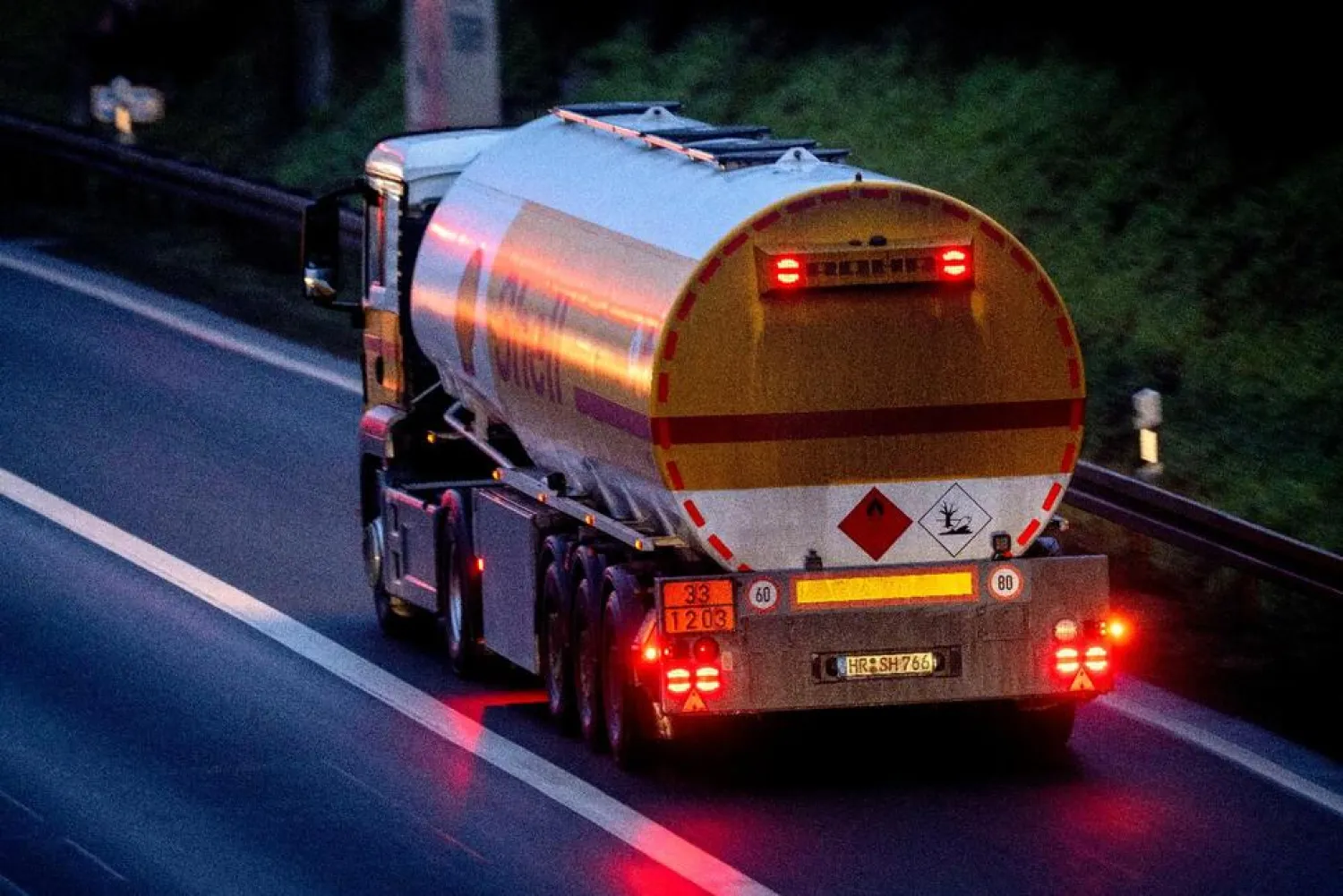

Europe Bans Russian Diesel, Other Oil Products over Ukraine

A fuel trucks drives on a highway in Frankfurt, Germany, Friday, Jan. 27, 2023. (AP)
TT

Europe Bans Russian Diesel, Other Oil Products over Ukraine

A fuel trucks drives on a highway in Frankfurt, Germany, Friday, Jan. 27, 2023. (AP)

Europe imposed a ban Sunday on Russian diesel fuel and other refined oil products, slashing energy dependency on Moscow and seeking to further crimp the Kremlin's fossil fuel earnings as punishment for invading Ukraine.

The ban comes along with a price cap agreed by the Group of Seven allied democracies. The goal is allowing Russian diesel to keep flowing to countries like China and India and avoiding a sudden price rise that would hurt consumers worldwide, while reducing the profits funding Moscow's budget and war.

Diesel is key for the economy because it is used to power cars, trucks carrying goods, farm equipment and factory machinery. Diesel prices have been elevated due to recovering demand after the COVID-19 pandemic and limits on refining capacity, contributing to inflation for other goods worldwide.

The new sanctions create uncertainty about prices as the 27-nation European Union finds new supplies of diesel from the US, Middle East and India to replace those from Russia, which at one point delivered 10% of Europe's total diesel needs. Those are longer journeys than from Russia's ports, stretching available tankers.

Prices also could be driven up by reviving demand from China as the economy rebounds after the end of draconian COVID-19 restrictions.

The price cap of $100 per barrel for diesel, jet fuel and gasoline is to be enforced by barring insurance and shipping services from handling diesel priced over the limit. Most of those companies are located in Western countries.

It follows a $60-per-barrel cap on Russian crude that took effect in December and is supposed to work the same way. Both the diesel and oil caps could be tightened later.

“Once we have these price caps set, we can squeeze the Russian price and deny them, deny (President Vladimir) Putin money for his war without a price spike that's going to hurt Western economies and developing economies,” said Thomas O'Donnell, a global fellow with the Washington-based Wilson Center.

The diesel price cap will not bite immediately because it was set at about what Russian diesel trades for. Russia’s chief problem now will be finding new customers, not evading the price ceiling. However, the cap aims to prevent Russian gains from any sudden price spikes in refined oil products.

Analysts say there might be a price bump initially as markets sort out the changes. But they say the embargo should not cause a price spike if the cap works as intended and Russian diesel keeps flowing to other countries.

Diesel fuel at the pump has been flat since the start of December, costing 1.80 euros per liter ($7.37 per gallon) as of Jan. 30, according to the weekly oil market report issued by the European Union’s executive commission. Pump prices in Germany, the EU’s largest economy, fell 2.6 cents to 1.83 euros per liter ($7.48 per gallon) as of Jan. 31.

The ban provides for a 55-day grace period for diesel loaded on tankers before Sunday, a step aimed at avoiding ruffling markets. European Union officials say importers have had time to adjust since the ban was announced in June.

Russia earned more than $2 billion from diesel sales to Europe in December alone as importers appear to have stocked up with added purchases ahead of the ban.

Europe has already banned Russian coal and most crude oil, while Moscow has cut off most shipments of natural gas.



Trump Says US Hit Dock for Venezuela Drug Boats

US President Donald Trump, with pharmaceutical executives, delivers remarks on lowering the prices of drugs and pharmaceuticals during an announcement in the Roosevelt Room of the White House in Washington, DC, USA, 19 December 2025.  EPA/WILL OLIVER / POOL
US President Donald Trump, with pharmaceutical executives, delivers remarks on lowering the prices of drugs and pharmaceuticals during an announcement in the Roosevelt Room of the White House in Washington, DC, USA, 19 December 2025. EPA/WILL OLIVER / POOL
TT

Trump Says US Hit Dock for Venezuela Drug Boats

US President Donald Trump, with pharmaceutical executives, delivers remarks on lowering the prices of drugs and pharmaceuticals during an announcement in the Roosevelt Room of the White House in Washington, DC, USA, 19 December 2025.  EPA/WILL OLIVER / POOL
US President Donald Trump, with pharmaceutical executives, delivers remarks on lowering the prices of drugs and pharmaceuticals during an announcement in the Roosevelt Room of the White House in Washington, DC, USA, 19 December 2025. EPA/WILL OLIVER / POOL

The United States hit and destroyed a docking area for alleged Venezuela drug boats, President Donald Trump said Monday, in what could amount to the first land strike of the military campaign against trafficking from Latin America.

The US leader's confirmation of the incident comes as he ramps up a pressure campaign against Venezuela's leftist President Nicolas Maduro, who has accused Trump of seeking regime change, said AFP.

"There was a major explosion in the dock area where they load the boats up with drugs," he told reporters at his Mar-a-Lago resort in Florida as he hosted Israeli Prime Minister Benjamin Netanyahu.

"So we hit all the boats and now we hit the area, it's the implementation area, that's where they implement. And that is no longer around."

Trump would not say if it was a military or CIA operation or where the strike occurred, noting only that it was "along the shore."

Sources familiar with the operation told CNN and the New York Times that the CIA had carried out a drone strike on a port facility.

The strike was believed to be targeting the Venezuelan gang Tren de Aragua, though no one was present at the time of the operation and there were no casualties, the US media outlets reported.

There has been no official comment from the Venezuelan government.

The Pentagon earlier referred questions to the White House. The White House did not respond to requests for comment from AFP.

Asked on Monday if he had spoken to Maduro recently, Trump said they had talked "pretty recently" but that "nothing much comes out of it."

Trump revealed details of the operation after being asked to elaborate on comments he made in a radio interview broadcast Friday that seemed to mention a land strike for the first time.

"They have a big plant or a big facility where they send, you know, where the ships come from," Trump told billionaire supporter John Catsimatidis on the WABC radio station in New York.

"Two nights ago, we knocked that out. So we hit them very hard."

Trump did not say in the interview where the facility was located or give any other details.

Trump has been threatening for weeks that ground strikes on drug cartels in the region would start "soon," but this is the first apparent example.

US forces have also carried out numerous strikes in both the Caribbean Sea and eastern Pacific Ocean since September, targeting what Washington says are drug-smuggling boats.

The administration has provided no evidence that the targeted boats were involved in drug trafficking, however, prompting debate about the legality of these operations.

International law experts and rights groups say the strikes likely amount to extrajudicial killings, a charge that Washington denies.

After Trump spoke Monday, the US military announced on social media that it had carried out another strike on a boat in the Eastern Pacific, killing two and bringing the total killed in the maritime campaign to at least 107.

It did not specify where exactly the strike took place.

The Trump administration has been ramping up pressure on Maduro, accusing the Venezuelan leader of running a drug cartel himself and imposing an oil tanker blockade.


Iran President Tells Government Listen to Protesters 'Legitimate Demands'

Iranian shopkeepers and traders protest against the economic conditions, as tear gas is fired by anti-riot police in Tehran, Iran, 29 December 2025. EPA/STRINGER
TT

Iran President Tells Government Listen to Protesters 'Legitimate Demands'

Iranian shopkeepers and traders protest against the economic conditions, as tear gas is fired by anti-riot police in Tehran, Iran, 29 December 2025. EPA/STRINGER

Iran's president urged his government to listen to the "legitimate demands" of protesters, state media reported Tuesday, after several days of demonstrations by shopkeepers in Tehran over economic hardships.

Shopkeepers in the capital had shut their stores for the second day in a row on Monday, after Iran's embattled currency hit new lows on the unofficial market, reported AFP.

The US dollar was trading at around 1.42 million rials on Sunday -- compared to 820,000 rials a year ago -- and the euro nearing 1.7 million rials, according to price monitoring websites.

"I have asked the Interior Minister to listen to the legitimate demands of the protesters by engaging in dialogue with their representatives so that the government can do everything in its power to resolve the problems and act responsibly," President Masoud Pezeshkian said, according to the state-run IRNA news agency.

Protesters "are demanding immediate government intervention to rein in exchange-rate fluctuations and set out a clear economic strategy", the pro-labor news agency ILNA reported Monday.

Price fluctuations are paralyzing the sales of some imported goods, with both sellers and buyers preferring to postpone transactions until the outlook becomes clearer, AFP correspondents noted.

"Continuing to do business under these conditions has become impossible," ILNA quoted protesters as saying.

The conservative-aligned Fars news agency released images showing a crowd of demonstrators occupying a major thoroughfare in central Tehran, known for its many shops.

Another photograph appeared to show tear gas being used to disperse protesters.

"Minor physical clashes were reported... between some protesters and the security forces," Fars said, warning that such gatherings could lead to instability.

-- Battered economy --

Iranian Chief Justice Gholamhossein Mohseni Ejei called for "the swift punishment of those responsible for currency fluctuations", the justice ministry's Mizan agency reported Monday.

The government has also announced the replacement of the central bank governor.

"By decision of the president, Abdolnasser Hemmati will be appointed governor of the Central Bank," presidency communications official Mehdi Tabatabaei posted on X.

Hemmati is a former economy and finance minister who was dismissed by parliament in March because of the sharp depreciation of the rial.

Pezeshkian delivered on Sunday the budget for the next Persian year to parliament, vowing to fight inflation and the high cost of living.

In December, inflation stood at 52 percent year-on-year, according to official statistics. But this figure still falls far short of many price increases, especially for basic necessities.

The country's economy, already battered by decades of Western sanctions, was further strained after the United Nations in late September reinstated international sanctions linked to the country's nuclear program that were lifted 10 years ago.

Western powers and Israel accuse Iran of seeking to acquire nuclear weapons, a charge Tehran denies.


Trump Hints at Land Strike as Venezuela Pressure Mounts

A US Air Force C-130J Super Hercules aircraft approaches for landing at Rafael Hernandez Airport, amid tensions between US President Donald Trump's administration and the government of Venezuelan President Nicolas Maduro, in Aguadilla, Puerto Rico, December 28, 2025. (Reuters)
TT

Trump Hints at Land Strike as Venezuela Pressure Mounts

A US Air Force C-130J Super Hercules aircraft approaches for landing at Rafael Hernandez Airport, amid tensions between US President Donald Trump's administration and the government of Venezuelan President Nicolas Maduro, in Aguadilla, Puerto Rico, December 28, 2025. (Reuters)

A throwaway remark last week by President Donald Trump has raised questions about whether US forces may have carried their first land strike against drug cartels in Venezuela.

Trump said the US knocked out a "big facility" for producing trafficking boats, as he was discussing his pressure campaign against Venezuelan President Nicolas Maduro in an interview broadcast Friday.

"They have a big plant or a big facility where they send, you know, where the ships come from," Trump said in an interview with billionaire supporter John Catsimatidis on the WABC radio station in New York.

"Two nights ago we knocked that out. So we hit them very hard."

Trump did not say where the facility was located or give any other details. US forces have carried out numerous strikes in both the Caribbean Sea and eastern Pacific Ocean since September, killing more than 100 people.

The Pentagon referred questions about Trump's remarks to the White House. The White House did not respond to requests for comment from AFP.

There has been no official comment from the Venezuelan government.

Trump has been saying for weeks that the United States will "soon" start carrying out land strikes targeting drug cartels in Latin America, but there have been no confirmed attacks to date.

The Trump administration has been ramping up pressure on Maduro, accusing the Venezuelan leader of running a drug cartel himself and imposing an oil tanker blockade.

Maduro has accused Washington of attempting regime change.