


‘I Want to Design a Crown for Youth of Lebanon,’ Fred Mouawad Tells Asharq Al-Awsat

Miss Universe 2023 pictured with her crown, designed by Maison Mouawad. (Maison Mouawad)
TT

‘I Want to Design a Crown for Youth of Lebanon,’ Fred Mouawad Tells Asharq Al-Awsat

Miss Universe 2023 pictured with her crown, designed by Maison Mouawad. (Maison Mouawad)

Who knew that the crown that adorned the head of Miss Universe 2023 was a Lebanese creation?

The rare piece, worth around $6 million, was created by Maison Mouawad at the initiative of Fred Mouawad, a fourth-generation member of the atelier founded in 1890.

Named the eighth richest diamond owner in the world by Wealth-X in 2013, Fred Mouawad adores gemstones, especially the colored ones. Passionate about his career from a young age, he oversees every little detail of their designs, and following the journey of every gemstone.

“I consider the story and value of every gemstone we use, then I make my decision about the design that suits it,” he told Asharq Al-Awsat.

Mouawad noted that his wide knowledge of gemstones peaked after he studied the field at the GIA, Gemological Institute of America.

Fred started working with his father when he was 21, and gained his expertise quickly. His first adventure with gemstones was in Sri Lanka, where he bought a 27-carat sapphire, polished and refined it, and then sold it for a good sum. This was the start of his story in the gemstones trade.

The Miss Universe crown wasn’t named “Force for Good” by coincidence; its unique design symbolizes positive change.

The handmade, fully-crusted crown contains 108.44 carats of sapphire and 48.12 carats of white diamonds. The wave-like swirls resemble the head of a snake, symbolizing challenges.

Moving up from the base, the sharpness of the white diamonds is softened by the sapphires, whose intensity increases gradually and ends with an astonishing, royal blue pear-like 45.14 carat sapphire, symbolizing the power of good.

“The hues and tones of the colors clearly express change and its long, exhausting route. That’s why the colors start with white, then pale blue, and end with royal blue with the pear-like stone at the top,” Fred explained to Asharq Al-Awsat.

“The snake-like base emphasizes that change cannot be achieved without resistance. That’s why the crown says: ‘resist and do never surrender’,” he added.

“My home country is always in my heart despite the distances. I was born in Saudi Arabia, then I moved to a boarding school in Switzerland. I studied in the US, and today, I am based in Thailand. But deep down, I will always be Lebanese from a Lebanese family,” he said.

“This love we feel for Lebanon was born with us and we hold it in our genes. The entire country wants change, especially the youth. The idea of the crown was inspired by the circumstances we are living, simulating the aspirations of people on this planet, and so, we chose a sapphire as a symbol for this change,” he added.

Maison Mouawad is planning to design another crown for Miss Universe and her runner-up. In a year or two, it might consider making more crowns for the pageant. “We believe we are still in the beginning, we must develop our thought and use our imagination to make more creations,” Fred said.

Maison Mouawad has made crowns for many celebrities and famous figures, but given the chance, Fred said he tomorrow’s generation is the most deserving of a crown.

“It belongs to the youth who love Lebanon, and to every person who is ready to give anything for the country’s evolution. Every one who feels proud of Lebanon deserves to receive this crown. It might not be one person, it could be a whole generation,” he said.

Asked what the crown would look like, he replied: “I envision green symbolizing hope, and yellow symbolizing the bright sun of a better future. I care about making a crown for Lebanon and its youth so it gives the Lebanese people hope, life, and continuity.”


Two Holy Mosques Exhibition Welcomes Visitors for Founding Day Celebrations

The exhibition is open daily from 10:00 a.m. to 1:30 a.m - SPA
TT

Two Holy Mosques Exhibition Welcomes Visitors for Founding Day Celebrations

The exhibition is open daily from 10:00 a.m. to 1:30 a.m - SPA

In celebration of the Kingdom’s Founding Day, the Exhibition of the Two Holy Mosques Architecture in Makkah is welcoming visitors to explore a comprehensive historical journey.

The exhibition presents the evolution of the Two Holy Mosques through rare artifacts, historical photographs, and documentation of successive Saudi expansions, according to SPA.

The halls highlight the Kingdom’s long-standing dedication to serving the Two Holy Mosques. They combine heritage and modern technology to present the architectural development of Islam’s holiest sites.

The exhibition is open daily from 10:00 a.m. to 1:30 a.m.


Photos Show Filming of Ramadan TV Drama Series on the War-scarred Streets of Syria's Aleppo

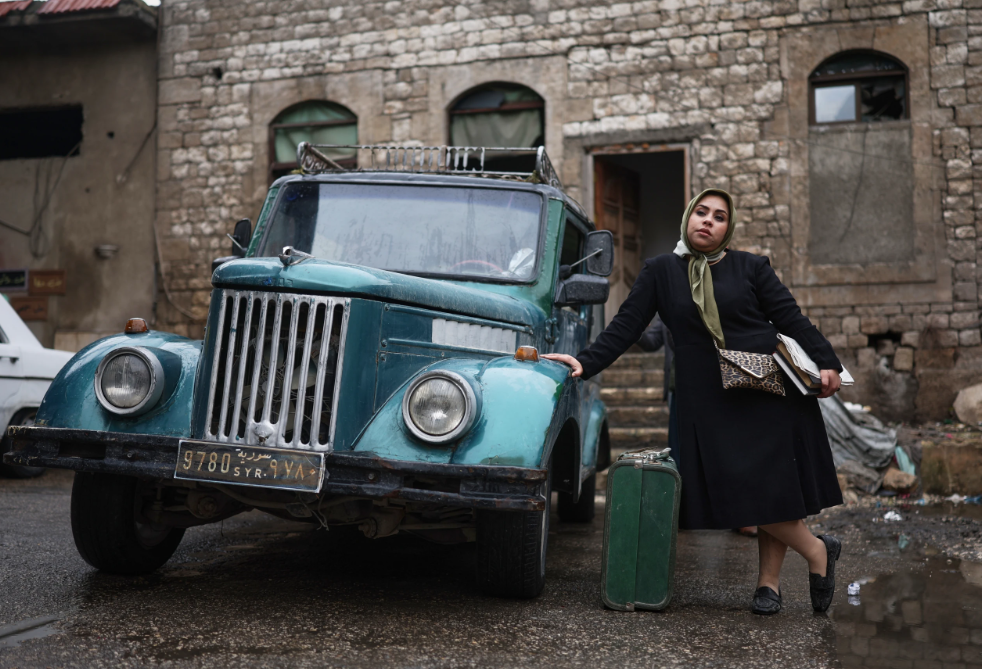
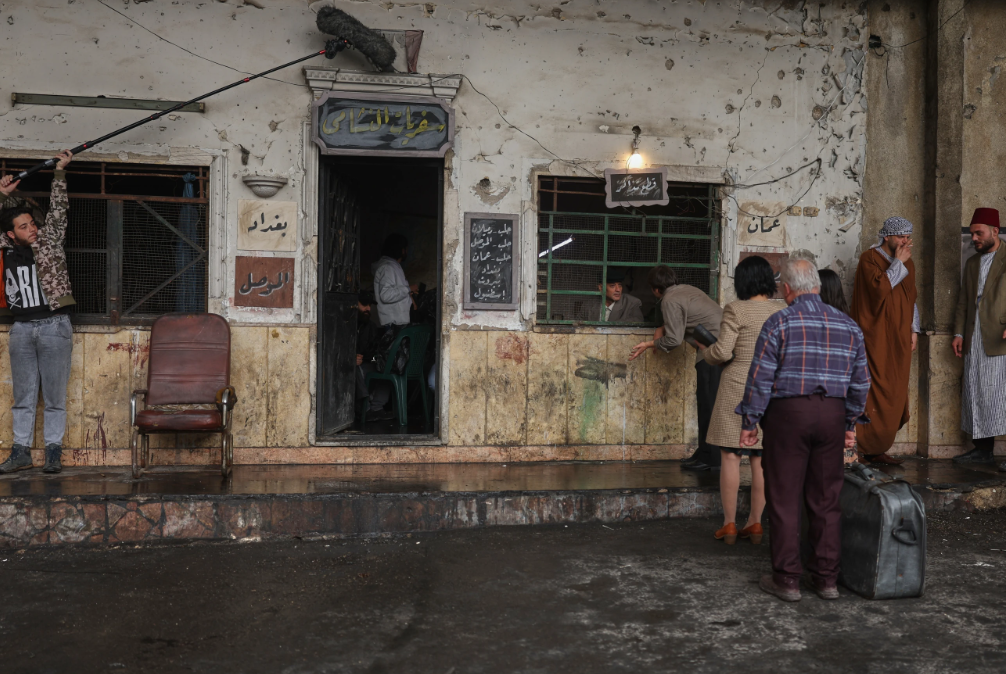
Extras stand by as a television crew films an episode of the TV series “Al-Souriyoun al-Aada” (“The Syrian Enemies”), based on a novel of the same name that was banned under Bashar Assad, along a transformed street in central Aleppo, Syria, Friday, Feb. 13, 2026. (AP Photo/Ghaith Alsayed)
TT

Photos Show Filming of Ramadan TV Drama Series on the War-scarred Streets of Syria's Aleppo

Extras stand by as a television crew films an episode of the TV series “Al-Souriyoun al-Aada” (“The Syrian Enemies”), based on a novel of the same name that was banned under Bashar Assad, along a transformed street in central Aleppo, Syria, Friday, Feb. 13, 2026. (AP Photo/Ghaith Alsayed)

Ramadan in the Arab world is a month of fasting and prayer by day — and television by night. For decades, families have gathered after the iftar, the evening meal that breaks the daytime fast, to follow the season’s highly anticipated drama series, produced specially to air during the Islamic holy month.

In the week before Ramadan, a television crew in central Aleppo was busy preparing one of those productions, with a battered street in the historic city transformed into a scene from decades past.

Lamees Al-Ali, an extra in the series, poses for a photograph during the filming of an episode of the TV series “Al-Souriyoun al-Aada” (“The Syrian Enemies”), based on a novel of the same name that was banned under Bashar Assad, along a transformed street in central Aleppo, Syria, Friday, Feb. 13, 2026. (AP Photo/Ghaith Alsayed)

Classic 1970s cars lined the curb. A horse-drawn cart rolled through the frame. A vendor in a red tarboush, a brimless cone-shaped hat, stood beside steaming pots of sahlep — a sweet, thickened milk drink flavored with spices and associated with winter evenings.

Just outside the camera’s view stood a stark reminder of Syria's more recent history. Collapsed buildings and damaged facades testified to Aleppo’s role as a major battleground during the country's civil war. However, with costumes, props and careful framing, the production temporarily carried the street back to what it portrays as a more innocent era, according to The AP news.

A television crew films an episode of the TV series “Al-Souriyoun al-Aada” (“The Syrian Enemies”), based on a novel of the same name that was banned under Bashar Assad, along a transformed street in central Aleppo, Syria, Friday, Feb. 13, 2026.(AP Photo/Ghaith Alsayed)

The series being filmed — “Al-Souriyoun al-Aada,” or “The Syrian Enemies” — is based on a novel that was banned during the rule of former President Bashar Assad. The story examines painful chapters of Syria’s past, including the 1982 events in Hama, when government forces crushed an uprising led by the Muslim Brotherhood, killing or disappearing an estimated 10,000 to 40,000 people and leaving the city in ruins.

As filming continues into Ramadan, the production reflects both a cherished seasonal tradition and Syria’s complex, layered history.


How Bomb Cyclones Form and Create Dangerous Conditions 

A man works in a snowstorm, Sunday, Feb. 22, 2026, in New York. (AP)
TT

How Bomb Cyclones Form and Create Dangerous Conditions 

A man works in a snowstorm, Sunday, Feb. 22, 2026, in New York. (AP)

When turbulent weather with whipping winds and heavy snow is in the forecast, meteorologists sometimes warn that a storm could “bomb out” or become a bomb cyclone. But what exactly does this mean?

According to the US National Oceanic and Atmospheric Administration, certain storms undergo bombogenesis, which happens when a storm’s central pressure drops at least 24 millibars in 24 hours. These storms are sometimes called bomb cyclones. Storm intensity is measured by central pressure, so the lower the pressure, the stronger the storm.

Such rapidly strengthening storms are capable of producing heavy rain, blizzard conditions and intense winds that can create dangerous conditions such as downed trees and power outages.

“If you’re watching TV at night and the weather report comes on and you’re hearing ‘bomb cyclone’ being used, that usually means there’s quite a bit of active weather going on,” said Andrew Orrison, a meteorologist with the National Weather Service in College Park, Maryland.

Bomb cyclones can happen in any season, but mainly occur during fall and winter when frigid air from the Arctic can creep south and clash with warmer air masses.

“It’s really the clash of those air masses that really kind of helps to generate the areas of low pressure in the first place,” said Orrison.

Regions in North America that are prone to seeing bomb cyclones include Alaska, the Pacific Northwest and the Great Lakes region.
