


Israel Steps Up Jerusalem Home Demolitions as Violence Rises

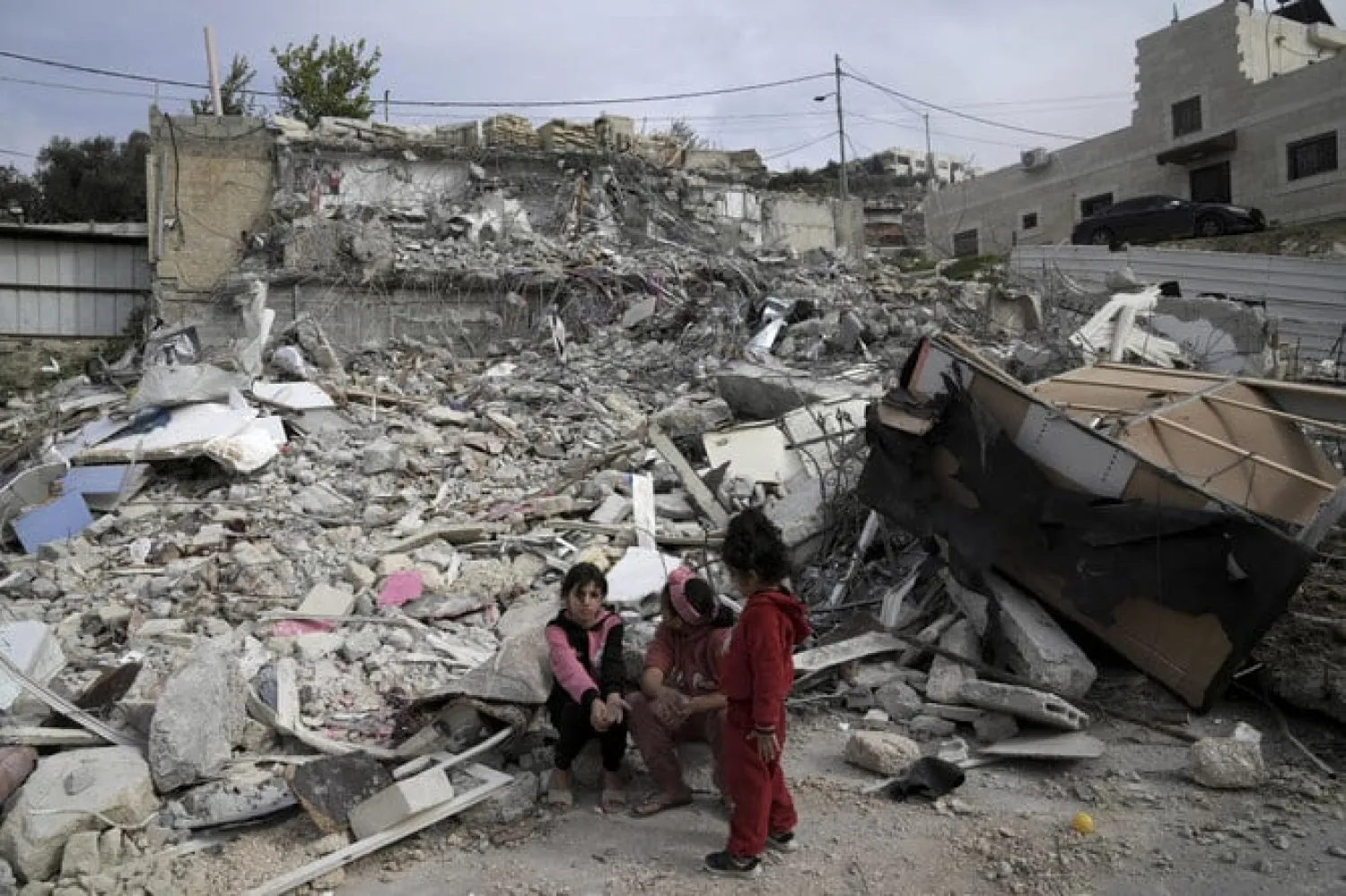
Girls from the Matar family sit near the rubble of their home that housed 11 people before it was demolished by Israeli authorities in the Jabal Mukaber neighborhood of east Jerusalem (AP)
TT

Israel Steps Up Jerusalem Home Demolitions as Violence Rises

Girls from the Matar family sit near the rubble of their home that housed 11 people before it was demolished by Israeli authorities in the Jabal Mukaber neighborhood of east Jerusalem (AP)

Ratib Matar’s family was growing. They needed more space.

Before his granddaughters, now 4 and 5, were born, he built three apartments on an eastern slope overlooking Jerusalem’s ancient landscape. The 50-year-old construction contractor moved in with his brother, son, divorced daughter and their young kids — 11 people in all, plus a few geese.

But Matar was never at ease. At any moment, the Israeli code-enforcement officers could knock on his door and take everything away, The Associated Press said.

That moment came on Jan. 29, days after a Palestinian gunman killed seven people in east Jerusalem, the deadliest attack in the contested capital since 2008. Israel’s new far-right National Security Minister Itamar Ben-Gvir called not only for the sealing of the assailant's family home, but also the immediate demolition of dozens of Palestinian homes built without permits in east Jerusalem, among other punitive steps.

Mere hours after Ben-Gvir's comments, the first bulldozers rumbled into Matar's neighborhood of Jabal Mukaber.

For many Palestinians, the gathering pace of home demolitions is part of the new ultranationalist government's broader battle for control of east Jerusalem, captured by Israel in the 1967 Mideast war and claimed by the Palestinians as the capital of a future independent state.

The battle is waged with building permits and demolition orders — and it is one the Palestinians feel they cannot win. Israel says it is simply enforcing building regulations.

“Our construction is under siege from Israel,” Matar said. His brothers and sons lingered beside the ruins of their home, drinking bitter coffee and receiving visitors as though in mourning. “We try really hard to build, but in vain," he said.

Last month, Israel demolished 39 Palestinian homes, structures and businesses in east Jerusalem, displacing over 50 people, according to the United Nations. That was more than a quarter of the total number of demolitions in 2022. Ben-Gvir posted a photo on Twitter of the bulldozers clawing at Matar's home.

“We will fight terrorism with all the means at our disposal,” he wrote, though Matar's home had nothing to do with the Palestinian shooting attacks.

Most Palestinian apartments in east Jerusalem were built without hard-to-get permits. A 2017 study by the UN described it as “virtually impossible" to secure them.

The Israeli municipality allocates scant land for Palestinian development, the report said, while facilitating the expansion of Israeli settlements. Little Palestinian property was registered before Israel annexed east Jerusalem in 1967, a move not internationally recognized.

Matar said the city rejected his building permit application twice because his area is not zoned for residential development. He's now trying a third time.

The penalty for unauthorized building is often demolition. If families don't tear their houses down themselves, the government charges them for the job. Matar is dreading his bill — he knows neighbors who paid over $20,000 to have their houses razed.

Now homeless, Matar and his family are staying with relatives. He vows to build again on land he inherited from his grandparents, though he has no faith in the Israeli legal system.

“They don't want a single Palestinian in all of Jerusalem,” Matar said. Uphill, in the heart of his neighborhood, Israeli flags fluttered from dozens of apartments recently built for religious Jews.

Since 1967, the government has built 58,000 homes for Israelis in the eastern part of the city, and fewer than 600 for Palestinians, said Daniel Seidemann, an Israeli lawyer specializing in the geopolitics of Jerusalem, citing the government’s statistics bureau and his own analysis. In that time, the city’s Palestinian population has soared by 400%.

“The planning regime is dictated by the calculus of national struggle,” Seidemann said.

Israel's city plans show state parks encircling the Old City, with some 60% of Jabal Mukaber zoned as green space, off-limits to Palestinian development. At least 20,000 Palestinian homes in east Jerusalem are now slated for demolition, watchdogs say.

Matar and his neighbors face an agonizing choice: Build illegally and live under constant threat of demolition, or leave their birthplace for the occupied West Bank, sacrificing Jerusalem residency rights that allow them to work and travel relatively freely throughout Israel.

While there are no reliable figures for permit approvals, the Israeli municipality set aside just over 7% of its 21,000 housing plans for Palestinian homes in 2019, reported Ir Amim, an anti-settlement advocacy group. Palestinians are nearly 40% of the city's roughly 1 million people.

“This is the purpose of this policy,” said Aviv Tatarsky, a researcher at Ir Amim. “Palestinians are forced to leave Jerusalem."

Arieh King, a Jerusalem deputy mayor and settler leader, acknowledged that demolitions help Israel entrench control over east Jerusalem, home to the city's most important religious sites.

“It’s part of enforcing sovereignty," King said. “I'm happy that at last we have a minister that understands," he added, referring to Ben-Gvir.

Ben-Gvir is now pushing for the destruction of an apartment tower housing 100 people. Trying to lower tensions, Prime Minister Benjamin Netanyahu delayed the eviction that was planned for Tuesday, Israeli media reported.

King contended it was possible for Palestinians to secure permits and accused them of building without authorization to avoid an expensive bureaucracy.

When the al-Abasi family in east Jerusalem found a demolition order plastered on their new breeze-block home last month, they contemplated their options. The government had knocked down their last apartment, built on the same lot, eight years ago. This time, Jaafar al-Abasi decided, he would tear it down himself.

Al-Abasi hired a tractor and invited his relatives and neighbors to join. The destruction took three days, with breaks for hummus and soda. His three sons borrowed pickaxes and jackhammers, angrily hacking away at the walls they had decorated with colored plates just last month.

“This place is like a ticking time bomb,” said his brother in law, 48-year-old Mustafa Samhouri, who helped them out.

Protests over the demolitions have roiled east Jerusalem in recent days. Two weekends ago, Samhouri said, the family's 13-year-old cousin opened fire at Jewish settlers in the neighborhood of Silwan just across the valley, wounding two people before being shot and arrested.

“The pressure just grows more and more,” Samhouri said. “And at last, boom."


Italy Arrests 7 Accused of Raising Millions for Hamas

Palestinian Hamas members secure the area as Egyptian workers accompanied by members of the International Committee of the Red Cross (ICRC) search for the remains of the last Israeli hostage in the Zeitoun neighborhood of Gaza City on December 8, 2025. (Photo by Omar AL-QATTAA / AFP)
TT

Italy Arrests 7 Accused of Raising Millions for Hamas

Palestinian Hamas members secure the area as Egyptian workers accompanied by members of the International Committee of the Red Cross (ICRC) search for the remains of the last Israeli hostage in the Zeitoun neighborhood of Gaza City on December 8, 2025. (Photo by Omar AL-QATTAA / AFP)

Italian police said Saturday that they have arrested seven people suspected of raising millions of euros for Palestinian group Hamas.

Police also issued international arrests for two others outside the country, said AFP.

Three associations, officially supporting Palestinian civilians but allegedly serving as a front for funding Hamas, are implicated in the investigation, said a police statement.

The nine individuals are accused of having financed approximately seven million euros ($8 million) to "associations based in Gaza, the Palestinian territories, or Israel, owned, controlled, or linked to Hamas."

While the official objective of the three associations was to collect donations "for humanitarian purposes for the Palestinian people," more than 71 percent was earmarked for the direct financing of Hamas" or entities affiliated with the movement, according to police.

Some of the money went to "family members implicated in terrorist attacks," the statement said.

Among those arrested was Mohammad Hannoun, president of the Palestinian Association in Italy, according to media reports.

Interior Minister Matteo Piantedosi posted on X that the operation "lifted the veil on behavior and activities which, pretending to be initiatives in favor of the Palestinian population, concealed support for and participation in terrorist organizations."


Türkiye Holds Military Funeral for Libyan Officers Killed in Plane Crash

The Libyan national flag flies at half-mast in Tripoli on December 24, 2025, after the head of Libya's armed forces and his four aides died in a plane crash in Türkiye. (AFP)
TT

Türkiye Holds Military Funeral for Libyan Officers Killed in Plane Crash

The Libyan national flag flies at half-mast in Tripoli on December 24, 2025, after the head of Libya's armed forces and his four aides died in a plane crash in Türkiye. (AFP)

Türkiye held a military funeral ceremony Saturday morning for five Libyan officers, including western Libya’s military chief, who died in a plane crash earlier this week.

The private jet with Gen. Muhammad Ali Ahmad al-Haddad, four other military officers and three crew members crashed on Tuesday after taking off from Ankara, Türkiye’s capital, killing everyone on board. Libyan officials said the cause of the crash was a technical malfunction on the plane.

Al-Hadad was the top military commander in western Libya and played a crucial role in the ongoing, UN-brokered efforts to unify Libya’s military.

The high-level Libyan delegation was on its way back to Tripoli, Libya’s capital, after holding defense talks in Ankara aimed at boosting military cooperation between the two countries.

Saturday's ceremony was held at 8:00 a.m. local time at the Murted Airfield base, near Ankara, and attended by the Turkish military chief and the defense minister. The five caskets, each wrapped in a Libyan national flag, were then loaded onto a plane to be returned to their home country.

Türkiye’s military chief, Selcuk Bayraktaroglu, was also on the plane headed to Libya, state-run news agency TRT reported.

The bodies recovered from the crash site were kept at the Ankara Forensic Medicine Institute for identification. Justice Minister Yilmaz Tunc told reporters their DNA was compared to family members who joined a 22-person delegation that arrived from Libya after the crash.

Tunc also said Germany was asked to help examine the jet's black boxes as an impartial third party.


Syrian Foreign Ministry: Talks with SDF Have Not Yielded Tangible Results

SDF fighters are seen at a military parade in Qamishli. (Reuters file)
TT

Syrian Foreign Ministry: Talks with SDF Have Not Yielded Tangible Results

SDF fighters are seen at a military parade in Qamishli. (Reuters file)

A source from the Syrian Foreign Ministry said on Friday that the talks with the Kurdish Syrian Democratic Forces (SDF) over their integration into state institutions “have not yielded tangible results.”

Discussions about merging the northeastern institutions into the state remain “hypothetical statements without execution,” it told Syria’s state news agency SANA.

Repeated assertions over Syria’s unity are being contradicted by the reality on the ground in the northeast, where the Kurds hold sway and where administrative, security and military institutions continue to be run separately from the state, it added.

The situation “consolidates the division” instead of addressing it, it warned.

It noted that despite the SDF’s continued highlighting of its dialogue with the Syrian state, these discussions have not led to tangible results.

It seems that the SDF is using this approach to absorb the political pressure on it, said the source. The truth is that there is little actual will to move from discussion to application of the March 10 agreement.

This raises doubts over the SDF’s commitment to the deal, it stressed.

Talk about rapprochement between the state and SDF remains meaningless if the agreement is not implemented on the ground within a specific timeframe, the source remarked.

Furthermore, the continued deployment of armed formations on the ground that are not affiliated with the Syrian army are evidence that progress is not being made.

The persistence of the situation undermines Syria’s sovereignty and hampers efforts to restore stability, it warned.
