


Palestinian Home to Be Razed Showing Israeli Punishment Policy

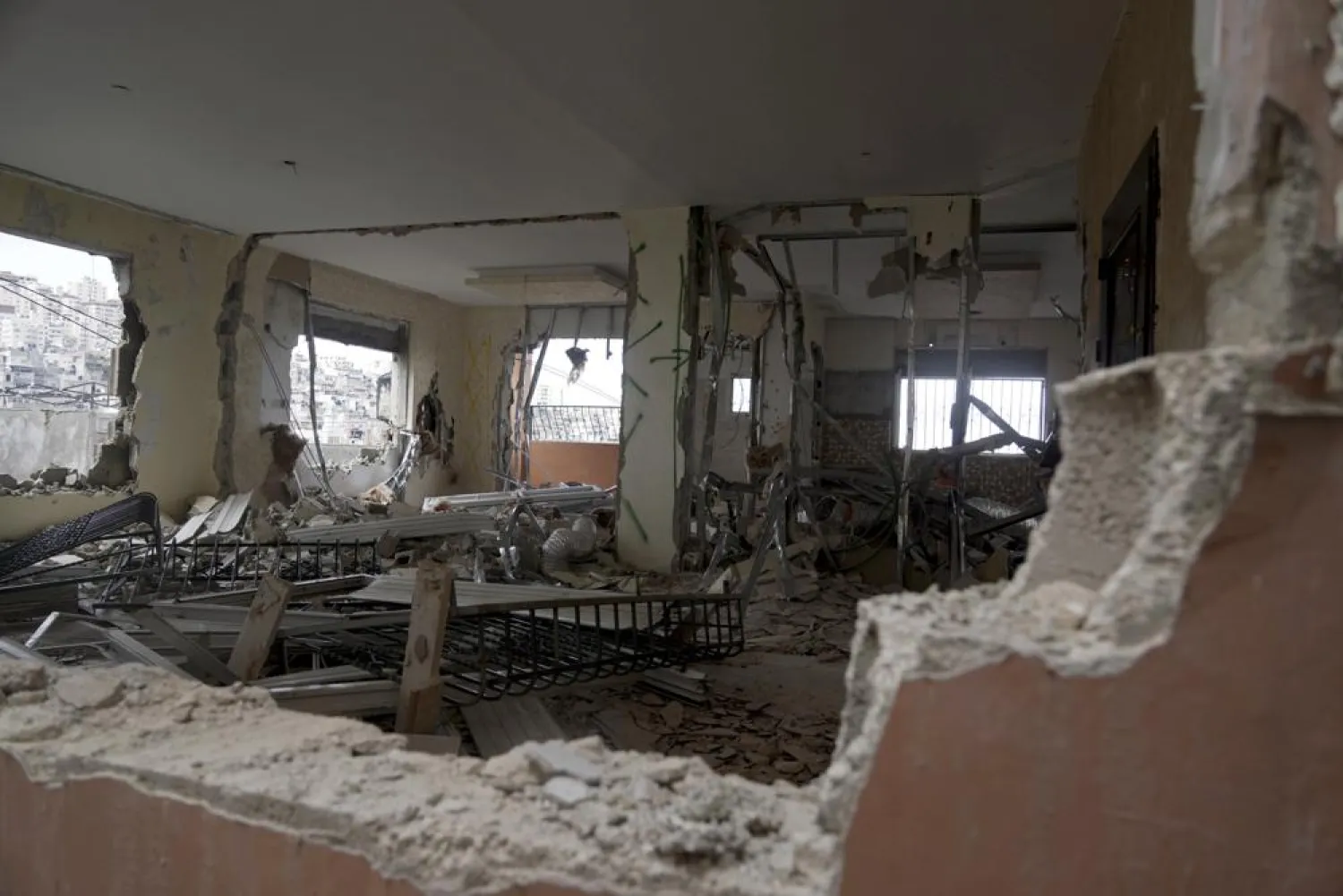
File photo: The ruins of the family home of Palestinian fighter Fadi Abu Shkhaidem, remain after demolition by Israeli security forces, Tuesday, Feb. 1, 2022. (AP Photo/Mahmoud Illean)
TT

Palestinian Home to Be Razed Showing Israeli Punishment Policy

File photo: The ruins of the family home of Palestinian fighter Fadi Abu Shkhaidem, remain after demolition by Israeli security forces, Tuesday, Feb. 1, 2022. (AP Photo/Mahmoud Illean)

The home of a Palestinian man behind a fatal attack on Israelis is to be demolished by Israeli authorities, even though it was built with compensation paid to them after one of their relatives was killed by an Israeli.

The entrances to the east Jerusalem home of Fatima Alqam, her husband Moussa and four children were sealed within days after her 21-year-old son killed seven people outside a synagogue in the settlement of Neve Yaacov, AFP said.

Khayri Alqam was shot dead in the January 27 attack and his family later received a demolition order for their apartment, under a long-standing policy to punish the families of Palestinians who kill Israelis.

"We hope that it won't be torn down. A lawyer has been appointed and we are waiting" for the appeals process, said one of the assailant's relatives who requested anonymity, fearing reprisals.

Khayri Alqam shared the name of his grandfather, who was killed in 1998, allegedly by an Israeli extremist.

An Israeli man was arrested in 2010 for that attack and a series of other murders of Palestinians, although he was later released and ultimately no one was convicted over the killing.

"Who do we complain to?" asked the relative. "He must be punished. We were wronged in 1998 and wronged today."

The accused Israeli in that case won the vocal support of Itamar Ben-Gvir, who has risen from extreme-right agitator to his current position as Israel's national security minister.

An adviser to the politician, whose portfolio includes policing, did not respond to a request from AFP to comment on Ben-Gvir's relationship with the accused.

At the time of the killing, the Alqam family said they were visited by then-Israeli president Ezer Weizman, and received compensation from the state over the murder.

They used some of the money to build their home in the al-Tur neighborhood of annexed east Jerusalem and were living on the second floor of the small apartment block, with the other floors taken by relatives.

- 'Military checkpoint' at home -
Nadia Daqqa, a lawyer with the Israeli rights group HaMoked, said that whether the state paid for part of the construction makes no difference to officials.

"For them, the house was where a Palestinian terrorist lived," she said.

When Israeli forces demolish one apartment within a block, they knock down the walls to make it uninhabitable.

While successive governments have implemented the demolition policy, there has usually been a period after such an order is issued to allow residents to appeal.

That changed with the Alqam home, which under the administration of Prime Minister Benjamin Netanyahu was sealed within 48 hours of the January 27 attack.

"These changes began with the new right-wing government," said Daqqa, who represents clients facing demolition orders.

"And the demolition policy was expanded to include cases in which there were no deaths, or operations (attacks) carried out by children," she added.

Last month the cabinet announced that the family home of a 13-year-old boy who shot and wounded two Israelis in the Silwan neighborhood of east Jerusalem would also be sealed.

In al-Tur, Fatima and Moussa Alqam have now moved in with his mother in the same building as their sealed apartment, along with their children, aged six to 16.

The four-storey building was like a "military checkpoint" according to Moussa Alqam, with Israeli forces stationed at the property for more than two weeks.

- 'Collective punishment' -
A day after the deadly January attack, Israel's security cabinet announced a slew of retaliatory measures.

This included revoking the rights to social security of "the families of terrorists that support terrorism", although the Alqam family has yet to lose such benefits.

Fatima Alqam said her son had no ownership of their home and his grandmother held the property deed.

But under Israeli legislation, a demolition order can be issued to a relative of an attacker and amounts to a form of "collective punishment", Daqqa said.

This approach sparked confusion this month after Netanyahu's office announced plans to "seal and demolish the home" of a 31-year-old Palestinian who killed three Israelis in east Jerusalem before being shot dead.

When authorities discovered that Hussein Qaraqe was renting an apartment not owned by a relative, they went in search of an alternative home to raze.

They settled upon his parents' house and sealed it ahead of the expected demolition, Daqqa said.

But in the confusion, his sister's home was also sealed off by Israeli forces for a few days, before being reopened.

The error was emblematic of the "chaos and current crazy period", Daqqa said, as the Israeli government seeks to ramp up retaliatory measures.




Türkiye’s Erdogan Urges World to ‘Immediately’ Start Rebuilding Gaza

Türkiye’s President Recep Tayyip Erdogan addresses the 81st United Nations General Assembly at UN headquarters in New York City, US, September 22, 2026. (Reuters)
TT

Türkiye’s Erdogan Urges World to ‘Immediately’ Start Rebuilding Gaza

Türkiye’s President Recep Tayyip Erdogan addresses the 81st United Nations General Assembly at UN headquarters in New York City, US, September 22, 2026. (Reuters)

The world must immediately start the reconstruction of the devastated Gaza Strip, Turkish President Recep Tayyip Erdogan said on Tuesday.

"We must begin the reconstruction of Gaza immediately," he told the United Nations General Assembly, urging world leaders to "exert greater pressure on Israel."

Since Hamas fighters launched their October 7, 2023 attack on Israel, triggering a massive response, the tiny Palestinian territory has been devastated by countless Israeli airstrikes, which by October 2025 had left 84 percent of all structures damaged or destroyed, UN figures show.

Despite a US-brokered ceasefire in October 2025, Israel has continued its airstrikes and restricted entry of equipment that international NGOs say is needed for the territory's reconstruction, which has yet to begin.

According to a joint assessment published by the United Nations, the World Bank and the European Union in April, Gaza will require $71.4 billion in recovery and reconstruction spending over the next decade.

Erdogan also urged all nations that have yet to recognize Palestine as an independent state to "reconsider," with his words prompting the Israeli delegation to walk out of the hall.

"I would like to call upon all those countries who have yet not recognized the state of Palestine to reconsider their decisions," he said.

A year ago, France led a special UN summit to recognize a Palestinian state at which 10 countries formally made the move, among them Britain, Canada and Australia, bringing the number of UN member states to do so to around 157, more than four-fifths of the UN membership.

The move has been roundly rejected by Israel.


In UN Farewell, Macron Denounces Trump’s Gaza Diplomacy as Spectacle of Shame

President of France, Emmanuel Macron speaks during the 81st session of the UN General Assembly at UN Headquarters on September 22, 2026 in New York City. (Getty Images/AFP)
TT

In UN Farewell, Macron Denounces Trump’s Gaza Diplomacy as Spectacle of Shame

President of France, Emmanuel Macron speaks during the 81st session of the UN General Assembly at UN Headquarters on September 22, 2026 in New York City. (Getty Images/AFP)

France's President Emmanuel Macron on Tuesday dismissed US President Donald Trump's claims of having secured peace in Gaza, saying not a single humanitarian corridor had been reopened in the enclave despite the proclaimed peace.

In his final address to the United Nations before leaving office next year, Macron said the world was witnessing a spectacle that should shame everyone, rebuking Trump's portrayal of his Gaza peace plan as a diplomatic triumph.

He spoke at the United Nations General Assembly hours after Trump had from the same rostrum hailed his Gaza peace plan as a diplomatic triumph.

"A year ago, here in this very hall, about a dozen states had recognized Palestine. I hear the cynicism of some people: 'Recognition is just a ‌piece of paper, ‌look at the reality,'" Macron said, banging his fist on the podium ‌in ⁠his last speech at ⁠the United Nations before stepping down next May.

"But what credibility do we have if we continue to remain inactive in the face of Gaza? Some boast of a supposed peace. But that peace has not reopened humanitarian access for a single second. Are we simply to stand by and watch this spectacle that should shame us all?"

WHITE HOUSE RESPONDS

In response to Macron's criticism, White House spokeswoman Anna Kelly said: “President Trump ended the war between Israel and Hamas, freed all living hostages, returned the bodies of the deceased to their loved ones, and ⁠is now leading the implementation of the 20-Point Plan for Peace in ‌Gaza. While others talk, this President took this complex problem head ‌on. No one has done more for peace and stability in the region.”

Macron has faced criticism among some politicians ‌and activists in France that he has done little since recognizing a Palestinian state last September.

Despite the ‌criticism, Paris has toughened its stance on settler violence against Palestinians in the West Bank, imposing some national sanctions and launching a process to ban products from Israeli settlements in the occupied West Bank.

"Look at what is happening in the West Bank, where every day violations are committed. In whose name? Hamas has never operated in the West Bank," ‌Macron said.

"What is happening there is building, day by day, the impossibility of a project that should be based on respect for the legitimate right ⁠of the Palestinian people ⁠to exist."

France's ties with Israel have been particularly strained over the last year. Macron said those who believed that violating the sovereignty of all of Israel's neighbors would ensure its security were mistaken.

"They are weakening Israel's security, both today and in the future," he said.

'LONG LIVE THE UNITED NATIONS'

Seven months from France's next presidential election, Macron was making his last appearance after first taking to the rostrum in 2017.

Often showing a keen eye for the trappings of diplomacy — the grand settings, the symbolism, the personal connections — he has at the same time failed to translate this into lasting strategic gains, analysts say.

However, he has always been a staunch defender of the multilateral system and the United Nations.

Macron warned against a global "return to the law of the jungle", saying countries faced a choice between a world governed by power and coercion and a "civilized international society."

"Our duty, more than ever, is to stand alongside the United Nations. We cannot accept the new order of impunity that some would like to build," he said.

He ended his speech with "Long Live the United Nations!"


Yemen Govt Expands Community Mobilization to Support Fighters on Frontlines

This frame grab taken from AFPTV video footage shows fighters affiliated with the Yemeni government engaging in clashes with Houthi militants in Al-Jawf province on September 15, 2026. (AFPTV / AFP)
TT

Yemen Govt Expands Community Mobilization to Support Fighters on Frontlines

This frame grab taken from AFPTV video footage shows fighters affiliated with the Yemeni government engaging in clashes with Houthi militants in Al-Jawf province on September 15, 2026. (AFPTV / AFP)

The Yemeni government has expanded community support for the armed forces and frontlines by mobilizing various social groups and provinces to participate in backing fighters and providing essential supplies to the frontlines.

Nayef Al-Bakri, Minister of Youth and Sports and head of a committee for popular support and government backing for the armed forces, told Asharq Al-Awsat that the committee operates under the directives of Chairman of the Presidential Leadership Council Dr. Rashad Muhammad Al-Alimi, council members, and the prime minister.

The committee aims to organize and activate popular support for the armed forces and fighters across various frontlines, which includes providing food, petroleum products, fuel, and essential materials needed for fighters to maintain their positions, he added.

The committee includes representatives from several ministries, including Interior, Defense, Social Affairs, Transport, Health, and Industry. A broader committee includes representatives from more than 15 provinces, aiming to unify popular efforts and strengthen the state of mobilization.

Several provinces, including Socotra, are preparing to dispatch relief convoys to battle areas, Al-Bakri revealed.

Community support encompasses the health sector through blood donations and backing provincial blood banks. Various social groups have become part of the support system, he went on to say.

Taiz, Hodeidah, Lahij, Dhale, Marib, Al-Jawf and Shabwa are priority frontlines, the minister said.

Taiz is witnessing a "decisive battle," he stressed.

On whether the support committee would handle preparing youths to join the frontlines, Al-Bakri explained that the responsibility for recruitment is the responsibility of military authorities.

The minister said that the Iran-backed Houthi group is threat to Yemen and regional stability, especially in light of its "attempts to undermine the security of navigation and regional waters."

He stressed that Saudi Arabia stands as the primary supporter of Yemen, a role that encompasses all economic, political, and military sectors, in addition to relief and development aid.

Al-Bakri was optimistic that the Yemeni armed forces would make progress on several fronts, including in Taiz, Kahbub, and Shabwah.