

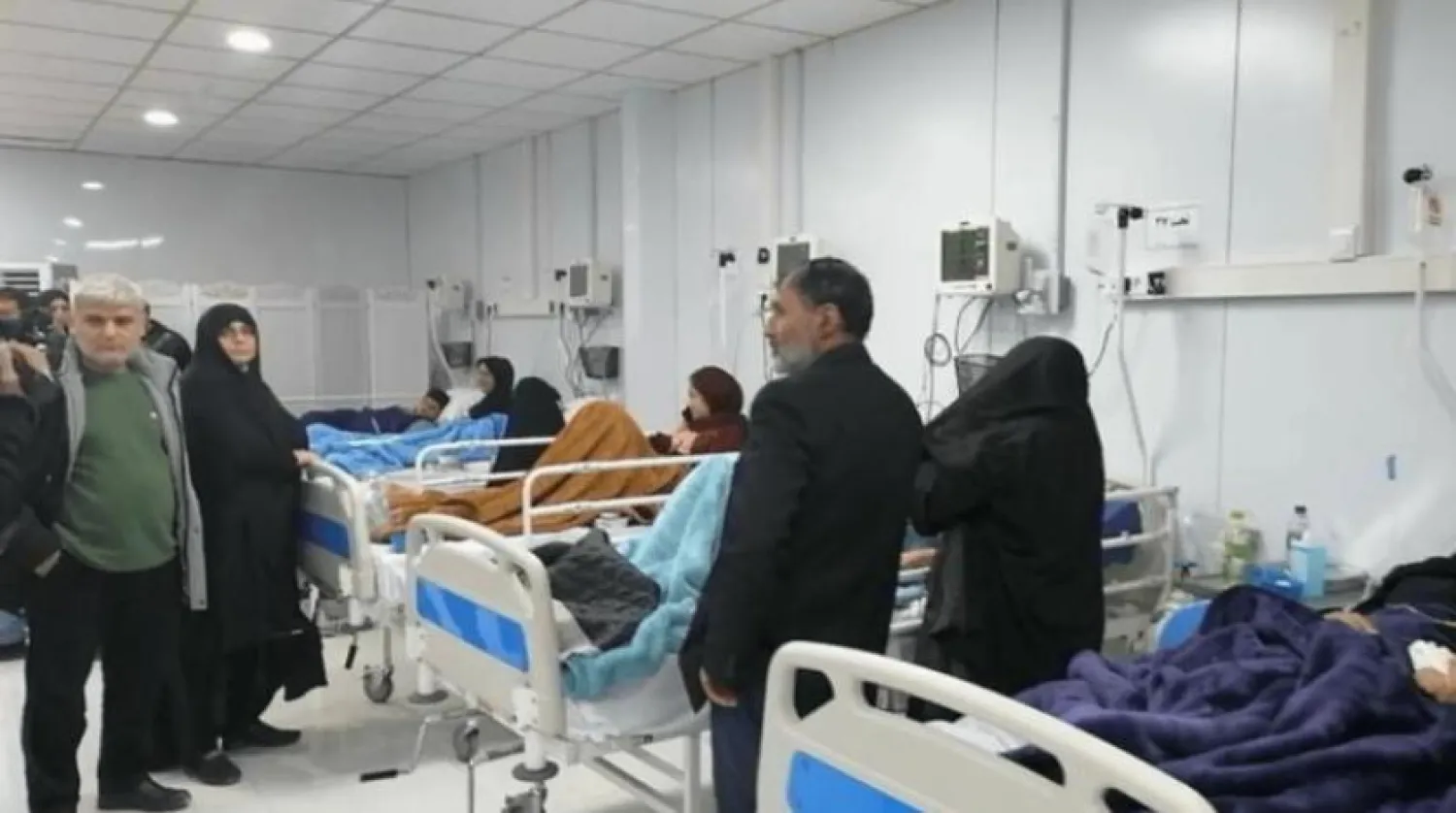

Over 100 Schoolgirls Hospitalized In Iran over Gas Poisoning

Hundreds of cases of respiratory distress have been reported in the past three months among schoolgirls across Iran - AFP
TT

Over 100 Schoolgirls Hospitalized In Iran over Gas Poisoning

Hundreds of cases of respiratory distress have been reported in the past three months among schoolgirls across Iran - AFP

More than 100 students were hospitalized in Iran after a new spate of suspected gas attacks on girls’ schools Wednesday, media outlets in Iran reported.

Hundreds of cases of respiratory distress have been reported in the past three months among schoolgirls across Iran, in what one government official has said could be an attempt to force the closure of girls’ schools.

At least 10 girls’ schools were targeted in the latest suspected attacks on Wednesday, seven of them in the northwestern city of Ardabil and three in the capital Tehran, media reported.

The incident in Ardabil forced the hospitalization of 108 students, all of whom were in stable condition, said Tasnim news agency, which also reported poisonings at three schools in Tehran.

Citing parents, Fars news agency said students at a high school in the capital’s western neighborhood of Tehransar had been exposed to a toxic spray. It did not elaborate.

Fars said the security forces had detained three people in the first reported arrests over the wave of suspected poisoning attacks on girls’ schools.

Since the outbreak of the mysterious poisonings in November, almost 1,200 students have required hospitalization for breathing difficulties, a lawmaker said Wednesday.

They included nearly 800 in the holy city of Qom, south of Tehran, and 400 in the western city of Borujerd, said Zahra Sheikhi, spokesperson for the Iranian parliament’s health committee.

Health ministry tests on the substance found at the schools in Qom detected traces of nitrogen, which is mainly used in fertilizers, the parliament’s website said, according to AFP.

The poisonings have provoked a wave of anger in the country, where critics denounced the silence of the authorities in the face of the growing number of affected schools.

On Sunday, Iran’s deputy health minister, Younes Panahi, said some people had been poisoned in Qom with the aim of shutting down education for girls.

Activists have compared those responsible for the attacks on schools to the Taliban in Afghanistan and the Boko Haram in the Sahel, who oppose girls’ education.



Taiwan's Parliament Approves $25 Bn Defense Spending Bill

The Taipei 101 building is seen at the Xinyi District in Taipei on April 30, 2026. (Photo by I-Hwa Cheng / AFP)
TT

Taiwan's Parliament Approves $25 Bn Defense Spending Bill

The Taipei 101 building is seen at the Xinyi District in Taipei on April 30, 2026. (Photo by I-Hwa Cheng / AFP)

Taiwan's parliament on Friday approved a $25 billion defense spending bill that opposition lawmakers say will be used for US weapons, following months of political wrangling.

The result was announced by the parliamentary speaker after a final vote on the bill, which falls well short of the government's proposed budget of nearly $40 billion.

Taiwanese lawmakers have been at loggerheads over how much to spend on improving defense capabilities against a potential attack by China, which claims the island is part of its territory and has threatened to forcibly seize it.

The Kuomintang (KMT), which is Taiwan's biggest opposition party and favors closer ties with China, as well as the Taiwan People's Party (TPP), announced Friday they would be willing to raise their defense spending proposal to NT$780 billion (nearly $25 billion) for US arms only.

The KMT and the TPP control Taiwan's 113-seat parliament. Only 107 lawmakers were present for the vote, which passed with 59 in favor, AFP reported.

President Lai Ching-te's government has proposed spending NT$1.25 trillion on defense purchases, including US arms as well as Taiwan-made drones and other weapons.

The special funds would be spread out over eight years and would be in addition to normal defense spending that is included in the government's annual budget.

Months of fighting have left the KMT deeply divided, with the party's chairperson Cheng Li-wun -- who has drawn criticism from inside and outside the KMT for being too pro-China -- pushing for the allocation of NT$380 billion for US weapons, with the option for more acquisitions.

As pressure from the United States -- Taiwan's most important security backer -- mounted, however, senior KMT lawmakers demanded a much higher budget than the one initially proposed by the party.

Taiwan's parliament previously gave the government a green light to sign US agreements for four weapons deals, even though funding for these and other arms had not yet been approved.

The weapons -- M109A7 self-propelled howitzers, Javelin anti-armor missiles, TOW 2B missiles and High Mobility Artillery Rocket Systems (HIMARS) -- account for nearly $9 billion of the $11.1 billion arms package announced by Washington in December.

The KMT was "willing to fully support" a second phase of arms sales worth more than $15 billion that the defense ministry has told lawmakers would include "Patriot missiles, Hellfire (missiles), and related counter-drone defense systems", party caucus leader Fu Kun-chi told a press conference before the vote.

The vote comes days before US President Donald Trump is due to arrive in Beijing for a summit with his Chinese counterpart Xi Jinping, who has warned the US against sending more weapons to Taiwan.

Cheng recently went to China, where she met with Xi, and she has expressed hopes to travel to the United States in June.


US Troops in Middle East Wait for the Next Big Moment

The USS George HW Bush aircraft carrier takes part in enforcing the US naval blockade on Iran (CENTCOM)
TT

US Troops in Middle East Wait for the Next Big Moment

The USS George HW Bush aircraft carrier takes part in enforcing the US naval blockade on Iran (CENTCOM)

By Helene Cooper, Eric Schmitt*


US President Donald Trump tasked some 50,000 troops to his war against Iran, sending them in aircraft carriers, destroyers, Marine expeditionary units and warplanes.

With parachutes in their packs and survival kits at their sides, they have been part of Trump’s declared mission against Iran “to destroy their missiles and raze their missile industry to the ground.”

Now, the US military is on standby in the region, as the White House gives contradictory signals about the status of the war effort.

On Tuesday, Secretary of State Marco Rubio declared that Operation Epic Fury, the name given to the US campaign, was “over.”

Defense Secretary Pete Hegseth said the big effort was to help ships get through the Strait of Hormuz, though Trump later said that even that effort was paused.

Then on Wednesday, the president said on social media that he would end the war and offer safe passage to vessels through the strait if Iran “agrees to give what has been agreed,” without elaborating.

He added: “If they don’t agree, the bombing starts.”

The US Navy is still enforcing a blockade on all shipping in and out of Iranian ports imposed after Iran effectively closed the strait. A Navy warplane disabled an Iranian-flagged oil tanker that was trying to cross the blockade on Wednesday.

Before the war started in February, there were typically about 40,000 US troops at bases and on ships in the Middle East. But as Trump escalated the war, the number rose to more than 50,000, according to a US military official.

The precise number is complicated by the fact that Iran retaliated by attacking US bases, forcing the military to relocate troops to other bases and locations, including in the region, Europe and even the United States.

Here is a look at the US forces still assigned to the region.

82nd Airborne

About 2,000 paratroopers with the Army’s elite 82nd Airborne Division are in the Middle East —Defense Department officials will not say where — as part of the buildup of forces.

The troops could be used in an effort to take Kharg Island, a hub for Iranian oil exports, though they would need more boots on the ground to hold it, officials said. And such an operation would come with the risk of US casualties.

Or the troops could be part of an effort to seize an airfield, military experts say, though it remains unclear what the United States would do with an airfield in Iran once it takes it.

Holding such a piece of territory in a country that is around a quarter of the size of the continental United States, with more than 90 million people, would be challenging.

31st Marine Expeditionary Unit

The arrival of 2,500 Marines and another 2,500 sailors helped keep the number of US troops in the region at over 50,000.

While it is still unclear what the Marines from the 31st Marine Expeditionary Unit may do, US officials said that they could also be part of an effort to seize an island or other territory.

Special Operations Troops

Several hundred US Special Operations forces arrived in the Middle East in March in a deployment meant to give Trump additional options, two US military officials recently said.

As specialized ground troops, they could be used in a mission aimed at Iran’s highly enriched uranium at the Isfahan nuclear site.

The USS Abraham Lincoln and the USS George HW Bush, aircraft carrier strike groups, along with their accompanying flotillas of warships and more than 10,000 sailors and Marines, are on hand in the Arabian Sea. From there, they can strike Iran using missiles and fighter jets launched from the carriers.

The Bush replaced the Gerald Ford, which is heading to the Atlantic Ocean and eventually back to Norfolk, Virginia, one US official said. The Ford suffered a fire in its laundry facilities early in the war.


*The New York Times


Russia, Ukraine Trade Major Attacks Ahead of Kremlin's WWII Celebrations

A site of a Russian air strike, amid Russia's attack on Ukraine, in Zaporizhzhia, Ukraine May 5, 2026. Press service of the State Emergency Service of Ukraine in Zaporizhzhia region/Handout via REUTERS
TT

Russia, Ukraine Trade Major Attacks Ahead of Kremlin's WWII Celebrations

A site of a Russian air strike, amid Russia's attack on Ukraine, in Zaporizhzhia, Ukraine May 5, 2026. Press service of the State Emergency Service of Ukraine in Zaporizhzhia region/Handout via REUTERS

Russia and Ukraine launched major attacks on each other on Friday, with a two-day unilateral ceasefire that Moscow had declared around its World War II commemorations appearing to be in tatters.

"On the Russian side, there was not even a token attempt to cease fire on the front," Ukrainian President Volodymyr Zelensky said, as Ukraine's air force reported downing 56 drones in the last hours.

"As we did over the past 24 hours, Ukraine will respond in kind today as well," Zelensky wrote on X.

Russia lobbed "more than 850 strikes with drones of various types" along with more than 140 strikes on Kyiv's frontline positions, Zelensky said.

Russia's defense ministry said it had downed 264 Ukrainian drones overnight, the first hours of the Kremlin's unilateral two-day ceasefire.

Ukraine had blasted Russia's temporary truce as a propaganda measure to protect the victory parade on May 9 -- one of the most important patriotic events for Russian leader Vladimir Putin.

Hours before Russia's ceasefire began, Zelensky warned allies of Russia against attending the parade.

"We have also received messages from some states close to Russia, saying that their representatives plan to be in Moscow... A strange desire... in these days. We do not recommend it," Zelensky said.

"They want from Ukraine a permit to hold their parade so that they can go out onto the square safely for one hour once a year, and then go on killing," the Ukrainian leader added.

Zelensky had earlier proposed a counter-truce from May 6 that has gone unheeded.

With Moscow doubling down on its attacks on Ukraine in the last days, Kyiv has struck back.

The Russian defense ministry had, in turn, urged residents and diplomats to leave Kyiv, threatening a potential retaliatory strike in case of a Ukrainian attack during its ceasefire.

"We remind the civilian population of Kyiv and staff at foreign diplomatic missions once again of the need to leave the city in good time," AFP quoted the defense ministry as saying in a statement.

Britain's foreign office said Moscow's threats were "unwarranted, irresponsible and completely unjustified", adding that any attack on a diplomatic mission would be a further escalation in the war.

German Foreign Minister Johann Wadephul told Bloomberg TV that Berlin will not pull its embassy staff out from Kyiv.

Zelensky will also stay "in Kyiv" over the weekend, a senior source close to the Ukrainian president told AFP on condition of anonymity.

During the truce, Russia's defense ministry said it would "completely" halt fire along the frontline and stop long-range strikes on military infrastructure.

If Ukraine did not follow suit, Moscow would respond "in kind", the ministry said.

Russia marks World War II Victory Day each year on May 9 with a massive military parade through Red Square.

Putin has made memory of the war a central narrative of his 25-year rule and invoked it to justify his invasion of Ukraine.

In recent weeks, Kyiv, which has expanded its drone capabilities, has stepped up strikes on Moscow and deep inside Russia, hitting targets hundreds of miles from Ukraine.

The attacks have created unease in Russia ahead of the parade, normally a grand show of force displaying tanks and missiles, which marks the Soviet victory over Nazi Germany.

Moscow has said it will omit military hardware from the procession for the first time in almost 20 years.

The number of foreign guests has also shrunk -- only the leaders of Belarus, Malaysia and Laos will attend, alongside leaders of two Russia-backed Georgian breakaway republics not recognized by the UN, according to the Kremlin.

Moscow has also started intermittent city-wide internet shutdowns lasting until Saturday.

Talks on ending what has spiraled into Europe's worst conflict since World War II have shown little progress and have been sidelined by the Iran conflict.

Moscow is demanding that Ukraine withdraw from four regions it claims as its own -- terms seen as unacceptable to Kyiv.