
EU Diplomat Demands Accountability Following Israeli Settler Rampage in West Bank

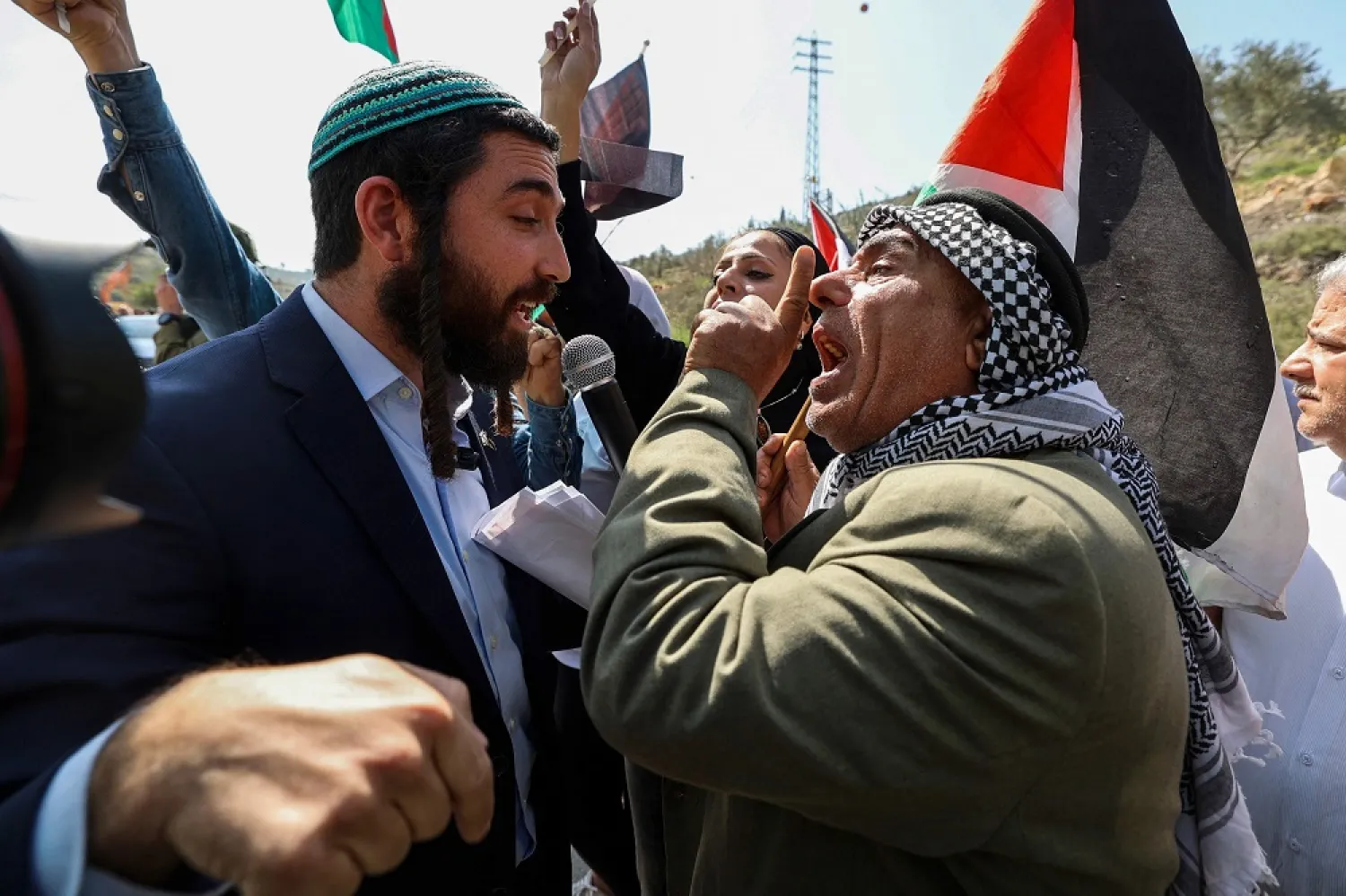
Knesset (Parliament) member for Israel's Religious Zionism party Tzvi Sukkot (L) is confronted as he tries to interrupt a rally by Palestinian and Israeli peace activists protesting at the entrance of Huwara in the occupied West Bank, on March 3, 2023, following deadly violence by Israeli settlers. (AFP)
TT

EU Diplomat Demands Accountability Following Israeli Settler Rampage in West Bank

Knesset (Parliament) member for Israel's Religious Zionism party Tzvi Sukkot (L) is confronted as he tries to interrupt a rally by Palestinian and Israeli peace activists protesting at the entrance of Huwara in the occupied West Bank, on March 3, 2023, following deadly violence by Israeli settlers. (AFP)

The European Union's envoy to the Palestinians called on Friday for accountability and for perpetrators to be brought to justice after a rampage by Israeli settlers this week in the occupied West Bank in which one Palestinian was killed and dozens of houses, shops and cars were torched.

Ambassador Sven Kuhn von Burgsdorff, heading one of the biggest EU delegations to visit the West Bank, said the officials wanted to see with their own eyes the damage left by Sunday's violence in and around the Palestinian village of Huwara. The rampage followed a Palestinian gun attack that killed two Israeli brothers.

"It is absolutely necessary for us that accountability is fully ensured, that the perpetrators be brought to justice, that those who lost property be compensated," Kuhn von Burgsdorff said.

Local media reported that, in a rare move, Israel's Defense Minister Yoav Gallant on Thursday signed administrative detention orders for two suspects over the rampage, after a Jerusalem court ordered police to release all seven people who had been detained in connection with the rampage.

Amnesty International condemned the release of the suspects in a statement on Friday. It also condemned the use of administrative detention, which it said was a practice that violated international law.

Israeli rights group Yesh Din found that 93% of investigations into settler attacks in the West Bank between 2005 and 2022 were closed without indictment.

Israeli Major General Yehuda Fuchs, who commands the Israeli military in the area, said on Tuesday that his forces had prepared for attempted settler retribution over the gun attack but had been surprised by the intensity of the violence, which he said was perpetrated by dozens of people. He called it a "pogrom carried out by outlaws".

Violence in the West Bank has surged over the past year with stepped-up Israeli military raids following a spate of Palestinian attacks. The United States, Jordan and Egypt have appealed for calm, concerned about an escalation ahead of the Muslim holy month of Ramadan and the Jewish Passover festival in late March and early April.

Washington’s call to Netanyahu

The United States has demanded that Israeli Prime Minister Benjamin Netanyahu disavow a call on Wednesday by far-right Finance Minister Bezalel Smotrich for the village of Huwara to be erased.

On the night of the rampage, Netanyahu urged people not to take the law into their own hands, but he has not publicly addressed Smotrich's statement or responded to the unusual criticism by Washington, a close ally.

The UN human rights chief on Friday criticized Smotrich for his remarks, describing them as "an unfathomable statement of incitement to violence and hostility".

Volker Turk was addressing the Geneva-based UN Human Rights Council, where he formally presented a report on the situation in the occupied Palestinian territories.

Late on Thursday, Palestinian officials said Israeli forces shot dead 15-year-old Mohammad Nidal Saleem in the back in the West Bank town of Azzoun.

Ahmad Enaya, the town's mayor, said an Israeli military vehicle drove into town and when teens hurled rocks at the car, soldiers responded with live fire.

The Israeli military said in a statement that soldiers shot at suspects who had hurled explosives at forces while they were conducting a search in the area for people who launched fireworks at Israeli vehicles passing near Azzoun.

It said it was aware of reports of people being wounded but did not confirm any Palestinian fatalities.

A statement by the public hospital in Qalqilya, near Azzoun, said two other people were treated for gunshot wounds.

"The terrorism waged by settlers, in cooperation with the occupation government, is unprecedented," said Walid Assaf, a former Palestinian Authority official who monitored Israeli settlements, speaking at Saleem's funeral in Azzoun on Friday.

At least 62 Palestinians, including gunmen and civilians, have been killed since the start of 2023, the Palestinian health ministry said. Thirteen Israelis and a Ukrainian tourist died in Palestinian attacks in the same period, according to official Israeli figures.

Palestinians seek to establish a state in the West Bank, East Jerusalem and Gaza, areas Israel captured in a 1967 war.

"We Palestinians will remain steadfast and we will defend our existence in the face of this occupation," said Assaf.


Egypt Urges Int’l Support for Lebanese Army to Ensure State Exclusivity over Arms

Egyptian Foreign Minister Badr Abdelatty (3rd L) speaks before representatives of participating countries during the preparatory meeting for the international conference in support of the Lebanese Armed Forces (LAF) and the Internal Security Forces (ISF) in Cairo on February 24, 2026. (AFP)
TT

Egypt Urges Int’l Support for Lebanese Army to Ensure State Exclusivity over Arms

Egyptian Foreign Minister Badr Abdelatty (3rd L) speaks before representatives of participating countries during the preparatory meeting for the international conference in support of the Lebanese Armed Forces (LAF) and the Internal Security Forces (ISF) in Cairo on February 24, 2026. (AFP)

Egypt on Tuesday urged the international community to better support Lebanon's armed forces as the country moves forward with a plan to disarm Hezbollah and bring all weapons under state control. 

Speaking at a preparatory meeting in Cairo ahead of next month's Paris conference in support of the Lebanese army, Egypt's Foreign Minister Badr Abdelatty praised "the success of the Lebanese army in completing the first phase of the plan". 

"This achievement reflects the efficiency of the military institution and requires intensifying international support to complete the remaining phases of the plan," Abdelatty said. 

Lebanon's government last year committed to disarming Hezbollah, which was badly weakened in a recent war with Israel, and tasked the army with drawing up a plan to do so. 

Lebanon has since received promises of support, amid a shortage of equipment, personnel and technical capabilities needed to carry out the army's mission. 

Though its capabilities are limited, the military has worked to dismantle Hezbollah facilities and tunnels and confiscate weapons in the last few months. 

It declared in January the completion of the first phase of its plan, which tackled the area south of the Litani river, located around 30 kilometers (20 miles) north of Israel. 

Lebanon's military now intends to tackle the area north of the river as the second phase of its plan, having said last week that it would need at least four months to finish the job. 

Abdelatty said Tuesday's meeting aimed "to enable the Lebanese state to ensure that all weapons are held exclusively by the state". 

The meeting brought together Lebanon's top security chiefs, including Army Commander General Rodolphe Haykal and Internal Security Forces Director-General Major General Raed Abdallah. 

They were joined by representatives of the Quintet Committee on Lebanon, among them Qatar's state minister for foreign affairs Mohammed bin Abdulaziz al-Khulaifi, French envoy Jean-Yves Le Drian and Saudi Arabia's envoy to Beirut Prince Yazid bin Farhan, along with senior officials from the United States. 

At a separate meeting with Le Drian, Abdelatty stressed the need for what he described as a comprehensive international approach to the crisis in Lebanon. 

"There is no path to restoring stability except by obliging Israel to immediately halt its aggression" and "fully withdraw from occupied Lebanese territories," he said. 

Israel, which accuses Hezbollah of rearming, has criticized the army's progress as insufficient, and has kept up regular strikes on Lebanon despite a November 2024 ceasefire that sought to end more than a year of hostilities with the group. 


About 6.5 Million People in Somalia Face Acute Hunger Due to Drought, Govt and UN Say

 Lime is displayed for sale at an open-air grocery market as Muslims start the fasting month of Ramadan within Bakara market in Mogadishu, Somalia February 18, 2026. (Reuters)
Lime is displayed for sale at an open-air grocery market as Muslims start the fasting month of Ramadan within Bakara market in Mogadishu, Somalia February 18, 2026. (Reuters)
TT

About 6.5 Million People in Somalia Face Acute Hunger Due to Drought, Govt and UN Say

 Lime is displayed for sale at an open-air grocery market as Muslims start the fasting month of Ramadan within Bakara market in Mogadishu, Somalia February 18, 2026. (Reuters)
Lime is displayed for sale at an open-air grocery market as Muslims start the fasting month of Ramadan within Bakara market in Mogadishu, Somalia February 18, 2026. (Reuters)

About 6.5 million people in Somalia ‌face acute hunger due to drought, the government and the United Nations said on Tuesday, sounding the alarm days after the UN's food agency warned that food aid could grind to a halt by April without new funding.

Somalia declared a national drought emergency in November after years of failed rains, and other countries in the region have also been hit.

More than a third of those facing acute malnutrition are children, Somalia's government and the United Nations Somalia said in a joint statement. The crisis has forced tens of thousands of ‌people to ‌flee their homes, with many crowding into camps ‌in ⁠Mogadishu and other ⁠cities.

"The drought ... has deepened alarmingly, with soaring water prices, limited food supplies, dying livestock, and very little humanitarian funding," George Conway, the UN's Humanitarian Coordinator for Somalia, said in a statement.

Hawo Abdi said she lost two children to illness after the drought laid waste to her homeland in Somalia's Bay region.

"When I saw that the suffering ⁠was getting worse, I fled my home and ‌came to ... Mogadishu," she told Reuters ‌from her shelter on the outskirts of the capital.

Last week, the UN World Food Program put the number of those facing acute hunger ‌at 4.4 million, and said it had already cut back its assistance to just over 600,000 people from 2.2 million earlier this year.

It was not clear whether the new figure reflected a sharp increase in those ‌at risk or different counting methods.

The government and United Nations figures tally with those also released on ⁠Tuesday by ⁠the Integrated Food Security Phase Classification (IPC), which sets the global standard for determining the severity of a food crisis.

While rainfall in the April to June season could offer some relief, some 5.5 million people were expected to remain in the crisis level or worse, with 1.6 million people in the emergency level, the statement said.

Abdiyo Ali was forced to abandon her farm in the Lower Shabelle region.

"Our farms were destroyed, our livestock died, and water sources became too far away. We have nothing left to bring with us," Ali told Reuters last week while preparing her food in a displaced people's camp outside Mogadishu.


Lebanon Fears Israeli Strikes if Iran Situation Escalates

 Lebanese Foreign Minister Youssef Raggi addresses the Human Rights Council in Geneva, Switzerland, Tuesday, Feb. 24, 2026. (AP)
Lebanese Foreign Minister Youssef Raggi addresses the Human Rights Council in Geneva, Switzerland, Tuesday, Feb. 24, 2026. (AP)
TT

Lebanon Fears Israeli Strikes if Iran Situation Escalates

 Lebanese Foreign Minister Youssef Raggi addresses the Human Rights Council in Geneva, Switzerland, Tuesday, Feb. 24, 2026. (AP)
Lebanese Foreign Minister Youssef Raggi addresses the Human Rights Council in Geneva, Switzerland, Tuesday, Feb. 24, 2026. (AP)

Lebanon's foreign minister said Tuesday his country feared its infrastructure could be hit by Israeli strikes if the situation with Iran escalates, as Israel has intensified its attacks on Tehran-backed Hezbollah.

Also on Tuesday, Lebanon's army accused the Israeli military of firing near a position it was setting up in the country's south, saying it had instructed troops to return fire.

"There are signs that the Israelis could strike very hard in the event of an escalation, potentially including strategic infrastructure such as the airport," foreign minister Youssef Raggi told reporters in Geneva.

His comments came amid a massive US military buildup in the Middle East that suggested Washington was prepared to wage a potentially sustained campaign against Iran.

Iran vowed on Monday to retaliate "ferociously" against any attack from the United States, and repeated its warning of a regional conflagration in response to President Donald Trump's latest threat of strikes.

"We are currently conducting diplomatic efforts to request that, even in the event of retaliation, Lebanese civilian infrastructure not be targeted," Raggi said.

He stressed that his country's leadership had been very clear: "This war does not concern us."

A Lebanese official who requested anonymity said "what the Lebanese fear is a chain reaction: an American strike against Iran, a Hezbollah retaliatory strike against Israel, followed by a massive Israeli response."

- Israeli strikes -

Israel has kept up regular strikes on Lebanon despite a November 2024 ceasefire that sought to halt more than a year of hostilities with Iran-backed Hezbollah, usually saying it was targeting the group.

Last Friday, Israel carried out deadly strikes on what it called Hezbollah positions in eastern Lebanon and targets linked to the Palestinian group Hamas in the south.

Hezbollah said Saturday that eight of its fighters had been killed, and vowed "resistance".

Its leader Sheikh Naim Qassem stated last month that any attack on Tehran would also be an attack on Hezbollah.

On Monday, Washington ordered non-emergency personnel to leave its embassy in Lebanon's capital Beirut as anticipation rose of a possible conflict with Iran.

On Tuesday, Lebanon's army said it was "establishing a new observation post on the southern border" when "the area surrounding the post was subjected to gunfire from the Israeli side".

"The army command issued orders to reinforce the post, remain there, and return fire."

On the same day in Cairo, a preparatory meeting was held ahead of a conference in Paris next month to back Lebanon's army, which is facing heavy pressure from Washington and Israel to disarm Hezbollah.

Egyptian Foreign Minister Badr Abdelatty said that Tuesday's meeting aimed "to enable the Lebanese state to ensure that all weapons are held exclusively by the state".

Lebanon's government last year committed to disarming Hezbollah, which was badly weakened in a recent war with Israel, and tasked the army with drawing up a plan to do so.

The army, which has limited capabilities, declared in January the completion of the first phase of its plan near the border with Israel.

It said last week it would need at least four months to complete the second phase.

Israel, which accuses Hezbollah of rearming, has criticized the army's progress as insufficient.