

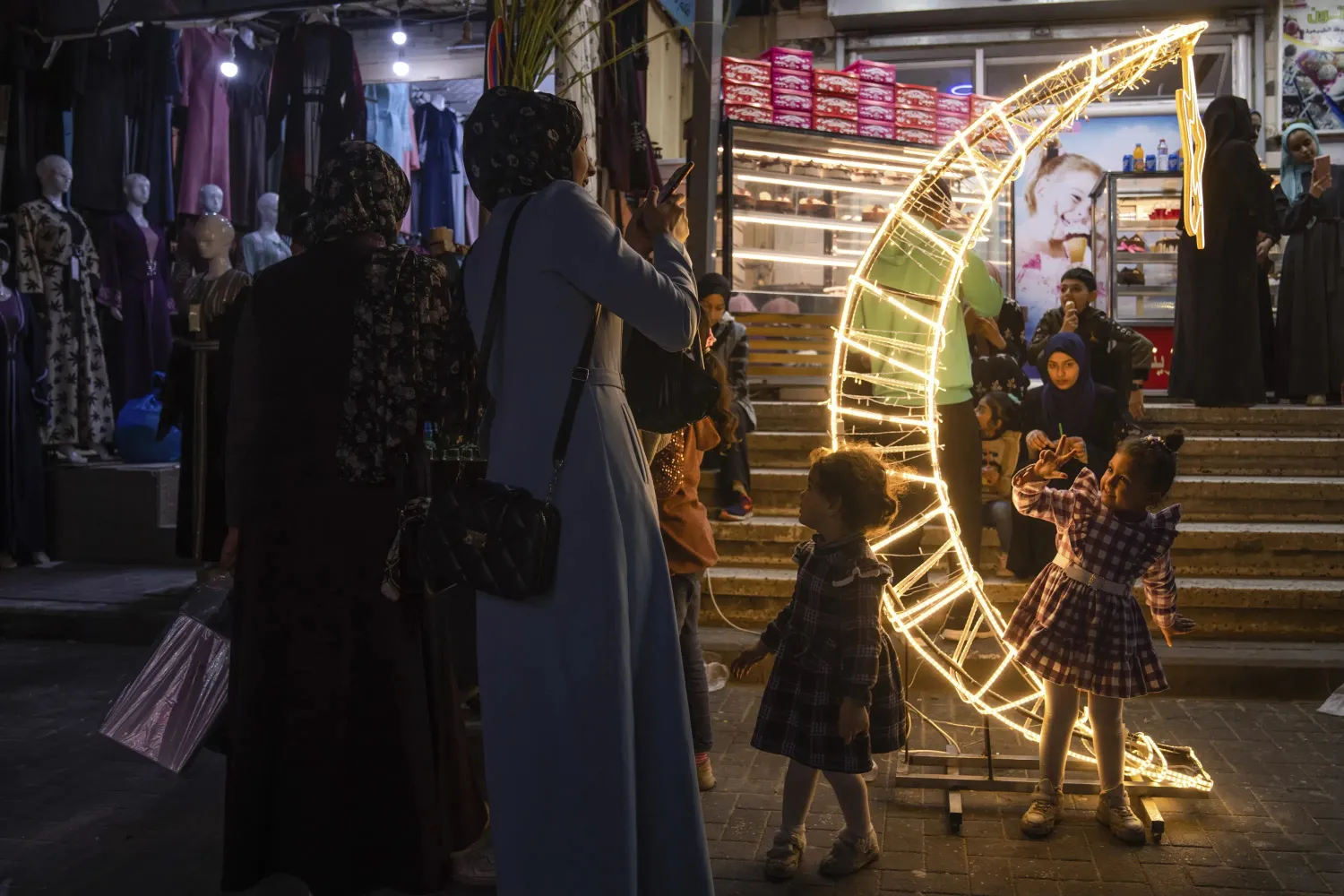

Ramadan Begins in Mideast amid High Costs, Hopes for Peace

A Palestinian woman takes photos of her daughter next to a crescent moon-shaped decoration in a market, at the beginning of the Muslim holy month of Ramadan in Jebaliya refugee camp, northern Gaza Strip, Wednesday, March 22, 2023. (AP Photo/Fatima Shbair)
TT

Ramadan Begins in Mideast amid High Costs, Hopes for Peace

A Palestinian woman takes photos of her daughter next to a crescent moon-shaped decoration in a market, at the beginning of the Muslim holy month of Ramadan in Jebaliya refugee camp, northern Gaza Strip, Wednesday, March 22, 2023. (AP Photo/Fatima Shbair)

The first daily fast of the Islamic holy month of Ramadan began Thursday, as hundreds of millions of Muslims worldwide enter a four-week period of worship.

The observance comes at a time when numerous countries and governments across the Middle East are taking tentative steps towards calming enduring conflicts and crises made more acute by the costly war in Ukraine and a devastating earthquake in Türkiye and Syria that killed over 52,000 people, The Associated Press said.

During the coming four weeks, hundreds of millions of Muslims will abstain from food and water from dawn to dusk, before gathering with family and friends for indulgent nighttime meals.
According to Islam, fasting draws the faithful closer to God and reminds them of the suffering of the poor.

In Sudan’s capital, families prepare and sell culinary delights weeks in advance to mark the break of the fast each evening, a meal known as Iftar.

The food and drink of choice for nighttime feasts across households in the Islamic African nation include assida, a semolina-based flour dish, and a sugary fermented drink called, “sweet bitter.” Both are recipes that date back generations.

“Those who can’t afford don’t have to pay,” said Fatima Mohammed Hamid, who sells the food items from her small home on Tuti island, just north of the Sudanese capital of Khartoum.

In addition to fasting, charity giving is another of Islam’s five pillars. During Ramadan, mosques and charities regularly provide meals for the poor at long tables that sprawl out onto the street.

For Sudan, the holy season comes as the promise of a new political era approaches. The country has been steeped in political chaos since a coup ousted a western powersharing government in October 2021.

A new transitional government could be formed before the holy month draws to a close, as promised by the country’s ruling military and other political forces earlier this week. However, many prominent Sudanese factions reject the move. Amid the uncertainty, most find common ground in complaining about the rising cost of living.

“Everything (the ingredients) costs double what it did last year,” said Hamid.

Israeli and Palestinian leaders pledged this week to lower tensions as Ramadan begins, following months of deadly violence in the West Bank and east Jerusalem. This year, the fasting period coincides with the Jewish festival of Passover, spurring concern about fresh flare-ups with large numbers of Jewish and Muslim faithful expected to pour into Jerusalem’s Old City.

From Gaza to Khartoum and Tunis to Sanaa, soaring prices are proving a further concern for those set to celebrate the occasion. Arab countries are continuing to suffer from the economic fallout of the war in Ukraine, with many reliant on grain imports from eastern Europe.

In Tunis’ once-bustling Bab al-Fellah market, rising costs have left shoppers unable to splurge on Ramadan food shopping as they might have in past years.

“I have almost used up the 40 dinars (roughly $13) that my husband gave me and I bought only vegetables, a chicken and some spices,’’ said a woman who identified herself only as Fatima B.

In war-torn Sanaa, the picture is bleaker still, with residents struggling to purchase even basic supplies. The country’s ruinous civil war, now entering its ninth year, has killed more than 150,000 people and pushed millions of Yemenis to the brink of famine.

“I am not able to provide daily sustenance for the children,” said Saleh al-Omrani, an unemployed resident from Sanaa. “We had Ramadan in the good old days, but today there is no longer Ramadan.”

In southern Türkiye and northwestern Syria, the destruction caused by last month’s earthquake poses perhaps the steepest challenge of all.

The quake destroyed or damaged hundreds of mosques, Turkish authorities say, leaving tens of thousands to pray in makeshift tents.

In northwestern Idlib province — Syria’s last rebel enclave -- very few families still have the energy or resources to make the necessary preparations for Ramadan this year.

Abdul Qahar Zakou, a cafe owner from the province, said he will decorate his cafe despite the prevailing misery and do his best to create a festive atmosphere.

“Despite all the odds, Ramadan will always have its own atmosphere, with a symbolism and spirituality that makes life easier,” said Zakou.

Fasting is required for all healthy Muslims, with exemptions for those who are sick and for women who are pregnant or breastfeeding. Small children are not expected to fast.

Eating or drinking in public during the day is generally frowned upon in Muslim countries.

Islam follows a lunar calendar, so Ramadan begins around a week and a half earlier each year.

At the end of Ramadan, Muslims celebrate the joyous Eid al-Fitr holiday, when children often receive new clothes and gifts.



Israel Permits 10,000 West Bank Palestinians for Friday Prayers at Al Aqsa

Palestinians attend Friday prayers in a mosque following an attack that local Palestinians said was carried out by Israeli settlers, in the village of Deir Istiya near Salfit in the Israeli-occupied West Bank November 14, 2025. REUTERS/Sinan Abu Mayzer
TT

Israel Permits 10,000 West Bank Palestinians for Friday Prayers at Al Aqsa

Palestinians attend Friday prayers in a mosque following an attack that local Palestinians said was carried out by Israeli settlers, in the village of Deir Istiya near Salfit in the Israeli-occupied West Bank November 14, 2025. REUTERS/Sinan Abu Mayzer

Israel announced that it will cap the number of Palestinian worshippers from the occupied West Bank attending weekly Friday prayers at the Al-Aqsa Mosque in east Jerusalem at 10,000 during the holy month of Ramadan, which began Wednesday.

Israeli authorities also imposed age restrictions on West Bank Palestinians, permitting entry only to men aged 55 and older, women aged 50 and older, and children up to age 12.

"Ten thousand Palestinian worshippers will be permitted to enter the Temple Mount for Friday prayers throughout the month of Ramadan, subject to obtaining a dedicated daily permit in advance," COGAT, the Israeli defense ministry agency in charge of civilian matters in the Palestinian territories, said in a statement, AFP reported.

"Entry for men will be permitted from age 55, for women from age 50, and for children up to age 12 when accompanied by a first-degree relative."

COGAT told AFP that the restrictions apply only to Palestinians travelling from the West Bank, which Israel has occupied since the 1967 Arab-Israeli war.

"It is emphasised that all permits are conditional upon prior security approval by the relevant security authorities," COGAT said.

"In addition, residents travelling to prayers at the Temple Mount will be required to undergo digital documentation at the crossings upon their return to the areas of Judea and Samaria at the conclusion of the prayer day," it said, using the Biblical term for the West Bank.

During Ramadan, hundreds of thousands of Palestinians traditionally attend prayers at Al-Aqsa, Islam's third holiest site, located in east Jerusalem, which Israel captured in 1967 and later annexed in a move that is not internationally recognized.

Since the war in Gaza broke out in October 2023, the attendance of worshippers has declined due to security concerns and Israeli restrictions.

The Palestinian Jerusalem Governorate said this week that Israeli authorities had prevented the Islamic Waqf -- the Jordanian-run body that administers the site -- from carrying out routine preparations ahead of Ramadan, including installing shade structures and setting up temporary medical clinics.

A senior imam of the Al-Aqsa Mosque, Sheikh Muhammad al-Abbasi, told AFP that he, too, had been barred from entering the compound.

"I have been barred from the mosque for a week, and the order can be renewed," he said.

Abbasi said he was not informed of the reason for the ban, which came into effect on Monday.

Under longstanding arrangements, Jews may visit the Al-Aqsa compound -- which they revere as the site of the first and second Jewish temples -- but they are not permitted to pray there.

Israel says it is committed to upholding this status quo, though Palestinians fear it is being eroded.

In recent years, a growing number of Jewish ultranationalists have challenged the prayer ban, including far-right politician Itamar Ben Gvir, who prayed at the site while serving as national security minister in 2024 and 2025.


EU Exploring Support for New Gaza Administration Committee, Document Says

Palestinians push a cart past the rubble of residential buildings destroyed during the two-year Israeli offensives, in Gaza City, February 17, 2026. REUTERS/Mahmoud Issa
TT

EU Exploring Support for New Gaza Administration Committee, Document Says

Palestinians push a cart past the rubble of residential buildings destroyed during the two-year Israeli offensives, in Gaza City, February 17, 2026. REUTERS/Mahmoud Issa

The European Union is exploring possible support for a new committee established to take over the civil administration of Gaza, according to a document produced by the bloc's diplomatic arm and seen by Reuters.

"The EU is engaging with the newly established transitional governance structures for Gaza," the European External Action Service wrote in a document circulated to member states on Tuesday.

"The EU is also exploring possible support to the National Committee for the Administration of Gaza," it added.

European foreign ministers will discuss the situation in Gaza during a meeting in Brussels on February 23.


Israel Military Says Soldier Killed in Gaza 

A drone view shows the destruction in a residential neighborhood, after the withdrawal of the Israeli forces from the area, amid a ceasefire between Israel and Hamas in Gaza, in Gaza City, October 21, 2025. (Reuters)
TT

Israel Military Says Soldier Killed in Gaza 

A drone view shows the destruction in a residential neighborhood, after the withdrawal of the Israeli forces from the area, amid a ceasefire between Israel and Hamas in Gaza, in Gaza City, October 21, 2025. (Reuters)

The Israeli military announced that one of its soldiers had been killed in combat in southern Gaza on Wednesday, but a security source said the death appeared to have been caused by "friendly fire".

"Staff Sergeant Ofri Yafe, aged 21, from HaYogev, a soldier in the Paratroopers Reconnaissance Unit, fell during combat in the southern Gaza Strip," the military said in a statement.

A security source, however, told AFP that the soldier appeared to have been "killed by friendly fire", without providing further details.

"The incident is still under investigation," the source added.

The death brings to five the number of Israeli soldiers killed in Gaza since a ceasefire took effect on October 10.