


Netanyahu Vows to Unite Israel but Opponents Dismiss Pledge

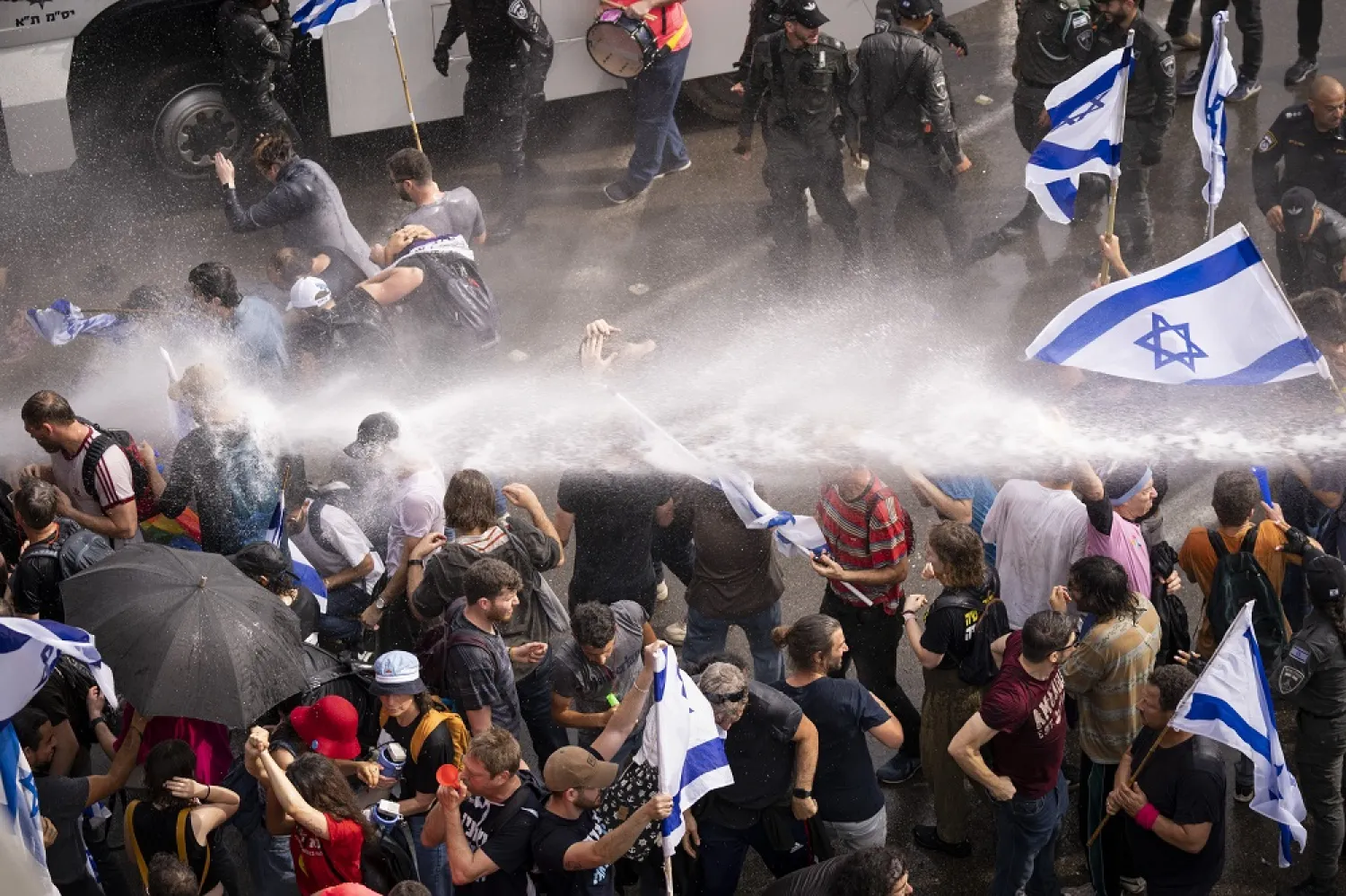
Israeli police use a water cannon to disperse Israelis blocking the freeway during a protest against plans by Prime Minister Benjamin Netanyahu's government to overhaul the judicial system in Tel Aviv, Israel, Thursday, March 23, 2023. (AP)
TT

Netanyahu Vows to Unite Israel but Opponents Dismiss Pledge

Israeli police use a water cannon to disperse Israelis blocking the freeway during a protest against plans by Prime Minister Benjamin Netanyahu's government to overhaul the judicial system in Tel Aviv, Israel, Thursday, March 23, 2023. (AP)

Israeli Prime Minister Benjamin Netanyahu on Thursday vowed to "mend the rift" in a nation deeply divided over his proposed overhaul of the country’s judiciary. But he offered no details on how he intends to do so and gave no indication that he would slow down the plan.

Netanyahu delivered his appeal in a nationally televised address after another day of mass protests across the country against the plan, and hours after his parliamentary coalition passed the first in a series of laws that make up the overhaul. His vague pledges were quickly rejected by the protest movement, which said it would continue to oppose "Netanyahu’s attempt to become a dictator."

Protesters blocked traffic on main highways and scuffled with police in unrest that shows no sign of abating. Police used water cannons to disperse crowds, and dozens of people — including leaders of the protest movement — were arrested.

The government’s plan has plunged the country into one of its worst domestic crises.

Netanyahu and his allies want to weaken the powers of the judiciary, saying unelected Supreme Court justices and other judges wield too much power.

Critics say the changes, which would give Netanyahu and his conservative allies the final say in choosing the country’s judges, will destroy a delicate system of checks and balances. They also say Netanyahu has a conflict of interest while he is on trial for multiple corruption charges.

In his speech, Netanyahu said he understood the concerns of both sides. He accused the Supreme Court of intervening in political issues but also acknowledged concerns by his opponents that a narrow parliamentary majority could impose its will and harm the rights Palestinian citizens and minorities.

"We will ensure the basic rights of all Israeli citizens — Jews and non-Jews, secular and religious, women, everyone without exception," he said. "I will do everything to calm the waters and mend the rift in the nation, because we are family."

As he spoke, thousands of people continued to march in cities across Israel, including a large crowd outside of his private residence in Jerusalem. Netanyahu pushed back his departure on an official trip to Britain until 4 a.m. on Friday to deal with the crisis.

His opponents quickly rejected the speech.

The grassroots protest movement said it would press ahead with the demonstrations, which have taken place weekly for the past three months.

"Tonight, we saw a dictator-in-the-making who instead of stopping the legal coup, decided to continue with the hostile political takeover of the Supreme Court," it said.

Opposition leader Yair Lapid said Netanyahu made clear he has "no intention of holding true dialogue." He called on "responsible" members of Netanyahu’s Likud party to speak up against the plan.

Among Lapid’s targets is Defense Minister Yoav Gallant, a top Likud official who met with Netanyahu shortly before the speech.

According to Israeli media, Gallant voiced his concerns that objections by Israeli reservists and other security forces were hurting Israel’s international image and power of deterrence. However, Gallant abruptly canceled a planned statement in which he was expected to call on Netanyahu to freeze the plan.

The opposition is rooted in broad swaths of society — including business leaders and top legal officials. Even the country’s military, seen as a beacon of stability by Israel’s Jewish majority, is enmeshed in the political conflict, as some reservists are refusing to show up for duty over the changes. Israel’s international allies have also expressed concern.

In a first step of the overhaul, Netanyahu’s parliamentary coalition approved legislation that would protect the Israeli leader from being deemed unfit to rule because of his trial and claims of a conflict of interest. Critics say the law is tailor-made for Netanyahu and encourages corruption.

The law to protect Netanyahu passed in a 61-47 vote in the 120-seat Knesset, or parliament, after a debate that ran through the night. It stipulates that a prime minister can only be deemed unfit to rule for health or mental reasons and that only he or his government can make that decision.

Civil society groups have called on the attorney general to declare him unfit to rule over his legal problems. The attorney general has already barred Netanyahu from direct involvement in the legal overhaul, saying he is at risk of a conflict of interest.

The Movement for Quality Government in Israel, a good governance organization, said it would challenge the new law in court.

On Thursday, protesters launched a fourth midweek day of demonstrations. They blocked major thoroughfares, set tires ablaze near an important seaport and draped a large Israeli flag and a banner with the country’s Declaration of Independence over the walls of Jerusalem’s Old City.

The protests have intensified in recent weeks, with a number of senior Cabinet ministers accosted and heckled by vocal crowds while making public appearances. Netanyahu called on opposition leaders to "stop the anarchy immediately."

A protest took place Thursday night in Bnei Brak, a large ultra-Orthodox city near Tel Aviv. The overhaul crisis has magnified a longstanding rift between secular Jewish Israelis and religious ones over how much of a role religion should play in their day-to-day lives.

Ultra-Orthodox lawmakers in government are central drivers of the overhaul because they believe the courts are a threat to their traditional way of life. In contrast, secular opponents to the changes fear they will open the door to religious coercion. They also object to exemptions granted to ultra-Orthodox men from military duty, which is mandatory for most Jews.

Along with Thursday’s demonstrations, tens of thousands have been showing up for weekly protests each Saturday night.

Netanyahu’s government rejected a compromise proposal earlier this month meant to ease the crisis. It said that it would slow the pace of the changes, pushing most of them to after a monthlong parliamentary recess in April.

But the government is plowing forward on a key part of the overhaul, which would grant the government control over who becomes a judge. That measure is expected to pass next week.

Netanyahu is on trial for fraud, breach of trust and accepting bribes in a series of scandals involving wealthy associates and powerful media moguls. He denies wrongdoing and dismisses critics who say he could find an escape route from the charges through the legal overhaul his government is advancing.

Israel’s Palestinian minority has largely avoided participating in the demonstrations. Rights groups and Palestinians say Israel’s democratic ideals have long been tarnished by the country’s 55-year, open-ended occupation of lands the Palestinians seek for an independent state and the treatment of Palestinian Israeli citizens, who face discrimination in many spheres.



US Judge Blocks Deportation of Columbia University Palestinian Activist

Mohsen Mahdawi at a press conference in Vermont last year - Photo by Alex Driehaus/AP
TT

US Judge Blocks Deportation of Columbia University Palestinian Activist

Mohsen Mahdawi at a press conference in Vermont last year - Photo by Alex Driehaus/AP

A US immigration judge has blocked the deportation of a Palestinian graduate student who helped organize protests at Columbia University against Israel's war in Gaza, according to US media reports.

Mohsen Mahdawi was arrested by immigration agents last year as he was attending an interview to become a US citizen.

Mahdawi had been involved in a wave of demonstrations that gripped several major US university campuses since Israel began a massive military campaign in the Gaza Strip.

A Palestinian born in the occupied West Bank, Mahdawi has been a legal US permanent resident since 2015 and graduated from the prestigious New York university in May. He has been free from federal custody since April.

In an order made public on Tuesday, Judge Nina Froes said that President Donald Trump's administration did not provide sufficient evidence that Mahdawi could be legally removed from the United States, multiple media outlets reported.

Froes reportedly questioned the authenticity of a copy of a document purportedly signed by Secretary of State Marco Rubio that said Mahdawi's activism "could undermine the Middle East peace process by reinforcing antisemitic sentiment," according to the New York Times.

Rubio has argued that federal law grants him the authority to summarily revoke visas and deport migrants who pose threats to US foreign policy.

The Trump administration can still appeal the decision, which marked a setback in the Republican president's efforts to crack down on pro-Palestinian campus activists.

The administration has also attempted to deport Mahmoud Khalil, another student activist who co-founded a Palestinian student group at Columbia, alongside Mahdawi.

"I am grateful to the court for honoring the rule of law and holding the line against the government's attempts to trample on due process," Mahdawi said in a statement released by his attorneys and published Tuesday by several media outlets.

"This decision is an important step towards upholding what fear tried to destroy: the right to speak for peace and justice."


Fire Breaks out Near Iran's Capital Tehran, State Media Says

Smoke rises from a fire caused by an explosion in Tehran (File photo - Reuters)
TT

Fire Breaks out Near Iran's Capital Tehran, State Media Says

Smoke rises from a fire caused by an explosion in Tehran (File photo - Reuters)

A fire broke out in Iran's Parand near the capital city Tehran, state media reported on Wednesday, publishing videos of smoke rising over the area which is close to several military and strategic sites in the country's Tehran province, Reuters reported.

"The black smoke seen near the city of Parand is the result of a fire in the reeds around the Parand river bank... fire fighters are on site and the fire extinguishing operation is underway", state media cited the Parand fire department as saying.


Pakistan PM Sharif to Seek Clarity on Troops for Gaza in US Visit

US President Donald Trump looks at Pakistan's Prime Minister Shehbaz Sharif speaking following the official signing of the first phase of the Gaza ceasefire agreement between Israel and Hamas, during a world leaders' summit on ending the Gaza war, in Sharm El-Sheikh, Egypt, October 13, 2025. REUTERS/Evelyn Hockstein/File Photo
TT

Pakistan PM Sharif to Seek Clarity on Troops for Gaza in US Visit

US President Donald Trump looks at Pakistan's Prime Minister Shehbaz Sharif speaking following the official signing of the first phase of the Gaza ceasefire agreement between Israel and Hamas, during a world leaders' summit on ending the Gaza war, in Sharm El-Sheikh, Egypt, October 13, 2025. REUTERS/Evelyn Hockstein/File Photo

Before Pakistan commits to sending troops to Gaza as part of the International Stabilization Force it wants assurances from the United States that it will be a peacekeeping mission rather than tasked with disarming Hamas, three sources told Reuters.

Pakistan's Prime Minister Shehbaz Sharif is set to attend the first formal meeting of President Donald Trump's Board of Peace in Washington on Thursday, alongside delegations from at least 20 countries.

Trump, who will chair the meeting, is expected to announce a multi-billion dollar reconstruction plan for Gaza and detail plans for a UN-authorized stabilization force for the Palestinian enclave.

Three government sources said during the Washington visit Sharif wanted to better understand the goal of the ISF, what authority they were operating under and what the chain of command was before making a decision on deploying troops.

"We are ready to send troops. Let me make it clear that our troops could only be part of a peace mission in Gaza," said one of the sources, a close aide of Sharif.

"We will not be part of any other role, such as disarming Hamas. It is out of the question," he said.

Analysts say Pakistan would be an asset to the multinational force, with its experienced military that has gone to war with arch-rival India and tackled insurgencies.

"We can send initially a couple of thousand troops anytime, but we need to know what role they are going to play," the source added.

Two of the sources said it was likely Sharif, who has met Trump earlier this year in Davos and late last year at the White House, would either have an audience with him on the sidelines of the meeting or the following day at the White House.

Initially designed to cement Gaza's ceasefire, Trump sees the Board of Peace, launched in late January, taking a wider role in resolving global conflicts. Some countries have reacted cautiously, fearing it could become a rival to the United Nations.

While Pakistan has supported the establishment of the board, it has voiced concerns against the mission to demilitarize Gaza's militant group Hamas.