


Lebanon Sees Signs of New Wave of Syrian Displacement

In one of the encampments for the displaced Syrians in the Lebanese Bekaa region (AP)
TT

Lebanon Sees Signs of New Wave of Syrian Displacement

In one of the encampments for the displaced Syrians in the Lebanese Bekaa region (AP)

Lebanese authorities have recorded a new influx of Syrian refugees crossing into Lebanon from neighboring Syria through the porous illegal border crossings between the two countries.

On a daily basis, authorities return close to 30 families caught crossing illegally from Syria, while other families manage to flee through overlapping border routes which the authorities cannot fully control.

The governor of the border area of Baalbek-Hermel, Bashir Khodr, said at a security meeting in the town of Arsal that security forces seize between 20 and 30 families of displaced Syrians entering Lebanon through the vicinity of Arsal.

“Those get deported after thorough legal procedures which are often complicated and hard,” said Khodr, describing the situation as “unbearable” and requiring preemptive measures to control it.

Displaced Syrians seeking refuge in Lebanon have grown following the February 6 earthquake that struck Türkiye and Syria.

Dozens of families try daily to reach the Lebanese interior. Lebanon's' security forces succeed at thwarting the bulk of human smuggling operations, while others are able to cross, benefiting from overlapping border areas.

Popular resentment is on the rise in Lebanon with the rising competition of the Syrian working force, and the difficulties they bear at various levels because of the influx of refugees.

At the security meeting held in the presence of security leaders in the Bekaa region, Khodr said: “Our meeting today is to address various complaints we received from Mokhtars and officials in Arsal related to the competition of the Syrian labor force. Arsal alone has 174 encampments of Syrian refugees, not to mention the rented apartments and shops.”

Syrians trying to enter Lebanon seek to join the Syrian displacement camps in the Bekaa Valley and the Palestinian refugee camps. Families head to Beirut seeing it as a safe haven for work.

Meanwhile, the coastal region of northern Lebanon is considered by some refugees as a station in preparation for flowing toward Europe via boats that depart from the north.

Lebanon hosts some 815,000 registered Syrian refugees and potentially hundreds of thousands more who are unregistered, the highest population of refugees per capita in the world. But since the country’s economic meltdown erupted three years ago, Lebanese officials have increasingly called for a mass return of the Syrians.


Norway Gives Additional $13 Million in Aid to Palestinians

Palestinian motorists wait in line to cross the Beit Furik military checkpoint, east of Nablus, West Bank, 20 September 2026. EPA/ALAA BADARNEH
TT

Norway Gives Additional $13 Million in Aid to Palestinians

Palestinian motorists wait in line to cross the Beit Furik military checkpoint, east of Nablus, West Bank, 20 September 2026. EPA/ALAA BADARNEH

Norway's government said on Thursday it will give an additional 125 million Norwegian crowns ($13.17 million) in aid to the occupied Palestinian territories through the United Nations and the World ⁠Bank, including public sector ⁠budget support.

Norway recognized a Palestinian state in 2024 and chairs the international donor ⁠group for the Palestinians.

Norway's Foreign Minister Espen Barth Eide said in a statement the need for international support was "greater than ever.”

Eide also criticized Israeli settlement activity ⁠in ⁠the occupied West Bank.

Norway is providing around 1 billion Norwegian crowns in assistance to the Palestinians in 2026.


Postwar Arrangements Top al-Zaidi’s New York Talks

Lebanese Prime Minister Nawaf Salam (L)speaks with Iraqi Prime Minister Ali al-Zaid during a Gulf Cooperation Council (GCC) multilateral meeting on the sidelines of the 81st United Nations General Assembly in New York on September 22, 2026. (Photo by Brendan SMIALOWSKI / AFP)
TT

Postwar Arrangements Top al-Zaidi’s New York Talks

Lebanese Prime Minister Nawaf Salam (L)speaks with Iraqi Prime Minister Ali al-Zaid during a Gulf Cooperation Council (GCC) multilateral meeting on the sidelines of the 81st United Nations General Assembly in New York on September 22, 2026. (Photo by Brendan SMIALOWSKI / AFP)

Iraqi Prime Minister Ali al-Zaidi is seeking to restore normal relations with neighboring and regional countries through a series of meetings in New York, where he is attending the UN General Assembly.

Al-Zaidi met US President Donald Trump on Wednesday to discuss strengthening bilateral cooperation and regional developments. The prime minister’s media office said the talks covered economic and investment partnerships between Baghdad and Washington, as well as joint efforts to bolster regional and international security and stability.

Al-Zaidi’s talks in New York have drawn particular attention, including his participation in a multilateral meeting with Trump to discuss postwar regional arrangements and his meeting with Syrian President Ahmad al-Sharaa.

Baghdad says it has been hurt by the closure of the Strait of Hormuz because of the war, but faces sharp contradictions at home because parties in the ruling Coordination Framework and armed factions are allied with Iran, one of the parties to the conflict with the United States.

Government spokesman Haider al-Aboudi said Iraq was pursuing an important program to coordinate positions and create opportunities for cooperation, noting that al-Zaidi had held several meetings in New York to coordinate policies and safeguard shared interests.

“Iraq has listened to the proposals of world leaders, but it has its own vision for producing solutions to secure energy supplies and stabilize the region,” al-Aboudi told reporters.

He explained that Iraq was guided by legal and constitutional principles of good-neighborly relations and non-interference in internal affairs while pursuing greater cooperation and integration to promote stability.

Al-Zaidi and Al-Sharaa

Al-Aboudi’s remarks followed a series of meetings al-Zaidi held with world leaders, most notably Syrian President Ahmad al-Sharaa.

Before a multilateral meeting convened by Trump on the sidelines of the UN General Assembly, journalists captured al-Sharaa and al-Zaidi shaking hands for the first time since the Iraqi premier took office.

Al-Zaidi’s office later confirmed that the two leaders met on the sidelines of the 81st UN General Assembly.

According to the statement, the talks covered regional and international developments, bilateral relations and ways to strengthen them in line with mutual interests, as well as efforts to promote de-escalation and ease regional tensions.

Al-Sharaa, for his part, told reporters that Damascus was working to provide a safe corridor for Iraqi oil exports through Syrian ports. He pointed to a strategic project to build an oil pipeline from Iraqi fields to Syrian ports, bypassing the Strait of Hormuz.

The Syrian president described Damascus’ relations with Iraq’s Kurdistan region as “very good,” citing shared interests in several areas. He also highlighted Kurdistan Democratic Party leader Masoud Barzani’s role in stabilizing Syria and integrating the Syrian Democratic Forces (SDF) into the state.

Postwar arrangements

Al-Zaidi also joined a multilateral meeting attended by Trump following what was described as a “productive” meeting between US and Iranian officials on Tuesday evening.

Al-Zaidi’s office reported that the meeting addressed security and stability, protecting global trade, securing supply chains and preserving development levels in regional economies.

Participants also discussed proposed strategies and arrangements for the postwar period and ways to advance peace and stability by prioritizing dialogue and diplomatic solutions.

The meeting included delegation heads from Saudi Arabia, Bahrain, Kuwait, the United Arab Emirates, Qatar, Oman, Jordan, Lebanon, Syria, Egypt and Türkiye, as well as the United States.

Baghdad political science professor Talib Mohammed Karim described al-Zaidi’s meetings as “an opportunity to give Baghdad greater room to build a more balanced foreign policy.”

The Iraqi government, he told Asharq Al-Awsat, was seeking security and economic cooperation and ways to protect shared interests at a complex geopolitical moment, without allowing regional relationships to become extensions of Iraq’s internal conflicts.


Battles, Airstrikes Exhaust Yemen’s Houthis

Houthi fighters standing in formation in an area of clashes with government forces in Yemen. (AP)
TT

Battles, Airstrikes Exhaust Yemen’s Houthis

Houthi fighters standing in formation in an area of clashes with government forces in Yemen. (AP)

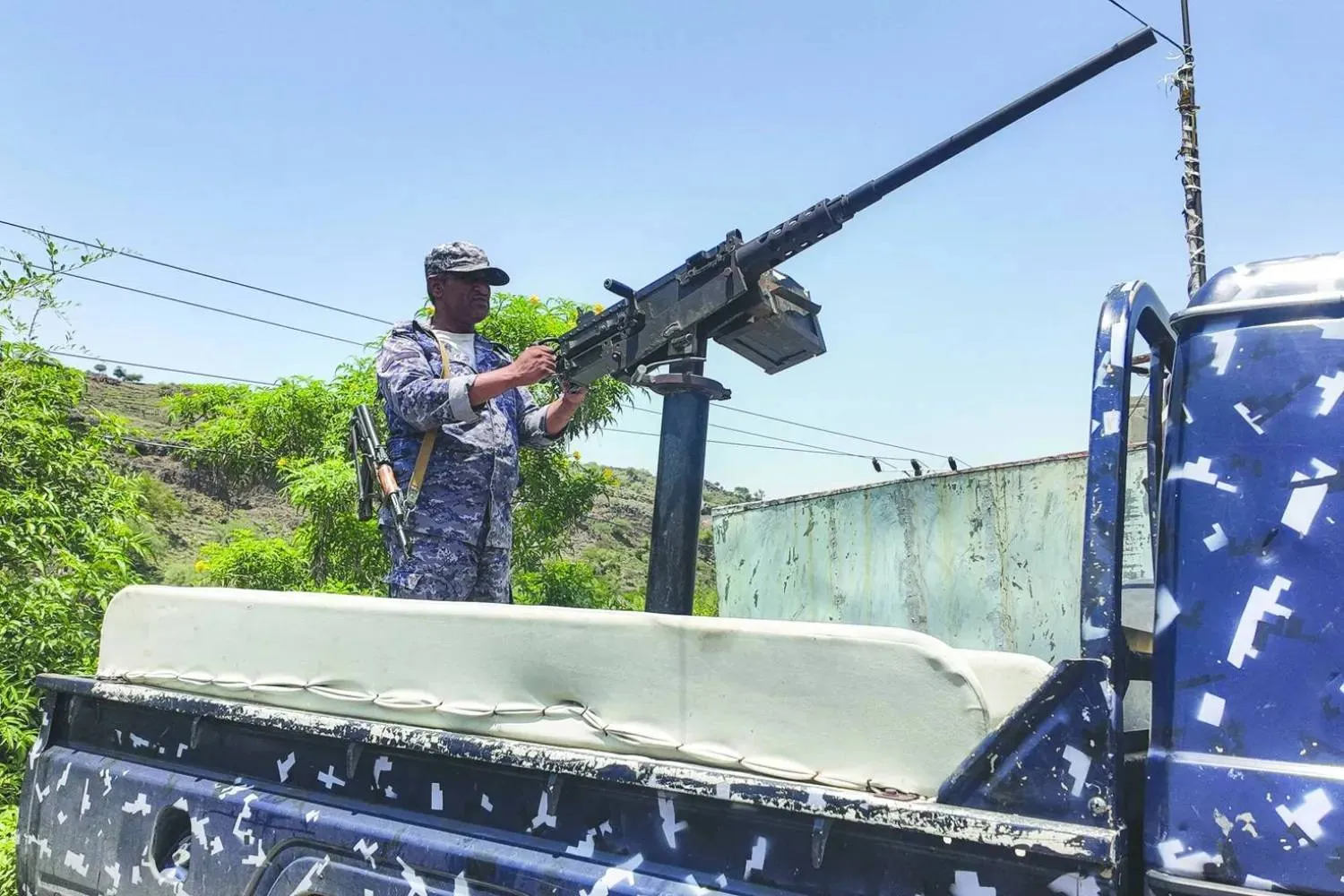
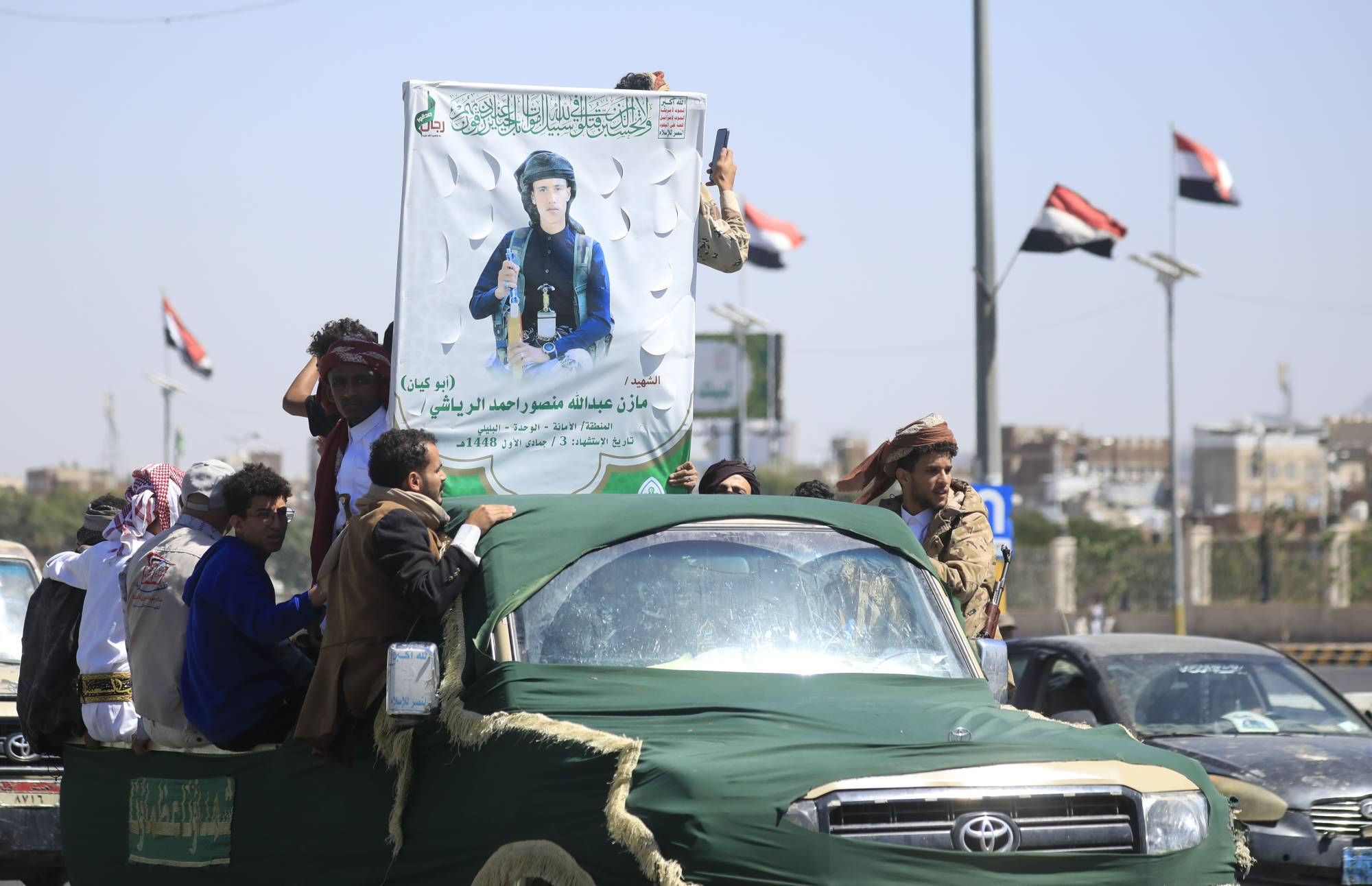
Fighting between Yemeni government forces and the Houthis continued across interconnected fronts stretching from western Taiz to Lahj and the west coast, with clashes intensifying on high ground overlooking the Bab al-Mandab strait and routes leading to the coast.

Government forces reported recapturing positions, repelling attacks and shooting down drones as airstrikes targeted Houthi fortifications and reinforcements.

The fighting has centered on an area extending from Ras al-Ara and Al-Mudaribah in Lahj through Al-Wazi’iyah and Kahbub to the southern countryside of Taiz, where the two sides are battling for high ground overlooking supply routes and coastal areas.

Government forces reported repelling a Houthi attack in the strategic Kahbub mountain range and regaining large parts of contested positions, while limited Houthi pockets remained in some sectors.

Strategic mountain retaken

In southern rural Taiz, government forces said they had taken full control of Jabal Qarfan in the Harad Jirdad area of Al-Shamayatayn district after fierce fighting with the Houthis.

Maj. Gen. Abdulaziz al-Majidi, chief of staff of the Taiz Military Axis, said government troops, backed by fighters from Bani Omar, seized the mountain, which he described as a strategic position in the range overlooking Al-Wazi’iyah.

The government forces said more than five Houthi fighters were killed and around 20 wounded in the clashes.

The high ground around Al-Wazi’iyah and Kahbub is strategically important because it overlooks parts of the coast and roads leading to it. Government forces say the Houthis use valleys, ravines and dense vegetation around Al-Wazi’iyah to conceal fighters and equipment and maintain supply lines toward the west coast.

Field sources said Houthi reinforcements continued to arrive, particularly in Al-Wazi’iyah, as the intensity of fighting shifted between fronts.

Government denial

Separately, government forces and the Houthis traded accusations over the deaths of government prisoners in Al-Jawf province.

Yemeni Armed Forces spokesman Col. Majed al-Nazili rejected a Houthi account claiming prisoners had been killed at a detention facility in Al-Hazm district, calling it “false and misleading” and accusing the group of trying to blame government forces for their deaths.

Al-Nazili maintained that no strike had been carried out inside Al-Hazm city, whose military sites he said were under Houthi control. He called on the group to ensure the safety of prisoners and detainees, keep them away from combat zones and inform the International Committee of the Red Cross of detention locations.

He also accused the Houthis of seeking to exploit the prisoners’ case to mislead public opinion, linking it to what he described as a Houthi attack on a market in Lahj province.

Government forces also announced strikes against Houthi personnel and equipment in the city of Mokha in Taiz province and in Al-Bayda, saying the operations were aimed at limiting the group’s ability to attack troops and civilians.

Displacement could top 230,000

The fighting comes as the latest escalation fuels a growing displacement crisis.

The UN refugee agency warned that the number of people internally displaced by the recent escalation could exceed 230,000 if the current pace of fighting and displacement continues.

UNHCR Yemen representative Armen Yedigaryan noted that more than 130,000 people had fled their homes since the beginning of September. More than 3,000 people have also reached Djibouti, while hundreds have fled to Somaliland and Puntland in Somalia.

The latest displacement comes on top of a protracted crisis that had already forced more than 5.2 million people from their homes, according to UNHCR.

Yedigaryan said more than 22 million people in Yemen require humanitarian assistance, including around 65,000 refugees and asylum-seekers, while aid operations face severe constraints from insecurity, movement restrictions, communications disruptions, damaged roads and infrastructure, and funding shortages.

Taiz accounts for more than 60 percent of the latest displacement, UNHCR revealed, with additional displacement reported in Al-Jawf, Marib and Hodeidah.

According to UNHCR spokesman Babar Baloch, some mothers had reported being displaced for the fourth time since the war began more than 12 years ago.
