


‘Era Has Passed’ as Beijing Subway Drops Mandatory COVID Mask Rule

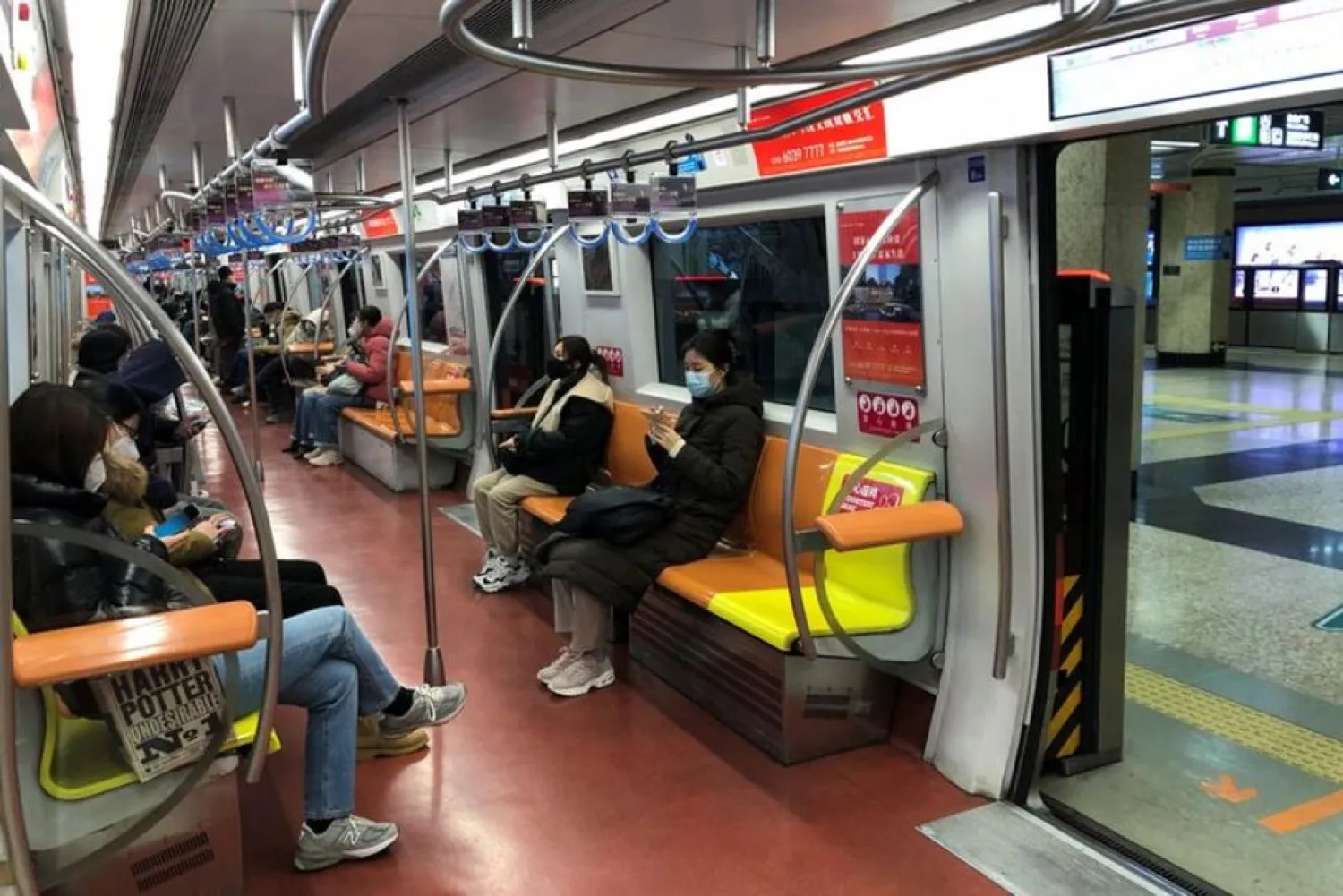
People ride on a subway during evening rush hour, after the government loosened coronavirus disease (COVID-19) restrictions, in Beijing, China December 9, 2022. (Reuters)
TT

‘Era Has Passed’ as Beijing Subway Drops Mandatory COVID Mask Rule

People ride on a subway during evening rush hour, after the government loosened coronavirus disease (COVID-19) restrictions, in Beijing, China December 9, 2022. (Reuters)

Beijing's subway has dropped mandatory mask requirements for travellers, local media reported on Sunday, days after a Chinese health expert said the threat of COVID-19 to humans is no longer at a serious level.

The mask move is in line with broader measures by China, which said last week it was now no longer mandatory to wear face masks when using public transport, according to state media.

"It's as if an era has passed," a user said on China's popular social e-commerce app Xiaohongshu, as social media was abuzz with news of the rules being eased.

Staff at a Beijing subway station tore down signs reminding people to wear masks, Beijing Daily reported.

The pandemic is nearing its end, based on World Health Organization data, said Wu Zunyou, chief epidemiologist at the Chinese Center for Disease Control and Prevention, according to the China Daily.

China, which dismantled its strict COVID rules in December, said the latest official data indicated the COVID positivity rate went up slightly in early April, according to the Global Times. However, respiratory specialists said it was unlikely China would experience another big wave of infections nationwide.

China has declared victory over COVID several times, highlighting the government's response and handling of the pandemic.

Some people on social media voiced concerns over the relaxation of mask rules, saying the virus remains a threat.

"Let's hope there will not be a second wave of infections," a user on China's Twitter-like social media Weibo site said.

Masks are optional on public transport and in supermarkets, movie theaters and other indoor places with large gatherings, Xinhua news reported.

Masks remain mandatory when a person has tested positive for COVID or is displaying symptoms, during local outbreaks and in medical institutions and nursing homes, the report said.

Chinese cities have been scrapping mask mandates for several weeks, including Hong Kong, which ended mask requirements on March 1.



2 Collisions on Hungarian Highway Kill 8 People

A damaged minibus is seen on the M1 motorway near Gyor, Hungary, 12 June 2026. EPA/Csaba Krizsan HUNGARY OUT
TT

2 Collisions on Hungarian Highway Kill 8 People

A damaged minibus is seen on the M1 motorway near Gyor, Hungary, 12 June 2026. EPA/Csaba Krizsan HUNGARY OUT

Two collisions one after another on a highway in western Hungary early Friday killed eight people, police said.

A truck caught fire after colliding with a construction vehicle near the city of Győr around 4.30 a.m., killing one person and snarling traffic, police said.

About half an hour later, a minibus with Moldovan license plates slammed into a truck that stopped on the highway following the first accident. The second crash killed seven people and seriously injured two, The Associated Press quoted police as saying.

Authorities closed one lane of the M1 highway toward Austria.

Hungarian Prime Minister Péter Magyar expressed condolences to the families of the victims.


Iran Media: Draft US Deal Sees Release of $24 Bn Frozen Assets

Iranians walk past a large-scale political billboard featuring Iranian missiles and a sword at Vanak square in Tehran, Iran, 11 June 2026.EPA/ABEDIN TAHERKENAREH
TT

Iran Media: Draft US Deal Sees Release of $24 Bn Frozen Assets

Iranians walk past a large-scale political billboard featuring Iranian missiles and a sword at Vanak square in Tehran, Iran, 11 June 2026.EPA/ABEDIN TAHERKENAREH

Iran's Mehr news agency on Friday published a draft deal with the United States which would, if adopted, secure the release of $24 billion in frozen assets within a 60-day period.

The agency, citing a source close to Iran's negotiating team, said an accord would allow for the "release of $24 billion of Iran's blocked funds during the 60-day final negotiation period."

It added that half of that sum would be "made available to Iran before the start of negotiations."

US President Donald Trump said Thursday he had called off new military strikes on Iran, claiming a breakthrough in negotiations to end the war just hours after the American leader threatened to escalate the conflict by seizing control of Iran's oil industry.

Trump has said multiple times in recent weeks that the warring parties have been on the cusp of a deal without anything coming to fruition. A spokesperson for Iran’s Foreign Ministry said in a live phone call on state television that mediators were active and nothing had been finalized to end the conflict that began Feb. 28 when the US and Israel jointly attacked Iran.

Trump opened an Oval Office event Thursday afternoon saying: “We just made a great settlement of the war with Iran.” He offered scant details, other than to say he expects an agreement to extend a fragile ceasefire that started in April to be finalized “over the next few days.”


Ahead of G7, Carney Softens Tone toward Trump with Trade Talks at Stake

Canadian Prime Minister Mark Carney arrives to Parliament Hill in Ottawa on Tuesday, May 26, 2026. (Sean Kilpatrick/The Canadian Press via AP)
TT

Ahead of G7, Carney Softens Tone toward Trump with Trade Talks at Stake

Canadian Prime Minister Mark Carney arrives to Parliament Hill in Ottawa on Tuesday, May 26, 2026. (Sean Kilpatrick/The Canadian Press via AP)

Canadian Prime Minister Mark Carney became a symbol of middle power resistance after a celebrated speech earlier this year, but he is expected to be more muted in his criticism of US President Donald Trump at an upcoming summit in Europe.

Carney's speech at the World Economic Forum in Davos, Switzerland, helped make him an international political star in January, when he declared the global rules-based order over and condemned coercion by great powers on smaller countries. The prime minister received widespread praise and attention for his remarks and upstaged Trump at the gathering.

But the Group of Seven summit of industrialized democracies that begins Monday in France comes ahead of the scheduled July 1 review of the US-Mexico-Canada Agreement, or USMCA, the latest iteration of the North American free-trade pact that has intertwined the economies of the United States, Mexico and Canada since the early 1990s. It is a crucial moment in trade talks, and Trump said this week that he may not renew the deal.

More than 70% of Canada’s exports go to the US, so preserving the accord is critical for Canada.

Canadian historian Robert Bothwell said Trump is more of a problem for Carney “than anybody else because we are more exposed to the United States than anybody else.”

Trump leaves for the G7 summit right after he hosts UFC fights at the White House on Sunday for his 80th birthday.

The summit will unfold as tensions are ramping up between Trump and Canada. One of the world’s most durable and amicable alliances — born of geography, heritage and centuries of common interests — is broken, as seen in several recent examples of tension between leaders.

Ontario Premier Doug Ford, the leader of Canada's most populous province, had a reception with the US Chamber of Commerce in Washington canceled Monday at the last minute. Vic Fedeli, one of Ford's ministers, said if Trump forced the chamber to cancel, “Ford should be wearing that as a badge of honor.”

Trump said again this week that the US doesn't need anything that Canada has. Carney has set a goal for Canada to double its non-US exports in the next decade, saying Trump’s trade war is causing a chill in investment.

In other developments, the opening of a major Canadian bridge across the Detroit River that Trump previously threatened to block was delayed Thursday due to unresolved issues.

Trump’s actions, including launching a trade war and suggesting Canada become the 51st US state, have infuriated Canadians and created the political environment for Carney to win the job of prime minister after promising to confront Trump.

Trump administration officials keep noting that only two countries, China and Canada, retaliated against America in the trade war. US Trade Representative Jamieson Greer says Canada’s retaliatory measures are a major issue in talks.

Daniel Béland, a political science professor at McGill University in Montreal, said Carney seems to have moderated his tone toward the Trump administration to avoid worsening relations.

“There is a clear tension between what Prime Minister Carney said in his Davos speech about middle powers standing up to hegemons and his attempt to nudge the US administration ‘in the right direction’ with regard to the USMCA review and trade policy more generally,” Béland said.

Carney has downplayed Trump’s most recent comments about Canada becoming the 51st state.

Canada and Mexico want the USMCA to be renewed for another 16 years. Trump has mused about withdrawing from it. More likely it will be subject to annual reviews for the next 10 years.

Carney arrived in Paris on Friday morning and will meet with French President Emmanuel Macron in the evening, a few days before the summit in Évian-les-Bains, France.

The prime minister will also travel to Ireland this weekend to meet with the Irish prime minister in a bid to diversify trade away from the US.

This is Carney's ninth trip to Europe in the 15 months since he became prime minister in March 2025.

The US “will clearly remain Canada’s largest trading partner for the predictable future,” Béland said, calling it an inescapable reality that Carney “must keep front of mind even as he seeks to make Canada somewhat less dependent on trade with the US.”