


Sudanese Flee Their Homes as Truce Fails, Fighting Rages

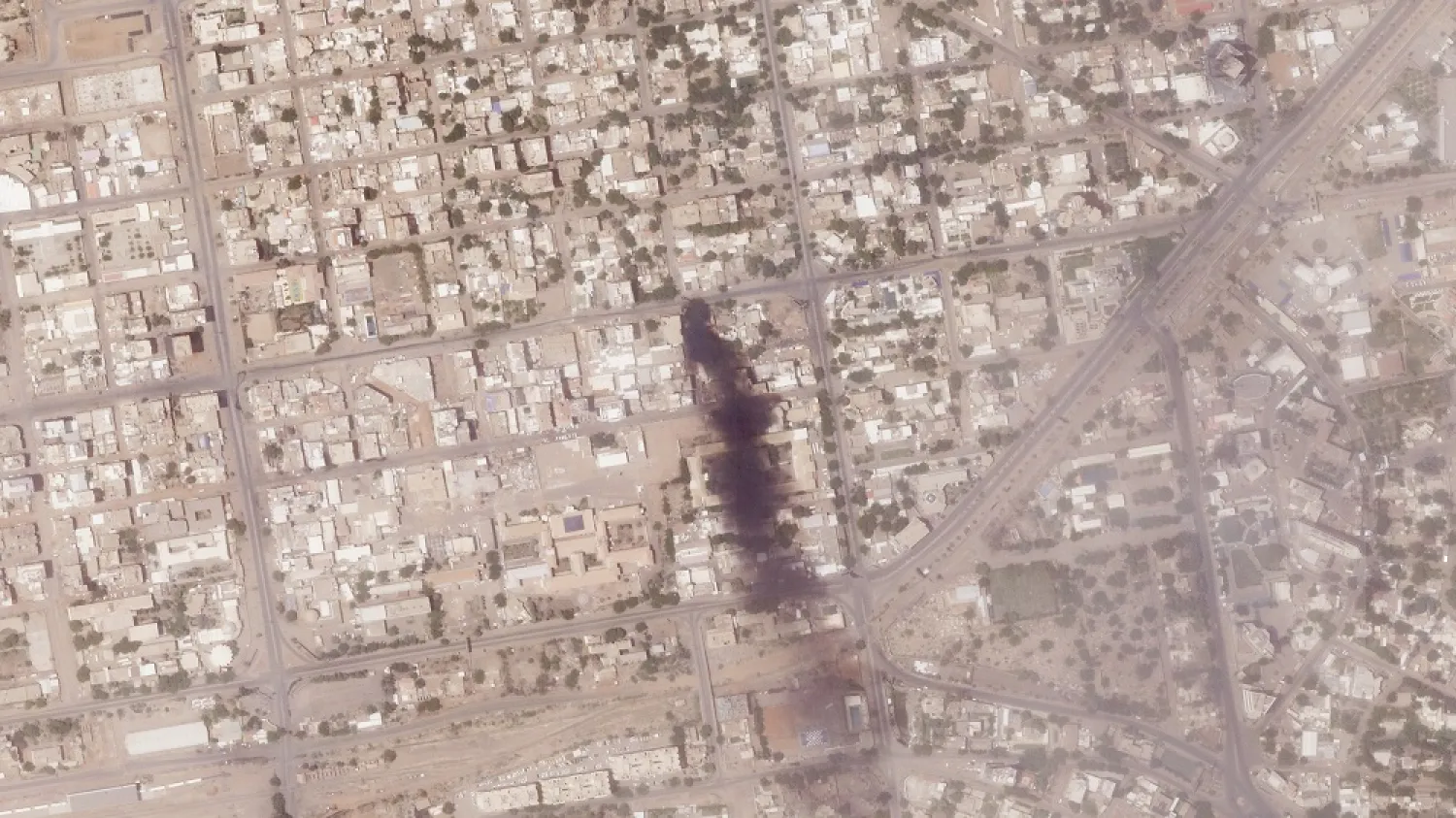
This satellite photo from Planet Labs PBC shows a fire near several hospitals in Khartoum, Sudan, Tuesday, April 18, 2023. (Planet Labs PBC via AP)
TT

Sudanese Flee Their Homes as Truce Fails, Fighting Rages

This satellite photo from Planet Labs PBC shows a fire near several hospitals in Khartoum, Sudan, Tuesday, April 18, 2023. (Planet Labs PBC via AP)

Terrified Sudanese who have been trapped for days in their homes by fighting in the capital of Khartoum fled on Wednesday, hauling out whatever belongings they could carry and trying to get out of the city, after an internationally brokered truce failed. Explosions shook the city as the army and a rival paramilitary force battled for a fifth day in the streets.

The swift failure of the 24-hour ceasefire, despite pressure from the United States and regional powers, suggested that Sudan's two top generals were determined to crush each other in a potentially prolonged fight for control of the country. It also underscored the inability of the international community to force a stop to the violence, with millions of people caught in the crossfire.

Residents of multiple neighborhoods in Khartoum told The Associated Press they could see hundreds of people, including women and children, leaving their homes, carrying luggage, some leaving by foot, others crowding into vehicles. Residents had been desperately holding out in hopes for a halt in the mayhem on their doorsteps, but with food and other supplies running low and no sign of respite, it appeared many had decided to risk making an escape.

“Khartoum has become a ghost city,” said Atiya Abdalla Atiya, secretary of the Doctors’ Syndicate, who is still in the capital.

Nearly 300 people have been killed in the past five days, the UN health agency said, but the toll is likely higher, since many bodies have been left in the streets, unreachable because of clashes.

Residents said the military was pounding positions of the opposing Rapid Support Forces with airstrikes since early Wednesday, while gunbattles continued to rage outside the main military headquarters in central Khartoum, which the RSF has tried repeatedly to capture.

At the nearby airport, another front line, plumes of black smoke rose and a damaged aircraft was in flames, according to satellite imagery provided by Planet Labs PBC. A high-rise in the city center was on fire with burning debris falling from its top floors, according to footage by the Al Arabiya news network. Fierce clashes were also reported around the state television building across the Nile River in the adjacent city Omdurman.

The army's monopoly on air power has appeared to give it an edge in fighting in Khartoum and Omdurman, enabling it to take several RSF bases over the past few days. But tens of thousands of fighters from the paramilitary force are fanned out across neighborhoods.

The result has been scenes of chaos. Residents have spoken of armed men looting shops and attacking anyone found on the streets.

“They take whatever they can, and if you resist, they kill you,” said Mahasen Ali, a tea vendor. She said many in her south Khartoum neighborhood have left their homes to take refuge in open areas, hoping to be safe from shelling hitting buildings. Others fled the city to stay with relatives elsewhere, she said.

A 24-hour ceasefire was to have been in effect from sundown Tuesday to sundown Wednesday. It was the most concrete attempt yet to bring a pause that it was hoped could be expanded into a longer truce.

It came after US Secretary of State Antony Blinken spoke separately by phone with the two rivals — the leader of the armed forces, Gen. Abdel Fattah Burhan, and the head of the Rapid Support Forces, Gen. Mohammed Hamdan Dagalo. Egypt, Saudi Arabia and the United Arab Emirates have also been calling on all sides to stand down.

But fighting continued after the intended start of the truce and through the night. Each side blamed the other for the failure.

The RSF said it has agreed on a day-long truce to take effect Thursday at 6 p.m. local time. There was no immediate comment from the military.

Aid agencies and foreigners, including diplomats, have also been trapped in the fighting.

The aid group Doctors Without Borders, or MSF after its French name, said in a tweet that its compound in Nyala in the western Darfur region had been raided by armed men who stole vehicles and office equipment and looted a warehouse storing medical supplies. The International Committee of the Red Cross said its office in Niyala was also looted, with one vehicle taken.

Darfur, which has been the scene of heavy fighting since the weekend, is a stronghold of the RSF, where the force had its origins among the Janjaweed militias.

German media, including the DPA news agency, reported that three A400M transport planes were dispatched to evacuate German citizens from Khartoum, but turned around Wednesday due to security concerns in Khartoum. Japan said it was preparing to send military aircraft to evacuate about 60 Japanese nationals.

In Brussels, Dana Spinant, a spokeswoman for the European Commission, confirmed reports that a senior EU official had been shot and wounded in Sudan. Spinant did not provide details.

The New York Times identified the official as Wim Fransen, a Belgian national. The report said Fransen was receiving medical treatment for serious injuries. It said he had gone missing on Sunday evening and that his colleagues tracked him down Tuesday.

Another spokeswoman said the EU office in Khartoum is still operating and the delegation is not being evacuated. The EU ambassador, who was assaulted when gunmen broke into his residence several days ago, is back at work, she said.

Hospitals in Khartoum are running dangerously low on medical supplies, often operating without power and clean water, the ICRC said in a statement. Dozens of health care facilities in Khartoum and around the country have stopped functioning because they are close to clashes, the Sudanese Doctors’ Syndicate said Wednesday. At least nine hospitals were bombed, it said.

“Our urgent priority is to get medical assistance to hospitals and try to make repairs to their water and power lines so they can treat the wounded,” said Patrick Youssef, the ICRC's Africa regional director. But fighting has made it impossible to reach the facilities.

The UN‘s World Health Organization said Wednesday at least 296 people have been killed and more than 3,000 wounded since fighting began, without offering a breakdown of civilians and combatants killed. The Doctors’ Syndicate, which monitors casualties, said Tuesday that at least 174 civilians have been killed and hundreds wounded.

The conflict between the military and the RSF has once again derailed Sudan’s transition to democratic rule after decades of dictatorship and civil war.

A popular uprising four years ago helped depose long-time president Omar al-Bashir. But Burhan and Dagalo joined to carry out a 2021 coup.

Under international pressure, Burhan and Dagalo recently agreed to a framework agreement with political parties and pro-democracy groups. But the signing was repeatedly delayed as tensions rose over the integration of the RSF into the armed forces and the future chain of command.



UN Says It Risks Halting Somalia Aid Due to Funding Cuts 

A Somali trader marks watermelons for sale at an open-air grocery market as Muslims start the fasting month of Ramadan, the holiest month in the Islamic calendar, within Bakara market in Mogadishu, Somalia, February 18, 2026. (Reuters)
TT

UN Says It Risks Halting Somalia Aid Due to Funding Cuts 

A Somali trader marks watermelons for sale at an open-air grocery market as Muslims start the fasting month of Ramadan, the holiest month in the Islamic calendar, within Bakara market in Mogadishu, Somalia, February 18, 2026. (Reuters)

The UN's World Food Program (WFP) warned Friday it would have to stop humanitarian assistance in Somalia by April if it did not receive new funding.

The Rome-based agency said it had already been forced to reduce the number of people receiving emergency food assistance from 2.2 million in early 2025 to just over 600,000 today.

"Without immediate funding, WFP will be forced to halt humanitarian assistance by April," it said in a statement.

In early January, the United States suspended aid to Somalia over reports of theft and government interference, following the destruction of a US-funded WFP warehouse in the capital Mogadishu's port.

The US announced a resumption of WFP food distribution on January 29.

However, all UN agencies have warned of serious funding shortfalls since Washington began slashing aid across the world following President Donald Trump's return to the White House last year.

"The situation is deteriorating at an alarming rate," said Ross Smith, WFP Director of Emergency Preparedness and Response, in Friday's statement.

"Families have lost everything, and many are already being pushed to the brink. Without immediate emergency food support, conditions will worsen quickly.

"We are at the cusp of a decisive moment; without urgent action, we may be unable to reach the most vulnerable in time, most of them women and children."

Some 4.4 million people in Somalia are facing crisis-levels of food insecurity, according to the WFP, the largest humanitarian agency in the country.

The Horn of Africa country has been plagued by conflict and also suffered two consecutive failed rainy seasons.


Hamas Says Path for Gaza Must Begin with End to ‘Aggression’ 

Makeshift tents of displaced Palestinian families among the ruins of their homes at sunset during the holy month of Ramadan in Jabaliya northern Gaza Strip on, 19 February 2026. (EPA)
TT

Hamas Says Path for Gaza Must Begin with End to ‘Aggression’ 

Makeshift tents of displaced Palestinian families among the ruins of their homes at sunset during the holy month of Ramadan in Jabaliya northern Gaza Strip on, 19 February 2026. (EPA)

Discussions on Gaza's future must begin with a total halt to Israeli "aggression", the Palestinian movement Hamas said after US President Donald Trump's Board of Peace met for the first time.

"Any political process or any arrangement under discussion concerning the Gaza Strip and the future of our Palestinian people must start with the total halt of aggression, the lifting of the blockade, and the guarantee of our people's legitimate national rights, first and foremost their right to freedom and self-determination," Hamas said in a statement Thursday.

Trump's board met for its inaugural session in Washington on Thursday, with a number of countries pledging money and personnel to rebuild the Palestinian territory, more than four months into a fragile ceasefire between Israel and Hamas.

Israeli Prime Minister Benjamin Netanyahu has insisted however that Hamas must disarm before any reconstruction begins.

"We agreed with our ally the US that there will be no reconstruction of Gaza before the demilitarization of Gaza," Netanyahu said.

The Israeli leader did not attend the Washington meeting but was represented by his foreign minister Gideon Saar.

Trump said several countries had pledged more than seven billion dollars to rebuild the territory.

Muslim-majority Indonesia will take a deputy commander role in a nascent International Stabilization Force, the unit's American chief Major General Jasper Jeffers said.

Trump, whose plan for Gaza was endorsed by the UN Security Council in November, also said five countries had committed to providing troops, including Morocco, Kazakhstan, Kosovo and Albania.


Official Contacts Aim to Keep Lebanon out of War on Iran as Israel Raises Readiness on Northern Front 

This photograph shows a memorial for slain Lebanese Hezbollah longtime leader Hassan Nasrallah at the entrance of the southern village of Qannarit on February 16, 2026. (AFP)
TT

Official Contacts Aim to Keep Lebanon out of War on Iran as Israel Raises Readiness on Northern Front 

This photograph shows a memorial for slain Lebanese Hezbollah longtime leader Hassan Nasrallah at the entrance of the southern village of Qannarit on February 16, 2026. (AFP)

Israel has raised the alert level of its military along the border with Lebanon, raising questions that Lebanon’s south may again be involved in a regional confrontation should the US attack Iran.

Given the heightened tensions between the US and Iran, questions have been asked over whether Hezbollah will become involved in a new war. Its Secretary-General Sheikh Naim Qassem had recently announced that the party will not remain on the side if Iran is attacked.

On the ground, Israel blew up houses in southern Lebanon border towns and carried out air strikes in the south. Israeli military spokesman Avichay Adraee said the raids targeted “Hezbollah infrastructure,” including arms caches and rocket launchers.

Their presence in the south is a violation of current agreements, he added.

Amid the high regional tensions, Israel’s Maariv quoted a military source as saying that the army has come up with plans, including a preemptive strike against Hezbollah, which would drag the south and the whole of Lebanon into a new war.

Ministerial sources told Asharq Al-Awsat that the presidency has been carrying out internal and foreign contacts since Thursday morning to keep Lebanon out of any escalation.

Hezbollah had launched a “support front” war against Israel a day after Hamas’ October 7, 2023 attack. In 2024, the war spiraled into an all-out conflict, with Israel decimating the Hezbollah leadership and severely weakening the party.

Israel believes that Hezbollah has been rebuilding its capabilities since the ceasefire that was struck in November 2024.

Kassim Kassir, a political analyst who is close to Hezbollah, told Asharq Al-Awsat: “No one knows what Hezbollah will do because the situation is tied the extent of the attack, should it happen.”

He noted that Qassem was ambiguous when he said the party will decide what to do when the time is right, but at any rate, he stressed that the party will not remain on the sidelines or abandon Iran.

“No one knows what Hezbollah’s abilities are, so everything is possible,” Kassir said.

Riad Kahwaji, a security and defense affairs expert, said he does not rule out the possibility that Hezbollah would join the war should the US attack Iran.

Speaking to Asharq Al-Awsat, he stressed that Iran is now the United States’ main target, when previously it used to confront its proxies.

It has now taken the fight directly to the heart of the problem, which is the Iranian regime, he remarked.

The extent of the military mobilization in the region and the frequent American statements about regime change all indicate that a major military operation may be imminent, he added.

Israel’s military also favors preemptive operations, so it is watching Hezbollah, which remains Iran’s most powerful regional proxy despite the blows it received in 2024 war, Kahwaji said.

Hezbollah still possesses a rocket arsenal that can threaten Israel, he remarked.

Israel’s high level of alert on the border with Lebanon could be in readiness for any development. Should Tel Aviv receive word from Washington that it intends to attack Iran, then it could launch operations against Hezbollah as part of preemptive strikes aimed at preventing the party from launching attacks against it, Kahwaji said.

“As long as Hezbollah possesses heavy weapons, such as rockets, and drones, that it has not handed over to the army, then Lebanon will continue to be vulnerable to attacks in the next confrontation. It will be exposed to Israeli strikes as long as this issue remains unresolved,” he added.