


Algerian FM Discusses in Mauritania Securing Border Trade Exchange

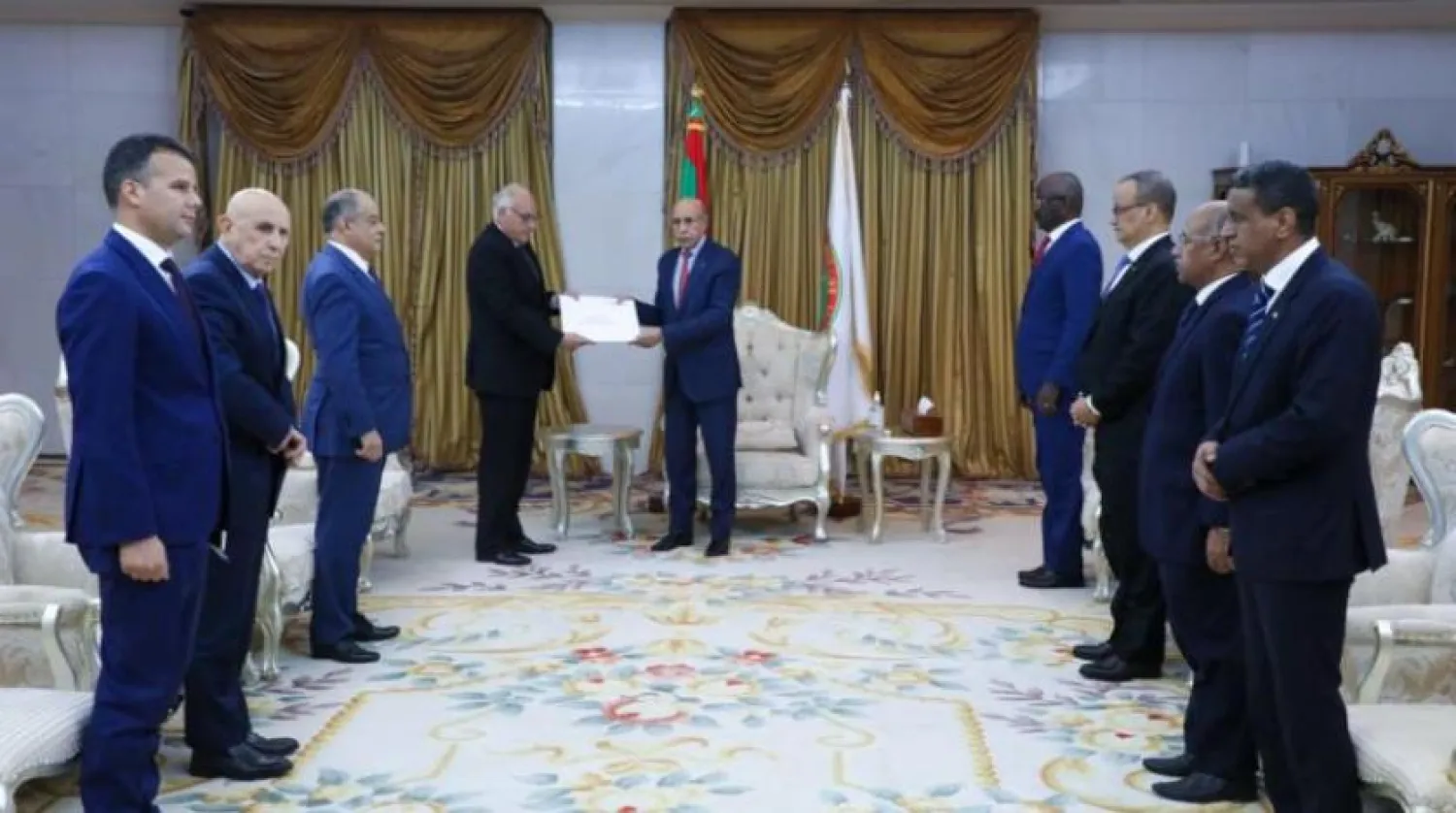
Mauritanian President Mohamed Ould Sheikh el-Ghazaouani receiving the Algerian delegation chaired by the Minister of Foreign Affairs and National Community Abroad, Ahmed Attaf (Algerian Foreign Ministry)
TT

Algerian FM Discusses in Mauritania Securing Border Trade Exchange

Mauritanian President Mohamed Ould Sheikh el-Ghazaouani receiving the Algerian delegation chaired by the Minister of Foreign Affairs and National Community Abroad, Ahmed Attaf (Algerian Foreign Ministry)

Algerian Minister of Foreign Affairs and National Community Abroad Ahmed Attaf discussed active trade exchange through the border center and the border security in Nouakchott.

The Foreign Ministry stated that Attaf met Tuesday with Mauritanian President Mohamed Ould Sheikh el-Ghazaouani, as part of his working visit to Nouakchott as the special envoy of President Abdelmadjid Tebboune.

The meeting provided an opportunity to discuss the progress made in the follow-up and implementation of the directives of the leaders of the two countries and the conclusions of their consultations during the state visit of Ghazaouani in December 2021 to Algeria, which initiated a new era in history of Algerian-Mauritanian relations.

According to the statement, the two sides welcomed the critical momentum of bilateral relations and the conclusions of the 19th session of the Grand Joint Commission, which opened promising prospects for establishing a strategic partnership based on critical economic plans.

The projects include the road linking Tindouf to Zouerate, the opening of an Algerian bank in Nouakchott, the establishment of a permanent exhibition of the Algerian Company of Fairs and Exports (SAFEX), and the exploitation of fishing quotas offered by Mauritania to Algeria.

The meeting was attended by the director general of Documentation and External Security, Major General M'henna Djebbar, which reflects the security aspect of Attaf's visit.

The meeting provided an opportunity to emphasize the commitment of the two countries leaders to the traditions of mutual support, consultation, and coordination on issues raised in the various spaces and organizations of common membership.

It established the basis of their deep conviction that the regional and international tensions and the challenges arising require adopting common approaches based more than ever on the principle of the common destiny.

Later, Attaf met Prime Minister Mohamed Ould Bilal Messaoud and discussed upcoming bilateral events, including the meeting of the Monitoring Committee and the holding of the 20th session of the Grand Joint Commission scheduled in Algiers.

They discussed the follow-up of the implementation of the results of the 19th session of the Grand Joint Commission of Algerian-Mauritanian cooperation held last September in Nouakchott, including the intensification of bilateral cooperation in the socio-economic, cultural, and scientific fields.

They also addressed the need to work to mobilize the human and material resources necessary to accelerate the implementation of joint projects between the two brotherly countries.

Sources following up on the visit pointed out that the Algerian political and security delegation focused on the security conditions surrounding the trade movement on the desert roads leading to Nouakchott after two attacks targeting merchants in 2021 and 2023.

In 2021, several trucks loaded with goods were hit by missiles twice in the border areas, coming from Morocco.

Algeria vowed to respond to the attack. The attack on the border between Ouargla, southern Algeria, and Nouakchott killed three persons.

The second attack took place at the beginning of 2023 on the Tindouf road, in southwestern Algeria, near the borders with Morocco and Mauritanian Zuerate, killing several.



Iraqi Army Commander Sacked After Drone Attacks Targeted Saudi Arabia

Iraqi Prime Minister Ali Al-Zaidi (Reuters)
TT

Iraqi Army Commander Sacked After Drone Attacks Targeted Saudi Arabia

Iraqi Prime Minister Ali Al-Zaidi (Reuters)

The office of Iraqi Prime Minister Ali al-Zaidi announced on Saturday the dismissal of the commander in charge of the southern Maysan province after Saudi Arabia said drones launched from Iraq hit the East-West pipeline and led to its closure.

The commander was fired following the "confirmation that the attacks targeting our brethren in the Kingdom of Saudi Arabia originated from a location within the governorate,” said al-Zaidi’s office.

The Saudi Foreign Ministry condemned "the targeting of the East-West pipeline in the Riyadh and Madinah regions by several drones coming from Iraq, which caused human injuries and damage.”

"The pipeline was stopped as a precaution, and the attacks resulted in some injuries," an Energy Ministry official told the SPA news agency earlier.

"At the request of the Iraqi Prime Minister... (Riyadh) has chosen not to respond at this stage and to support the efforts of the Iraqi government ... to prevent attacks launched from Iraq against the Kingdom and neighboring countries," the Foreign Ministry said.


Israel-Lebanon Talks in Rome Next Week Reportedly Postponed

(2L/R) Israel's Ambassador to the US Yechiel Leiter, State Department Chief of Staff Daniel Holler, US Ambassador to Lebanon Michel Issa and Lebanese Ambassador to the US Nada Hamadeh attend a meeting between Israeli and Lebanese delegations hosted by the United States at the State Department in Washington, DC, on June 3, 2026. (Photo by Oliver Contreras / AFP)
TT

Israel-Lebanon Talks in Rome Next Week Reportedly Postponed

(2L/R) Israel's Ambassador to the US Yechiel Leiter, State Department Chief of Staff Daniel Holler, US Ambassador to Lebanon Michel Issa and Lebanese Ambassador to the US Nada Hamadeh attend a meeting between Israeli and Lebanese delegations hosted by the United States at the State Department in Washington, DC, on June 3, 2026. (Photo by Oliver Contreras / AFP)

Talks between Israel and Lebanon that were scheduled to take place in Rome next week have been postponed and will occur instead in ⁠October, Axios reported ⁠on Friday, citing a US official.

Jewish holidays, a Paris conference ⁠and UN General Assembly preparations meant participants could not convene in Rome, Axios cited a source as saying.

The Lebanese and Israeli ambassadors are ⁠due ⁠to meet in Washington, according to the post on X.


Houthi Casualties Strain Sanaa Hospitals’ Capacity

Houthis use images of their dead to recruit more fighters (X)
TT

Houthi Casualties Strain Sanaa Hospitals’ Capacity

Houthis use images of their dead to recruit more fighters (X)

The fallout from the Houthis’ military escalation in Yemen is straining hospitals and endangering civilians in areas under the group’s control, while fueling rare criticism from within its own ranks.

Activists and former fighters accuse the group of exploiting poverty to recruit young men, trading on fighters’ blood and diverting resources to the war effort at the expense of civilian needs.

Medical sources in the Houthi-held capital Sanaa told Asharq Al-Awsat that the group’s Health Ministry had recently ordered several government hospitals to limit admissions of critically ill patients.

Intensive care units, emergency departments and other wards have instead been reserved for wounded Houthi fighters arriving from the front lines.

The measures cover Al-Thawra, Al-Jumhouri, Police, Military, Al-Quds, 48 and Kuwait hospitals — among the capital’s leading medical facilities. Their capacity to treat civilians has consequently shrunk, particularly for patients needing urgent care or intensive treatment.

The restrictions coincided with the arrival in Sanaa of large numbers of dead and wounded Houthi fighters following battles on several fronts across Yemen.

Health workers said hospitals were taking in growing numbers of casualties and setting aside beds, equipment and wards for those arriving from combat zones, including fighters requiring surgery or intensive care.

Hospitals under strain

The Houthis have tightened security around several medical facilities, barred media access and withheld information about the identities and conditions of casualties arriving from the front lines.

Health workers said the influx of wounded fighters had pushed hospitals closer to capacity, leaving less room for civilian patients.

Ahmed, whose relative needed treatment in Sanaa, said his family struggled to obtain the necessary care at Al-Jumhouri Hospital and was forced to look elsewhere because the facility lacked the resources to treat the patient.

He accused the Houthis of channeling available medical resources into the war effort, warning that civilians — particularly children, older people, chronically ill patients and emergency cases — faced growing risks.

The measures come as the health system in Houthi-held areas reels from years of war, dwindling funding and severe shortages of medicine, supplies and medical staff. Health facilities have also been damaged, forcing some to close.

The strain extends beyond Sanaa. The capital’s main hospitals routinely receive referrals from other provinces and regions, meaning their reduced capacity affects a far wider population under Houthi control.

Dissent from within

As the escalation weighs on the health sector, criticism is also mounting among figures and activists aligned with the Houthis.

Their complaints center on the war’s human cost, the treatment of fighters and the families of those killed or wounded, and recruitment practices that prey on economic hardship.

In the latest rebuke, activist and former Houthi fighter Abdullah Sharaf al-Mahdi attacked the group’s leaders and supervisors, accusing them of trading on fighters’ blood and sidelining bereaved and wounded families for personal gain.

Fighters and their families bear the cost of the war, al-Mahdi said, while officials and supervisors receive privileges including property and financial allocations. The conflict, he added, had become a vehicle for advancing the interests of factions within the group.

Al-Mahdi said he regretted the years he had spent fighting for the Houthis and would not support them again. His comments reflect a shift among some critics from opposing the group’s policies to questioning its motives for prolonging the war.

Criticism has also emerged from within Houthi-controlled institutions.

Abdu Bishr, a member of the Houthi-controlled parliament in Sanaa, accused the group of ignoring Yemenis’ suffering and pursuing what he called “futile” wars. He urged it to keep economic and humanitarian issues out of the conflict.

Bishr called for salaries to be paid, detainees released and airports reopened. He warned that what he described as “taking pleasure in bloodshed” would deepen the humanitarian catastrophe and urged the group to ease people’s suffering or “leave the scene.”

Houthi activist and writer Zaid al-Kibsi also criticized the group’s recruitment of young people and adolescents, saying it exploited poverty and worsening economic conditions to push more of them toward the front lines.

He accused the Houthis of using religious and sectarian rhetoric, along with slogans of “jihad and martyrdom,” to recruit young people as many families struggle to meet their basic needs.

Some recruits depend on the group’s modest payments to support their families while risking death or injury in combat, al-Kibsi said.

Many are young men who have had no chance to build their lives or start families, leaving their relatives to bear the consequences when they are killed or wounded.