


Queen’s Coronation Recalled as UK Prepares to Crown Her Son

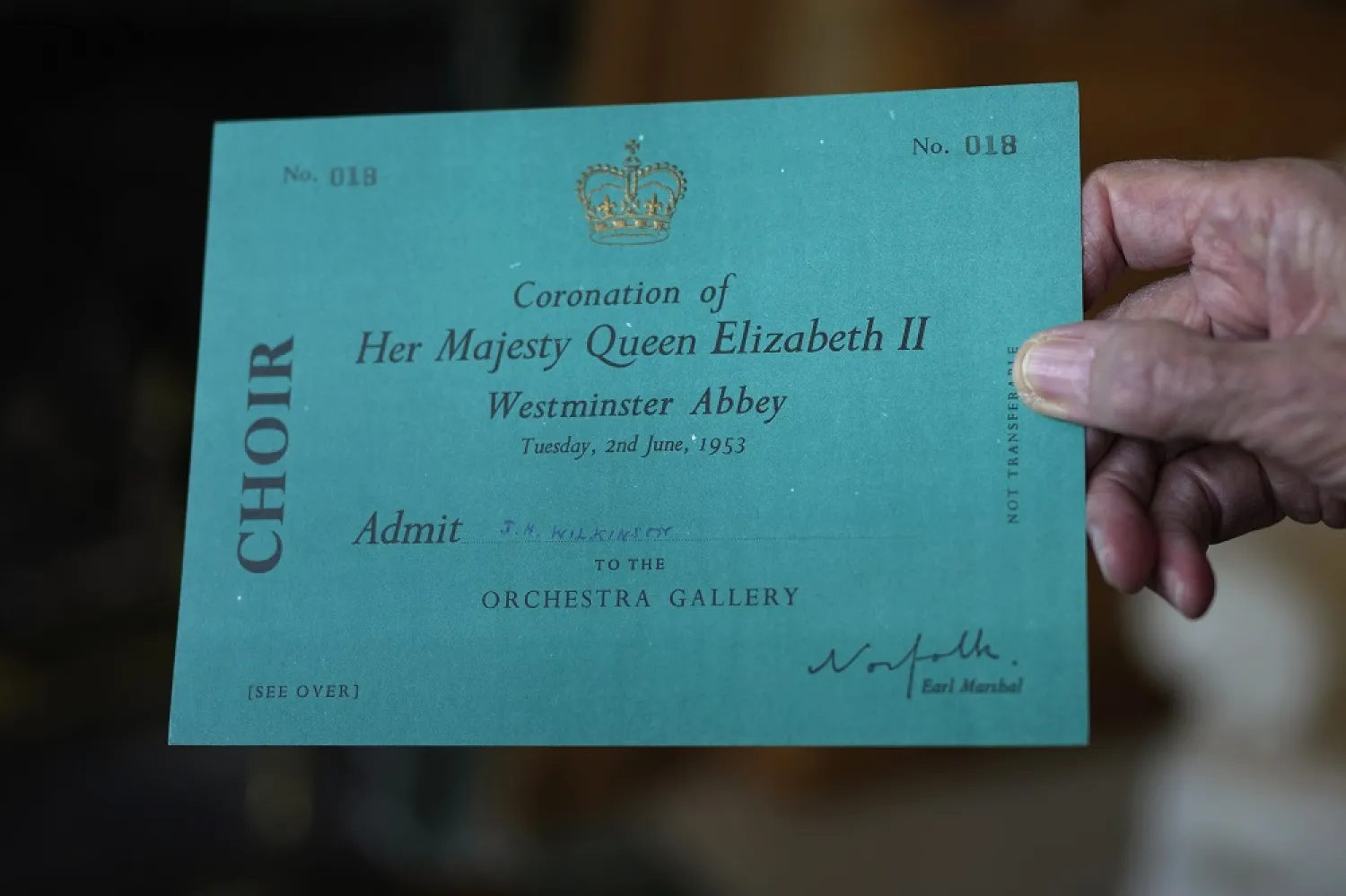
James Wilkinson displays his invitation for Queen Elizabeth II's coronation where he performed as a Westminster Abbey chorister on June 2, 1953, during an interview in London, April 17, 2023. (AP)
TT

Queen’s Coronation Recalled as UK Prepares to Crown Her Son

James Wilkinson displays his invitation for Queen Elizabeth II's coronation where he performed as a Westminster Abbey chorister on June 2, 1953, during an interview in London, April 17, 2023. (AP)

In 1953, London was still recovering from World War II. The city was pockmarked with bomb damage, food supplies were tight and life was dull for children who had never eaten anything so exotic as a banana.

But the coronation of Queen Elizabeth II helped lift the gloom. Central London buzzed with activity as workers built temporary stands along the 5-mile route of the queen’s procession. Giant crowns were suspended from arches that soared over The Mall approaching Buckingham Palace, and shopkeepers filled their windows with colorful banners and coronation-themed products.

With Elizabeth's son, King Charles III, set to be crowned on May 6, people are recalling his mother's coronation 70 years ago, which was the last time the British public witnessed the ritual.

“The whole of London was sort of a cauldron of people rushing to the area to look at what was happening,” said James Wilkinson, then an 11-year-old member of the Westminster Abbey choir, which sang during the ceremony.

A front-row seat

Wilkinson’s memories of those events begin more than a year before the coronation.

The choristers, all of whom attended a special boarding school for choir members, were in a Latin lesson when the abbey's great tenor bell began to toll every minute, and the Union flag was lowered to half staff. “The headmaster came in and told us that the king had died,” Wilkinson said. “And, of course, what excited us then was the fact that there would be new coins and stamps with the queen’s head on them, because we all collected stamps.”

The initial buzz was followed by the realization that there would be a coronation.

The choristers spent months preparing for the service, learning the music and lyrics to the hymns they would sing during the three-hour long ceremony. The abbey was closed to get ready.

Tiers of temporary seating were installed to quadruple the abbey’s capacity to accommodate 8,251 guests, a temporary annex was built outside to provide space for the participants to don their robes and get ready for the procession, and preparations were made to broadcast the event on the still emerging medium of television.

Wilkinson, now 81, remembers being stunned when the choristers entered the church for their first on-site rehearsal a few weeks before the coronation. “We hadn’t been into the abbey for a long time, and I was absolutely astonished by the sight of it because it was … transformed inside with wonderful new carpets and balconies,” he said. “There (were) the television lights for the filming, which made the whole thing sparkle.”

A moment of empire

More than 4,000 miles away on the Caribbean island of Dominica, in what was still a corner of the British Empire, children were also preparing for the crowning of the glamorous young woman who was their queen, too.

Sylius Toussaint, now 83, still remembers the coronation song he learned seven decades ago, chuckling as he softly croons out the blessing for “our queen who is crowned today,” only occasionally stumbling over a phrase lost to the passage of time.

“When in the dust of the abbey brown, and bells ring out in London town, the queen who is crowned with a golden crown, may be crowned, may be crowned, be crowned with thy children’s love,” he concludes. “Heheheh. Yes, I remember that!”

There were no TVs in the village of St. Joseph, about 10 miles from the capital, Roseau, so the adults huddled around two radios to follow events in London.

For Toussaint and his friends, it was a day of food, games and patriotic songs, just like on Empire Day, the annual holiday created at the turn of the last century to remind children in the United Kingdom’s far-flung outposts that they were British.

They played cricket and rounders, and ate cake sweet with margarine and coconut, Toussaint said. The Boy Scouts marched, and there were three-legged races.

“This is what it was for the queen’s coronation,” he said. “People were talking about her and so on, and we always wished to see her... We were brought up as British; we were proud to be British.”

It was only later, when he moved to Preston in northern England to work in the city’s textile mills that Toussaint learned about racism. Then several years ago the UK government forced Toussaint and his wife to apply for British citizenship, dashing the illusions of the child who once sang about “our queen.”

Thousands of people from the Caribbean were caught up in a government crackdown on immigration, with many losing jobs, housing and benefits if they were unable to produce documents proving their right to be in the country. The government was forced to apologize and pay compensation for what became known as the Windrush Scandal, named after the ship that brought the first Caribbean migrants to Britain in 1948.

But Toussaint blames Britain’s elected government for the scandal, not the monarchy. And despite the country’s problems, he plans to watch the coronation of King Charles III on May 6.

“All told, I am pleased to be able to say, ‘Charles, you are king. God bless you and do a good job.’ Because that’s the system we have until we can come up with something better, that’s where we are. And I’m willing to celebrate it with my neighbors and friends.”

An airman’s appreciation

Max Hancock, a 19-year-old from Sparks, Georgia, was a US airman stationed at RAF Brize Norton near Oxford at the time of the coronation.

As Americans, Hancock and his buddies had no allegiance to the British monarch, but they knew the coronation would be a historic event so they made the 70-mile trip to London by bus and train, then joined the crowds hoping to see the queen pass by.

On a misty, rainy day, an estimated 3 million people packed the sidewalks along the parade route lined with soldiers, sailors and airmen.

Staking out a position on Regent Street, even then a high-end shopping district, Hancock climbed up a barricade with his camera to get a better view as 46 marching bands, troops of cavalry, and carriages carrying Commonwealth dignitaries and members of the royal family passed by on their circuitous route from the Abbey to Buckingham Palace.

But he only had one roll of film — 25 frames— to capture the cavalcade in the era before smart phones and digital cameras, and he wanted to make sure he got one image of the queen.

Then, up ahead, he saw a carriage that was “the most beautiful thing I thought I’d ever seen,” so he snapped off three or four quick shots thinking it must be Elizabeth. But it turned out to be her sister, Princess Margaret, and the queen mother.

He only had two frames left.

When the golden state coach, pulled by eight white horses and surrounded by liveried footmen, came into view, he knew it was time to use them.

“Though I thought that the queen mother's was great, it didn’t compare with the queen’s — it was all gold,” Hancock remembered.

“And as I’ve said many times, as I think back on it, I’ve never thought of her being a very great beauty queen, but she was the most beautiful woman I’ve ever seen in the world when she rode by there in that chariot.”

With understandable pride, Hancock showed the slides an elementary school in southern Georgia so he could give the kids a closeup view of history. And when the queen died in September, his local newspaper, the Moultrie Observer, told the story of the day a local boy went to the coronation.

“Seeing that parade, seeing the enthusiasm, seeing the people that were there … it was overwhelming for me,” he said. “I knew I was seeing something special. I knew it would be, for the rest of my life, I'd remember it.”

A moment never to forget

James Wilkinson knew he, too, was part of something extraordinary, so the future BBC journalist recorded everything he saw, in a looping script on the now-yellowed pages of his diary.

There was the ham sandwich, apple and hard candy each boy was given to keep his stomach from growling after the choir filed into the Abbey early in the morning, then waited for the ceremony to begin at 11:15 a.m. The lords and ladies in fur-trimmed state robes and the excitement that went through the crowd when a bustle of activity suggested the queen was on her way, only to be deflated when it turned out to be a troop of attendants with carpet sweepers tidying the way for her majesty.

But the climax for Wilkinson was when the Archbishop of Canterbury raised St. Edward's Crown — with its purple velvet cap and solid gold frame topped with a bejeweled cross — high in the air, then lowered it slowly onto the queen’s head.

Sitting with the rest of the choir somewhere behind the queen’s right shoulder, he didn’t actually see the moment Elizabeth was crowned because her head was hidden behind the high, peaked back of the Coronation Chair. But he saw its journey to her head.

“I knew this was going to be a thing I should never forget, and I watched it very closely knowing that it was, you know, the highlight of the service and that’s how I remember it today,” he said. “It was a marvelous event.”



'No Divisions, No Borders', French Astronaut Says of Seeing Earth

European Space Agency (ESA) French astronaut Sophie Adenot cries while speaking to the media as she returns to Europe, following the return of NASA's SpaceX Crew-12 mission to Earth after nearly eight months in space, in Cologne, Germany, October 10, 2026. REUTERS/Thilo Schmuelgen
TT

'No Divisions, No Borders', French Astronaut Says of Seeing Earth

European Space Agency (ESA) French astronaut Sophie Adenot cries while speaking to the media as she returns to Europe, following the return of NASA's SpaceX Crew-12 mission to Earth after nearly eight months in space, in Cologne, Germany, October 10, 2026. REUTERS/Thilo Schmuelgen

French astronaut Sophie Adenot went through "all human emotions, from the most joyful to the hardest" during her eight months in space, she said back on solid ground on Saturday in Germany.

Adenot splashed down in the Pacific Ocean Thursday off the coast of California in the Dragon capsule that carried Crew-12, having returned to Earth from a mission on the International Space Station (ISS), Agence France Presse reported.

She had spent a total of 235 days in space, breaking the record for the longest uninterrupted orbital stay by a European astronaut.

At 400 km away from Earth, Adenot could see there are "no divisions, no borders" but "just a precious planet that we all share," she said Saturday on the tarmac of the European Space Agency (ESA) training center in Cologne, occasionally in tears.

The 44-year-old astronaut looked visibly weakened on her arrival in Germany and was assisted by two ESA physicians.

In space, the body adapts to the absence of gravity, which leads to bone loss, muscle wasting, cardiovascular deconditioning and even visual problems.

Adenot must now begin an intensive recovery program of about three weeks to regain her pre-flight condition.

"It's a cocktail of astonishing emotions, it's incredible. It's great to be back on Earth, but it also comes with its share of challenges, especially physiological ones," she told a press conference.

She also described the "difficult" moment of Thursday's splashdown, when the capsule bringing back the four astronauts on her team had to endure "a lot of waves for 25 minutes.”

"And when the commandos pulled me out of the capsule, the first thing I said to them was, 'Send me back to space, please!' It was much easier up there," she added.

During the mission, Adenot became the first French female astronaut to venture outside the space station for a spacewalk. In all, she undertook three spacewalks on August 18 and 25, and September 1.


Wolf Near Athens Removed after Suspected Attacks

An ambulance leaves Corinth General Hospital, in Greece, Friday, Oct. 9, 2026. (AP Photo/Vasilis Psomas)
TT

Wolf Near Athens Removed after Suspected Attacks

An ambulance leaves Corinth General Hospital, in Greece, Friday, Oct. 9, 2026. (AP Photo/Vasilis Psomas)

Greek conservation groups have caught and removed a male wolf suspected of links to attacks on joggers in Mount Parnitha near Athens in recent months, officials said late on Thursday.

The move was authorized by the environment ministry after the animal allegedly attacked and slightly injured a jogger in a forested area of the rural town of Kryoneri, northeast of the capital, on September 24, the Callisto group said, according to AFP.

"After a lengthy chase during the night of October 5 to 6, 2026, the male wolf that had alarmed the residents of the Kryoneri, Varybobi and Olympic Village settlements in recent months due to his frequent appearances within the urban fabric was successfully and safely tranquilized," the group said.

The wolf had been fitted with a tracking collar in July and returned to the woods but it continued to return to urban areas near Mount Parnitha, mainly to prey on stray cats, Callisto said.

"(It) continued to display bold behavior, even following citizens at close range," the group said.

The wolf allegedly attacked a jogger in February and again in September.

It was taken to a wolf sanctuary operated by the Arcturos wildlife organization in northern Greece.

Wolves are protected in Greece under the Bern Convention, to the consternation of many farmers who claim their numbers have swelled in recent years.

The population stands at 2,075 individuals, mainly in the north of the country, according to a recent study by Callisto.

In mid-August, a female wolf suspected of having attacked and injured a four-year-old child near Thessaloniki was also captured.

She was found to be missing a leg and was in poor health.

In September 2025, another wolf reportedly attacked and injured a five-year-old girl near a seaside resort in Chalkidiki, northern Greece.

On its website, Callisto explained that wolves inhabited remote areas far from people when suitable wild prey is abundant there. But when that natural habitat is destroyed, they move closer to areas where they could find food.

In Greece, "populations of wild ungulates that could naturally sustain wolves-such as roe deer and wild boar-remain relatively sparse...

"As a result, wolves in Greece currently depend to a significant extent on livestock, refuse dumps, animal carcasses originating from slaughterhouses and livestock farms, and other human-associated food sources," it explained.


After 20 Years, Sofia Coppola’s ‘Marie Antoinette’ Movie Has Come Home to Versailles

Filming Kirsten Dunst as Marie Antoinette on set (imdb)
TT

After 20 Years, Sofia Coppola’s ‘Marie Antoinette’ Movie Has Come Home to Versailles

Filming Kirsten Dunst as Marie Antoinette on set (imdb)

Paris: Laura Cappelle

In 2006, the American director’s whimsical, candy-colored “Marie Antoinette” divided audiences with its Manolo Blahnik shoes and contemporary soundtrack. Yet the film has since become a classic, and Versailles is honoring its 20th anniversary with an exhibition at the Petit Trianon, the small chateau on the royal estate given to the queen for her private use in the 1770s, where part of “Marie Antoinette” was filmed.

Curated by Hélène Delalex and Laurent Salomé and running through Jan. 24, the show brings back Milena Canonero’s Oscar-winning costumes alongside props, sketches and photographs. In Marie Antoinette’s private rooms, mannequins recreate some of the movie’s frames.

And Coppola is revisiting “Marie Antoinette” onscreen, too. As she made the film 20 years ago, someone was watching closely: her mother, Eleanor, who shot almost 100 hours of behind-the-scenes footage with the goal of making a documentary.

Eleanor Coppola died in 2024 without completing the project, but her daughter has completed it for her. The movie “Making Marie Antoinette,” a time capsule of the film and of a young director finding her way, will be released in US theaters on Oct. 23.

In a recent video interview, Coppola, 55, talked about stepping back into Versailles, fighting for the film’s female perspective and watching hip-hop cut-ups of “Marie Antoinette” on TikTok. These are edited excerpts from the conversation.

Were you surprised when Versailles reached out to you about this exhibition?

Yes, I was really surprised — it was like being offered the Petit Trianon to put our posters up. It was surreal to be there again, in the real home of Marie Antoinette, with the costumes from our version.

I thought it was cool that the curators were interested in the preparation materials and research, so I was excited to open up the boxes that I had in my storage at my family home in Napa Valley. Anne Seibel, the art director, also saved a lot of things, and Milena Canonero, our great costume designer, tracked down different pieces and put the accessories together to bring it all back. We even recreated some of the lighting that was used in the film.

What do you remember about how you felt while making it?

It was really stressful and overwhelming, because I’d never taken on anything of that scale. There were just so many people there in order to pull it off, so many extras and crew. I think I had that sort of youthful naïveté — I don’t think I would take on something like that now.

But I had a really clear vision in my head, and I was really trying to do a different kind of period movie. The ones that I had grown up with were very big tableaux, based on paintings. I always felt like you were looking back at history, and I wanted this to feel like you’re jumping back in time and you’re alive with the characters. When I visited the real private rooms of Marie Antoinette, I was struck by the fact that the fabric was this bright turquoise color. At that time, you never saw that in period films: It was always muted, dusty earth tones.

The depiction of ennui and aimlessness connects it to some of your other films. What did you draw on to bring it to life?

I was trying to imagine what Marie Antoinette’s emotional life was like, and I could see parallels in LA at the time when I was writing the script in the early 2000s. I saw women shopping when they didn’t have anything else to do, to fill their time. It was my version of what I could imagine that might be like.

Were you taken aback by the controversy over the anachronisms in the movie when it came out?

It was disappointing that some people were really offended by it. To me, it’s hard to imagine that the modern music was so offensive to people, and it’s done a lot now. I knew that it was a little bit obnoxious and rebellious for an American to make that story, but you don’t ever really know how things are going to be received.

You lived in France for a few years after “Marie Antoinette.” What is your relationship nowadays to the country?

My husband [Thomas Mars, of the band Phoenix] is actually from Versailles. Their home was right down the street from the Petit Trianon. They moved away in more recent years, but we had holidays there, which was wild. My daughter Romy was born in Paris, and I feel really grateful that I still get to spend time there. I grew up with French New Wave films, and I’ve always felt supported by French culture.

The film’s reputation seems to have changed considerably since its release. Do you feel that?

Definitely. I feel like it has a whole new audience of young people. My daughters show me these edits to hip-hop songs on TikTok, which I love. It’s been a fun surprise, because usually your movies aren’t talked about afterward. A lot of mothers and daughters say that they watch it together, or men come up to me and say that that was their gay coming-out.

The film has a strong female gaze, and that registers differently today. Did you have to fight for that perspective when you made it?

My mom shot almost 100 hours of documentary footage on set. I helped edit it recently, and there’s a lot of me pushing for the female point of view of the story. That was really important to me, and it was interesting to see that men on the crew did not understand this idea or were resisting it. It just didn’t exist in filmmaking at that time. Nowadays, the guys I work with are much more open.

The documentary you edited based on your mother’s footage, “Making Marie Antoinette,” will be out in the US in October. Why did it take so long to come back to it?

Only a very small amount was used for a DVD bonus at the time, and we went on with our lives — I was having kids and I forgot about it. Then during the pandemic, my family was all together at home in Napa. My mom got the footage out to look at it, and I had never seen it before. It was amazing for me to see like all the details that she caught, all of the craftsmanship: the costumes, the wigs, the flowers.

And she really wanted to do something with it. She passed away two years ago now, but at the end of her life, it was really important to her that we got this film done. I promised her that I would. I’ve worked a lot this last year with an editor and a friend of my mom’s, trying to think of how she would want it made — even though it’s hard for me to have perspective, because I’m in it, and it’s embarrassing to see my young self.

Why?

I am not as assured of asserting myself. I’m kind of finding my way as a young director. And I thought maybe that would be interesting for other young people interested in film, to see that there is a process of how you evolve as a creative person.

It’s also me seeing through my mother’s eyes, her watching her daughter work. It was very emotional to work on, and I felt like it was a gift that she left for me.

The New York times