Erdogan Unveils Türkiye’s First Astronaut on Election Trail https://english.aawsat.com/home/article/4301356/erdogan-unveils-t%C3%BCrkiye%E2%80%99s-first-astronaut-election-trail
Erdogan Unveils Türkiye’s First Astronaut on Election Trail
In this photo released by the Turkish Presidency, Türkiye's President Recep Tayyip Erdogan, right, holds a Turkish flag with Turkish air force pilot Alper Gezeravci at Teknofest military fair in Istanbul, Türkiye, Saturday, April 29, 2023. (Turkish Presidency via AP)
Erdogan Unveils Türkiye’s First Astronaut on Election Trail
In this photo released by the Turkish Presidency, Türkiye's President Recep Tayyip Erdogan, right, holds a Turkish flag with Turkish air force pilot Alper Gezeravci at Teknofest military fair in Istanbul, Türkiye, Saturday, April 29, 2023. (Turkish Presidency via AP)
Türkiye’s first astronaut will travel to the International Space Station by the end of the year, President Recep Tayyip Erdogan said Saturday after an illness forced him to cancel several days of appearances.
Air force pilot Alper Gezeravci, 43, was selected to be the first Turkish citizen in space. His backup is Tuva Cihangir Atasever, 30, an aviation systems engineer at Turkish defense contractor Roketsan.
Erdogan made the announcement at the Teknofest aviation and space fair in Istanbul, the president's first public appearance since falling ill during a TV interview on Tuesday. He appeared alongside Azerbaijan’s president, Ilham Aliyev, and head of Libya’s Government of National Unity (GNU) Abdulhamid al-Dbeibah.
“Our friend, who will go on Türkiye’s first manned space mission, will stay on the International Space Station for 14 days,” Erdogan said. “Our astronaut will perform 13 different experiments prepared by our country’s esteemed universities and research institutions during this mission.”
Erdogan described Gezeravci as a “heroic Turkish pilot who has achieved significant success in our Air Force Command.”
The Turkish Space Agency website describes Gezeravci as a 21-year air force veteran and F-16 pilot who attended the US Air Force Institute of Technology.
Wearing a red flight jacket, Erdogan appeared in robust health as he addressed crowds at the festival. Türkiye’s presidential and parliamentary elections are scheduled for May 14, and opinion polls show Erdogan in potentially his toughest race since he came to power two decades ago.
Türkiye is dealing with a prolonged economic downturn, and the government received criticism after a February earthquake killed more than 50,000 in the country. Experts blamed the high death toll in part on shoddy construction and law enforcement of building codes.
While campaigning for reelection, Erdogan has unveiled a number of prestigious projects, such as Türkiye’s first nuclear power plant and the delivery of natural gas from Black Sea reserves.
Newly Identified Green Star Leaves Astronomers Amazedhttps://english.aawsat.com/varieties/5330345-newly-identified-green-star-leaves-astronomers-amazed
An artist's impression of the cool white dwarf star WDJ1330+6435 in a handout image released on October 14, 2026. Mark A. Garlick/University of Warwick/Handout via REUTERS
Newly Identified Green Star Leaves Astronomers Amazed
An artist's impression of the cool white dwarf star WDJ1330+6435 in a handout image released on October 14, 2026. Mark A. Garlick/University of Warwick/Handout via REUTERS
Astronomers for the first time have identified a green star, documenting a dense stellar remnant called a white dwarf that became a ghostly shade of chartreuse after ingesting rocky debris from planets that once had orbited it.
A star's color typically is governed by its temperature, with cooler stars appearing orange, the sun and stars similar to it appearing white, and the hottest ones appearing a pale blue.
But the formula is different for a white dwarf, which is the leftover core of a low- to medium-mass star that burned through its nuclear fuel and blew off its outer layers. Most white dwarfs have colors similar to other stars, and their average color is white. But changes in their chemistry over time can turn some of them into rarer colors.
The newly identified green one, named WD J1330+6435, is a white dwarf in the Milky Way galaxy that is located about 280 light-years from Earth in the constellation Draco. A light-year is the distance light travels in a year, 5.9 trillion miles (9.5 trillion km).
"We first became interested in this white dwarf because bits of planetary material have fallen onto its surface, enriching its outer layers in elements including calcium, lithium and, in particular, sodium," said astrophysicist Mark Hollands of the University of Warwick in England, lead author of the study published in the journal RAS Techniques and Instruments.
In normal stars, sodium absorbs a very specific wavelength of orange — the same orange that gives sodium street lamps their characteristic color.
"In this particular white dwarf, however, the density is so high that the sodium atoms are constantly being bombarded by surrounding helium atoms, which alters the sodium atomic energy levels," Reuters quoted Hollands as saying.
"The end result is that the sodium atoms no longer absorb one very narrow wavelength of orange — they absorb the yellows, oranges and some of the red wavelengths. And what you're left with is a star that has a beautiful chartreuse green glow, something that wouldn't be possible for sun-like stars," Hollands said.
The discovery was part of a project assessing the color of white dwarfs as human eyes would see them. A white dwarf typically has half the mass of the sun compacted into the size of Earth.
"Because white dwarfs are super-dense stars — they are roughly the size of the Earth, but contain about 165,000 times its mass — even a small amount of sodium blocks out a large amount of the orange light coming out of the star," University of Warwick astrophysicist and study co-author Boris Gänsicke said.
"In the end, it's all very similar to the mixing of colors in the palette of a painter. They start with a few basic colors, then mix them together to form any color they need for their painting. Take away some of the color going into the mix, and the output will change," Gänsicke said.
The researchers studied 151 white dwarfs located within about 65 light-years of Earth, with white the average color.
One showed perhaps the reddest hue of any known star, a salmon pink. Named WD J1011+2845, it is located 48 light-years from Earth in the constellation Leo Minor. This time, it was not sodium that was changing the palette, but carbon.
"Rather than something hitting the star, in this case the carbon comes out from its deep interior," Gänsicke said.
Data used by the researchers included light spectrum observations from the Sloan Digital Sky Survey using a telescope in New Mexico, as well as white dwarf spectrum models they developed.
They found that white dwarf colors divide into distinct groups based on atmospheric composition. Carbon-rich white dwarfs usually were pink or purple. Those enriched with debris from shattered remnants of planetary systems leaned toward yellow. Lower-temperature white dwarfs with mixed hydrogen and helium atmospheres tended toward a cyan or pale blue hue.
In all, they spanned almost every color of the spectrum.
While WD J1330+6435 was the first documented example of a green star in the real world, green stars have existed in science fiction, including in the recent comic book movie "Supergirl."
"It does show that the universe is sometimes just as weird as anything science fiction can conjure up," Hollands said.
Rare Family of Barn Owls Move into Manhattan's Upper West Sidehttps://english.aawsat.com/varieties/5330261-rare-family-barn-owls-move-manhattans-upper-west-side
Rare Family of Barn Owls Move into Manhattan's Upper West Side
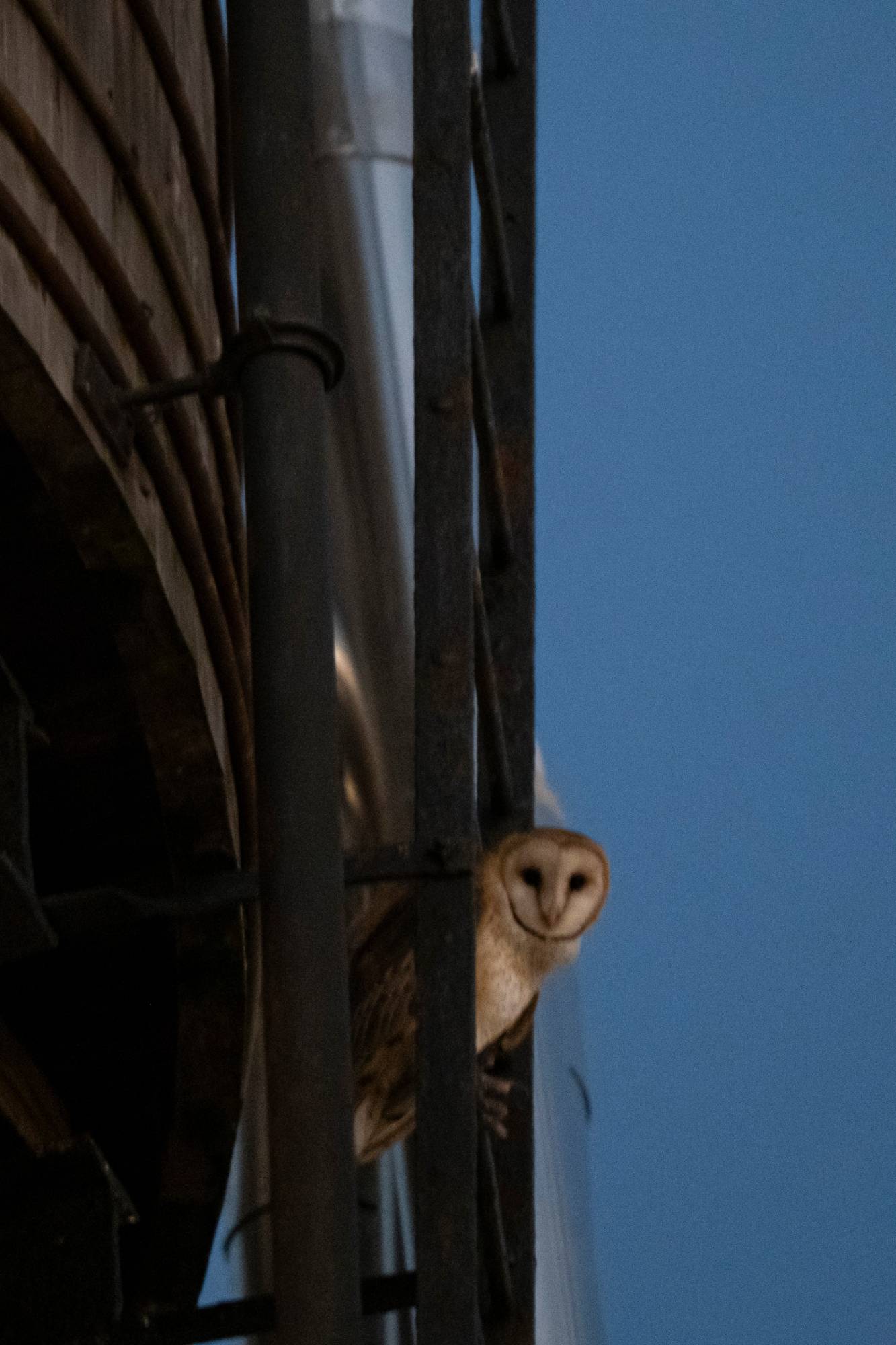
An American Barn Owl sits perched on a water tower on the Upper West Side neighborhood, Wednesday, Oct. 14, 2026, in New York. (AP Photo/Yuki Iwamura)
Manhattan's Upper West Side has been reveling in the company of its latest celebrities: A family of barn owls nested in a water tower atop a building near Central Park.
This is the first documented instance of barn owls nesting in Manhattan in modern history, according to one expert, and the owls have attracted nightly crowds of people in the street eager to get a glimpse of the elusive birds.
“It was, like, totally shocking,” Andrew Farnsworth, a migration ecologist at the Cornell Lab of Ornithology, said of the barn owls. “To the best of our knowledge, like the collective birding knowledge, there hasn’t been a nest in, you know, in Manhattan, at least in recorded history.”
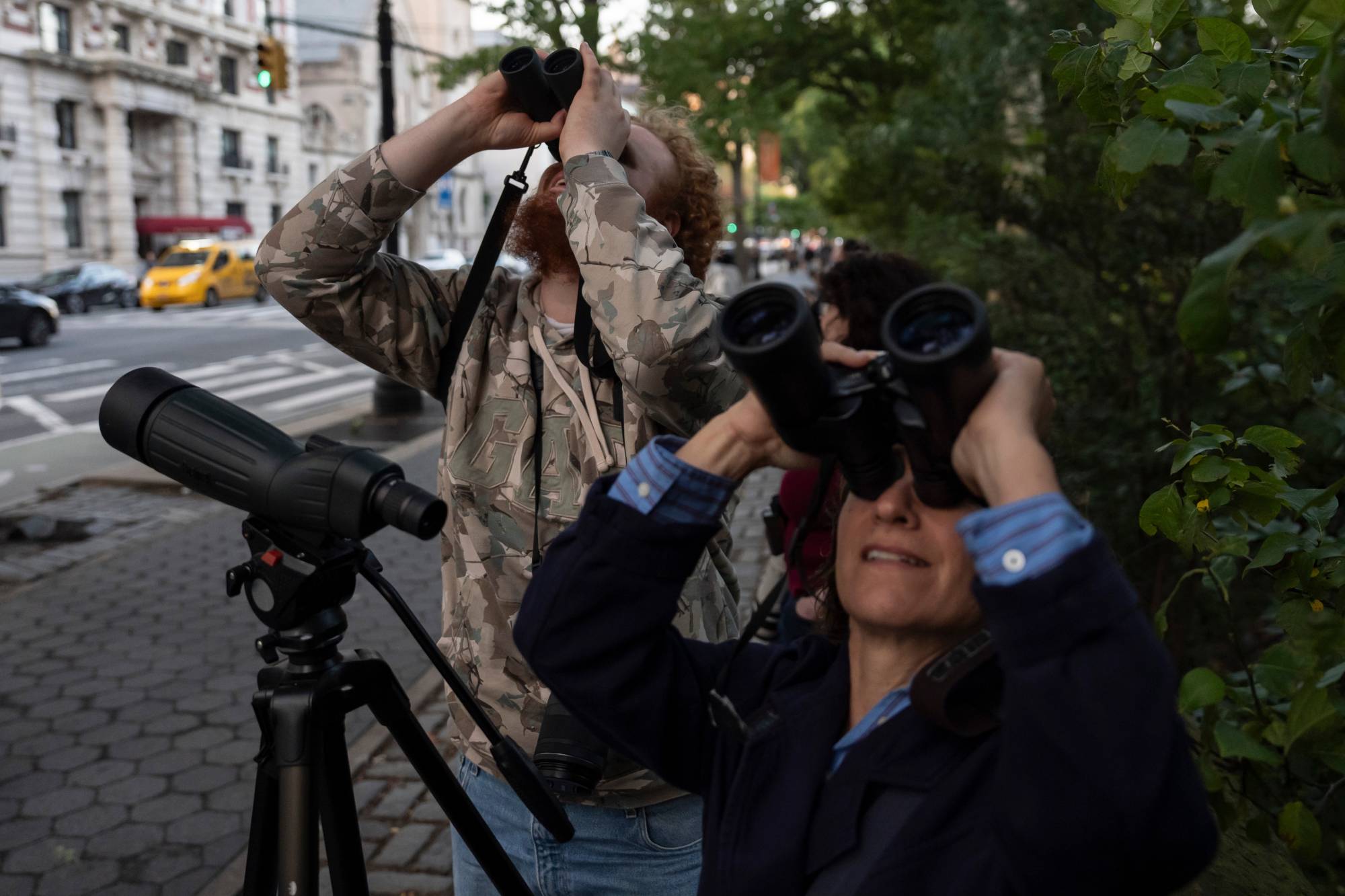
People look at American Barn Owls sit perched on a water tower on the Upper West Side neighborhood, Tuesday, Oct. 13, 2026, in New York. (AP Photo/Yuki Iwamura)
Word of the barn owl family didn't get around until last week, when Elisabeth Williams, an Upper West Side resident, notified a local news outlet on Oct. 6 that she and her husband saw multiple owls at the water tower atop a building on West 75th Street close to Central Park West.
The couple had previously seen a single owl on an apartment windowsill a few days earlier and were shocked even then, Williams recalled, according to The Associated Press.
“In a place like Manhattan, you normally really have to go out of your way to encounter nature,” she said. “And here it was, just sort of right outside our window.”
Barn owl sightings are rare in New York City It's not the first time that birds have captivated New Yorkers. Residents have fallen in love with American woodcocks, who are known to stop in Midtown Manhattan’s Bryant Park every year as they migrate north in early spring.
After Flaco the Eurasian eagle-owl died in 2024, dozens of mournful fans gathered to say goodbye to the beloved creature who flew around Manhattan and became a joy to many after someone let him out of his zoo enclosure the previous year. Then there was Pale Male, a red-tailed hawk who nested above Fifth Avenue for three decades before dying in 2023.
But barn owl sightings in New York City parks are very rare, according to the New York City Department of Parks & Recreation. New York is at the northern fringe of the barn owl's range and the barn owl population has declined “at an alarming rate” over time, according to the state Department of Environmental Conservation.
“There’s lots of excitement among New Yorkers, both birders and non-birders alike, about these owls because owls really capture the attention,” said Jessica Wilson, executive director of NYC Bird Alliance. “They’re magical, they’re nocturnal, they are secretive, they’re not commonly seen, especially on the Upper West Side of Manhattan. And to have this chance to see these birds is really thrilling.”
Photographers and casual onlookers have gathered on the street on a nightly basis to spot the owls.
“I’ve only seen one barn owl ever, and that was in California,” said Val Coleman, a retired New York City resident who was on the Upper West Side earlier this week trying to spot the owls.
“At dusk, we hope they will come out to hunt. We hope they don’t eat poisoned rats with rodenticide in ’em.”
David Barrett, a Manhattan-based birder who runs the popular social media account, Manhattan Bird Alert, said he’s observed at least one adult barn owl and five fledglings at the water tower. He’s also seen an adult owl carrying rodents back to the water tower. There are believed to be two adult owls, and some photographers have claimed to have seen six fledglings, Barrett added.
“Having one barn owl is a rarity, but it’s not national news. Having a family, for the first time ever, breeding in Manhattan in recorded history, that’s special news,” Barrett said.
Screeching was heard by residents Before the recent barn owl sightings, Williams and her husband heard periodic screeching noises outside going back to early September. They initially assumed it was a bird of some kind but were skeptical when a phone app indicated the noise was from a barn owl.
Thomas Obersteiner said that he first heard bizarre screeching and wailing noises from outside one evening in mid-September. It sounded like someone was “being murdered outside,” he said.
“That lasted for two or three weeks, every night, sometimes more, sometimes less, coming from different directions,” Obersteiner added. “But I had no idea what that was.”
An American Barn Owl sits perched on a water tower on the Upper West Side neighborhood, Wednesday, Oct. 14, 2026, in New York. (AP Photo/Yuki Iwamura)
On multiple occasions, Obersteiner or his wife ran into their children's bedroom after mistaking the owls' screech for a child in pain, he said. It wasn't until he saw a news report that he realized that owls were making the sounds.
Farnsworth said the screech is typical of barn owls, who use it to communicate with one another. The screech is like a “horror movie kind of experience,” he said.
Obersteiner, who said his roof deck is “probably the best location in town right now” to watch the owls, has been letting nature photographers access that perch to observe the owls “almost every night” since news of the barn owls spread. On one night last week, 20 people had gathered.
“We can’t say no because it’s so much fun and these people are so serious,” Obersteiner added. “It's beautiful.”
Williams and her husband were not bird watchers before the barn owl family moved in to the water tower. But that may change soon after their “delightful” experience.
“I think we’re about to become birders,” Williams said.
Spain Sizzles in Hottest September on Recordhttps://english.aawsat.com/varieties/5330222-spain-sizzles-hottest-september-record
The unprecedented heat in September came after Spain's hottest summer on record. Oscar DEL POZO / AFP
Mainland Spain sizzled in its warmest September since records began in 1961, with exceptional heat effectively making it another summer month, national weather agency AEMET said on Friday.
The announcement is the latest in a series of new temperature records this year across Europe, scorched by successive summer heatwaves that scientists say were turbo-charged by human-driven climate change.
The average temperature in September was 22.5C, 3.4C above the norm for the 1991-2020 reference period, said AEMET, with the unprecedented reading coming after Spain's hottest summer on record, said AFP.
It was the first time the figure for September exceeded the average summer temperature of 22.1C for the 1991-2020 period, AEMET added in a statement.
The country equaled its all-time heat record for the month when 45.7C was registered in the southwestern municipality of El Granado on September 3.
AEMET briefly issued the highest red alert for heat in small areas of the southern region of Andalusia in September, the first time such warnings had been sent in the month since they started in 2007.
Last month was also extremely dry, recording just 36 percent of the normal rainfall expected in September in mainland Spain based on the 1991-2020 reference period.
Extreme temperatures have been linked to tens of thousands of excess deaths across the continent, as well as disrupting daily life and the economy through drought and low river levels.
لم تشترك بعد
انشئ حساباً خاصاً بك لتحصل على أخبار مخصصة لك ولتتمتع بخاصية حفظ المقالات وتتلقى نشراتنا البريدية المتنوعة