


Qatar's Trade Balance Surplus Drops 19.6%

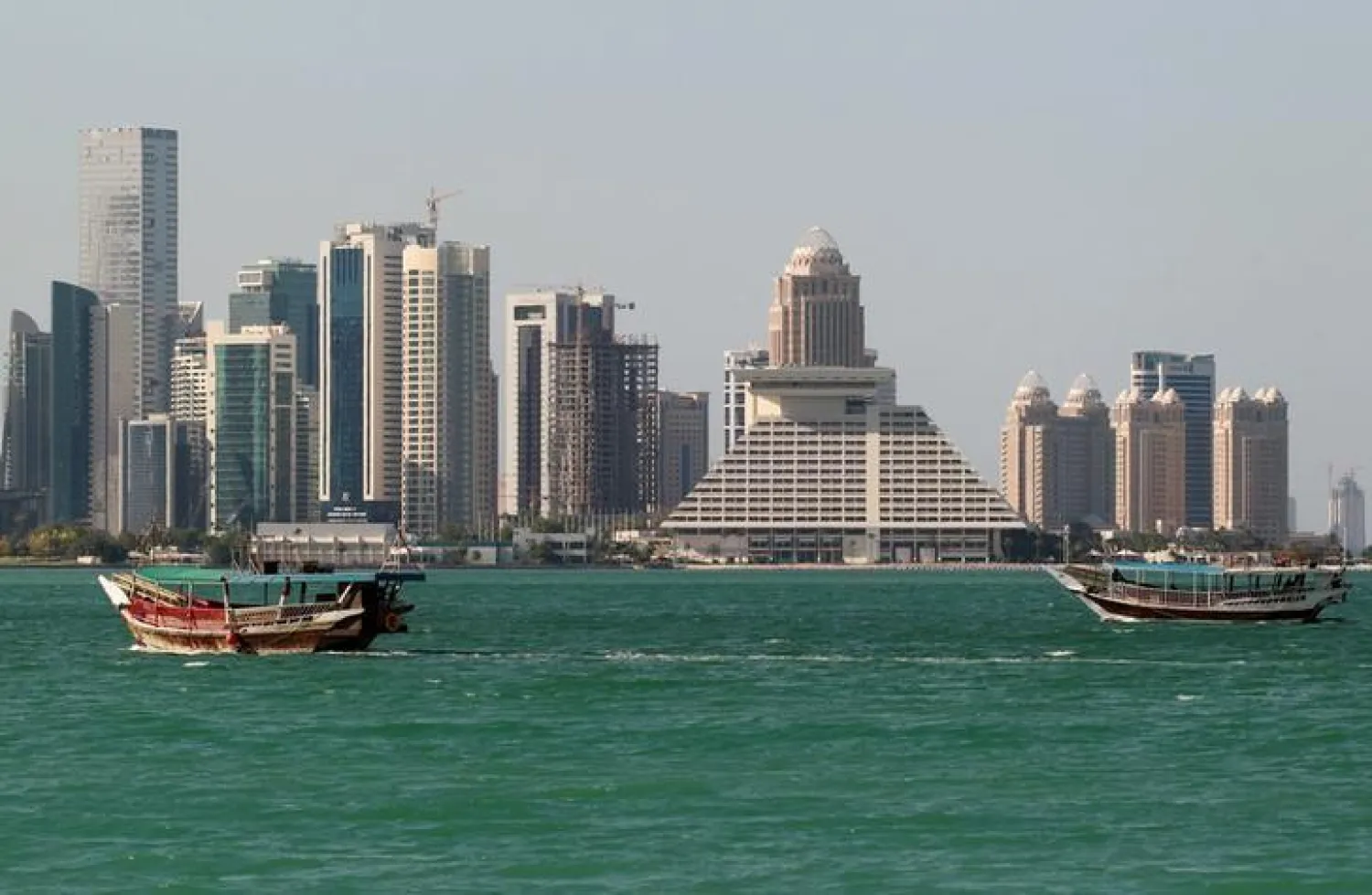
Buildings are seen on a coastline in Doha, Qatar (File Photo: Reuters)
TT

Qatar's Trade Balance Surplus Drops 19.6%

Buildings are seen on a coastline in Doha, Qatar (File Photo: Reuters)

Qatar Planning and Statistics Authority issued its preliminary report on foreign trade statistics for March, which showed a decline in the merchandise trade balance surplus of 19.6 percent in March on an annual basis.

Total exports of goods, including exports of goods of domestic origin and re-exports, amounted to approximately QR30.9 billion, a decrease of 15.5 percent annually and a decrease of 0.6 percent every month.

The imports of goods fell in March to about QR9.6 billion, a 4.6 percent drop compared to the same month last year and an increase of 18.1 percent compared to last February.

In March 2023, the foreign merchandise trade balance, which represents the difference between total exports and imports, showed a surplus of QR 21.3 billion almost, a decrease of about QR 5.2 billion or 19.6 percent compared to March 2022, and a drop by nearly QR 1.6 billion or 7.2% compared to February 2023.

Months after hundreds of thousands of football fans packed into its hotels and stadiums, Qatar seeks to recover from the post-World Cup depression by hosting more global events.

Since the end of the FIFA World Cup in December, the city's merchants recall with nostalgia the period which attracted 1.4 million visitors, according to the authorities figures.

Thousands of foreign workers left the Gulf country within four months, while luxury hotels built for the tournament laid off hundreds of employees, according to the French Press Agency.

After recording a trade surplus of nearly $100 billion in 2022, growth in 2023, bolstered by its natural gas riches, is predicted by the World Bank to hit 3.4 percent, among the highest in the Middle East.

A wave of newcomers has added nearly 100,000 to the population since the World Cup final, taking it to over three million, according to official figures.

The head of Qatar's tourism agency and Qatar Airways, Akbar al-Baker, said hotel occupancy in the months after a World Cup is "always low."

Baker added that the tiny country has made investments in tourism and hosting more significant events a focus, predicting Qatar will welcome more than five million visitors this year, more than twice the number in pre-pandemic 2019.

According to AFP, new prime minister Sheikh Mohammed bin Abdulrahman bin Jassim Al-Thani took office in March and is expected to announce new economic initiatives soon.

Business executives say they expect measures to attract the skilled expatriates and investment needed to wean Qatar's economy off its reliance on gas and oil.

The Director of PricewaterhouseCoopers consultancy - Qatar branch, Bassam Hajhamad, said he is "definitely sure" the government will make changes.

He said businesses show a "push for transformation" into digital and other new areas, adding that companies want "more resources, more talent."

Hajhamad noted that reforms to "labor and visa" regulations would make Qatar more attractive.

"Qatar has a lot of unique propositions compared to other countries. But we need to develop a more structured approach to attract talent."

Foreign workers in Qatar must leave once their contract finishes, and few have the right to buy property.

Saudi Arabia Welcomes Yemen Prisoner Exchange Agreement

Officials are seen at the announcement of the prisoner exchange in Muscat. (Saudi Ambassador to Yemen on X)
TT

Saudi Arabia Welcomes Yemen Prisoner Exchange Agreement

Officials are seen at the announcement of the prisoner exchange in Muscat. (Saudi Ambassador to Yemen on X)

Saudi Arabia welcomed on Tuesday the agreement signed in Muscat earlier to exchange prisoners and detainees in Yemen.

It deemed the development “an important humanitarian step that contributes to alleviating human suffering and boosting confidence-building opportunities.”

The Kingdom praised “the sincere efforts and generous initiatives exerted by Oman in hosting and sponsoring the talks, as well as its support for the negotiating efforts conducted from December 9 to 23.”

The Kingdom also hailed the efforts by the Office of the United Nations Special Envoy for Yemen, the International Committee of the Red Cross, and all parties who participated in the negotiations.

It reiterated its support for all efforts to achieve peace, security, and stability in a manner that fulfills the aspirations of the Yemeni people.

Yemen’s legitimate government and the Iran-backed Houthi militants reached an agreement to free 2,900 detainees held during the 11-year war.

Saudi Ambassador Mohamed Al-Haber said in a statement on X that the agreement was signed under the supervision of the Office of the UN Special Envoy for Yemen and the ICRC, “which will enable all detainees to return to their families.”

“I commend the efforts of the negotiation teams from both sides who succeeded in reaching an understanding and concluding this agreement, which addresses a humanitarian issue and strengthens efforts to bring calm and build confidence in Yemen,” he added.

The UN special envoy, Hans Grundberg, said the agreement was a “positive and meaningful step that will hopefully ease the suffering of detainees and their families across Yemen.”

“We are ready and determined to carry out the release, transfer and repatriation of detainees so that people separated from their families can be reunited in a safe and dignified manner,” said Christine Cipolla, the ICRC’s head of delegation in Yemen.


Saudi-US Ties See Year of Stronger Political Interests, Defense Cooperation

The reception ceremony for Prince Mohammed bin Salman, Crown Prince and Prime Minister, on the South Lawn of the White House, November 2025. (AFP)
TT

Saudi-US Ties See Year of Stronger Political Interests, Defense Cooperation

The reception ceremony for Prince Mohammed bin Salman, Crown Prince and Prime Minister, on the South Lawn of the White House, November 2025. (AFP)

Saudi Arabia’s foreign policy in 2025 crystallized the Kingdom’s strategic priorities, reinforcing its standing as a trusted international mediator for major powers, its leadership in pressing for an end to the war in Gaza, and its firm rejection of displacement of the Palestinian people.

Riyadh doubled down on its advocacy of a two-state solution and the establishment of a Palestinian state, while stepping up support for Syria and working to strengthen collective regional security, including that of the Gulf Cooperation Council. At the same time, the Kingdom moved to deepen cooperation with the United States and other global powers.

Two Saudi-US summits stood out during the year, held during what were described as historic visits. The first came in May, when US President Donald Trump visited Saudi Arabia, followed by a November visit to the United States by Prince Mohammed bin Salman, Saudi Crown Prince and Prime Minister.

Together, the two meetings highlighted Riyadh’s exceptional international standing in 2025.

During Trump’s visit to Riyadh, the US president praised the Crown Prince’s leadership, saying he best represented America’s strong allies. He said that a bright dawn awaited the Middle East, describing Saudi Arabia as the heart and center of the world, and stating that Riyadh was on track to become a global business hub.

During the Crown Prince’s visit to Washington, the two countries signed a broad package of agreements, including a Strategic Defense Agreement, the second such defense accord signed by Saudi Arabia in 2025.

The deals also encompassed a defense sales package, cooperation on civil nuclear energy, a strategic partnership on artificial intelligence, a framework for securing uranium and critical mineral supply chains, and measures to accelerate investments, among other initiatives.

Trump announced that Saudi Arabia would be designated a major non-NATO ally and praised Saudi negotiating skills, calling them “great negotiators.”

Backing Syria’s recovery

Although the war in Gaza continued to dominate global attention in 2025, sweeping changes in Syria prompted Saudi Arabia to play an active role in supporting the transition, with an eye toward the country’s recovery and international recognition of its new leadership.

After Saudi Arabia announced in late December last year that a Saudi delegation led by a Royal Court adviser had visited Damascus and met Ahmed al-Sharaa, then the leader of the new administration and now Syria’s interim president, Riyadh moved to intensify its support.

Saudi air and land bridges continued to deliver aid to the Syrian people, alongside humanitarian, medical and development projects set to expand by the end of the year to more than 103 projects, with a total cost nearing $100 million.

In addition to receiving Sharaa three times in 2025, Saudi Arabia pressed for the lifting of US sanctions on Syria at the direct request of Crown Prince Mohammed. Support also included settling Syria’s outstanding debts to the World Bank, estimated at around $15 million, and covering part of the salaries of Syrian government employees through a joint initiative with Qatar and the United Nations.

Saudi Arabia also continued to confront Israeli violations in the region, with senior officials repeatedly rejecting Israeli actions that went beyond the Gaza war to include violations of the sovereignty of several countries, including Syria, Qatar and Iran.

The Crown Prince reaffirmed Saudi Arabia’s unlimited support for Qatar following an Israeli attack on a Hamas meeting there in September 2025.

Rejecting attempts to sideline the Palestinian cause

Riyadh moved to counter what it described as attempts to “liquidate the Palestinian cause”. A statement issued in February reaffirmed Saudi Arabia’s unwavering position on the establishment of a Palestinian state.

Crown Prince Mohammed said the stance was “clear and explicit, leaving no room for interpretation,” stressing that Saudi Arabia would not establish relations with Israel without the creation of a Palestinian state and that the position was “firm and not subject to negotiation or bidding.”

The statement, issued about an hour after remarks by Trump during a White House press conference with the Israeli prime minister, was welcomed by the Palestinian Authority.

President Mahmoud Abbas praised what he called Saudi Arabia’s “sincere fraternal positions,” rejecting settlement expansion, annexation and displacement, and commended Riyadh’s continued humanitarian support for Gaza and its diplomatic efforts, including the establishment of a global alliance to mobilize recognition of the State of Palestine and the convening of an international peace conference in June.

Two-state solution

After two years in which Saudi Arabia brought together Arab and Islamic leaders over Gaza, a high-level international conference on the peaceful settlement of the Palestinian question and implementation of the two-state solution was held in September under Saudi and French leadership.

The meeting adopted the New York Declaration, which won broad backing in the UN General Assembly in what was described as a historic and decisive moment for peace, security and stability in the Middle East.

In comments to Asharq Al-Awsat, the Palestinian prime minister praised Saudi Arabia’s firm positions, saying they had helped mature international stances toward recognizing a Palestinian state and providing all possible support, noting that the two-state solution remained the foundation for peace and stability in the region.

Global influence and mediation

In February 2025, Diriyah hosted Saudi-sponsored talks between the United States and Russia aimed at improving relations. The US State Department described the summit as a significant step forward, while Kremlin diplomatic adviser Yuri Ushakov called it a success.

The following month, Jeddah hosted US-Ukrainian talks under the patronage of Crown Prince Mohammed, alongside US foreign and national security officials, as well as Ukraine’s defense minister and head of the president’s office.

Michael Mitchell, the US State Department’s regional spokesperson, told Asharq Al-Awsat that the world was closer than ever to a Russia-Ukraine ceasefire following the Saudi-hosted negotiations.

He expressed Washington’s appreciation for Saudi Arabia’s role in advancing diplomatic efforts and hosting key talks, reaffirming the US commitment to working with all parties to achieve lasting peace in Ukraine.

As part of its mediation role, Saudi efforts alongside other countries also helped contain tensions between Pakistan and India, which had seen the worst military escalation between the two nuclear-armed neighbors before a comprehensive and immediate ceasefire was announced in May.

Pakistan’s Ambassador to Saudi Arabia Ahmad Farooq stated that Riyadh played a decisive role, engaging actively from the outset through high-level contacts and visits to both countries to facilitate de-escalation.

Defense partnerships

The Atlantic Council noted that the recent strengthening of US-Saudi defense cooperation reflected a pragmatic partnership based on shared interests rather than dependency, extending beyond arms sales to include intelligence sharing, tactical coordination to protect maritime routes, and joint efforts to build Saudi domestic defense capabilities.

Earlier, Saudi Arabia and Pakistan signed a Strategic Joint Defense Agreement during the official visit of Pakistani Prime Minister Shehbaz Sharif to the Kingdom in September.

The agreement stipulates that an attack on either country would be considered an attack on both. The move drew widespread international media attention and praise from political and military circles, particularly given that the two countries do not share a direct border.

Saudi national security analyst Ahmed al-Quraishi told Asharq Al-Awsat that the agreement conveyed a significant message to multiple regional actors, while emphasizing that Saudi sources had made it clear that it was not directed at any specific country or development.

He described it as a mature strategic outlook, noting that Riyadh had emphasized there was no hostile intent behind the arrangement.

Pakistani journalist Abdul Rahman Hayat told Asharq Al-Awsat that the agreement represented the emergence of a new Islamic pole, reflecting Saudi Arabia’s regional and Islamic standing alongside Pakistan’s status as the world’s only Islamic nuclear power.

He said the deal would strengthen Islamic unity under Saudi leadership and help deter external violations.

Focus on Sudan and Yemen

In addition to its role within the international quartet on Sudan, Crown Prince Mohammed sought to persuade Trump of the need to halt the war, prompting greater US engagement in ceasefire efforts and the humanitarian crisis. He later received Sudan’s transitional sovereign council leader in Riyadh to bolster those efforts.

In December, following recent military moves by Yemen’s Southern Transitional Council in the eastern provinces of Hadramout and Mahra, a Saudi delegation led by Major General Mohammed al-Qahtani visited the areas for more than 10 days, underscoring Saudi Arabia’s efforts to resolve the crisis, end the conflict and restore stability.

Yemen’s Presidential Leadership Council Chairman Dr. Rashad al-Alimi praised Saudi Arabia’s role in easing tensions in eastern Yemen and urged political, tribal and social forces in the two provinces to unite behind state efforts.

Summing up the year, political analyst Ahmed Al-Ibrahim told Asharq Al-Awsat that Saudi Arabia has strengthened its defense capabilities and, through what he described as “measured diplomacy,” consolidated firm positions on issues such as Syria and the Gaza war.

He said the Kingdom had also established a new, credible international mediation platform that could be relied upon with confidence when needed.


GCC Welcomes Prisoner Exchange Agreement in Yemen

Secretary-General of the Gulf Cooperation Council (GCC) Jasem Albudaiwi.
TT

GCC Welcomes Prisoner Exchange Agreement in Yemen

Secretary-General of the Gulf Cooperation Council (GCC) Jasem Albudaiwi.

Secretary-General of the Gulf Cooperation Council (GCC) Jasem Albudaiwi welcomed on Tuesday the prisoner exchange agreement in Yemen that was reached in Muscat.

A GCC General Secretariat statement said, Albudaiwi commended the efforts of Saudi Arabia, Oman, the Office of the Special Envoy of the Secretary General of the United Nations to Yemen, and the International Committee of the Red Cross in reaching Tuesday’s agreement.

He hoped the deal will help in strengthening the path to peace and stability in Yemen, alleviating the humanitarian suffering of the people, building trust between parties, and ultimately leading to a comprehensive and sustainable political solution that guarantees Yemen's security, stability, and unity, and serves the aspirations of its people for peace and development.
