


Khamenei Continues Changing Senior Commanders of Armed Forces

Iran's Supreme Leader Ayatollah Ali Khamenei speaks during a meeting with Iranian officials and ambassadors of Islamic countries, in Tehran, Iran, April 25, 2017. Leader.ir/Handout via REUTERS
TT

Khamenei Continues Changing Senior Commanders of Armed Forces

Iran's Supreme Leader Ayatollah Ali Khamenei speaks during a meeting with Iranian officials and ambassadors of Islamic countries, in Tehran, Iran, April 25, 2017. Leader.ir/Handout via REUTERS

Iranian Supreme Leader Ali Khamenei continued changing senior commanders of the armed forces. In the latest sudden change, Khamenei issued two separate decrees on Monday appointing Major General Abdolrahim Mousavi as new commander-in-chief for Army and assigning a new post to former Commander Major General Ataollah Salehi as deputy chief of staff of the Iranian Armed Forces.

General Mousavi was deputy chief of staff of the Iranian Armed Forces prior to his appointment.

Praising the two-star general for his “genuine service” and “valuable experience and record of commandership”, Khamenei said that Salehi has been appointed to the new post upon a proposal by Chief of Staff of the Iranian Armed Forces Major General Mohammad Hossein Baqeri.

Notably, General Salehi was commander of Iranian Army for 12 years prior to his appointment.

In this context, and in the decree in which Mousavi has risen to the rank of major general and has been assigned to the Army Chief, Khamenei stressed the need for a “revolutionary attitude” in commanding the Army in order to “boost the combat capabilities and preparedness” of the forces.

He has repeatedly stressed the need for strengthening the country’s military power and called on the Armed Forces to maintain a high level of preparedness.

Khamenei also thanked Salehi and Mousavi for their loyal services to the Islamic Republic and wished them good luck in their new military posts.

Mousavi, 57, served as armed forces deputy chief of staff from 2016 to 2017. He was second-in-command of the Army from 2008 to 2016.

For his part, Salehi, 67, served as the Army chief from 2005 until 2017. As head of Iran's regular military he was a member of the Supreme National Security Council; Salehi was the third Army chief since the 1979 Islamic Revolution.

The new appointment came one day after the parliament gave the highest votes for Brigadier General Amir Hatami to confirm him as defense minister.



UN Chief Warns of Risk of Return to ‘Full War’ in Middle East

UN Secretary General Antonio Guterres speaks during a United Nations Security Council meeting on the Middle East, at UN Headquarters in New York, on June 10, 2026. (AFP)
TT

UN Chief Warns of Risk of Return to ‘Full War’ in Middle East

UN Secretary General Antonio Guterres speaks during a United Nations Security Council meeting on the Middle East, at UN Headquarters in New York, on June 10, 2026. (AFP)

United Nations chief Antonio Guterres warned Wednesday of the risk of return to "full war" in the Middle East after Iran and the United States traded strikes.

His intervention came after Iran and the United States once again traded fire following the downing of an American helicopter, further straining a ceasefire that took effect in April but has been marked by sporadic flare-ups of violence.

"We should not minimize the risks of a lesser fire becoming full fire, or in another word -- full war," Secretary-General Guterres said at a meeting of the UN Security Council devoted to the situation in the Middle East.

The UN rights chief echoed Guterres, saying he was "horrified by the fact that we see escalation upon escalation."

"We have, I mean, we're always very relieved when ceasefires are announced, but ceasefires need to be respected in full. International law needs to be respected in full," said the UN High Commissioner for Human Rights Volker Turk in Geneva.

The war, which began with US-Israeli strikes on Iran, threw the region into chaos and rattled global markets before the shaky truce began.

Iran said it attacked Jordan and Bahrain on Wednesday after US forces carried out strikes on the country in retaliation for the downing of a helicopter.


Pentagon’s Hegseth Warns Cuba That Arms Procurement Could Invite Confrontation

US Defense Secretary Pete Hegseth delivers a speech at the US cemetery to commemorate the 82nd anniversary of the D-Day landings, in Colleville-sur-Mer, Normandy, France, Saturday, June 6, 2026. (AP)
TT

Pentagon’s Hegseth Warns Cuba That Arms Procurement Could Invite Confrontation

US Defense Secretary Pete Hegseth delivers a speech at the US cemetery to commemorate the 82nd anniversary of the D-Day landings, in Colleville-sur-Mer, Normandy, France, Saturday, June 6, 2026. (AP)

US Defense Secretary Pete Hegseth warned the government of Cuba on Wednesday against seeking weapons that could strike the US homeland or the US naval base at ‌Guantanamo Bay, ‌saying it would invite ‌a ⁠confrontation Havana would ⁠not endure.

Hegseth, speaking to US troops during a visit to the US base, said still he held out hope ⁠for a positive ‌relationship with ‌Cuba.

“It would be unwise of ‌the government of Cuba ‌to try to procure or get access to the types of weapons that ‌could reach this base or the American homeland,” Hegseth ⁠said, ⁠without offering specifics on weaponry.

“They would be inviting the kind of confrontation not only do they not want but they could not stand. No country on Earth can match the capabilities of the United States of America.”


UN Watchdog Demands Stockpile ‘Information’ from Iran

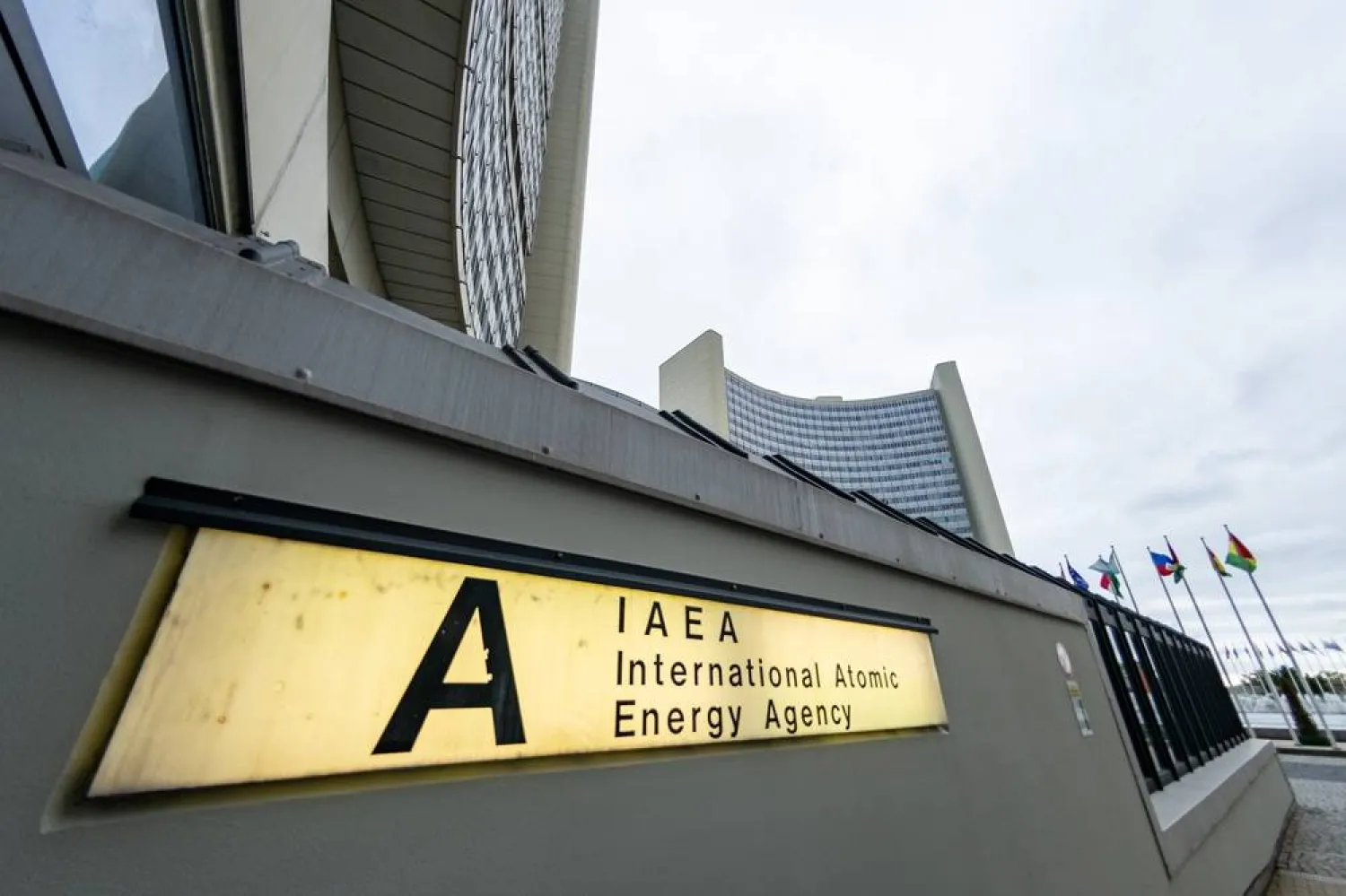
An exterior view prior to the International Atomic Energy Agency (IAEA) headquarters in Vienna, Austria, 05 June 2026. (EPA)
TT

UN Watchdog Demands Stockpile ‘Information’ from Iran

An exterior view prior to the International Atomic Energy Agency (IAEA) headquarters in Vienna, Austria, 05 June 2026. (EPA)

The UN nuclear watchdog's governing board on Wednesday approved a western resolution demanding that Iran immediately provide information on its uranium stockpile and production facilities.

Iran's nuclear sites have been targeted in US-Israel attacks and Iran has suspended access for International Atomic Energy Agency inspectors.

The resolution, drawn up by Britain, France, Germany and the United States, said it is "essential and urgent" that Iran "without delay" provides the IAEA with "complete information on nuclear material inventories and design information for facilities".

The resolution -- passed by 21 votes to three with 10 abstentions -- also demanded that Iran "grant the agency all access it requires to verify this information", said diplomats. One country on the 35-member board did not vote.

The IAEA estimates that Iran had 440 kilograms of uranium enriched to 60 percent, close to the level needed for a bomb. But inspectors have not seen the material since June 10 last year, as Israel launched its first strikes on Iran's nuclear facilities.

Iran then suspended cooperation with the watchdog and western nations say the information and access is crucial to determining whether uranium has been diverted.

The agency said in a report ahead of the board meeting that Iran's refusal to allow access was a "proliferation concern".

On Tuesday, Iran's Vienna mission posted on X that it was "ridiculous" for the United States "aggressor" to submit this "unnecessary provocative resolution".

The IAEA board adopted a resolution in November calling on Iran to cooperate with nuclear inspectors.

Since the Middle East war erupted with US-Israeli strikes on February 28, Iran has negotiated with the United States but resisted demands to give up its nuclear program.

Western countries and Israel have long accused Iran of seeking a nuclear weapon. It denies the charge.