


2 Arrested in Morocco over Barcelona Attack as Suspects’ Trial Kicks off

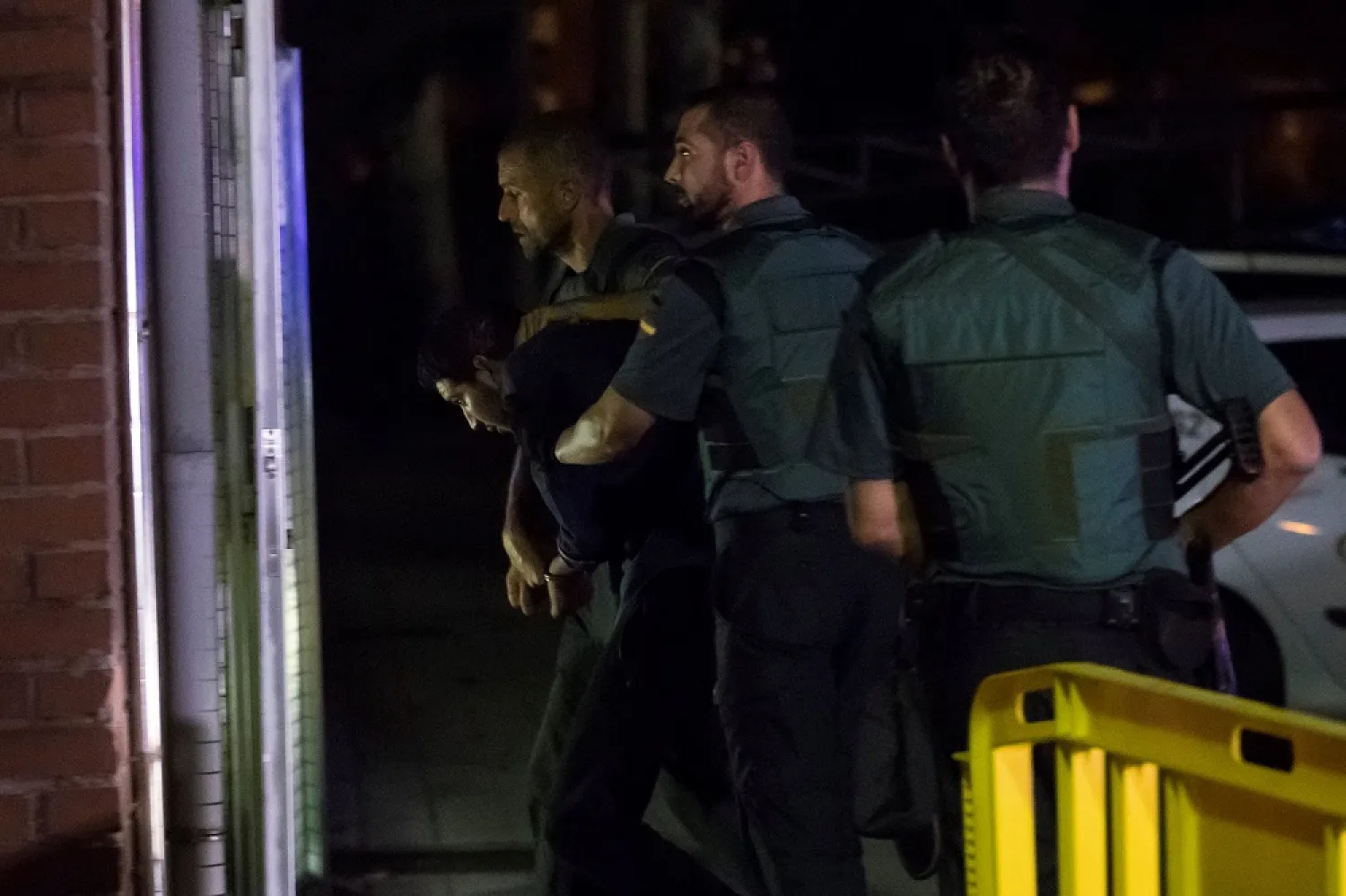
Spanish Civil Guards escort one of the four suspects of a militant cell behind last week’s Barcelona van attack. (Reuters)
TT

2 Arrested in Morocco over Barcelona Attack as Suspects’ Trial Kicks off

Spanish Civil Guards escort one of the four suspects of a militant cell behind last week’s Barcelona van attack. (Reuters)

Two people were arrested on Sunday on suspicion of being linked to last week’s deadly van-ramming attack in the Spanish city of Barcelona, said Moroccan state TV channel 2M on Tuesday.

One of the men, a 28-year-old detained in the Nador, close to the Spanish enclave of Melilla, lived for 12 years in Barcelona and is suspected of links to ISIS and of plotting to attack the Spanish embassy in Rabat, the channel reported. It gave no details of the alleged plot.

No direct link has been identified between the suspect and the cell of mainly young Moroccans behind the Barcelona attack, but he had celebrated the attack on Facebook, the report said.

A second suspect was arrested in the town of Oujda, close to Morocco's border with Algeria, 2M reported. He was a resident of Ripoll, the small town in northeastern Spain where many members of the cell were living.

The militant cell behind the van-ramming that killed 13 people in Barcelona had planned one or several major bomb attacks, possibly against churches or monuments, one suspect told a court on Tuesday, according to sources close to the investigation.

After a day-long hearing of four suspects in the plot, Judge Fernando Andreu late on Tuesday ordered Mohamed Houli Chemlal and a second defendant, Driss Oukabir, remanded on charges of membership of a terrorist group and murder. Chemlal was also charged with explosives possession.

A third suspect, Salh El Karib, who ran an internet cafe in a northeastern Spanish town where most of the alleged members of the cell lived, will remain in police custody for now pending further investigation. The fourth man, Mohamed Aalla, was released on certain conditions.

Chemlal was the only one of the four suspects who admitted a role in the plot, the sources said. The other three all denied involvement.

Police said the cleric suspected of leading the militant cell, Abdelbaki Es Satty, died a day before the Barcelona attack when a house the group was using to build bombs blew up.

According to Judge Andreu's court order, in the ruins of the house in Alcanar, southwest of Barcelona, police found several plane tickets to Brussels in Es Satty's name issued by the Spanish airline Vueling.

The air tickets will raise questions about possible links of the group to Belgium, where a number of militant plots have been hatched or carried out.

Investigators also found receipts for purchases made by the group, including 500 liters of acetone and other materials which can be used to make explosives, bought at the beginning of August, the court document showed.

Last Thursday at 9:26 p.m. local time (1926 GMT), a few hours after the Barcelona van attack, they bought four knives and an ax that were used in the Cambrils attack, it said.

Chemlal told the court in the closed hearing that the group had obtained materials for making explosives in Spain, abroad and via the internet, the sources said.

Chemlal, who told the court he regretted his part in the plot, said Es Satty, the imam in Ripoll, the small town in northeastern Spain where many of the group came from, led the cell, according to the sources.

The group had planned to commit "one or several" attacks with explosives, Chemlal said. He said there was no "clear or certain target" but he referred to attacks against churches and monuments, the sources said.

The cell was making explosives and planned to use butane gas canisters to make a more powerful bomb, guided by tutorials found on the internet, Chemlal said.

The plan went wrong when an explosion wrecked the house where the plotters were making the bombs a day before the Barcelona attack, killing the cleric and another man and leading the survivors to hurriedly change tactics.

Tuesday's hearing was the first in a long legal process, and it could be months or even years before the case is brought to a full trial.



470-kilo WWII Bomb Removed in Belgrade

This handout photograph taken on December 28, 2025 and released by Serbia's Ministry of Interior shows a 470-kg World War II aerial bomb, dropped on Nazi-occupied Belgrade in 1944, found in a construction site in the Serbian capital before being removed by Serbian bomb disposal experts. (Photo by Handout / SERBIAN MINISTRY OF INTERIOR AFFAIRS / AFP)
TT

470-kilo WWII Bomb Removed in Belgrade

This handout photograph taken on December 28, 2025 and released by Serbia's Ministry of Interior shows a 470-kg World War II aerial bomb, dropped on Nazi-occupied Belgrade in 1944, found in a construction site in the Serbian capital before being removed by Serbian bomb disposal experts. (Photo by Handout / SERBIAN MINISTRY OF INTERIOR AFFAIRS / AFP)

A 470-kilogram (1,000-pound) World War II aerial bomb was safely removed on Sunday from a construction site in a central district of Serbia’s capital, Belgrade, police said.

The US-made AN-M44 bomb was used during Allied air raids on German positions during the liberation of Belgrade from Nazi occupation in 1944.

Ahead of the bomb’s removal, the site, which is near a residential area and a shopping mall, underwent detailed reconnaissance "to ensure safe conditions," AFP quoted police as saying.

Residents were also told to remove vehicles and leave their homes if possible.
The bomb was transported to an army arms training ground 180 km (110 miles) from Belgrade, where it will be destroyed in the coming days.

Several unexploded bombs dating back to past wars have been discovered in Serbia in recent years, all of which were safely removed without detonating.

In September 2024, a century-old artillery shell weighing nearly 300 kilograms (660 pounds) was cleared from a construction site near the Serbian parliament in Belgrade.

Earlier that year, in April, a large bomb from the 1999 NATO bombing campaign was found in Nis, southern Serbia.

In 2021, a 242-kilogram (530-pound) World War II bomb was also removed from a construction site in a Belgrade suburb.


Has Iran Built an Espionage Network in Israel?

People walk in the rain during stormy weather in the port of Tel Aviv, Israel, 27 December 2025.  EPA/ABIR SULTAN
People walk in the rain during stormy weather in the port of Tel Aviv, Israel, 27 December 2025. EPA/ABIR SULTAN
TT

Has Iran Built an Espionage Network in Israel?

People walk in the rain during stormy weather in the port of Tel Aviv, Israel, 27 December 2025.  EPA/ABIR SULTAN
People walk in the rain during stormy weather in the port of Tel Aviv, Israel, 27 December 2025. EPA/ABIR SULTAN

For the past year, Israel has arrested dozens of Israeli citizens on suspicion of spying for Iran, Yedioth Ahronoth has reported on.

The Hebrew newspaper revealed on Saturday that some of the recruits were asked to photograph sensitive facilities and to collect information including documentation of Israeli army bases, strategic sites and homes linked to senior Israeli officials.

The newspaper said that since September 2024, Israeli authorities have uncovered 35 serious Iranian espionage cases. In some, individuals acted alone; in others, they were part of organized cells, with a mission to sow chaos, burn vehicles and carry out failed assassination plots.

It said the youngest of their recruits is a 13-year-old boy from Tel Aviv. Others had served in the reserves and regular forces.

They leaked sensitive information, including documentation of sensitive military bases, strategic sites and homes linked to senior Israeli officials.

The recruits included Mordechai “Moti” Maman, 72, of Ashkelon. He entered Iran twice and discussed with the agents the possibility of carrying out terror attacks in Israel.

The Iranian handlers discussed with him the option of assassinating senior figures such as Prime Minister Benjamin Netanyahu, then-Defense Minister Yoav Gallant and then-Shin Bet chief Ronen Bar.

After Maman told them the level of security surrounding senior officials made such attacks impractical, the sides discussed alternative terror and espionage activities, including possible attacks on former Prime Minister Naftali Bennett or mayors. Maman was arrested in September 2024.

In October 2024, four cells were arrested, including a couple who had been in contact with Iranian agents since 2021 and groups of five to eight people on suspicion of conducting espionage for Iran.

One of the cases involved seven Israelis who immigrated from Azerbaijan, including a father and son, suspected of maintaining ties for two years with operatives from Iran.

As part of that relationship, the suspects photographed military bases that later became targets in Iran’s ballistic missile attack last year. Some of the group were caught surveilling a senior Israeli official and his son, allegedly as part of an assassination plan.

Authorities also uncovered another case in which seven people aged 19 to 23 from the Jerusalem neighborhood of Beit Safafa were arrested on suspicion of conducting espionage for Iran for several months. Their main assignment was to assassinate an Israeli nuclear scientist and a mayor.

In early 2025, another espionage case was uncovered, and an indictment was filed against an Israeli from Petah Tikva, on charges including contact with a foreign agent and passing information to the enemy.

According to the indictment, the recruit photographed the neighborhood of National Unity party leader Benny Gantz and a power station in Tel Aviv.

His handler contacted him via Telegram and offered payment through a digital wallet in exchange for carrying out security-related tasks. These included documenting security facilities, spraying political graffiti, arson attacks on vehicles and other acts.

During 2025, more than nine indictments have been filed against cells and individuals accused of spying for Iran, most of them Jews the newspaper said.
Investigations revealed that most of the spies had carried out various missions in exchange for payment.

The majority of the recruits had not travelled to Iran to complete their recruitment, but communicated with Iranians through social networks or during their presence in other countries.


Polls Open for Myanmar's 1st Election Since Military Seized Power

Myanmar voters line up to cast ballots during the first phase of general election at a polling station in Naypyitaw, the capital city of Myanmar, 28 December 2025. EPA/RUNGROJ YONGRIT
TT

Polls Open for Myanmar's 1st Election Since Military Seized Power

Myanmar voters line up to cast ballots during the first phase of general election at a polling station in Naypyitaw, the capital city of Myanmar, 28 December 2025. EPA/RUNGROJ YONGRIT

Voters went to the polls Sunday for the initial phase of Myanmar ’s first general election in five years, held under the supervision of its military government while a civil war rages throughout much of the country.

Final results will not be known until after two more rounds of voting are completed later in January. It is widely expected that Min Aung Hlaing, the general who has ruled the country with an iron hand since an army takeover in 2021, will then assume the presidency.

The military government has presented the vote as a return to electoral democracy, but its bid for legitimacy is marred by bans on formerly popular opposition parties and reports that soldiers have used threats to force voters to participate.

While more than 4,800 candidates from 57 parties are competing for seats in national and regional legislatures, only six are competing nationwide with the possibility to gain political clout in Parliament. The well-organized and funded Union Solidarity and Development Party, with its support from the military, is by far the strongest contender.

Voting is taking place in three phases, with Sunday’s first round being held in 102 of Myanmar’s 330 townships. The second phase will take place Jan. 11, and the third on Jan. 25. Final results are expected to be announced by February.

Critics call the election a sham to keep the army in power Critics charge that the election is designed to add a facade of legitimacy to military rule that began when the military ousted the elected government of Aung San Suu Kyi in February 2021. It blocked her National League for Democracy party from serving a second term despite winning a landslide victory in the 2020 election.

They argue that the results will lack legitimacy due to the exclusion of major parties and limits on freedom of speech and an atmosphere of repression.

The expected victory of the military-backed Union Solidarity and Development Party makes the nominal transition to civilian rule a chimera, say opponents of military rule and independent analysts.

“An election organized by a junta that continues to bomb civilians, jail political leaders, and criminalize all forms of dissent is not an election — it is a theater of the absurd performed at gunpoint,” Tom Andrews, the UN-appointed human rights expert for Myanmar, posted on X.

The United Nations also said Sunday that Myanmar needs free elections.

"It is critical that the future of Myanmar is determined through a free, fair, inclusive and credible process that reflects the will of its people," said the United Nations in Myanmar, adding the UN "stands in solidarity with the people of Myanmar and their democratic aspirations.”

Holding the election may provide an excuse for neighbors like China, India and Thailand to continue their support, claiming the election promotes stability.

Western nations have maintained sanctions against Myanmar’s ruling generals due to their anti-democratic actions and the brutal war against their opponents.

Suu Kyi, Myanmar’s 80-year-old former leader, and her party are not participating in the polls. She is serving a 27-year prison term on charges widely viewed as spurious and politically motivated. Her party, the National League for Democracy, was dissolved in 2023 after refusing to register under new military rules.

Other parties also refused to register or declined to run under conditions they deem unfair, and opposition groups have called for a voter boycott.