


N.Korea Escalates Tensions by Launching Missile over Japan

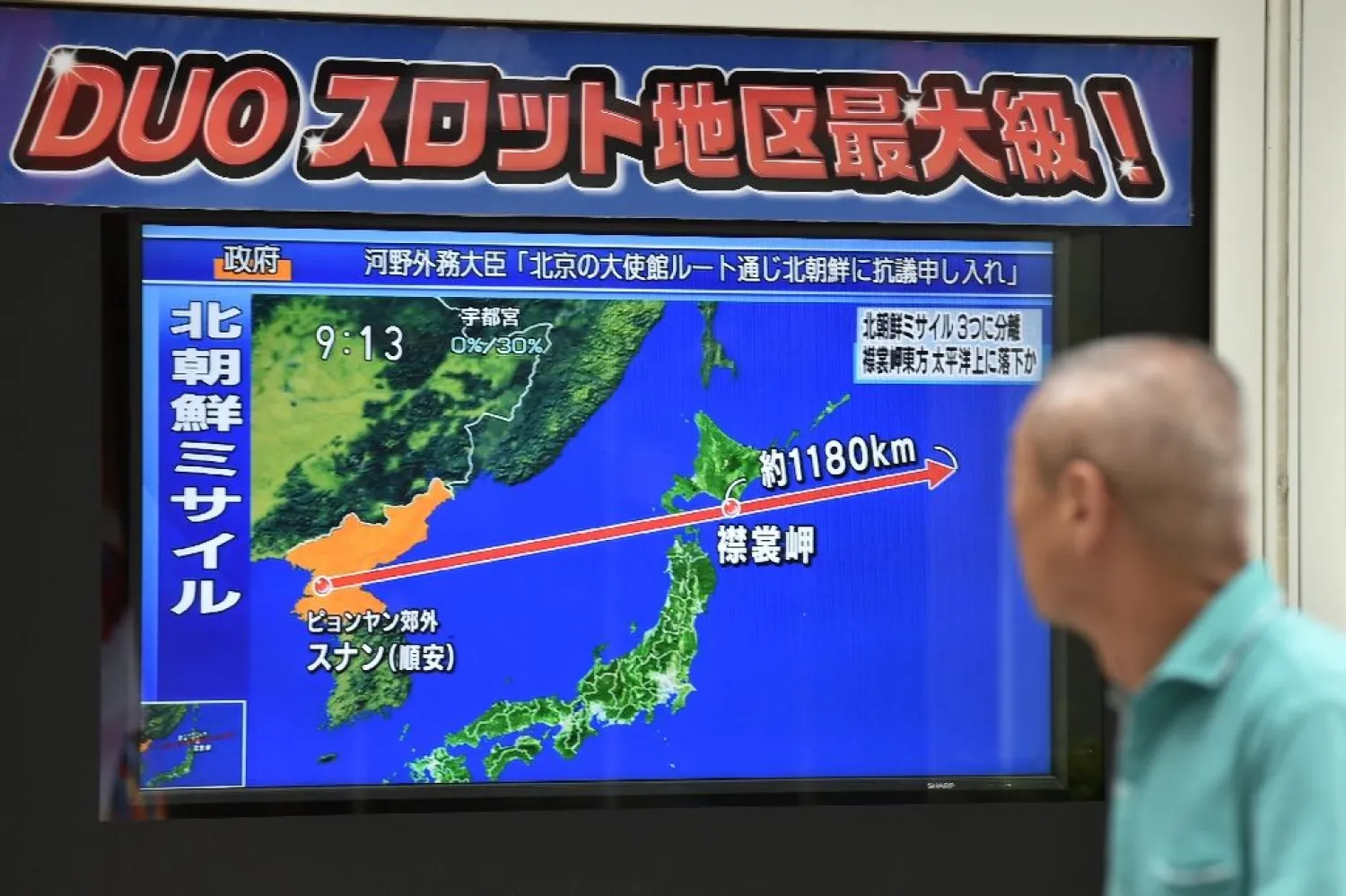
A television screen displays a map of Japan and the Korean Peninsula, in Tokyo, on August 29, 2017, following a North Korean missile test that passed over Hokkaido island. (AFP)
TT

N.Korea Escalates Tensions by Launching Missile over Japan

A television screen displays a map of Japan and the Korean Peninsula, in Tokyo, on August 29, 2017, following a North Korean missile test that passed over Hokkaido island. (AFP)

In an unprecedented move, North Korea fired on Tuesday a mid-range ballistic missile over Japan’s northern Hokkaido island that landed into the northern Pacific Ocean and that sparked a critical reaction from Prime Minister Shinzo Abe.

The launch came as US and South Korean forces conduct annual military drills on the peninsula, to which North Korea strenuously objects.

The test, one of the most provocative ever from the reclusive state, appeared to have been of a recently developed intermediate-range Hwasong-12 missile, experts said. Japan’s Chief Cabinet Secretary Yoshihide Suga said the latest missile fell into the sea 1,180 km (735 miles) east of Cape Erimo on Hokkaido.

North Korea has conducted dozens of ballistic missile tests under young leader Kim Jong Un, the most recent on Saturday, but firing projectiles over mainland Japan is rare.

“North Korea’s reckless action is an unprecedented, serious and a grave threat to our nation,” Abe told reporters.

Abe said he spoke to Trump on Tuesday and they agreed to increase pressure on North Korea. Trump also said the United States was “100 percent with Japan”, Abe told reporters.

The United Nations Security Council would meet later on Tuesday to discuss the test, diplomats said.

South Korea’s military said the missile was launched from near the North Korean capital, Pyongyang, just before 6 a.m. (2100 GMT Monday) and flew 2,700 km (1,680 miles), reaching an altitude of about 550 km (340 miles). The length and type of the missile test seemed designed to show that North Korea can back up a threat to target the US territory of Guam, if it chooses to do so, while also establishing a potentially dangerous precedent of sending future missile tests over Japan.

“We will respond strongly based on our steadfast alliance with the United States if North Korea continues nuclear and missile provocations,” the South’s foreign ministry said in a statement.

In an unusual move, South Korea's military released footage of its own missile tests it says were conducted last week. The videos showed two types of new missiles with ranges of 800 kilometers (497 miles) and 500 kilometers (310 miles) being fired from truck-mounted launchers during three tests conducted on August 24.

South Korea's Agency for Defense Development said the launches represented the last flight test for the longer-range missile before it is operationally deployed. Such missiles, which would be the latest additions to South Korea's Hyumoo family of missiles, are considered key components of the so-called "kill chain" preemptive strike capability that the South is pursuing to counter the North's nuclear and missile threat.

South Korea also said its air force conducted a live-fire drill involving four F-15 fighters dropping eight MK-84 bombs that accurately hit targets at a military field near the country's eastern coast. Park Su-hyun, spokesman of South Korean President Moon Jae-in, said the exercise was conducted after Moon directed the military to "display a strong capability to punish" the North if need be.

South Korea and the United States had discussed deploying additional “strategic assets” on the Korean peninsula, the presidential Blue House said in a statement, without giving any more details.

North Korea remained defiant.

“The US should know that it can neither browbeat the DPRK with any economic sanctions and military threats and blackmails nor make the DPRK flinch from the road chosen by itself,” North Korea’s official Rodong Sinmun said later on Tuesday, using the initials of the North’s official name, the Democratic People’s Republic of Korea.

North Korea fired what it said was a rocket carrying a communications satellite into orbit over Japan in 2009 after warning of its plans. The United States, Japan and South Korea considered it a ballistic missile test.

Television and radio broadcasters broke into their regular programming with a “J-Alert” warning citizens of the missile launch. Bullet train services were temporarily halted and warnings went out over loudspeakers in towns in Hokkaido.

“I was woken by the missile alert on my cellphone,” said Ayaka Nishijima, 41, an office worker from Morioka, the capital of Iwate prefecture, 300 km (180 miles) south of Cape Erimo.

“I didn’t feel prepared at all. Even if we get these alerts there’s nowhere to run. It’s not like we have a basement or bomb shelter, all we can do is get away from the window,” she told Reuters by text message.

Earlier this month, North Korea threatened to fire four Hwasong-12 missiles into the sea near the US. Pacific territory of Guam after US President Donald Trump warned Pyongyang would face “fire and fury” if it threatened the United States.

Also in early August, the 15-member Security Council unanimously imposed new sanctions on North Korea in response to two long-range missile launches in July.

Some experts said Kim was trying to pressure Washington to the negotiating table with its latest test.

“(North Korea) think that by exhibiting their capability, the path to dialogue will open,” Masao Okonogi, professor emeritus at Japan’s Keio University, said by phone from Seoul.

“That logic, however, is not understood by the rest of the world, so it’s not easy,” he said.

The Japanese military did not attempt to shoot down the missile, which passed over Japanese territory around 6:07 a.m. local time (2107 GMT), Japanese Minister of Defense Itsunori Onodera said. The missile broke into three pieces and fell into waters off Hokkaido, he said.

Experts say defenses in Japan and South Korea that are designed to hit incoming missiles would struggle to bring down a missile flying high overhead.

In Washington, the Pentagon confirmed the missile flew over Japan but said it did not pose a threat to North America and that it was gathering further information.

The United States and South Korea are technically still at war with the North because their 1950-53 conflict ended in a truce, not a peace treaty. The North routinely says it will never give up its ballistic missile and nuclear weapons programs, saying they are necessary to counter perceived hostility from the United States and its allies.



Thousands of Somalis Protest Israeli Recognition of Somaliland

This picture taken on November 7, 2024 shows a general view of the city of Hargeisa, capital and largest city of the self-proclaimed Republic of Somaliland. (Photo by LUIS TATO / AFP)
TT

Thousands of Somalis Protest Israeli Recognition of Somaliland

This picture taken on November 7, 2024 shows a general view of the city of Hargeisa, capital and largest city of the self-proclaimed Republic of Somaliland. (Photo by LUIS TATO / AFP)

Large protests broke out in several towns and cities across Somalia on Tuesday in opposition to Israel's recognition of the breakaway region of Somaliland.

Israel announced on Friday that it viewed Somaliland -- which declared independence in 1991 but has never been recognized by any other country -- as an "independent and sovereign state".

Somali President Hassan Sheikh Mohamud has condemned the move as a threat to stability in the Horn of Africa. He travelled Tuesday to Türkiye, a close ally, to discuss the situation, AFP reported.

Thousands of protesters marched through the streets of Somali capital Mogadishu and gathered at a stadium, waving placards with anti-Israeli slogans alongside Somali and Palestinian flags.

"We will never allow anyone to violate our sovereignty," one attendee, Adan Muhidin, told AFP, adding that Israel's move was "a blatant violation of international law".

Demonstrations also took place in Lascanod in the northeast, Guriceel in central Somalia, and Baidoa in the southwest.

"There is nothing we have in common with Israel. We say to the people of Somaliland, don't bring them close to you," said Sheikh Ahmed Moalim, a local religious leader, in Guriceel.

Somaliland has long been a haven of stability and democracy in the conflict-scarred country, with its own money, passport and army.

It also has a strategic position on the Gulf of Aden that makes it an attractive trade and military partner for regional and international allies.

But Israel's decision to recognize its statehood has brought rebukes from across the Muslim and African world, with many fearing it will stoke conflict and division.

There have been celebrations in Somaliland's capital Hargeisa, with the rare sight of Israeli flags being waved in a Muslim-majority nation.


Iranian Students Protest in Tehran and Isfahan, Says Local Media

Shopkeepers and traders walk over a bridge during a protest against the economic conditions and Iran's embattled currency in Tehran on December 29, 2025. (Handout / Fars News Agency / AFP)
TT

Iranian Students Protest in Tehran and Isfahan, Says Local Media

Shopkeepers and traders walk over a bridge during a protest against the economic conditions and Iran's embattled currency in Tehran on December 29, 2025. (Handout / Fars News Agency / AFP)

Student protests erupted on Tuesday at universities in the capital Tehran and the central city of Isfahan, decrying declining living standards following demonstrations by shopkeepers, local media reported.

"Demonstrations took place in Tehran at the universities of Beheshti, Khajeh Nasir, Sharif, Amir Kabir, Science and Culture, and Science and Technology, as well as the Isfahan University of Technology," reported Ilna, a news agency affiliated with the labor movement.


Iran Designates Royal Canadian Navy a Terrorist Organization

Iranians drive past a huge banner of former Iranian Revolutionary Guard Corps (IRGC) Quds Force commander Qassem Soleimani ahead of the sixth anniversary of his assassination at Valiasr Square in Tehran, Iran, 30 December 2025. (EPA)
TT

Iran Designates Royal Canadian Navy a Terrorist Organization

Iranians drive past a huge banner of former Iranian Revolutionary Guard Corps (IRGC) Quds Force commander Qassem Soleimani ahead of the sixth anniversary of his assassination at Valiasr Square in Tehran, Iran, 30 December 2025. (EPA)

The Iranian foreign ministry designated the Royal Canadian Navy a terrorist organization on Tuesday in what it said was retaliation for Canada's 2024 blacklisting of Iran's Revolutionary Guards.

In a statement, the ministry said that the move was in reaction to Ottawa declaring the Guards, the ideological arm of Iran's military, a terror group "contrary to the fundamental principles of international law".

Iran "within the framework of reciprocity, identifies and declares the Royal Canadian Navy as a terrorist organization," the statement added, without specifying what ramifications if any the force will face.

On June 19, 2024, Canada declared the IRGC a terror group. This bars its members from entering the country and Canadians from having any dealings with individual members or the group.

Additionally, any assets the Guards or its members hold in Canada could also be seized.
Canada accused the Guards of "having consistently displayed disregard for human rights both inside and outside of Iran, as well as a willingness to destabilize the international rules-based order."

One of the reasons behind Ottawa's decision to designate the force as a terror group was the Flight PS752 incident.

The flight was show down shortly after takeoff from Tehran in January 2020, killing all 176 passengers and crew, including 85 Canadian citizens and permanent residents.

The IRGC admitted its forces downed the jet, but claimed their controllers had mistaken it for a hostile target.

Ottawa broke off diplomatic ties with Tehran in 2012, calling Iran "the most significant threat to global peace".

Iran's archenemy, the United States, listed the Guards as a foreign terrorist organization in April 2019 while Australia did the same last month, accusing the force of being behind attacks on Australian soil.