


Tensions High in India after Court Jails Controversial Spiritual Leader over Rape

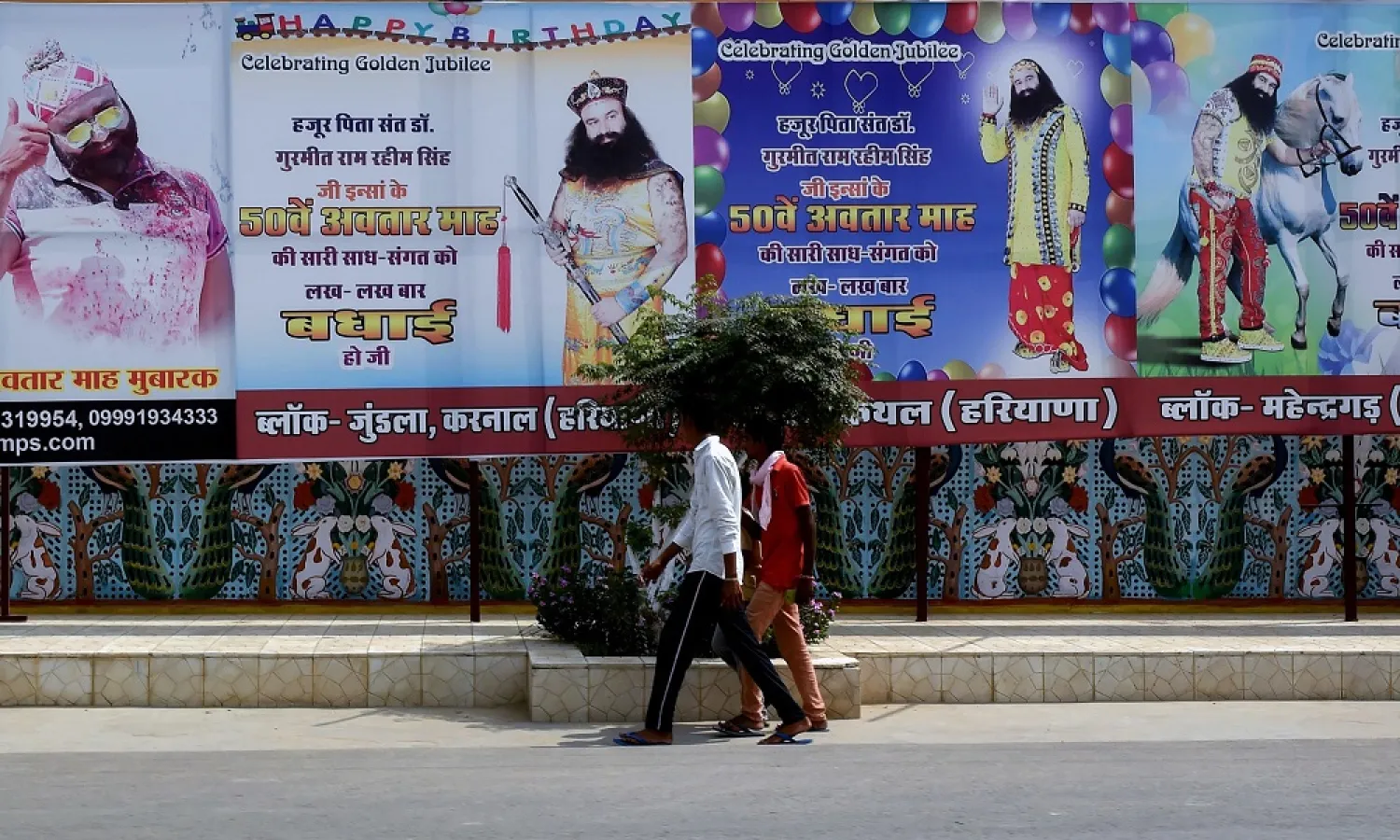
Followers of controversial Indian guru Ram Rahim Singh walk outside the Dera Sacha Sauda ashram in Sirsa. (AFP)
TT

Tensions High in India after Court Jails Controversial Spiritual Leader over Rape

Followers of controversial Indian guru Ram Rahim Singh walk outside the Dera Sacha Sauda ashram in Sirsa. (AFP)

An Indian court on Monday sentenced controversial spiritual guru Gurmeet Ram Rahim Singh to 20 years in prison for raping two female followers of his popular Dera Sacha Sauda sect.

Riots erupted on Friday when the Singh was convicted of the charges, leaving 38 people dead.

He is accused of raping the two women at the sprawling headquarters of his hugely popular sect in the northern state of Haryana in a case that dates back to 1999.

"He has been sentenced for 10 plus 10, which is a total of 20 years of imprisonment," said Abhishek Dayal, spokesman for India's Central Bureau of Investigation (CBI), after the sentencing hearing.

The sentences were pronounced amid intense security at a prison in the northern town of Rohtak where the guru, who calls himself Dr. Saint Gurmeet Singh Ram Rahim Insan, has been held since his conviction.

A lawyer for the victims earlier told AFP that Singh, 50, had been sentenced to 10 years in jail. In fact, he was given two consecutive 10-year sentences.

Authorities had imposed a security clampdown on Rohtak due to fears of a repeat of Friday's violence, when tens of thousands of his supporters set fire to cars and clashed with security forces.

Prime Minister Narendra Modi condemned the violence but his ruling Bharatiya Janata Party, which is also in power in Haryana, was criticized for failing to anticipate the riots.

Police took no chances Monday in Rohtak, where mobile internet was been cut, roads barricaded with barbed wire and soldiers deployed to man checkpoints.

More than 100 of Singh's senior loyalists had been placed in detention as a precautionary measure, said Rohtak police chief Navdeep Singh Virk.

He said his officers would use "whatever force is required" against the guru's devotees should they again resort to violence.

A judge was flown in by helicopter to sentence the spiritual leader, known as the "guru in bling" for his penchant for bejeweled costumes.

The rape case was brought after an anonymous letter was sent to then-prime minister Atal Bihari Vajpayee in 2002, accusing Singh of repeatedly raping the sender and several other women in the hugely popular sect.

A judge asked the federal Central Bureau of Investigation to look into the accusations, but it took years to trace the alleged victims and it was not until 2007 that two women came forward and filed charges.

Utsav Singh Bains, a lawyer for the victims, said there could be dozens more cases of abuse involving women at the sect.

"We believe there are at least 48 more victims who were sexually abused and who may have been killed or are too scared to come out and testify against Ram Rahim," he told AFP by phone.

Singh also stood trial for conspiracy over the murder in 2002 of a journalist investigating the rape allegations. He denied the charge and the case is ongoing.

Over the weekend thousands of followers congregated in the spiritual headquarters of his sect at Sirsa, despite calls from police and troops for them to disperse.

Devotees eventually began trickling out one by one from the compound Sunday, under the supervision of hundreds of soldiers and riot police.

Modi said Sunday it was "natural to be worried" as the violence even briefly reached the capital New Delhi.

"Violence is not acceptable in the nation, in any form," he said in his monthly radio address.

"Those who take law in their hands or take to violence will not be spared, whoever they are."

Haryana authorities came under fire grossly underestimating the risk posed by the army of devotees after violent protests in many parts of the northern state on Friday.

Followers of the self-styled "godman" continue to insist upon his innocence.

Religious sects like Dera Sacha Sauda have huge followings in India. These sects and their leaders inspire intense devotion among their believers and also wield considerable political clout. Many maintain private militias for their protection.

The sect campaigns for vegetarianism and against drug addiction. It also organizes blood-donation and tree-planting drives. Singh's sect describes itself as a social welfare and spiritual organization but he is no stranger to controversy.

In 2015 he was accused of encouraging 400 followers to undergo castration at his ashram so they could get closer to god.

The bling-loving guru, who claims about 50 million followers, is fond of red leather jackets, bejeweled hats, bicep-baring T-shirts - and cinema.

He has started a film franchise in which he stars as the "Messenger of God," or MSG, with divine powers to save the world. In his most recent film, he plays a secret agent armed with a twirled moustache and an assortment of swords to fight aliens and UFOs.



French, Japanese Ships Cross Strait of Hormuz in First Since War

A cargo ship in the Gulf, near the Strait of Hormuz, as seen from northern Ras al-Khaimah, near the border with Oman’s Musandam governance, amid the US-Israeli conflict with Iran, in United Arab Emirates, March 11, 2026. (Reuters)
TT

French, Japanese Ships Cross Strait of Hormuz in First Since War

A cargo ship in the Gulf, near the Strait of Hormuz, as seen from northern Ras al-Khaimah, near the border with Oman’s Musandam governance, amid the US-Israeli conflict with Iran, in United Arab Emirates, March 11, 2026. (Reuters)

One French- and another Japanese-owned vessel are among a handful of vessels to have crossed the war-torn Strait of Hormuz, maritime tracking data showed Friday.

The passage, a vital maritime route for oil and liquified natural gas, has been virtually blocked by Iran since the start of the war, said AFP.

But both ships made the crossing on Thursday, according to ship tracking company Marine Traffic's website.

The Maltese-flagged Kribi belonging to the French maritime transport group CMA CGM crossed the waterway to leave the Gulf on Thursday afternoon, Marine Traffic's data showed.

By early Friday, it was off Muscat, Oman, still broadcasting the message "owner France" on its transponder system in the field usually used to give the destination.

The vessel's navigation data showed it had crossed via an Iranian-approved route through its waters, dubbed the "Tehran Toll Booth" by leading shipping journal Lloyd's List.

- Southern route -

In addition, three tankers -- including one co-owned by a Japanese company -- crossed the Strait of Hormuz on Thursday by taking an alternative, southern route.

They hugged close to the shore of Oman's Musandam Peninsula -- a first in nearly three weeks according to Lloyd's List.

Before the war, which started more than a month ago, about a fifth of global oil and liquefied natural gas (LNG) passed through the Strait.

All three ships signaled they were an "OMANI SHIP" in the message broadcast by their transponder as they crossed the strait.

The Sohar LNG, which was empty when crossing, is co-owned by Japanese shipping company Mitsui O.S.K.

That makes it the first Japanese vessel to exit the Gulf since the start of the war, according to a company statement quoted by Japanese media.

The Hong-Kong flagged New Vision, which crossed the strait on March 1 right after the war started, is expected in the French port of Le Havre on Saturday evening.

Since the conflict started however, that has dwindled to a trickle as Iran selectively attacks ships and energy facilities throughout the Gulf in retaliation for US and Israeli attacks.

A few commercial ships crossing the Strait of Hormuz recently have passed through the Iranian-approved route in the north of the waterway.

- Down to a trickle -

Just 221 commodities vessels have crossed the Strait of Hormuz since March 1, some more than once, according to Kpler data up to Friday morning.

In peacetime, the same waterway handles around 120 daily transits, according to Lloyd's List.

Of the vessels that made the crossing, 60 percent either came from Iran or were heading there.

It was not clear from the data how many had been cleared to make the crossing by Tehran.

But it did show that, among the 118 crossings by ships carrying cargo, 37 had left the Gulf carrying crude oil.

Most of those oil tankers -- 30 of them -- came from Iran or sailed under the Iranian flag. And most ships carrying Iranian oil did not specify their destination on their transponder.

Of those who did, all but one reported they were heading to China.

In the early days of the war, transponder data showed dozens of ships broadcasting messages such as "Chinese crew" or "Chinese owner" in the field usually used for their destination.

This appeared to be an attempt by the ships to avoid being targeted by Iran.


Iran Executes Two Linked to Opposition Group

Executions in Iran have surged in recent years - AFP
TT

Iran Executes Two Linked to Opposition Group

Executions in Iran have surged in recent years - AFP

Iran on Saturday executed two men it said were convicted of links to an opposition group, the People's Mojahedin Organization of ‌Iran, and ‌of carrying out armed ‌attacks, ⁠domestic media reported.

The ⁠executions were the latest in recent days of individuals with PMOI links.

The PMOI confirmed ⁠Saturday's executions, saying ‌in ‌a statement that Iran was "trying ‌to hide its ‌weakness by executing political prisoners, especially PMOI members and supporters." Four PMOI ‌members were executed earlier this week, ⁠it ⁠said.

The group said the two men executed on Saturday were arrested in January 2024 and had their death sentences upheld in December 2025.


Earthquake Kills 8 Members of Same Family near Afghan Capital

Previous earthquake in Afghanistan (Archive-Reuters)
TT

Earthquake Kills 8 Members of Same Family near Afghan Capital

Previous earthquake in Afghanistan (Archive-Reuters)

An earthquake that struck Afghanistan overnight killed eight members of the same family in Kabul province, the health ministry said on Saturday.

The 5.8-magnitude quake struck at 8.42 pm (1612 GMT) on Friday at a depth of 186 kilometers (115 miles) at the epicenter in northeastern Badakhshan province, according to the US Geological Survey (USGS).

Shaking was felt in multiple parts of the country, including the capital Kabul, according to AFP journalists.

"In the Gosfand Dara area of Kabul Province, eight members of a family died as a result of the earthquake," Health Ministry spokesman Sharafat Zaman said in a message to media.

He added that a child aged around two years old was the only survivor from the household and the country's disaster management agency said the boy had been injured in the tremor.

Afghanistan is frequently jolted by earthquakes, particularly along the Hindu Kush mountain range near where the Eurasian and Indian tectonic plates meet.

In August, a shallow magnitude 6 earthquake wiped out mountainside villages and killed more than 2,200 people in eastern Afghanistan, making it the deadliest tremor in the country's recent history.