


Police, Stewards Should Stop Treating Football Fans as the Enemy

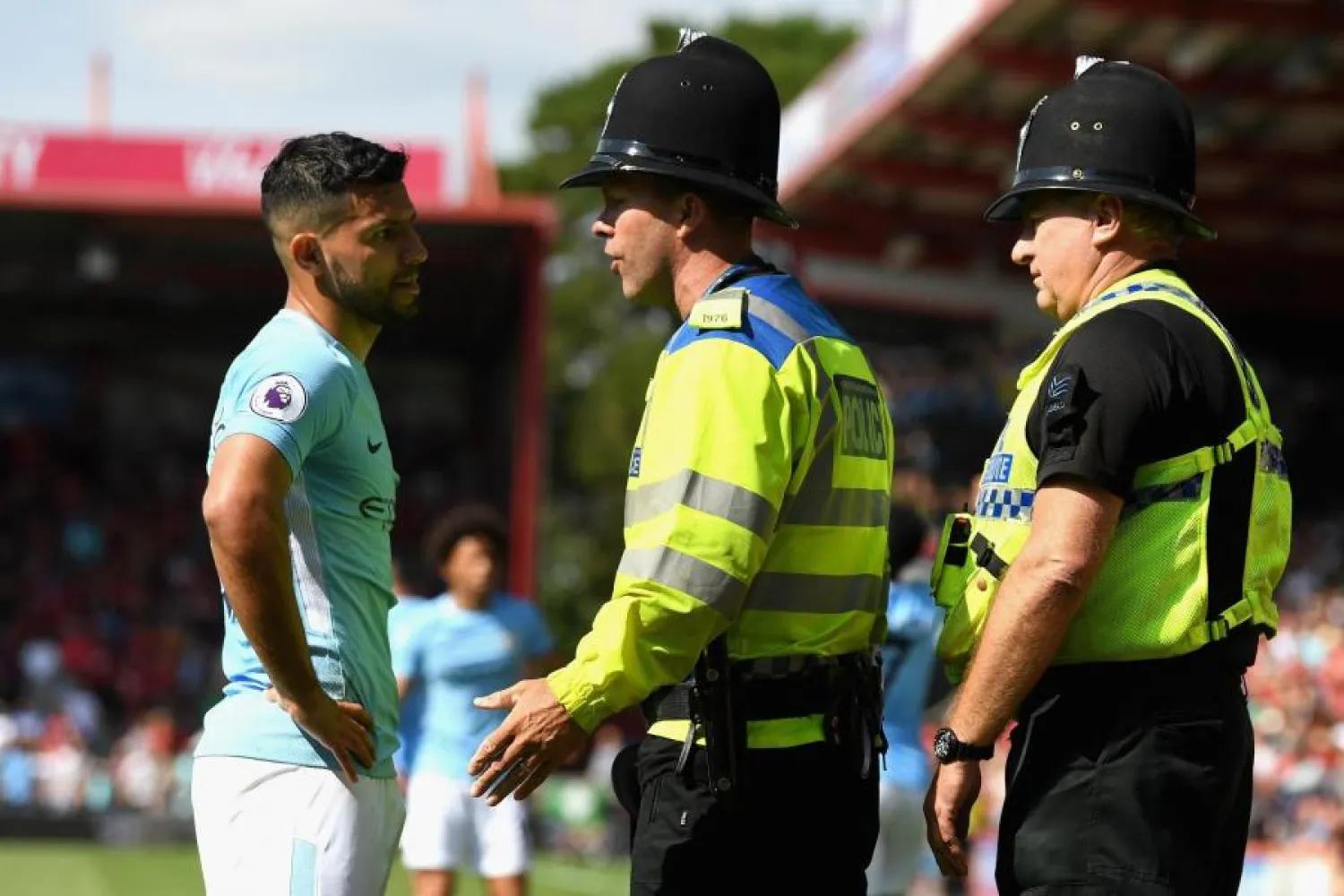
Manchester City striker Sergio Aguero speaks to a police officer after a security incident during his club’s Premier League match against Bournemouth on August 26. (Getty Images)
TT

Police, Stewards Should Stop Treating Football Fans as the Enemy

Manchester City striker Sergio Aguero speaks to a police officer after a security incident during his club’s Premier League match against Bournemouth on August 26. (Getty Images)

The outcry against the treatment of Manchester City fans at Bournemouth is a reminder – heavy-handed police and stewards should be shown the red card, writes Nick Glynn in the Guardian Sport.

It’s great. Your football team scores, first minute, last minute, last minute of injury time, any time. There are 30 seconds of ecstasy, exuberance, jumping around, hugging people you would never hug anywhere else. It is accompanied by smiles, laughter, singing.

For 99.99 percent of football fans, violence could not be further from their minds. Goals are rare in football – I am a lifelong Birmingham City fan, I know this. This is not rugby, or cricket, or tennis, where players score with dreary repetition. This is football, where you can watch a brilliant 90-minute game where there isn’t a single goal.

I remember shaking the hand of a Millwall fan when they beat Leicester away with an 87th-minute goal and saying to him “It’s the best feeling in the world”. He was shocked, expecting me as the police bronze commander for the match to have some sort of action taken against him. Decades earlier I remember rescuing one of my colleagues from the Coventry pen in the Spion Kop at Leicester, as he tried to stop their fans singing George and John’s Sky Blue Army, like singing was some sort of dangerous pastime.

There has been an outcry about the recent treatment of Manchester City fans (and Sergio Agüero) at Bournemouth on August 26 – after Raheem Sterling scored a 97th-minute winner. To be clear, pitch invasions are wrong, but there is a difference between a pitch invasion and joyful celebrations momentarily spilling over the white line and on to the turf – and that is where a bit of common sense is needed.

It is always interesting to watch the reaction of stewards and police officers when a goal is scored. I see fear, anger, aggression, sometimes panic. For many, it seems the overriding desire is to stop a perfectly normal and natural human reaction to a rare event, rather than taking a few steps back, a few deep breaths, remaining calm, and observing and giving half a minute for things to calm down.

And the crowd almost always will calm down, especially where the situation isn’t aggravated by stewards and police officers diving in and unnecessarily intervening. When players go to their own fans to celebrate, don’t worry – there’s nothing to worry about. The fans will be safely back in their seats in a minute, and the players will be getting on with the game.

The reaction of stewards and police officers to goal celebrations is symptomatic of a wider problem with the rules and regulations that govern football fans, and the way that authorities treat them as a group. Many regulations apply only to football fans, and please, don’t try to claim we all deserve it. We don’t.

The Football (Offences) Act 1991 was written in the flawed and biased times after the Hillsborough disaster, when the public were conned by a tabloid newspaper’s lying headlines and the perception supported by politicians of the time that all football fans were “scum”, capable of urinating on dying fans.

Those lies are perpetuated in the Football (Offenses) Act and the underlying sentiment of dislike and suspicion of football fans is preserved in its use by the police and stewards across the country. We’re all hooligans, deep down, goes the thinking.

Some of the laws that govern football are ridiculous. The rules on pitch encroachment are too broad. We want to prevent pitch invasions, not criminalize and throttle someone who steps over a line by a few centimeters while celebrating.

Throwing coins can blind someone or cause other serious injury. If the individuals who throw coins can be identified, I welcome the full force of the law being used. Technically, within the “missile throwing” provisions, throwing the match ball back on to the pitch can be a criminal offense. So can throwing the ball to the kid who desperately wants to be the one who throws the ball back on to the pitch. Simply drinking alcohol in sight of the pitch is a criminal offense. The rules are outdated and ridiculous.

Now that the Hillsborough victims and their families are finally on their way to seeing real justice, and trials of safe standing are finally on the cards – at last – a review of the Football (Offenses) Act and other relevant rules and regulations that cover football is long overdue. Inconsistencies in how football is policed and stewarded cannot continue. It is time for an independent, national review.

As for headlocks – as suffered by the fan on the pitch at Bournemouth last weekend, who Agüero seemed so keen to help – there is no need for a review or new laws. Section 3 of the Criminal Law Act 1967 makes it clear that force used by the police, and anyone else, including football stewards, must be reasonable in the circumstances. Force has to be proportionate to the threat being dealt with.

Headlocks are not outlawed (any use of force could be reasonable in the right circumstances), but the only circumstances that could justify use of a headlock are where the violence or risk being averted is so serious that causing death or really serious injury to the “assailant” would be justified.

Make no mistake, headlocks can kill. Therefore justification for their use is rare. A simple reminder of that fact to police officers and football stewards might be enough to avert an easily avoided tragedy.

*Nick Glynn is a retired senior police officer. He is an expert witness on police use of force, and was a football commander and adviser for nearly two decades.

The Guardian Sport


Wawrinka ‘at Peace’ with Retirement but No Plans to Go Quietly

Switzerland's Stan Wawrinka serves to Great Britain's Jacob Fearnley during their men's singles match on day 2 of the French Open tennis tournament at the Roland-Garros Complex in Paris on May 26, 2025. (AFP)
TT

Wawrinka ‘at Peace’ with Retirement but No Plans to Go Quietly

Switzerland's Stan Wawrinka serves to Great Britain's Jacob Fearnley during their men's singles match on day 2 of the French Open tennis tournament at the Roland-Garros Complex in Paris on May 26, 2025. (AFP)

Three-time Grand Slam winner Stan Wawrinka said Monday he was "at peace" with his decision to make 2026 his last year on tour but insisted there were still goals to meet.

The 40-year-old announced this month that he plans to call it quits, with the United Cup in Perth starting Friday the beginning of the end for the popular Swiss star.

"Of course, I'm still passionate about the game, about the sport I love," he said.

"What I received from it, the emotion playing in a different country, coming back here with a lot of fans, a lot of support, so I'm going to miss that part, that's for sure," he said.

"The last few months, I've had time to decide whether it will be my last year or not, and for me, it's quite clear. I'm happy with the decision, I'm at peace with that."

Wawrinka won the Australian Open in 2014, the French Open a year later and the US Open in 2016, at a time when Roger Federer, Rafael Nadal and Novak Djokovic were dominating men's tennis.

A former world number three, he is now ranked 157 after struggling with injuries but said he would work as hard as ever this season.

"I still want to play some good tennis, I still have goals. Hopefully I can come back in the top 100, finish on a good ranking," he said.

"I want to play the full year, the big tournaments, the main ones, and let's see my ranking in the next few months."

Wawrinka has 16 career ATP titles although the last came in Geneva in 2017.

He won Olympic gold in doubles alongside Federer at Beijing in 2008 and helped deliver a first Davis Cup triumph for Switzerland in 2014.

Wawrinka leads a Swiss team also boasting world number 11 Belinda Bencic at the mixed-teams United Cup where they are grouped with France and Italy.


Sudan Beat Equatorial Guinea for Rare AFCON Win

A woman poses for picture in front of AFCON 2025 symbol outside the Fan Zone in Marrakech city on December 25, 2025, during the Africa Cup of Nations (CAN) football tournament. (Photo by Khaled DESOUKI / AFP)
TT

Sudan Beat Equatorial Guinea for Rare AFCON Win

A woman poses for picture in front of AFCON 2025 symbol outside the Fan Zone in Marrakech city on December 25, 2025, during the Africa Cup of Nations (CAN) football tournament. (Photo by Khaled DESOUKI / AFP)

Sudan boosted their chances of qualifying for the knockout stage of the Africa Cup of Nations after a Saul Coco own goal gave them a 1-0 win over Equatorial Guinea on Sunday.

Unlucky Torino center-back Coco saw the ball come off him and ricochet into the net in the 74th minute in Casablanca when his teammate Luis Asue attempted to clear a Sudan free-kick, AFP reported.

Sudan won the Africa Cup of Nations in 1970 but this is just their second victory in 18 matches across six appearances at the tournament since then.

They lie 117th in the FIFA world rankings, compared to Equatorial Guinea in 97th.

The win leaves Kwesi Appiah's team on three points from two games in Group E, while Equatorial Guinea have lost both matches so far.

Sudan are competing at this AFCON in Morocco despite the country having been devastated since war broke out between the army and the Rapid Support Forces (RSF) in April 2023.

They will play Burkina Faso in their last group game on Wednesday and will be aiming to reach the knockout stages of the Cup of Nations for just the second time since that 1970 triumph -- they got to the quarter-finals in 2012 before losing to eventual winners Zambia.


Hakimi Could Finally Make 2025 Africa Cup of Nations Bow against Zambia

Paris 2024 Olympics - Football - Men's Quarter-final - Morocco vs United States - Parc des Princes, Paris, France - August 02, 2024. Achraf Hakimi of Morocco celebrates scoring their third goal. REUTERS
TT

Hakimi Could Finally Make 2025 Africa Cup of Nations Bow against Zambia

Paris 2024 Olympics - Football - Men's Quarter-final - Morocco vs United States - Parc des Princes, Paris, France - August 02, 2024. Achraf Hakimi of Morocco celebrates scoring their third goal. REUTERS

Morocco coach Walid Regragui has confirmed captain Achraf Hakimi is fit to face Zambia in their final ​Group A clash at the Africa Cup of Nations on Monday after two false starts in the competition so far.

Hakimi was crowned Africa’s best player at the Confederation of African Football awards last month but appeared ‌at the ‌ceremony in Rabat ‌on ⁠crutches, ​sparking doubt ‌over whether he would recover in time for the finals, according to Reuters.

The Paris St Germain right-back said he felt ready to play on the eve of the tournament, but has not been used in ⁠host Morocco’s opening two games, a 2-0 victory ‌over Comoros and a ‍1-1 draw against ‍Mali.

However, Regragui said on Sunday that ‍the player is now available and thanked PSG for aiding the player’s recovery and releasing him early to link up with ​the national team and work with their medical staff.

“I want to thank ⁠Paris St Germain. If Hakimi is back with us today, it's thanks to them,” Regragui said.

"There's not a single club in the world that would release a player 15 days before the start of the Africa Cup of Nations.

Morocco need victory over Zambia to ensure they win Group B having ‌last lifted the Cup of Nations trophy in 1976.
