

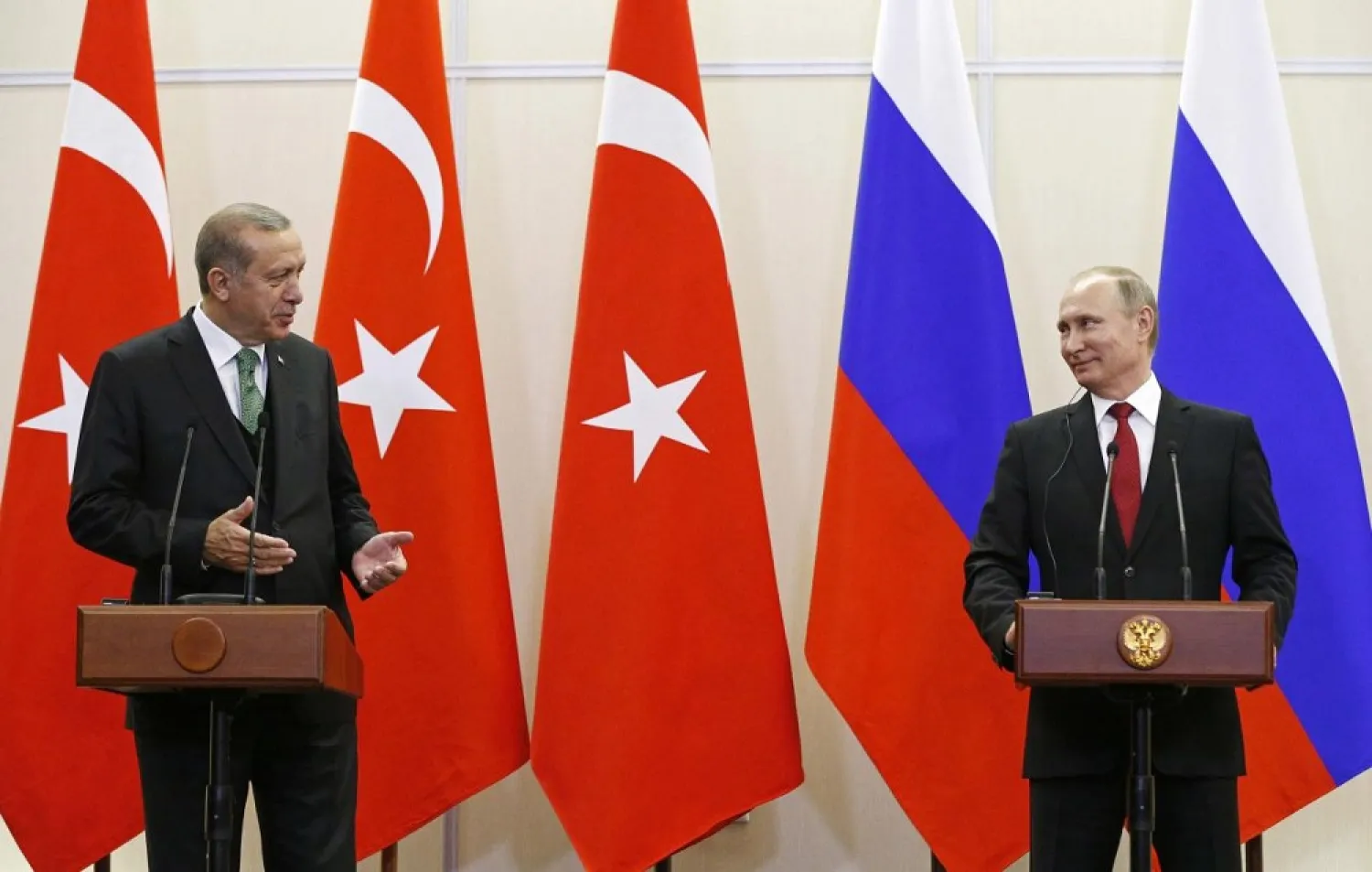

Russia, Turkey Sign S-400 Deal despite Criticism and Suspicion

Russian President Vladimir Putin and Turkish President Recep Tayyip Erdogan. (Reuters)
TT

Russia, Turkey Sign S-400 Deal despite Criticism and Suspicion

Russian President Vladimir Putin and Turkish President Recep Tayyip Erdogan. (Reuters)

Moscow and Ankara confirmed on Tuesday that they signed a deal in which Moscow would sell Ankara S-400 missiles.

“Signatures have been made for the purchase of S-400s from Russia. A deposit has also been paid as far as I know,” President Recep Tayyip Erdogan said on Monday.

He stated that he and Russian President Vladimir Putin “are determined on this issue.”

This is the largest deal that Turkey signs with a country from outside NATO. It represents an advanced political step in the journey of normalizing relations between the two sides after a crisis that erupted when a Turkish jet shot down a Russian aircraft over Syria in 2015.

Turkey’s announcement of its intention to purchase the Russian missile system triggered however negative reaction from Ankara’s allies in NATO.

US Defense Secretary James Mattis stated earlier that the US will not impede the S-400 missiles deal, saying that it is a Turkish “sovereign decision”. He did complain however over the incompatibility between the Russian system and the NATO systems.

Russian analysts also voiced their skepticism.

Center for Strategic Studies Director Ivan Konovalov declared that the prospect of signing the deal “is part of the political game,” but he added that nothing “can be ruled out at this current time.”

Russia says that S-400 missiles are designed to protect vital political, economic, administrative and military facilities from airstrikes, and are considered of the most advanced systems in the air- and anti-missiles defense.

China was the first country to purchase this system from Russia.


Deliberate Attacks on Civilian Targets ‘A War Crime’, Says UN

An Iranian flag lies amidst the rubble of a building of the Sharif University of Technology, which was damaged in a strike, amid the US-Israeli conflict with Iran, in Tehran, Iran, April 7, 2026. Majid Asgaripour/WANA (West Asia News Agency) via Reuters
TT

Deliberate Attacks on Civilian Targets ‘A War Crime’, Says UN

An Iranian flag lies amidst the rubble of a building of the Sharif University of Technology, which was damaged in a strike, amid the US-Israeli conflict with Iran, in Tehran, Iran, April 7, 2026. Majid Asgaripour/WANA (West Asia News Agency) via Reuters

The UN rights chief decried Tuesday the "incendiary rhetoric" in the Middle East war, warning that deliberate attacks on civilians and civilian infrastructure was "a war crime".

"Under international law, deliberately attacking civilians and civilian infrastructure is a war crime," UN high commissioner for human rights Volker Turk said in a statement, insisting that "anyone responsible for international crimes must be held to account by a competent court."

His comment came as US President Donald Trump ramped up his rhetoric against Iran, vowing to carry out the "complete demolition" of critical infrastructure, particularly bridges and power plants if Iran did not agree a deal by late Tuesday.

Hours before the deadline, the Israeli military said it had already completed a broad wave of strikes targeting "infrastructure sites" across Iran.

Writing on Truth Social, Trump stated that "a whole civilization will die tonight, never to be brought back again. I don't want that to happen, but it probably will", if the country does not heed his call for a deal.

Turk did not explicitly mention Trump nor the other countries involved in the conflict that began on February 28. But he said "I deplore the tirade of incendiary rhetoric being used in the Middle East war over the last couple of weeks by all parties."

In particular, he highlighted "the latest threats to annihilate a whole civilization and to target civilian infrastructure".

"This is sickening," he said, warning that "carrying through on such threats amounts to the most serious international crimes".

The UN rights chief stressed that "threats that spread fear and terror among civilians are unacceptable and must cease immediately."

He called on the international community to "take urgent steps to de-escalate the situation and to help protect the lives of all civilians."


Israel Army Chief Vows to ‘Intensify Damage Inflicted on Regime’ in Iran

Smoke rises following strikes on Tehran on April 7, 2026. (AFP)
TT

Israel Army Chief Vows to ‘Intensify Damage Inflicted on Regime’ in Iran

Smoke rises following strikes on Tehran on April 7, 2026. (AFP)

Israeli military chief Lieutenant General Eyal Zamir said on Tuesday that the joint US-Israeli offensive against Iran was "approaching a strategic crossroads" and vowed to "intensify the damage inflicted on the regime".

"We are approaching a strategic crossroads in the joint campaign against Iran. So far, we have achieved significant gains, including relative to the objectives we set at the outset of the operation," Zamir was quoted as saying in a military statement.

"We will continue to act with determination and intensify the damage inflicted on the regime."

The remarks came after the Israeli military announced it had struck eight bridges that it said were used by Iran's armed forces "for transporting weapons and military equipment".

Zamir also spoke of military operations in Lebanon, where Israeli forces have been fighting Iran-backed Hezbollah since March 2.

"Lebanon constitutes an additional central arena," Zamir said in the statement, adding that troops were "deepening the multi-focal effort to degrade the Hezbollah terrorist organization".

"We continue to establish a forward defense posture to prevent direct fire toward our communities, while simultaneously operating against surface-to-surface fire," he added.

Earlier on Tuesday, the Israeli military said it had completed the deployment of ground troops along a "defense line" in southern Lebanon.

"War carries heavy costs, and we will continue to act to remove threats against our civilians," Zamir said.

The Israeli military has announced the deaths of 11 soldiers in combat in southern Lebanon.


Iran Judiciary Urges Courts to ‘Speed Up’ Execution Verdicts

Women take part during a ceremony for the memorial of Minab school children who were killed in an airstrike on 28 February, in Tehran, Iran, 07 April 2026. (EPA)
TT

Iran Judiciary Urges Courts to ‘Speed Up’ Execution Verdicts

Women take part during a ceremony for the memorial of Minab school children who were killed in an airstrike on 28 February, in Tehran, Iran, 07 April 2026. (EPA)

Iran's hardline judiciary chief on Tuesday urged courts to speed up verdicts linked to the US-Israeli war, including capital punishment, as activists sounded the alarm about surging hangings of convicts seen as political prisoners.

Since the war began on February 28, Iran has hanged seven people in connection with January protests, six convicted of membership of banned opposition group the People's Mujahedin of Iran (MEK) and a dual Iranian-Swedish citizen on charges of spying for Israel.

Rights groups have warned dozens more are at risk of execution over the January protests or after being arrested on suspicion of helping the enemy during the current war.

"You need to speed up the issuing of sentences for executions and the confiscation of property," judiciary chief Gholam Hossein Mohseni Ejei told a televised meeting of senior judiciary officials.

Using existing laws on punishing espionage, "it is necessary to continue issuing judicial verdicts for elements and agents of the aggressor enemy with greater speed", he added.

Iranian Nobel Peace Prize laureate Shirin Ebadi, who now lives in exile, said on Telegram that instead of defending Iranians in the face of threats by US President Donald Trump, Tehran’s response "is to accelerate executions, repression and confiscation of the opposition's property".

Two teenagers are among those who have been executed over the January protests, which were suppressed by authorities in a crackdown that left thousands dead, according to rights groups.

Authorities have branded those facing hanging over those protests as "terrorists" who acted on behalf of Israel and the United States, but rights groups have said they were convicted in "grossly unfair" trials.

"In the midst of the ongoing war, the execution of death sentences for protesters and political prisoners through non-transparent and hasty processes is seen as an attempt to instill fear and maintain control over society," said the US-based Abdorrahman Boroumand Center rights group.

With wartime arrests continuing, national police chief Ahmad Reza Radan was quoted by state media as saying that 85 people had been arrested in 25 provinces for operating in an alleged "organized network" sending location information to Iran's enemies.

"The confessions of the accused and the full details of how they collaborated with the enemy will be published soon," he added.

Rights groups accuse Iranian authorities of using torture to extract from prisoners false confessions that are then broadcast during televisions news bulletins.
