


Germany’s Stand on ‘Despicable’ Fans Puts Silent England to Shame

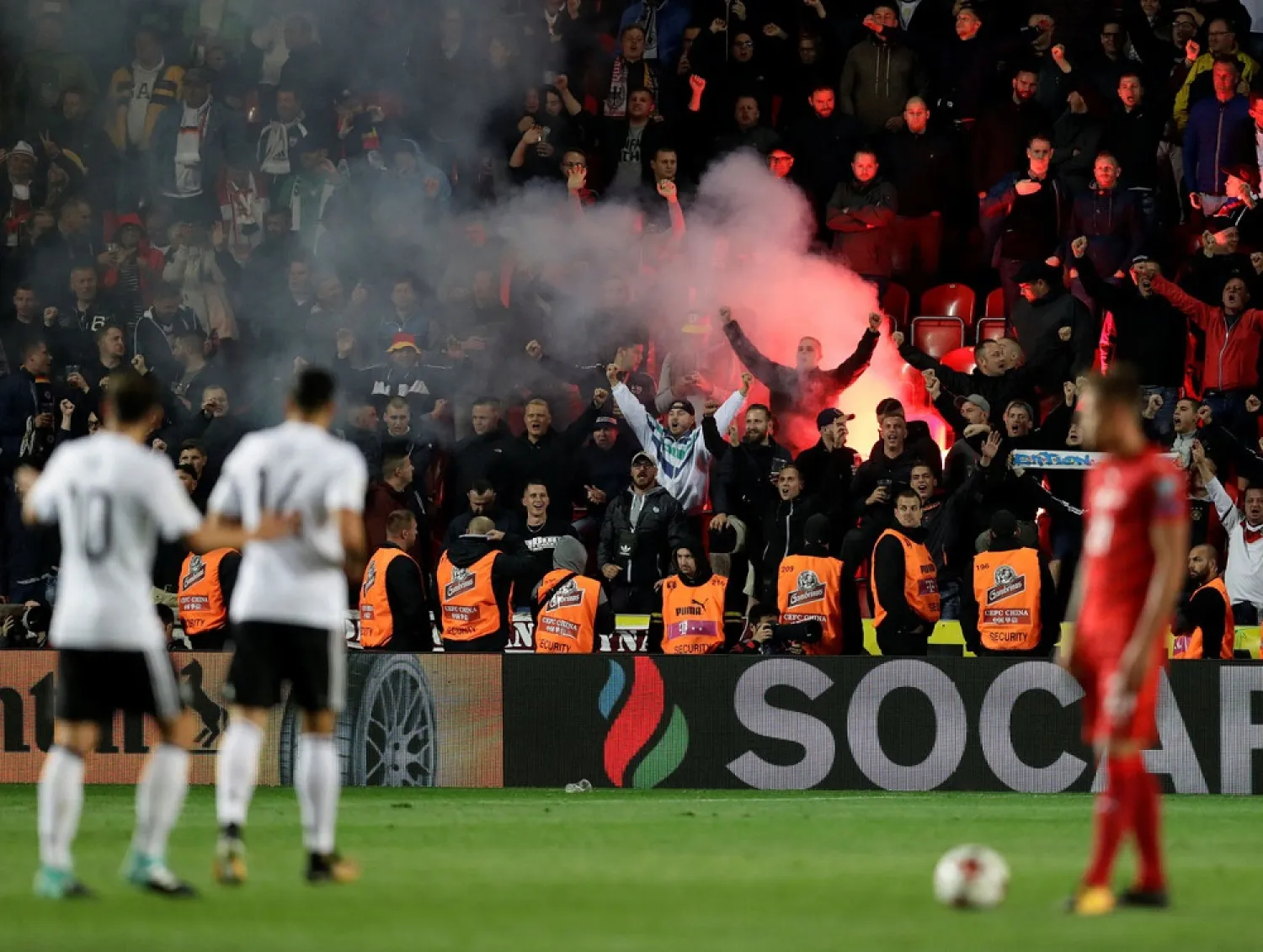
German supporters light flares during the FIFA World Cup 2018 qualifying match between Germany and the Czech Republic in Prague on September 1, 2017. (Reuters)
TT

Germany’s Stand on ‘Despicable’ Fans Puts Silent England to Shame

German supporters light flares during the FIFA World Cup 2018 qualifying match between Germany and the Czech Republic in Prague on September 1, 2017. (Reuters)

That was some performance from Joachim Löw, the Germany national manager, after the jarring evidence during the international break that there are still a few troglodytes among his team’s support who seem hell-bent on providing living proof of Einstein’s theory that there is no limit to human stupidity.

Löw had just seen his team win 2-1 against the Czech Republic in Prague, maintaining an immaculate record in their World Cup qualifying group, but when he arrived for his press conference, face like thunder, the questions about his team’s performance had to wait. “I am neither upset nor sad,” he began. “I am full of rage, that explains my feelings better. I am really, really angry about this – that some so-called fans have used the stage of an international football match, and the stage of football, to bring shame on our country with their embarrassing behavior and appearance. We don’t want these anarchists. We are not their national team and they are not our fans. Their behavior was the lowest of the low and utterly despicable.”

It isn’t usual to hear a manager speak this way but, then again, these weren’t usual circumstances. A section of Germany’s support had disrupted a minute’s silence, abused one of their own players, Timo Werner, and followed up the traditional chants of “Sieg” (victory) towards the end of the game with an echoed “Heil”. It was an abomination and, at the final whistle, something happened that the people who follow die Mannschaft tell me they have never seen before. Germany’s players refused to go to the away end. They didn’t wave, there was no clapping, zero appreciation. It was a choreographed protest, a public disavowal and a clear, defiant message that they didn’t want any association.

For that, the players deserve our applause and Mats Hummels, in particular, as the captain who directed his team-mates off the pitch and made it absolutely clear it was a time to make a stand. “The chants were a catastrophe,” Hummels said later. “They started during the minute’s silence, which shows you the kind of people we’re dealing with. Timo Werner was insulted and ridiculed. Then the fans started shouting their insults. We distance ourselves completely from it and want nothing to do with it. And that’s why we didn’t go [to them].”

Bravo, that man, and what a pity England’s players did not have it in them to do the same in response to that abysmal night in Dortmund six months ago and the absence of respect for their hosts from the corner of the Westfalenstadion decorated in St. George’s flags.

That occasion needed a strong voice, too, when virtually the entire soundtrack was about the second world war and the only real choreography came in the form of the outstretched arms, creating a fleet of pretend fighter planes, during the various renditions of Ten German Bombers, one lasting fully 15 minutes, and how “the RAF from England shot them down”.

Unfortunately, it did not get one. Gareth Southgate’s comments were, frankly, not nearly enough and let’s not kid ourselves: it won’t even have crossed the players’ minds that they might be in a position to affect change and try to stop it happening again. The modern‑day England footballer just isn’t made that way. You will never find one speaking in the way that Hummels did. And more’s the pity.

The only counter-argument is that the 21,000-capacity Eden Arena in Prague is a much smaller stadium than the Westfalenstadion, making what happened feel even more intrusive and lamentable, and the behavior was on a different, more sinister level than the backdrop to the Germany-England encounter.

Maybe that’s true. Reports in Germany say the 100 or so troublemakers were associated with Dynamo Dresden and a number of other clubs from the former East Germany, where right‑wing extremism is said to be more prominent than other parts of the country. They mostly wore black and targeted their own football association with chants of “scheisse, DFB” during what was supposed to be a minute’s silence. Rudolf Kocek, president of the Czechoslovak FA when they won 1976 European Championship, was one of the people the host nation wanted to remember. Rudolf Bat’a, the organization's former general secretary, was another; and so was Lenka Civinova, who was on holiday in Egypt during the summer when a terrorist went on the rampage in two beachfront hotels. Civinova, 36, the Czech FA’s accountant, was among the seven tourists stabbed. Two of the dead were actually from Germany.

It isn’t easy to understand why anybody would want to shout that down, but don’t forget what happened when England arranged a minute’s silence against Brazil in 2013 to honor the people who died in the Munich air tragedy, the 20th anniversary of Bobby Moore’s death and the 238 victims of a nightclub fire in Santa Maria. Perhaps you might remember the England-Wales match in 2004 and what happened after a request by the authorities for a minute’s silence for Ken Bigley, the news of whose murder by terrorists in Iraq had broken the previous day.

The difference on those occasions is that it is very rare for anyone involved with England – the manager, the captain, any of the players – ever to dare criticize their own supporters, even when criticism would be deserved, and it is a shame they have never found their voice when Löw, Hummels and their various colleagues have shown that it is possible to make a stand and in the process, change the narrative.

The FA did hold a media briefing three months after the Dortmund game to go over what had happened but nobody from the England setup itself was prepared to go on record even though it was clear by that point it was more than just a few beery, offensive chants. The footage of England’s end showed people making Nazi salutes and slit-throat gestures. One member of the choir could be seen holding a finger above his lip to imitate Hitler, in between gesturing that he would stab the German fans. All of which brought to mind the verdict of one Philadelphia Inquirer columnist after the United States had been awarded the 1994 World Cup. “What’s the first word to come into your head when I say: ‘British soccer fan’?” he asked. “It was ‘sub-human’, wasn’t it? I rest my case.”

It’s a nice line but, in reality, there are plenty of people who go abroad to watch England and enjoy their adventures without restoring to time‑warp chanting, 90-minute xenophobia or pretend patriotism about conflicts from another phase of history.

Yet it was still easy enough to find lads going through “No Surrender” in the queues on Wembley Way after England’s last game and, when it comes to next year’s World Cup, it has been interesting to hear from the relevant authorities about some of the supporters who will be making that trip to Russia and why those people had better wise up bearing in mind what could be waiting for them.

England’s troublemakers still tend to wear the same uniform that was fashionable on the terraces a quarter of a century ago – Stone Island, Burberry, Adidas trainers (more Gazelles than the Maasai Mara) – but it is a different form of trouble these days. The old category-C hooligans have gone, for the most part, and in their place it is a new breed of younger supporters, largely 19 to 25, who are not so dangerous but make up for that by adopting an anything-goes, stag-weekend mentality, whereby they take pride in behaving badly and regard England trips as a bit of escapism. When the FA’s travel club emailed its members after the Germany game a number of replies came back telling the FA to stop being spoilsports, arguing the behavior was exactly how they liked it.

The difficult part is breaking that kind of mentality and perhaps Southgate and his players missed a trick when the alternative, as their equivalents in Germany have shown, would have been to turn their backs and disown the people who still confuse international football matches with old medieval tournaments.

It doesn’t automatically mean that when Germany go on future excursions the demagogues and dunderheads will stay away or come with a new songbook. But at least the manager and players of the world champions have realized this kind of behavior affects them, too, and that it would be better to confront it rather than sitting on their hands and deciding it is somebody else’s problem. That has to count for something and, for that alone, it is tempting to think their English counterparts could learn a thing or two.

The Guardian Sport


Injured Aubameyang to Miss International Swansong with Gabon

 Gabon's forward #09 Pierre-Emerick Aubameyang scores a goal in front of Mozambique's defender #17 Edson Sitoe during the Africa Cup of Nations (CAN) Group F football match between Gabon and Mozambique at Grand Stadium in Agadir on December 28, 2025. (AFP)
Gabon's forward #09 Pierre-Emerick Aubameyang scores a goal in front of Mozambique's defender #17 Edson Sitoe during the Africa Cup of Nations (CAN) Group F football match between Gabon and Mozambique at Grand Stadium in Agadir on December 28, 2025. (AFP)
TT

Injured Aubameyang to Miss International Swansong with Gabon

 Gabon's forward #09 Pierre-Emerick Aubameyang scores a goal in front of Mozambique's defender #17 Edson Sitoe during the Africa Cup of Nations (CAN) Group F football match between Gabon and Mozambique at Grand Stadium in Agadir on December 28, 2025. (AFP)
Gabon's forward #09 Pierre-Emerick Aubameyang scores a goal in front of Mozambique's defender #17 Edson Sitoe during the Africa Cup of Nations (CAN) Group F football match between Gabon and Mozambique at Grand Stadium in Agadir on December 28, 2025. (AFP)

Pierre-Emerick Aubameyang’s international career looks to have ended with a whimper as he headed back to France on Tuesday and will miss Gabon’s last game at the Africa Cup of Nations ​finals.

After losing their opening two matches in Group F to Cameroon and Mozambique, Gabon have been eliminated with one match left to play against holders Ivory Coast in Marrakech on Wednesday.

At the age of 36, it was expected the clash against the Ivorians would bring down the curtain on his 16-year international career, but he will skip the last group game as he returns to his club ‌Olympique de Marseille. ‌

A thigh injury on the eve of ‌the ⁠tournament ​in Morocco ‌meant his participation was in doubt, but he came on after 30 minutes against Cameroon in Gabon’s opening game on Christmas Eve and played the full game against Mozambique on Sunday, scoring in the 3-2 defeat.

“Following the established medical protocol between Marseille and Gabon medical staff regarding Pierre-Emerick Aubameyang, clinical examinations were conducted daily,” said a statement on Tuesday from the ⁠Gabon football federation.

“The most recent examination confirmed the discomfort he experienced in his left thigh ‌the day after the Gabon-Mozambique match. Given the ‍disappointing results, which cut short ‍Gabon’s participation, the medical staff, in consultation with his club, agreed to ‍protect the player's physical well-being by exempting him from the final, inconsequential match."

GABON’S LONG TIME TALISMAN

Aubameyang has long been Gabon’s talisman, electing to play for the team his father had captained, even after playing for France, where he ​was born, at junior level.

He made his debut for Gabon in 2009, scoring against Morocco in a World Cup qualifier, ⁠and went on to win 82 caps and score 39 goals.

Aubameyang helped Gabon reach the Cup of Nations quarter-final when they hosted the tournament in 2012 but was the only player to fail to convert his penalty in a post-match shootout loss to Mali.

The tournament in Morocco was Aubameyang’s sixth Cup of Nations finals appearance. He was African Footballer of the Year in 2015.

Earlier this year, he helped Gabon finish as one of the four best runners-up in the World Cup qualifiers, including four goals in the game against Gambia in October.

Gabon, however, lost in ‌last month’s Africa playoffs, ending hopes of qualifying for a first-ever World Cup finals appearance in North America next June.


Hosts Morocco Cruise as South Africa Reach Cup of Nations Last 16

Ayoub El Kaabi is mobbed by teammates after scoring his second goal in Morocco's 3-0 win over Zambia. Gabriel BOUYS / AFP
TT

Hosts Morocco Cruise as South Africa Reach Cup of Nations Last 16

Ayoub El Kaabi is mobbed by teammates after scoring his second goal in Morocco's 3-0 win over Zambia. Gabriel BOUYS / AFP

Ayoub El Kaabi's brace helped Morocco to a 3-0 win over Zambia on Monday as the Africa Cup of Nations hosts cruised into the last 16 while South Africa beat Zimbabwe 3-2 to also secure a berth in the knockout phase.

African player of the year Achraf Hakimi made his comeback from almost two months out injured for Morocco as Mali also qualified for the next round and Mohamed Salah was rested for Egypt's 0-0 draw against Angola.

Morocco are the tournament favorites as the host nation and Africa's top-ranked team but they were booed off by supporters following a 1-1 draw against Mali in their last outing.

Nevertheless, Walid Regragui's team knew a win against Zambia at the Prince Moulay Abdellah Stadium in capital Rabat would guarantee their progress to the next round in first place in Group A and they outclassed their opponents.

Olympiakos striker El Kaabi nodded in an early opener and scored an overhead kick shortly after half-time, with both of his goals set up by the outstanding Azzedine Ounahi.

In between, Real Madrid attacking midfielder Brahim Diaz swept home Morocco's second goal on 27 minutes at the end of a fine team move, again involving Ounahi.

Diaz has found the net in all three of Morocco's games so far and he and El Kaabi join Algeria captain Riyad Mahrez on three goals at the top of the Cup of Nations scoring charts.

Captain Hakimi came off the bench in the 64th minute for his first appearance since suffering an ankle injury in action for Paris Saint-Germain at the beginning of November.

Morocco will stay in Rabat for a last-16 tie in the same stadium on Sunday against one of the best third-place finishers.

"Scoring early on changes everything," said Regragui. "We need to continue like this but not get carried away and keep our feet on the ground."

Zambia go out and have now failed to win any of their 12 AFCON matches across four tournament appearances since lifting the trophy in 2012.

Mali go through in second place after a 0-0 draw with Comoros in Casablanca, a game they ended with 10 men after Amadou Haidara was sent off.

It was a third stalemate in as many matches for the Eagles, who will remain in Morocco's largest city for a last-16 tie on Saturday.

Salah rested by Egypt

Earlier, Oswin Appollis converted a late penalty to give South Africa victory against Zimbabwe in Marrakesh as Bafana Bafana qualified for the knockout stage.

Rising star Tshepang Moremi gave South Africa an early lead with a deflected effort.

However, falling behind motivated Zimbabwe and they deservedly levelled on 19 minutes thanks to the individual brilliance of Tawanda Maswanhise from Scottish Premiership club Motherwell.

Maswanhise gained possession inside the South African half, dribbled past two opponents and fired the ball wide of goalkeeper Ronwen Williams into the far corner.

South Africa began the second period aggressively and regained the lead on 50 minutes through Burnley striker Lyle Foster, for whom it was a second goal of the tournament.

Zimbabwe brought it back to 2-2 on 73 minutes when Aubrey Modiba conceded an own goal, but Appollis then netted from an 82nd-minute penalty to give Bafana the lead for the third time, which they retained.

"Once again we fell asleep after a good start. We continuously lost possession," said 73-year-old South Africa coach Hugo Broos.

"Our passing was bad at times and we should have concentrated on retaining possession in the closing minutes instead of seeking a fourth goal. We have to work on controlling games."

Egypt, who rested stars like captain Salah with first place already assured, topped Group B with seven points after their draw against Angola in Agadir. South Africa finished with six points, Angola two and Zimbabwe one.

The last round of group games continues on Tuesday, with Tanzania playing Tunisia and Nigeria facing Uganda in Group C. Senegal take on Benin and the Democratic Republic of Congo play Botswana in Group D.


Japan Great Miura, 58, Joins New Club to 'Make History'

This picture taken on December 1, 2016 shows Japanese football player Kazuyoshi Miura speaking to journalists in Tokyo. (AFP)
TT

Japan Great Miura, 58, Joins New Club to 'Make History'

This picture taken on December 1, 2016 shows Japanese football player Kazuyoshi Miura speaking to journalists in Tokyo. (AFP)

Japanese soccer great Kazuyoshi Miura, 58, has signed a new loan deal with the Japanese third division ​side Fukushima United, setting him up for his 41st season as a professional footballer.

Miura, known as "King Kazu", will also be playing his first season in five years in the top three divisions of Japanese ‌football.

"My passion ‌for football hasn't changed, ‌no ⁠matter ​how ‌old I get," Miura, who turns 59 in February, said.

"I'm very grateful to be given this opportunity. I promise I will play with everything I have to make a contribution."

"Let's make ⁠history together."

The forward, who started his professional career ‌for Brazilian club Santos ‍in 1986, also ‍competed at several European clubs across ‍Italy (Genoa), Croatia (Dinamo Zagreb) and Portugal (Oliveirense) throughout his career.

This will be his fourth loan spell since 2022 from J2 League side ​Yokohama FC.

He went goalless last season, playing a total of 69 ⁠minutes across seven games at fourth-tier club Atletico Suzuka, while his side was relegated to Japan's regional leagues.

Miura scored 55 goals in 89 appearances for Japan after making his debut in 1990, but was famously dropped from the side for their first World Cup appearance in 1998, before he retired ‌from international football in 2000.
