

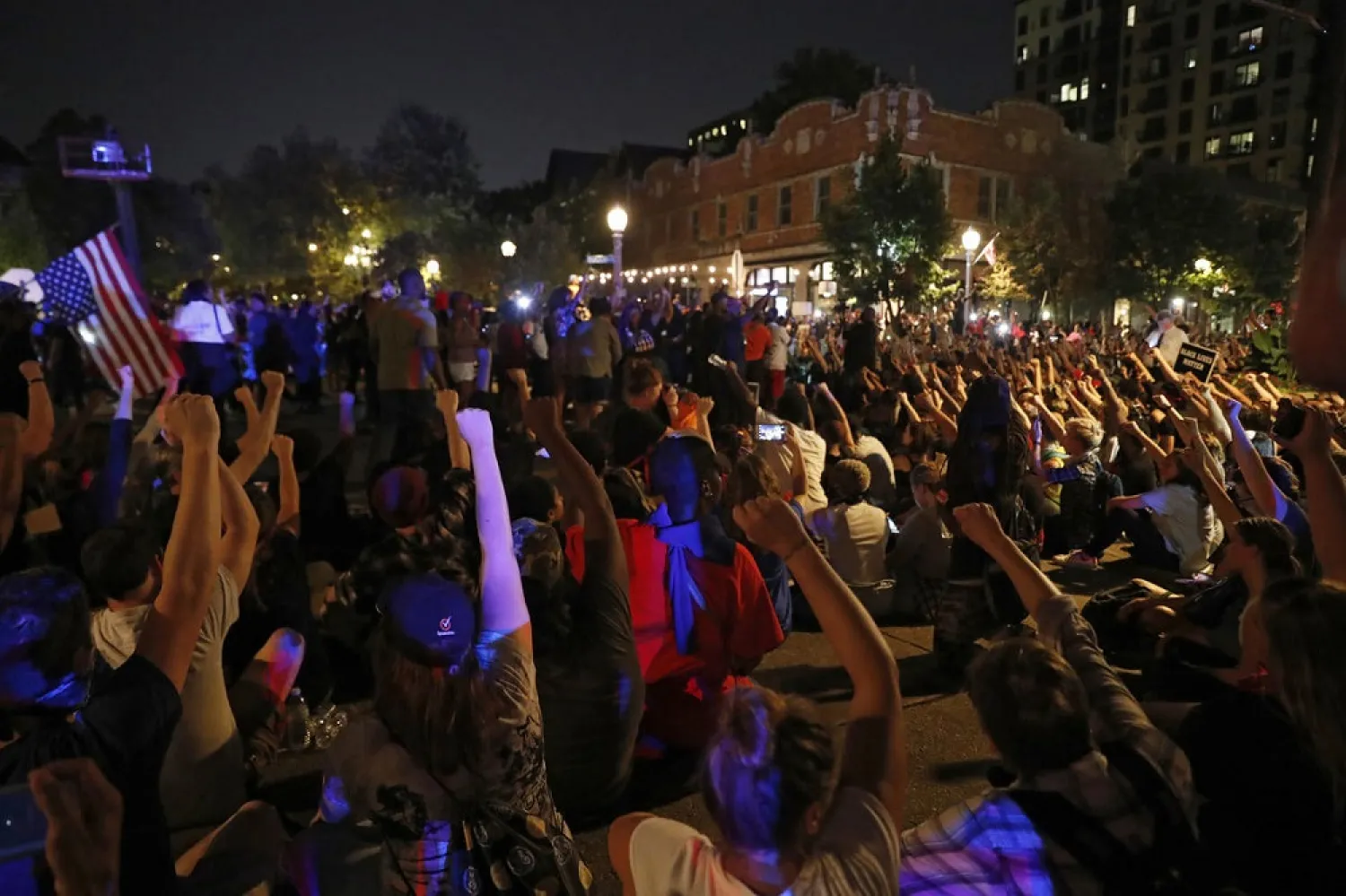

Riots Continue in St. Louis after Ex-Cop Acquitted of Shooting Black Man

Protests erupt in St. Louis in the US after a judge acquits a white former cop of the fatal shooting of a black man. (AP)
TT

Riots Continue in St. Louis after Ex-Cop Acquitted of Shooting Black Man

Protests erupt in St. Louis in the US after a judge acquits a white former cop of the fatal shooting of a black man. (AP)

Protesters continued for a second night in a row in the US city of St. Louis after a white former policeman was acquitted of the fatal shooting of a black man.

The protests turned violent when demonstrators refused to disperse, breaking windows at dozens of businesses and throwing objects at police, who moved in with hundreds of officers in riot gear to make arrests.

Several protesters were seen in handcuffs and city and county police tweeted that they arrested nine people. Police in riot gear were seen carrying one man away from the scene upside down in handcuffs. At least one demonstrator was treated after he was hit with pepper spray.

"We had been getting such a good turn out earlier and it was a peaceful protest," said Jomar Jackson, 32. "But then a bunch of people came and decided to be disruptive."

The confrontation took place in the Delmar Loop area of University City, a suburb about 10 miles (16 kilometers) west of St. Louis near Washington University.

University City had been the scene of a tense but calm march earlier in the evening to protest a judge's ruling Friday clearing ex-officer Jason Stockley of first-degree murder in the 2011 shooting of 24-year-old Anthony Lamar Smith.

After the spasm of violence ended, a reporter for The Associated Press found at least half of the businesses on one side of the street with broken windows along a two block area.

Sam Thomas, who was helping his friend clean up the glass from the shattered windows of his business said he understands why people are angry. The US justice system is broken and needs to be fixed, he said.

"I'm not saying this is the right way to fix it," he said of the damage. "The window isn't murdered. Nobody is going to have a funeral for the window. We can replace it."

Elisheva Heit, whose flower shop window was smashed on the eve of its grand opening, said "I don't understand how this would bring the poor guy back to life."

"We don't want to see property destruction or see people getting hurt," Elad Gross, a 29-year-old St. Louis civil rights attorney, told Reuters as activists gathered peacefully at another protest site in a park on Saturday.

"But this is a protest that addresses injustices not only happening here in St. Louis but around the country."

The eruption late Saturday followed a day of non-violent demonstrations at suburban shopping malls.

Demonstrators shouted slogans such as "black lives matter" and "it is our duty to fight for our freedom" as they marched through West County Center mall in the city of Des Peres, west of St. Louis. A group also demonstrated at Chesterfield Mall in the suburbs and at a regional food festival.

Organizers took their grievances to the suburbs Saturday to spread the impact of the protests beyond predominantly black neighborhoods to those that are mainly white.

"I don't think racism is going to change in America until people get uncomfortable," said Kayla Reed of the St. Louis Action Council, a protest organizer.

Smith's death is just one of several high-profile US cases in recent years in which a white officer killed a black suspect, including the 2014 killing of Michael Brown in nearby Ferguson that sparked months of angry and sometimes violent protests.

Federal prosecutors said Saturday they won't open a new civil rights investigation into the killing.

Justice Department spokeswoman Lauren Ehrsam said the department decided in September not to prosecute, but didn't announce it then to avoid affecting the judge's decision.

After Stockley was acquitted, violence on Friday night resulted in nearly three-dozen people arrested and 11 police officers injured, including a broken jaw and dislocated shoulder, police said. Five officers were taken to hospitals. Police said that 10 businesses were damaged. Protesters also broke a window and spattered red paint on the home of St. Louis Mayor Lyda Krewson.

Ex-officer Stockley shot Smith after the suspected drug dealer fled from officers trying to arrest him.
Stockley, 36, testified he felt he was in danger because he saw Smith holding a silver revolver when the suspect backed his car toward officers and sped away.

Prosecutors said Stockley planted a gun in Smith's car after the shooting. The officer's DNA was on the weapon but Smith's wasn't. Dashcam video from Stockley's cruiser recorded him saying he was "going to kill this (expletive)." Less than a minute later, he shot Smith five times.

Stockley left the force in 2013 and moved to Houston.


Army Chief Says Switzerland Can’t Defend Itself from Full-Scale Attack

Lieutenant General Thomas Suessli, Chief of the Armed Forces of the Swiss Army, attends a news conference on the outbreak of the coronavirus disease (COVID-19) in Bern, Switzerland, March 16, 2020. Picture taken March 16, 2020. (Reuters)
TT

Army Chief Says Switzerland Can’t Defend Itself from Full-Scale Attack

Lieutenant General Thomas Suessli, Chief of the Armed Forces of the Swiss Army, attends a news conference on the outbreak of the coronavirus disease (COVID-19) in Bern, Switzerland, March 16, 2020. Picture taken March 16, 2020. (Reuters)

Switzerland cannot defend itself against a full-scale attack and must boost military spending given rising risks from Russia, the head of its armed forces said.

The country is prepared for attacks by "non-state actors" on critical infrastructure and for cyber attacks, but its military still faces major equipment gaps, Thomas Suessli told the NZZ newspaper.

"What we cannot do is defend against threats from a distance or even a full-scale ‌attack on ‌our country," said Suessli, who is ‌stepping ⁠down at ‌the end of the year.

"It's burdensome to know that in a real emergency, only a third of all soldiers would be fully equipped," he said in an interview published on Saturday.

Switzerland is increasing defense spending, modernizing artillery and ground systems ⁠and replacing ageing fighter jets with Lockheed Martin F-35As.

But the ‌plan faces cost overruns, while ‍critics question spending on artillery ‍and munitions amid tight federal finances.

Suessli said ‍attitudes towards the military had not shifted despite the war in Ukraine and Russian efforts to destabilize Europe.

He blamed Switzerland's distance from the conflict, its lack of recent war experience and the false belief that neutrality offered protection.

"But that's historically ⁠inaccurate. There are several neutral countries that were unarmed and were drawn into war. Neutrality only has value if it can be defended with weapons," he said.

Switzerland has pledged to gradually raise defense spending to about 1% of GDP by around 2032, up from roughly 0.7% now – far below the 5% level agreed by NATO countries.

At that pace, the Swiss military would only be ‌fully ready by around 2050.

"That is too long given the threat," Suessli said.


Another 131 Migrants Rescued off Southern Crete

A dinghy transporting dozens of refugees and migrants is pulled towards Greece's Lesbos island after being rescued by a war ship during their sea crossing between Türkiye and Greece on February 29, 2020. Aris Messinis, AFP/File picture
TT

Another 131 Migrants Rescued off Southern Crete

A dinghy transporting dozens of refugees and migrants is pulled towards Greece's Lesbos island after being rescued by a war ship during their sea crossing between Türkiye and Greece on February 29, 2020. Aris Messinis, AFP/File picture

The Greek coast guard Saturday rescued 131 would-be migrants off Crete, bringing the number of people brought out of the sea in the area over the past five days to 840, a police spokesperson said.

The migrants rescued Saturday morning were aboard a fishing boat some 14 nautical miles south of Gavdos, a small island south of Crete.

The passengers, whose nationality was not revealed, were all taken to Gavdos.

Many people attempting to reach Crete from Libya drown during the risky crossing.

In early December, 17 people -- mostly Sudanese or Egyptian -- were found dead after their boat sank off the coast of Crete, and 15 others were reported missing. Only two people survived.

According to the UN High Commissioner for Refugees, more than 16,770 people trying to get to Europe have arrived in Crete since the beginning of the year, more than on any other Greek island.

In July, the conservative government suspended the processing of asylum applications for three months, particularly those of people arriving from Libya, saying the measure as "absolutely necessary" in the face of the increasing flow of migrants.


Thailand and Cambodia Sign New Ceasefire Agreement to End Border Fighting

A handout photo made available by the Defense Ministry of Thailand shows Cambodian Defense Minister Tea Seiha (L) and Thai Defense Minister Natthaphon Narkphanit attending a General Border Committee Meeting in Ban Pak Kard, Chanthaburi Province, Thailand, 27 December 2025. (EPA/Defense Ministry of Thailand/Handout)
TT

Thailand and Cambodia Sign New Ceasefire Agreement to End Border Fighting

A handout photo made available by the Defense Ministry of Thailand shows Cambodian Defense Minister Tea Seiha (L) and Thai Defense Minister Natthaphon Narkphanit attending a General Border Committee Meeting in Ban Pak Kard, Chanthaburi Province, Thailand, 27 December 2025. (EPA/Defense Ministry of Thailand/Handout)

Thailand and Cambodia on Saturday signed a ceasefire agreement to end weeks of armed combat along their border over competing claims to territory. It took effect at noon local time.

In addition to ending fighting, the agreement calls for no further military movements by either side and no violations of either side’s airspace for military purposes.

Only Thailand employed airstrikes in the fighting, hitting sites in Cambodia as recently as Saturday morning, according to the Cambodian defense ministry.

The deal also calls for Thailand, after the ceasefire has held for 72 hours, to repatriate 18 Cambodian soldiers it has held as prisoners since earlier fighting in July. Their release has been a major demand of the Cambodian side.

The agreement was signed by the two countries’ defense ministers, Cambodia’s Tea Seiha and Thailand’s Nattaphon Narkphanit, at a checkpoint on their border after lower-level talks by military officials met for three days as part of the already-established General Border Committee.

The agreement declares that the two sides are committed to an earlier ceasefire that ended five days of fighting in July and follow-up agreements and includes commitments to 16 de-escalation measures.

The original July ceasefire was brokered by Malaysia and pushed through by pressure from US President Donald Trump, who threatened to withhold trade privileges unless Thailand and Cambodia agreed. It was formalized in more detail in October at a regional meeting in Malaysia that Trump attended.

Despite those deals, the two countries carried on a bitter propaganda war and minor cross-border violence continued, escalating in early December to widespread heavy fighting.

Thailand has lost 26 soldiers and one civilian as a direct result of the combat since Dec. 7, according to officials. Thailand has also reported 44 civilian deaths from collateral effects of the situation.

Cambodia hasn’t issued an official figure on military casualties, but says that 30 civilians have been killed and 90 injured. Hundreds of thousands of people have been evacuated from affected areas on both sides of the border.

Each side blamed the other for initiating the fighting and claimed to be acting in self-defense.

The agreement also calls on both sides to adhere to international agreements against deploying land mines, a major concern of Thailand. Thai soldiers along the border have been wounded in at least nine incidents this year by what they said were newly planted Cambodian mines. Cambodia says the mines were left over from decades of civil war that ended in the late 1990s.

Another clause says the two sides “agree to refrain from disseminating false information or fake news.”

The agreement also says previously established measures to demarcate the border will be resumed and the two sides also agree to cooperate on an effort to suppress transnational crimes.

That is primarily a reference to online scams perpetrated by organized crime that have bilked victims around the world of billions of dollars each year. Cambodia is a center for such criminal enterprises.
