

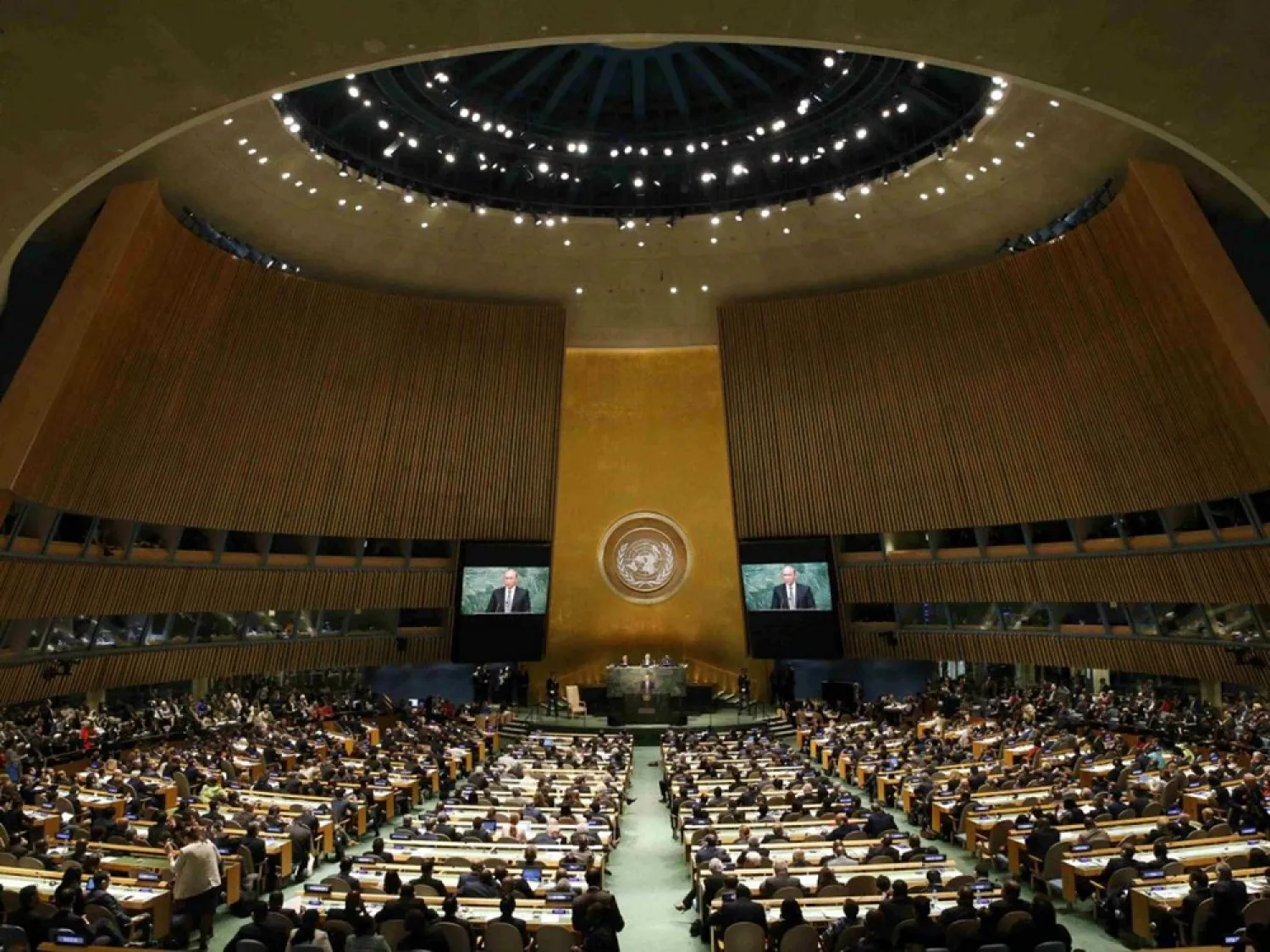

World Leaders Flock to New York for UN General Assembly

Russian President Vladimir Putin delivers an address to the UN General Assembly in New York. (Reuters)
TT

World Leaders Flock to New York for UN General Assembly

Russian President Vladimir Putin delivers an address to the UN General Assembly in New York. (Reuters)

World leaders began arriving in New York to attend this year's 72nd General Assembly of United Nations. The sessions are scheduled to begin on Tuesday morning amid political crises all over the world.

North Korean provocations and the future of Iran's nuclear agreement are expected to be discussed on the international platform, in addition to the ethnic cleansing of Rohingya Muslims in Myanmar.

However, a few leaders will be missing from the General Assembly meeting, including Russian President Vladimir Putin and Chinese President Xi Jinping – both of whom have urged a de-escalation of tensions between the US and North Korea. Myanmar's Aung San Suu Kyi will not attend the General Assembly following outrage over ethnic violence in her country.

US President Donald Trump is set to meet several foreign leaders in New York, including French President Emmanuel Macron, Israeli Prime Minister Benjamin Netanyahu and UN Secretary General António Guterres. He will also meet with Japanese Prime Minister Shinzo Abe and South Korean President Moon Jae-In to discuss Pyongyang’s rapidly advancing weapons program.

Every year, world leaders attend the UN General Assembly in New York to discuss urgent international crises.

The whole world will be waiting to Trump's speech and whether he will threaten certain countries. He will urge other countries to confront North Korea’s nuclear program, Iran’s hostile actions in the Middle East and other global dangers when he addresses world leaders for the first time.

Director of the Middle East program and senior vice president at the Center for Strategic and International Studies in Washington Jon Alterman said that while the General Assembly may appeal to Trump’s desire to have the world’s attention, the forum does not suit his negotiating style.

“The world is still trying to take the measure of this president. For a number of leaders, this is going to be their first chance to see him, to judge him, to try to get on his good side,” explained Alterman.

He is expected to discuss two big global issues: North Korea and Iran’s nuclear program.

Reports revealed that the US administration’s delegation at General Assembly is going to be much smaller than usual. Sources said that there will be strict limits on how many deputy assistant secretaries are allowed to stay in New York at a time.

That big reduction has analysts worried that General Assembly meetings won’t be able to deliver the usual amount of meaningful results.

Trump is expected to stay at his New Jersey golf club for the duration of the conference and may host world leaders there as well. The State Department is preparing for a number of meetings with foreign leaders at the resort next week, according to an August report by the Washington Post.

For decades, presidents have stayed at the Waldorf Astoria in Manhattan, although Obama shifted to the Lotte New York Palace in 2015 due to security concerns.

A senior fellow in the foreign policy program at the Brookings Institution Ted Piccone stated that it is just another example of how everything is about Trump.

He added that “it is relatively insignificant in the scheme of things,” but it does send a bit of a message.

Usually, each leader is assigned 15 minutes to deliver their speech before the General Assembly. However, Cuban leader Fidel Castro broke the record in 1960 with 269 minutes speech followed by Libyan leader Moammar al-Ghadhafi, who in 2009, spoke for over 90 minutes.

On the sidelines of the General Assembly, Bloomberg will hold its first-ever Global Business Forum, which will bring heads of state together with global CEOs to discuss opportunities for advancing trade and economic growth, and the related societal challenges, from climate change to workplace automation to terrorism, facing both groups.

World leaders from over 30 countries along with more than 100 global CEOs have confirmed attendance.

Bloomberg is sponsoring the forum in partnership with the Alibaba Group; Dangote Industries Limited; EXOR, the holding company controlled by the Agnelli family; the Mahindra Group; and MiSK, the philanthropic foundation of Saudi Crown Prince Mohammad bin Salman bin Abdulaziz.

President Bill Clinton, Bill Gates, UN Secretary General Antonio Guterres, Christine Lagarde, President, World Bank Group Jim Kim, CEO and Chairman, Goldman Sachs Lloyd Blankfein and many others will attend the forum.

The 2017 Global Business Forum program will feature topics such as: multilateral engagement between business and government; understanding the new rules of globalization including changes to international trade, immigration, and labor policies amidst a populist backlash; greatest sources of opportunity exploring the new business models poised to succeed in the new global order, and the ways pioneering CEOs, world leaders, and next-generation visionaries are adapting their companies, their investments, and their national priorities to prosper in this new environment; and solving urgent global challenges through a new multi-lateralism and finding innovative ways to fill the gaps of government-led agreements with business solutions.



US, Ukraine to Discuss Ceasefire in Berlin Ahead of European Summit

Anti-drone nets hang taut along a road near the city of Izyum of Kharkiv region, northeastern Ukraine, 12 December 2025. (EPA)
TT

US, Ukraine to Discuss Ceasefire in Berlin Ahead of European Summit

Anti-drone nets hang taut along a road near the city of Izyum of Kharkiv region, northeastern Ukraine, 12 December 2025. (EPA)

Germany will host US and Ukrainian delegations over the weekend for talks on a ceasefire in Ukraine, ahead of a summit with European leaders and President Volodymyr Zelenskiy in Berlin on Monday, a German official said on Saturday.

A US official said overnight that President Donald Trump's envoy Steve Witkoff and son-in-law Jared Kushner were travelling to Germany for talks involving Ukrainians and Europeans.

The choice to send Witkoff, who has led negotiations with Ukraine and Russia regarding a US peace proposal, appeared to be a signal that Washington saw a chance of progress. The White House had said on Thursday Trump would send an official to talks only if he felt there was enough progress to be made.

"Talks on a possible ceasefire in Ukraine are taking place in Berlin this weekend between foreign policy advisors from, among others, the US and Ukraine," said a German government source when asked about the meetings.

On Monday, Merz is hosting Zelenskiy and European leaders for a summit in Berlin, the latest in a series of public shows of support for the Ukrainian leader from allies across Europe as Kyiv faces pressure from Washington to sign up to a peace plan that initially backed Moscow's main demands.

Britain, France and Germany have been working in the last few weeks to refine the US proposals, which, in a draft disclosed last month, called for Kyiv to cede more territory, abandon its ambition to join NATO and accept limits on its armed forces.


Germany to Send Soldiers to Fortify Poland Border

A border guard officer stands guard at the Polish-Belarusian border, in Polowce, Poland. (AP file photo)
TT

Germany to Send Soldiers to Fortify Poland Border

A border guard officer stands guard at the Polish-Belarusian border, in Polowce, Poland. (AP file photo)

Germany has said it will send a group of soldiers to Poland to help with a project to fortify the country's eastern border as worries mount about the threat from Russia.

Poland, a strong supporter of Ukraine in its fight against Moscow, announced plans in May last year to bolster a long stretch of its border that includes Belarus and the Russian exclave of Kaliningrad.

The main task of the German soldiers in Poland will be "engineering activities," a spokesman for the defense ministry in Berlin said late Friday.

This could include "constructing fortifications, digging trenches, laying barbed wire, or erecting tank barriers," he said.

"The support provided by German soldiers as part of (the operation) is limited to these engineering activities."

The spokesman did not specify the exact number of troops involved, saying only it would be a "mid-range two-digit number".

They are expected to participate in the project from the second quarter of 2026 until the end of 2027.

The spokesman stressed that parliamentary approval was not needed for the deployment as "there is no immediate danger to the soldiers from military conflicts".

Except for certain exceptional cases, the German parliament has to approve the deployment of the country's armed forces overseas.

Since Russia's full-scale invasion of Ukraine in 2022, Warsaw has staunchly backed Kyiv and been a transit route for arms being supplied by Ukraine's Western allies.

Warsaw has also modernized its army and hiked defense spending.

Germany is Ukraine's second-biggest supplier of military aid after the United States and has sent Kyiv a huge quantity of equipment ranging from air defence systems to armored vehicles.


Erdogan Warns Black Sea Should Not Be 'Area of Confrontation' after Strikes

Turkish President Recep Erdogan addresses the media after the conclusion on the G20 Summit held at the Nasrec Expo Center in Johannesburg, South Africa, 23 November 2025. EPA/HALDEN KROG
TT

Erdogan Warns Black Sea Should Not Be 'Area of Confrontation' after Strikes

Turkish President Recep Erdogan addresses the media after the conclusion on the G20 Summit held at the Nasrec Expo Center in Johannesburg, South Africa, 23 November 2025. EPA/HALDEN KROG

Turkish President Recep Tayyip Erdogan on Saturday warned that the Black Sea should not turn into an "area of confrontation" between Russia and Ukraine, after several strikes in recent weeks. 

"The Black Sea should not be seen as an area of confrontation. This would not benefit Russia or Ukraine. Everyone needs safe navigation in the Black Sea," he was quoted as telling reporters aboard his plane, according to the official Anadolu news agency. 

A Russian air strike damaged a Turkish-owned vessel in a port in Ukraine's Black Sea region of Odesa, Kyiv and the operator said on Friday. 

The attack came hours after Erdogan had raised the issue personally with his Russian counterpart Vladimir Putin on the sidelines of a summit in Turkmenistan, said AFP. 

Erdogan had called for a "limited ceasefire" concerning attacks on ports and energy facilities in the Russia-Ukraine war, during the face-to-face talks with Putin, according to his office. 

On the plane, Erdogan said he mainly discussed the war and peace efforts with Putin, Anadolu reported. 

"Like all other actors, Mr Putin knows very well where Türkiye stands on this issue," he said. 

"After this meeting we held with Putin, we hope to have the opportunity to also discuss the peace plan with US President (Donald) Trump," he added. 

"Peace is not far away, we can see it." 

Türkiye, which has sought to maintain relations with Moscow and Kyiv throughout the war, controls the Bosphorus Strait, a key passage for transporting Ukrainian grain and Russian oil towards the Mediterranean. 

Over the past weeks, several attacks also targeted Russia-linked tankers in the Black Sea, some of which were drone attacks claimed by Kyiv. 

The attacks sparked harsh criticism from Ankara, which summoned envoys from both Russia and Ukraine.