


Kurdish Referendum: Between Turkish Threats and Iranian Caution

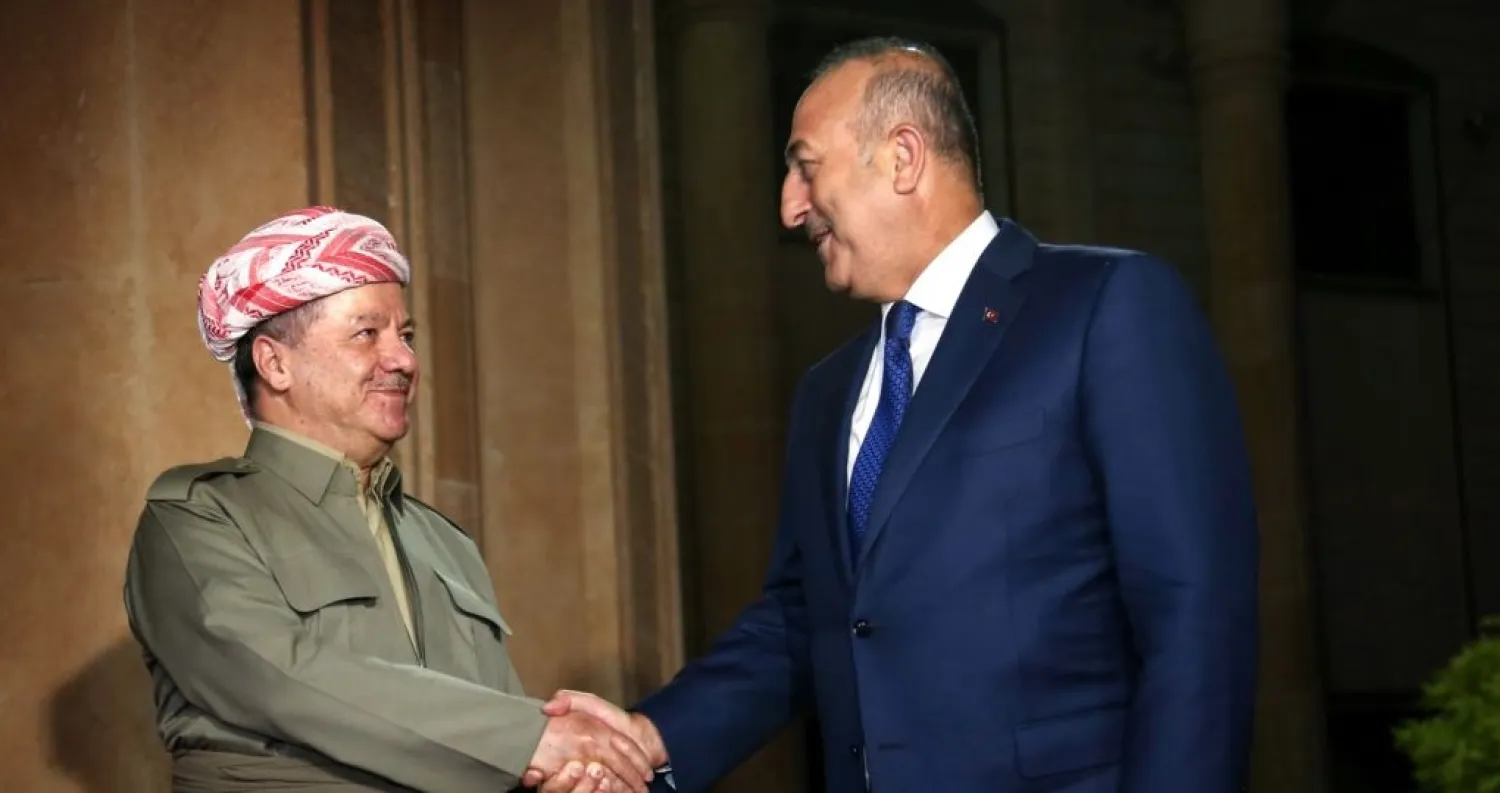
The president of Iraq's Kurdish autonomous region, Masud Barzani (left), meets with Turkish Foreign Minister Mevlut Cavusoglu in Irbil. AFP file photo
TT

Kurdish Referendum: Between Turkish Threats and Iranian Caution

The president of Iraq's Kurdish autonomous region, Masud Barzani (left), meets with Turkish Foreign Minister Mevlut Cavusoglu in Irbil. AFP file photo

President of the northern Iraqi Kurdish region Masoud al-Barzani has rejected international, regional and Iraqi pressure to cancel a planned independence referendum, stressing that the Kurdish people are prepared to pay the price for their freedom.

This comes as the Turkish National Security Council called Barzani to stop the referendum.

Barzani concluded his tour to support the independence referendum in the Kurdistan capital, Erbil, on Friday afternoon.

Addressing a rally of thousands of people, Barzani said that Erbil is open to have serious and friendly talks with Baghdad after the September 25 vote, but it is now too late to postpone it.

He stressed that Kurdistan is not a threat to its neighbors, as has been demonstrated over the past 25 years, but warned the Peshmerga would not allow anyone to feel “comfortable” and invade Kurdistan.

He directed the Peshmerga to be prepared to “pay whatever cost” necessary to protect Kurdistan, because they will not allow the region to fall to the enemy.

The president called upon all Kurdish people to head to the polls on Monday and decide their future, saying the road ahead is difficult but worth it.

“Either we live a life of subordination, or a free life,” Barzani told the rally adding that if they must die to achieve freedom, they will “die with honor."

Barzani said that the “free union” described in the Iraqi constitution has failed and that the path ahead is for the Iraqi and Kurdish nations to part.

Describing how Iraqi officials did not respect partnership in the new Iraq established after the 2003 US-led invasion, Barzani declared, “We won’t go back to a failed experience," reiterating: “We can no longer live with Baghdad."

Addressing a UN Security Council statement asking Kurdistan to postpone the vote out of fear it may affect the war on ISIS and the return of one million or displaced Iraqis who are currently in the Kurdistan Region, Barzani said Kurdistan’s coordination with Iraqi and global forces will continue.

“We will be more insistent in the fight against ISIS and will fight even stronger,” he said.

He also said the displaced Iraqis are the guests of Kurdistan.

Addressing Turkey and Iran, Barzani said: “You have punished us for 100 years. Are you not tired yet?”

He explained that it was too late to call off the vote despite global pressure, adding that he would not postpone the referendum to please foreign capitals.

Meanwhile, negotiations are still taking place to persuade Barzani on postponing any referendum, according to officials close to the discussions.

"Nothing is definitive yet. Discussions are continuing to try to offer him serious guarantees that will convince him to change his mind," said one official who did not wish to be identified.

On the Iranian front, AFP quoted a top official as saying that Major General Qassem Soleimani of the Revolutionary Guards' al-Quds Force returned to Kurdistan and met several officials.

The source said that Soleimani was in Sulaimaniyyah and will head to Erbil later.

"It's his last visit before the referendum to advise Kurdish officials that Iran is seriously hostile to it and warn them to call it off," the source said, adding that Soleimani promised Kurdish officials during his last visit that Iran is pressuring the Iraqi leadership so it accepts Kurdish demands and solves the issues of the budget, Peshmerga salaries and disputed areas.

In 2014, Baghdad decided to suspend payments to Barzani's Kurdish regional government of 17 percent of Iraq's national budget, worth about $12 billion, because of a dispute over oil exports.

Wages, along with those of Kurdish peshmerga fighters, made up 80 percent of the region's budget revenues.

On Thursday, the UN Security Council warned that the referendum was potentially destabilizing, urging warring parties to dialogue and compromise to address differences between the Iraqi government and the regional authorities.

On Tuesday, Prime Minister Haider al-Abadi rejected the independence referendum under any form, even non-binding.

At a press conference in Baghdad, Abadi said that the poll was "rejected, whether today or in the future.”

Barzani also rejected an initiative from Iraqi President Fuad Massum, a Kurd, for negotiations.

In a document seen by AFP, Massum suggested starting UN-backed talks towards a deal with Baghdad.

An official of the Popular Mobilization Forces (PMF) in Tuz Khurmatu, of Salaheddine, Atef Annajar said he will not allow the poll.

"We're ready for a fight to the death," said, adding however that "the leadership is trying to calm the situation."

Also, US presidential envoy to the coalition fighting ISIS Brett McGurk said on Friday that a referendum on Kurdish independence in northern Iraq “carries a lot of risks", according to Reuters.

McGurk told reporters: “The (Kurdish) referendum just carries an awful lot of risks and that’s not something the United States can control. In terms of the consequences of the referendum it’s not something that we can fully control, (it) just carries a lot of risks.”

Meanwhile in Russia, Foreign Minister Sergei Lavrov told his Iraqi counterpart Ibrahim al-Jaafari that Moscow supported Iraq’s territorial integrity and sovereignty.

“The Russian side confirmed its constant support for the unity, sovereignty and territorial integrity of Iraq,” the ministry said in a statement.

Following his return from the 72nd UN General Assembly, Turkish President Recep Tayyip Erdogan held back-to-back meetings of Turkey’s cabinet and National Security Council during which the Kurdish referendum was discussed.

On Saturday, Turkish parliament will also convene to discuss the response to the referendum.

The council called on Barzani to stop the referendum. It warned the Kurdish government against holding a referendum on independence, saying such a move would create grave results.

In a statement released following a meeting at the presidential complex in Ankara, the council said that Turkey reserves all options arising from bilateral and international agreements if the referendum is held on September 25.

''It is strongly emphasized that this attempted Kurdish referendum is a grave mistake which directly threatens the security of Turkey and the peace, security and stability of the region as well as Iraq's territorial unity and territorial integrity,” the statement said.

Turkish Prime Minister Binali Yildirim said the referendum was a matter of national security for the country and Ankara would never accept a change of status in Iraq or Syria.

“An action that will change the status in Syria and Iraq is an unacceptable result for Turkey, and we will do what is necessary,” Yildirim said.



Italy Arrests 7 Accused of Raising Millions for Hamas

Palestinian Hamas members secure the area as Egyptian workers accompanied by members of the International Committee of the Red Cross (ICRC) search for the remains of the last Israeli hostage in the Zeitoun neighborhood of Gaza City on December 8, 2025. (Photo by Omar AL-QATTAA / AFP)
TT

Italy Arrests 7 Accused of Raising Millions for Hamas

Palestinian Hamas members secure the area as Egyptian workers accompanied by members of the International Committee of the Red Cross (ICRC) search for the remains of the last Israeli hostage in the Zeitoun neighborhood of Gaza City on December 8, 2025. (Photo by Omar AL-QATTAA / AFP)

Italian police said Saturday that they have arrested seven people suspected of raising millions of euros for Palestinian group Hamas.

Police also issued international arrests for two others outside the country, said AFP.

Three associations, officially supporting Palestinian civilians but allegedly serving as a front for funding Hamas, are implicated in the investigation, said a police statement.

The nine individuals are accused of having financed approximately seven million euros ($8 million) to "associations based in Gaza, the Palestinian territories, or Israel, owned, controlled, or linked to Hamas."

While the official objective of the three associations was to collect donations "for humanitarian purposes for the Palestinian people," more than 71 percent was earmarked for the direct financing of Hamas" or entities affiliated with the movement, according to police.

Some of the money went to "family members implicated in terrorist attacks," the statement said.

Among those arrested was Mohammad Hannoun, president of the Palestinian Association in Italy, according to media reports.

Interior Minister Matteo Piantedosi posted on X that the operation "lifted the veil on behavior and activities which, pretending to be initiatives in favor of the Palestinian population, concealed support for and participation in terrorist organizations."


Türkiye Holds Military Funeral for Libyan Officers Killed in Plane Crash

The Libyan national flag flies at half-mast in Tripoli on December 24, 2025, after the head of Libya's armed forces and his four aides died in a plane crash in Türkiye. (AFP)
TT

Türkiye Holds Military Funeral for Libyan Officers Killed in Plane Crash

The Libyan national flag flies at half-mast in Tripoli on December 24, 2025, after the head of Libya's armed forces and his four aides died in a plane crash in Türkiye. (AFP)

Türkiye held a military funeral ceremony Saturday morning for five Libyan officers, including western Libya’s military chief, who died in a plane crash earlier this week.

The private jet with Gen. Muhammad Ali Ahmad al-Haddad, four other military officers and three crew members crashed on Tuesday after taking off from Ankara, Türkiye’s capital, killing everyone on board. Libyan officials said the cause of the crash was a technical malfunction on the plane.

Al-Hadad was the top military commander in western Libya and played a crucial role in the ongoing, UN-brokered efforts to unify Libya’s military.

The high-level Libyan delegation was on its way back to Tripoli, Libya’s capital, after holding defense talks in Ankara aimed at boosting military cooperation between the two countries.

Saturday's ceremony was held at 8:00 a.m. local time at the Murted Airfield base, near Ankara, and attended by the Turkish military chief and the defense minister. The five caskets, each wrapped in a Libyan national flag, were then loaded onto a plane to be returned to their home country.

Türkiye’s military chief, Selcuk Bayraktaroglu, was also on the plane headed to Libya, state-run news agency TRT reported.

The bodies recovered from the crash site were kept at the Ankara Forensic Medicine Institute for identification. Justice Minister Yilmaz Tunc told reporters their DNA was compared to family members who joined a 22-person delegation that arrived from Libya after the crash.

Tunc also said Germany was asked to help examine the jet's black boxes as an impartial third party.


Syrian Foreign Ministry: Talks with SDF Have Not Yielded Tangible Results

SDF fighters are seen at a military parade in Qamishli. (Reuters file)
TT

Syrian Foreign Ministry: Talks with SDF Have Not Yielded Tangible Results

SDF fighters are seen at a military parade in Qamishli. (Reuters file)

A source from the Syrian Foreign Ministry said on Friday that the talks with the Kurdish Syrian Democratic Forces (SDF) over their integration into state institutions “have not yielded tangible results.”

Discussions about merging the northeastern institutions into the state remain “hypothetical statements without execution,” it told Syria’s state news agency SANA.

Repeated assertions over Syria’s unity are being contradicted by the reality on the ground in the northeast, where the Kurds hold sway and where administrative, security and military institutions continue to be run separately from the state, it added.

The situation “consolidates the division” instead of addressing it, it warned.

It noted that despite the SDF’s continued highlighting of its dialogue with the Syrian state, these discussions have not led to tangible results.

It seems that the SDF is using this approach to absorb the political pressure on it, said the source. The truth is that there is little actual will to move from discussion to application of the March 10 agreement.

This raises doubts over the SDF’s commitment to the deal, it stressed.

Talk about rapprochement between the state and SDF remains meaningless if the agreement is not implemented on the ground within a specific timeframe, the source remarked.

Furthermore, the continued deployment of armed formations on the ground that are not affiliated with the Syrian army are evidence that progress is not being made.

The persistence of the situation undermines Syria’s sovereignty and hampers efforts to restore stability, it warned.