

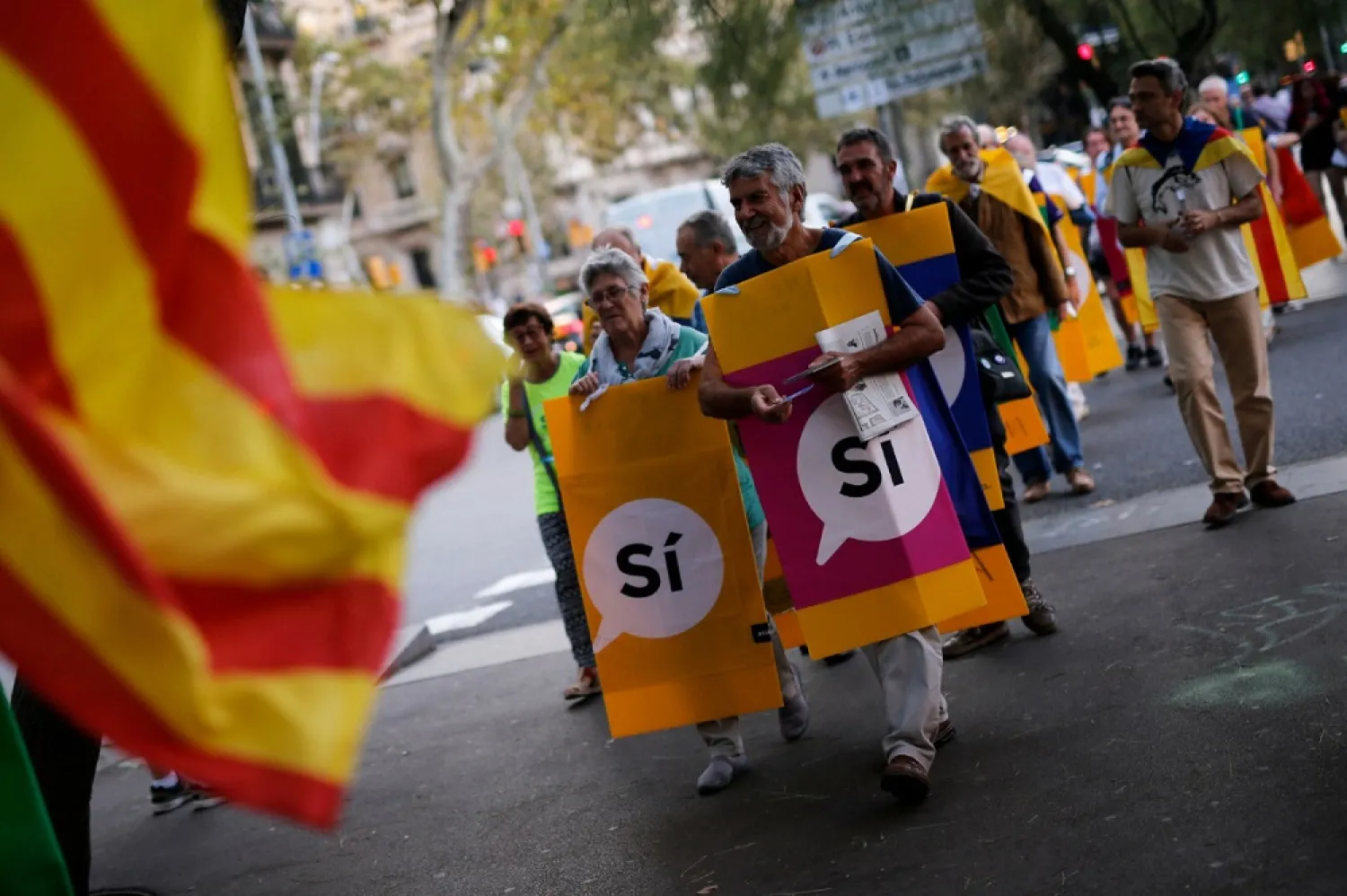

90 Percent Vote in Favor of Catalan Independence from Spain

Catalans voted 90 percent in favor of breaking away from Spain in a vote that was marred by a violent police crackdown. (AFP)
TT

90 Percent Vote in Favor of Catalan Independence from Spain

Catalans voted 90 percent in favor of breaking away from Spain in a vote that was marred by a violent police crackdown. (AFP)

Catalans voted 90 percent in favor of breaking away with Spain after in a turbulent referendum that was marred by a violent police crackdown on voters.

Catalonia has "won the right to become an independent state," Catalan president Carles Puigdemont said after the polls closed, adding that he would keep his pledge to declare independence unilaterally if the "yes" side wins.

Catalan regional government spokesman Jordi Turull told reporters early Monday that 90 percent of the 2.26 million Catalans who voted chose the "yes" side in favor of independence. He said nearly 8 percent of voters rejected independence and the rest of the ballots were blank or void. He said 15,000 votes were still being counted.

This turnout came despite Spanish police using batons and rubber bullets to disrupt the banned referendum, which was declared unconstitutional by Madrid.

Catalan officials said more than 800 people were injured in clashes with Spanish riot police during the referendum, which has pitched the country into its deepest constitutional crisis in decades and deepened a rift between Madrid and Barcelona.

Police were acting on a judge's orders to stop the referendum, which the Spanish government had declared illegal and unconstitutional — and Prime Minister Mariano Rajoy said going forward with the vote only served to sow divisions.

Rajoy accused separatists of trying to “blackmail ... the whole nation”. He offered all-party talks on the region’s future.

Spanish Foreign Minister Alfonso Dastis said the violence, while "unfortunate" and "unpleasant" was "proportionate."

"If people insist in disregarding the law and doing something that has been consistently declared illegal and unconstitutional, law enforcement officers need to uphold the law," Dastis told The Associated Press in an interview.

“On this day of hope and suffering, Catalonia’s citizens have earned the right to have an independent state in the form of a republic,” Puigdemont said in a televised address.

“My government, in the next few days will send the results of today’s vote to the Catalan Parliament, where the sovereignty of our people lies, so that it can act in accordance with the law of the referendum,” he said.

The law of the referendum foresees a unilateral declaration of independence by the Catalan parliament if the majority votes to leave Spain. The law does not set a minimum turnout for the outcome to be valid.

The results announced early on Monday were not a surprise, given that many unionists were not expected to turn out to vote.

Earlier in the day, the streets of Catalonia, an industrial and tourism powerhouse accounting for a fifth of Spain’s economy, erupted into violence as national police burst into polling stations with batons, dragging voters away.

The action drew criticism at home and abroad. British Foreign Secretary Boris Johnson voiced worries over the violence while backing Madrid’s view that the vote was unconstitutional.

Spain’s deputy prime minister said force used by the police had been proportionate.

“The absolute irresponsibility of the regional government has had to be met by the security forces of the state,” said Soraya Saenz de Santamaria.

The euro lost about a third of a US cent after the violence-marred vote before steadying. It touched a low of $1.1776 in thin Asian trade but soon steadied at $1.1801.

Puigdemont called on Europe to step in to make sure fundamental rights were fully respected. He said he would appeal to the European Union to look into alleged human rights violations during the vote.

In another sign tensions would endure beyond the vote, secessionist groups and trade unions in Catalonia called a general strike for Tuesday, La Vanguardia newspaper said.

Catalan officials said 844 people had been injured in the police crackdown and the Spanish Interior Ministry said 12 police officers had been hurt.

“I propose that all political parties with parliamentary representation meet and, together, reflect on the future we all face,” Rajoy said in his televised address.

Opinion polls had shown around 40 percent of the northeastern region wanted independence from Spain although a majority were in favor of a referendum on the issue.

Despite the national police action, some polling stations remained open, especially in areas supervised by the Catalan police force which adopted much milder tactics.

“I’m so pleased because despite all the hurdles they’ve put up, I’ve managed to vote,” said Teresa, a 72-year-old pensioner in Barcelona who had stood in line for six hours to vote.

The ballot will have no legal status as it has been blocked by Spain’s Constitutional Court which ruled it at odds with the 1978 constitution that effectively restored democracy in Spain after the dictatorship of General Francisco Franco.



Israeli Air Force Deploys First Laser Interception System

FILED - 26 March 2024, Israel, Jerusalem: Israel Katz attends a meeting at a hotel in Jerusalem. Photo: Christoph Soeder/dpa
TT

Israeli Air Force Deploys First Laser Interception System

FILED - 26 March 2024, Israel, Jerusalem: Israel Katz attends a meeting at a hotel in Jerusalem. Photo: Christoph Soeder/dpa

Israel's defense ministry said on Sunday it had deployed a new "Iron Beam" laser system for the air force to intercept aerial threats.

The laser system's main developers, the ministry's research and development department and defense contractor Rafael, delivered it to the air force at a ceremony in northern Israel.

"For the first time globally, a high-power laser interception system has achieved full operational maturity, successfully executing multiple interceptions," Defense Minister Israel Katz said at the ceremony, according to a statement.

"This monumental achievement... delivers a critical message to our enemies, near and far alike: do not challenge us, or face severe consequences," AFP quoted him as saying.

The handover marks a major milestone in a project more than a decade old.
"Israel has become the first country in the world to field an operational laser system for the interception of aerial threats, including rockets and missiles," said Yuval Steinitz, chairman of Rafael.

The laser system seeks to enhance and slash the cost of Israel's interception of projectiles, and will supplement other aerial defense capacities such as the more well-known Iron Dome.

Iron Dome offers short-range protection against missiles and rockets. The David's Sling system and successive generations of Arrow missiles are Israeli-American technology built to bring down ballistic missiles.

The defense ministry announced in early December that the laser system was complete, and would be deployed by the end of the month.

During the 12-day war launched by Israel against Iran in June, the country's missile defense system failed to intercept all the projectiles fired by Tehran toward Israeli territory.

Israel has since acknowledged being hit by more than 50 missiles during the war with Iran, resulting in 28 deaths.


Trump Says Had 'Productive' Call with Putin Ahead of Zelensky Meeting

US President Donald Trump takes part in a Christmas Eve dinner in the ballroom of his Mar-a-Lago club in Palm Beach, Florida, US, December 24, 2025. REUTERS/Jessica Koscielniak
TT

Trump Says Had 'Productive' Call with Putin Ahead of Zelensky Meeting

US President Donald Trump takes part in a Christmas Eve dinner in the ballroom of his Mar-a-Lago club in Palm Beach, Florida, US, December 24, 2025. REUTERS/Jessica Koscielniak

US President Donald Trump said he had a productive telephone call with his Russian counterpart Vladimir Putin on Sunday ahead of a planned meeting in Florida with Ukraine's leader Volodymyr Zelensky.

"I just had a very good and productive telephone call with President Putin of Russia" before the planned talks with Zelensky at Trump's Florida estate at 1:00 pm local time (1800 GMT), the US leader said on Truth Social.

Putin said Ukraine was in no hurry for peace and if it did not want to resolve their conflict peacefully, Moscow would accomplish all its goals by force.

Putin's remarks on Saturday, carried by state news agency TASS, followed a vast Russian drone and missile attack that prompted Zelensky to say Russia was demonstrating its wish to continue the war while Kyiv wanted peace.


Russia Sends 3 Iranian Satellites into Orbit, Report Says

In this photo released by Roscosmos space corporation on Thursday, Feb. 29, 2024, the Soyuz-2.1b rocket blasts off at the Vostochny cosmodrome outside the city of Tsiolkovsky, about 200 kilometers (125 miles) from the city of Blagoveshchensk in the far eastern Amur region, Russia. A Russian Soyuz rocket successfully put an Iranian satellite into orbit along with 18 Russian satellites on Thursday. (Roscosmos space corporation via AP)
TT

Russia Sends 3 Iranian Satellites into Orbit, Report Says

In this photo released by Roscosmos space corporation on Thursday, Feb. 29, 2024, the Soyuz-2.1b rocket blasts off at the Vostochny cosmodrome outside the city of Tsiolkovsky, about 200 kilometers (125 miles) from the city of Blagoveshchensk in the far eastern Amur region, Russia. A Russian Soyuz rocket successfully put an Iranian satellite into orbit along with 18 Russian satellites on Thursday. (Roscosmos space corporation via AP)

Russia on Sunday sent three Iranian communications satellites into orbit, the second such launch since July, Iranian state television reported.

The report said that a Russian rocket sent the satellites to circle the Earth on a 500-kilometer (310-mile) orbit from the Vostochny launchpad in eastern Russia. The three satellites are dubbed Paya, Kowsar and Zafar-2.

The report said that Paya, weighing 150 kilograms (330 pounds), is the heaviest satellite that Iran has ever deployed into orbit. Kowsar weighs 35 kilograms (77 pounds), but the report didn't specify how heavy Zafar-2 is.

The satellites feature up to 3-meter resolution images, applicable in the management of water resources, agriculture and the environment. Their life span is up to five years.

Russia occasionally sends Iran's satellites into orbit, highlighting the strong ties between the two countries. In July, a Russian rocket sent Iranian communications satellite Nahid-2 into orbit.

Russia, which signed a “strategic partnership” treaty with Iran in January, strongly condemned the Israeli and US strikes on Iran that came during a 12-day air war in June and killed nearly 1,100 Iranians, including military commanders and nuclear scientists. Retaliatory missile barrages by Iran killed 28 people in Israel.

As a long-standing project, Iran from time-to-time launches satellite carriers to send its satellites into space.

The United States has said that Iran’s satellite launches defy a UN Security Council resolution and called on Tehran to undertake no activity involving ballistic missiles capable of delivering nuclear weapons. UN sanctions related to Iran’s ballistic missile program expired in 2023.