

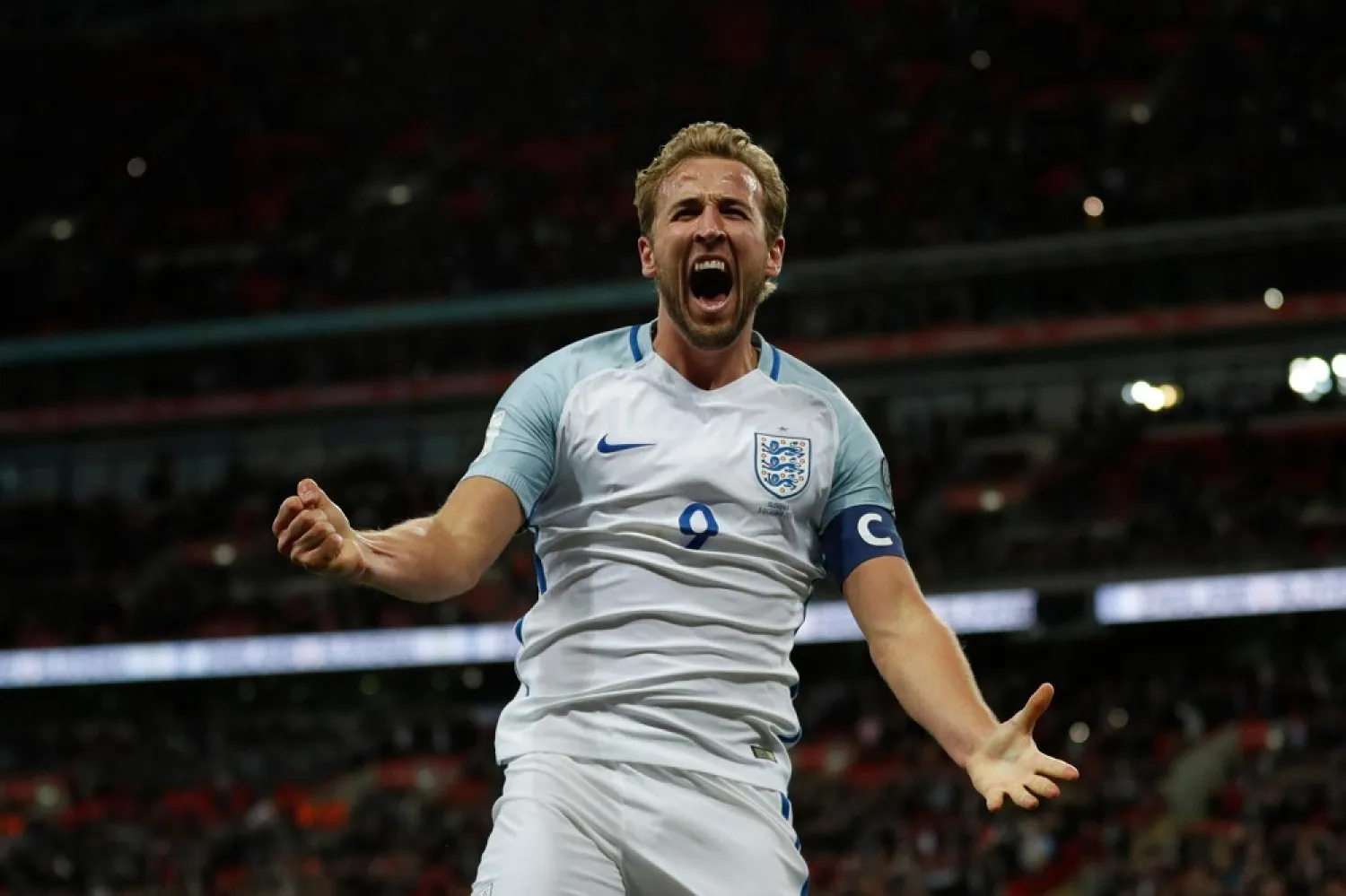

Gareth Southgate Must Give Freedom a Chance after Numbing England Spectacle

England forward Harry Kane celebrates after scoring the sole goal against Slovenia in his country's qualifier for the 2018 FIFA World Cup. (AFP)
TT

Gareth Southgate Must Give Freedom a Chance after Numbing England Spectacle

England forward Harry Kane celebrates after scoring the sole goal against Slovenia in his country's qualifier for the 2018 FIFA World Cup. (AFP)

Put out more flags. Dust down the red and white jester’s hat. Root out the gumshield, the crumpled Yekaterinburg metro map. And prepare to head once more into that strangely grueling territory between bruised and fearful cynicism and the eternal quiver of tournament hope.

England have booked their place at the World Cup in Russia after surely the most meandering, flaccid qualification victory yet devised by any England team. Slovenia were beaten by Harry Kane’s goal but make no mistake – this was both a dreadful game of football and a numbing spectacle for those loyal supporters still willing to drag themselves out on a Thursday night to enter the vast money-rinsing concrete cauldron of the Wembley entertainment complex.

Victory may have sealed qualification, but it also deflated further any realistic expectations of what might happen when England get there. This should be of great concern to the Football Association. There are only so many times even England fans will be prepared to pay £40 for the pleasure of throwing paper airplanes at the pitch, which brought the loudest cheers of the night right up until Kane’s finish in stoppage time.

At the end England’s players gathered in the center circle and wandered around applauding the empty red plastic seats and the backs of people queuing to leave while the PA burbled gamely about the prestige friendlies to come. As an image of England football 2017, and the slow, gilded death for what was once football’s most compelling theater, it is probably quite hard to beat.

England were at least terrible in a grimly fascinating way. Gone are the days when a poor England team sent it long, seeking out the head of some game forward battering ram. Here they were terrible in the new style, passing to each other but setting out with two lumbering central midfield wardrobes shielding a defense threatened only by its own misplaced passes. In the opening hour they produced a performance so lacking in purpose and precision it was like watching a piece of performance art, a 45-minute Warhol-style short film called Wembley Angst No94.

England did improve after the hour mark but by then they had a lot of ground to make up from a standing start as the game congealed early on into another game just like the other games. Jordan Henderson had the ball quite a lot, worrying about from side to side, always looking back into the yonic safety of his defense. Midway through the half England produced a stunningly terrible free-kick routine, working the ball very slowly backwards and finally teeing it up for Henderson to perform a spectacular falling-over air-kick on the edge of the area. Grimly, Slovenia cleared.

Only Marcus Rashford seemed really interested in trying to run forward quickly. Raheem Sterling ran quite a lot. Alex Oxlade-Chamberlain played like Alex Oxlade-Chamberlain. And that was pretty much that for the most soft-pedaled minor chord moment of qualification imaginable, given a spark of life at the death by Kane’s opportunism.

What now then? One thing is clear. England does not expect. It has been more than a decade since the national team had the luxury of traveling in a state of doomed optimism, the mood ever more stricken since that golden, foolish summer of 2006 when the world was still young, when Crouchie did the robot with Prince William, and when the idea of some grand Premier League talent-legacy waiting to be spent died for good on the fields of Stuttgart, Cologne and Gelsenkirchen.

The challenge now for Gareth Southgate is not to try to reach the World Cup final. It is to produce a team that people actually want to watch. This has been a deathly qualification, with only 16 goals scored and a feeling of having spent endless hours watching England’s furrowed and fearful back five play a variety of keep-ball.

From here it seems absolutely clear Southgate needs to take a chance, to chuck out the Dan Ashworth handbook of mind-bogglingly dull and outmoded possession football, to accept that playing with adventure, life, pace, and risky attacking vim might revive not just the dwindling England brand but his own managerial career.

In their current guise, watching England is like watching a 12-round under-card split decision wrestle-off between a pair of ponderous 15st taxi drivers, the craft-free double defensive midfield bolt the managerial equivalent of tucking both your shirt and your vest into your underpants.

What is the point of playing this way? From here to next summer every moment of Southgate’s time should be devoted to trying to wring the most out of what he does have, a spritz of genuine forward talent in Kane, Dele Alli and Rashford. He needs a midfielder who can pass. And he needs to trust his defense to carry the ball forward.

Success for this team would involve simply playing with a little freedom, exploring their own limits and refusing to leave the competition until they have at least been beaten by a demonstrably superior team. Score some goals. Produce at least one performance that lets everyone feel giddy and stupid and deluded for four days in June.

There is a wider issue here about international football itself. When the away fans in Malta last month sang against their team, they weren’t angry or incensed or spoiling for a fight. They were taking the mickey out of the whole thing: England, us, them, the enduring disjunct between a domestic league of such screeching urgency and a national team who have withered in its shadow. Take note, Gareth. It is when they stop booing you really want to start worrying. For now England will travel with hope, as ever. But not much of it.

The Guardian Sport


Sudan Dream of AFCON Glory as Conflict Rages at Home

 Sudan's players pose for the team picture before the Africa Cup of Nations group E soccer match between Algeria and Sudan in Rabat, Morocco, Wednesday, Dec. 24, 2025. (AP)
Sudan's players pose for the team picture before the Africa Cup of Nations group E soccer match between Algeria and Sudan in Rabat, Morocco, Wednesday, Dec. 24, 2025. (AP)
TT

Sudan Dream of AFCON Glory as Conflict Rages at Home

 Sudan's players pose for the team picture before the Africa Cup of Nations group E soccer match between Algeria and Sudan in Rabat, Morocco, Wednesday, Dec. 24, 2025. (AP)
Sudan's players pose for the team picture before the Africa Cup of Nations group E soccer match between Algeria and Sudan in Rabat, Morocco, Wednesday, Dec. 24, 2025. (AP)

When war broke out in Sudan in April 2023, Ammar Taifour was in a training camp with his club Al Merrikh in Khartoum.

"I just remember the surprise, the shock of the first gunshots. It was very surprising," the 28-year-old midfielder with the Sudan team at the Africa Cup of Nations tells AFP.

"Then in the days after that there were power cuts and constant gunshots. It was just unbelievable.

"I just pray for peace and for everyone who's in this situation to be safe and make it out."

Taifour, who was born in the United States, is among the lucky ones. He says he is "grateful and blessed" that family members in Sudan were able to leave the country.

Goalkeeper Mohamed Al Nour, meanwhile, had to deal with the anguish of his brother being taken prisoner by the paramilitary Rapid Support Forces.

"Luckily I have not lost any members of my family but my brother was taken prisoner for nine months by the RSF before being released," says Al Nour.

"We have experienced terror, people being killed. We just hope things improve."

The war that erupted close to three years ago between the country's army and its former allies the RSF has had a devastating impact on the population.

Tens of thousands of people have been killed and 11 million driven from their homes in what the UN has declared "the world's worst humanitarian disaster".

Despite that backdrop, Sudan's national football team qualified for the ongoing AFCON in Morocco and on Sunday they beat Equatorial Guinea 1-0 in Casablanca.

It was just their second win at the Cup of Nations in 18 matches across six tournament appearances since they lifted the trophy in 1970.

They play Burkina Faso in their final group game on Wednesday and do so with the pressure off because they are already assured of progressing to the last 16.

That is a remarkable achievement regardless of the current off-field context, given Sudan have only once made the knockout stages at an AFCON since 1970 -- they reached the quarter-finals in 2012.

- 'Big responsibility' -

"It's a big honor," says Taifour. "But also we have big expectations and we want to make it as far as possible and even to win the tournament, make our country happy."

"Obviously it's a big responsibility. I think each one of us as individuals, we know the situation that's going on, we all can relate to it, we all have someone involved.

"So whatever we can do to help, whatever we can do to bring some happiness, we try our best to do so."

Al Nour, also known by his nickname Abooja, adds: "Of course the team has been impacted. Everyone has just tried to get through this period but it has been difficult with the tension all over Sudan."

"In the end our results on the pitch are what make the people happy and boost their morale."

The impact of the conflict on Sudanese football has been enormous, leading to the domestic championship being halted and the country's two biggest clubs going into exile.

Al Hilal and Al Merrikh of Omdurman played in the Mauritanian league last season. A domestic elite league did make its return in July, but now the two rivals are playing in Rwanda.

Some players have moved to different countries like Taifour, who departed Al Merrikh for Libya and is now plying his trade in Tunisia.

Despite that the national team has flourished under Ghanaian coach Kwesi Appiah.

They qualified for the competition at the expense of Ghana and put in some good showings in their World Cup qualifying group, beating the Democratic Republic of Congo and drawing with Senegal en route to finishing third.

In August they got to the semi-finals of the African Nations Championship -- a competition for locally-based players -- and they also appeared at the recent FIFA Arab Cup in Qatar.

"We have tried to use every match as preparation and to build chemistry within the group," says Taifour.

Al Nour, meanwhile, describes Appiah as "an exceptional person. We have learned a lot thanks to him."

It has all led to this, with Sudan now building towards a Cup of Nations knockout tie this weekend and hoping to put smiles on the faces of supporters back home.


Prince Abdul Mohsin Airport Receives First Dakar Rally 2026 Arrivals

This comes as part of ongoing preparations to host the global sporting event - SPA
TT

Prince Abdul Mohsin Airport Receives First Dakar Rally 2026 Arrivals

This comes as part of ongoing preparations to host the global sporting event - SPA

Prince Abdul Mohsin bin Abdulaziz International Airport in Yanbu has received the first arrivals of competitors participating in the Dakar Rally 2026, as part of ongoing preparations to host the global sporting event.

Cluster2 Airports, the operator of Prince Abdul Mohsin bin Abdulaziz International Airport, stated that arrivals will continue from December 28 to December 31, with approximately 17 flights, both private and commercial, designated for the arrival of competitors and participating teams, SPA reported.

The process is being handled with a high level of operational readiness and full coordination among the relevant authorities.

Cluster2 Airports affirmed that operational and service preparations at the airports have been completed to ensure smooth passenger movement and the provision of high-quality services to participating delegations, reflecting the efficiency of the affiliated airports and their ability to accommodate major international events.


Knee Injury for Shaheen Shah Afridi Forces Early Exit from Big Bash League

Pakistan’s ODI’s team captain Shaheen Shah Afridi attends a press conference, in Rawalpindi, Pakistan, on Nov. 10, 2025. (AP Photo/Anjum Naveed, File)
TT

Knee Injury for Shaheen Shah Afridi Forces Early Exit from Big Bash League

Pakistan’s ODI’s team captain Shaheen Shah Afridi attends a press conference, in Rawalpindi, Pakistan, on Nov. 10, 2025. (AP Photo/Anjum Naveed, File)

A knee injury has forced fast bowler Shaheen Shah Afridi to return home after playing four games for Brisbane Heat in the Big Bash League.

“Due to an unexpected injury; I have been called back by the PCB and will have to take a rehab. Hopefully, I will be back in the fields soon,” Afridi wrote on X on Tuesday.

Afridi limped off the field when he picked up the injury on his right knee while bowling against Adelaide Strikers last Saturday, The AP news reported.

Apparently the Pakistan Cricket Board has called back Afridi as a precautionary step with T20 World Cup due to start from February 7.

“I’m massively thankful to the Brisbane Heat team and fans for showering me with immense love and support,” Aridi said, while adding: “Meanwhile, I will be cheering for the amazing team.”

Afridi had a challenging short stint at Brisbane Heat where he picked up just two wickets in four matches at an expensive economy rate of 11.19. In his first game of the season he was removed from the attack in the 18th over when he bowled to waist-high full tosses to Melbourne Renegades’ batters Tim Seifert and Oliver Peake.

It is not the first time that Afridi has hurt his right knee. He sustained an injury on that knee while fielding during a test match in Sri Lanka in 2022 that also ruled him out from the early stages of the T20 World Cup in Australia.

He returned at the later stages of the tournament, but again picked up injury on the same knee during the death overs of the final against England that let the title match slip away from Pakistan.

Pakistan didn’t name Afridi for next month’s three-match T20 series in Sri Lanka as a rotation policy, but he remains one of the key players for the T20 World Cup to be jointly hosted by Sri Lanka and India.
