
CIA Officers Detail Part of Benghazi Attack at Abu Khattala’s Trial

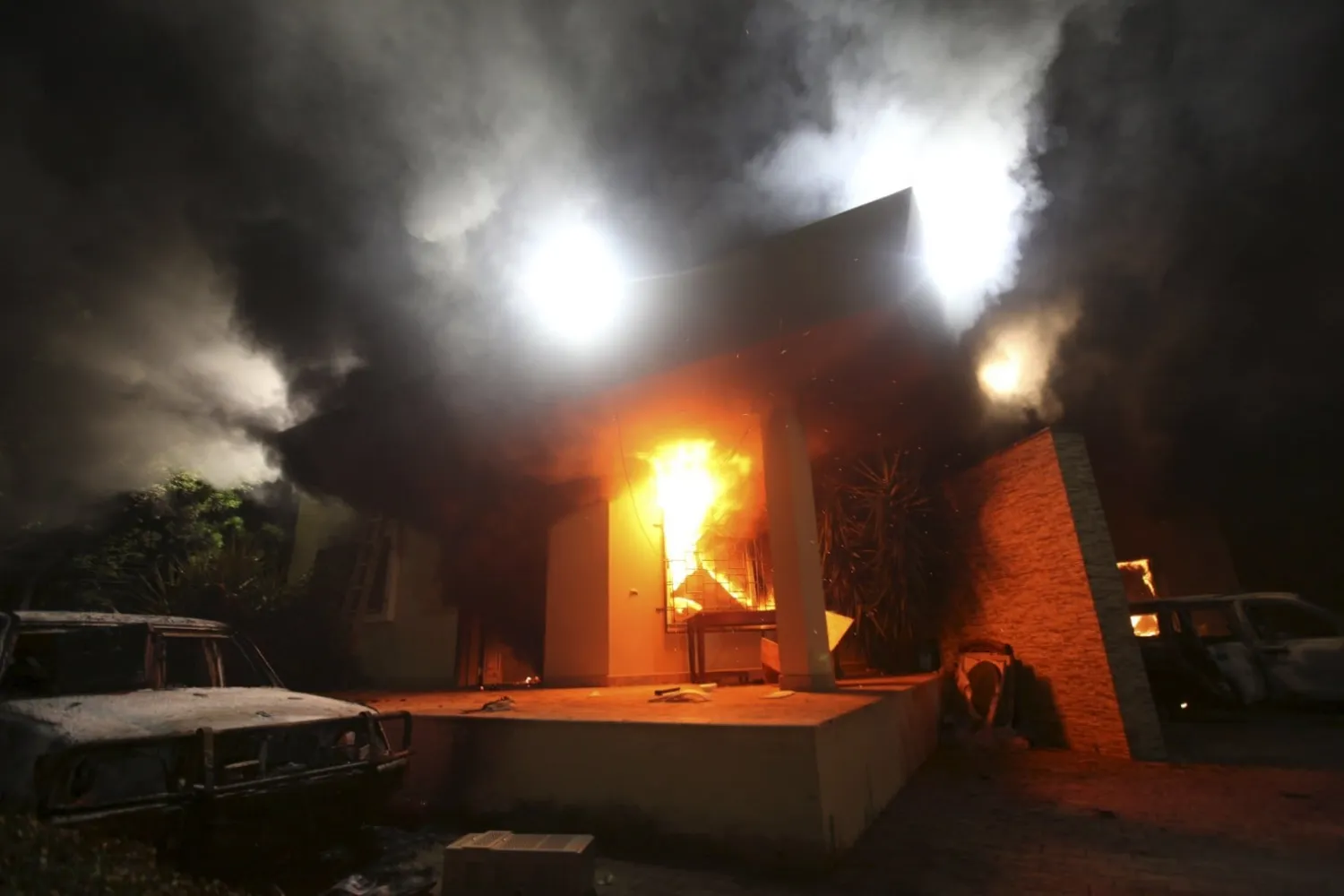
The US Consulate in Benghazi is seen in flames in the 2012 attack. (Esam Al-Fetori/Reuters)
TT

CIA Officers Detail Part of Benghazi Attack at Abu Khattala’s Trial

The US Consulate in Benghazi is seen in flames in the 2012 attack. (Esam Al-Fetori/Reuters)

A CIA witness testified Tuesday that the body of US Ambassador J. Christopher Stevens was returned after the September 2012 attacks on US facilities in Benghazi, Libya, only after he overheard Libyan fighters discussing whether to tell Americans about a dead compatriot at a hospital.

Appearing under false names and in wigs or a mustache because their identities remain classified, two active CIA employees gave gripping accounts at the trial of the accused mastermind of the attacks about the chaotic, at times haphazard US response to the bloody assault on Sept. 11 and 12, 2012, that killed Stevens and three other Americans at a US special diplomatic mission and nearby CIA Annex.

The two witnesses said they used $30,000 in cash to arrange a one-hour, midnight flight for six US security operatives to go from Tripoli to reinforce Benghazi in the immediate aftermath of the attacks. There, they waited — futilely — for an armed escort of Libyan special forces personnel who were supposed to take them from the Benghazi airport to the CIA annex. In the end, one testified, he offered $1,000 to Libyan ambulance drivers for a litter to carry Stevens’s body aboard a Libyan Air Force C-130 aircraft evacuating the American dead and surviving security officers.

The drivers offered the litter — and declined to accept payment for the courtesy.

The testimony by “Alexander Charles” and “Roy Edwards,” an Arabic-speaking CIA operations support manager and the CIA’s team leader for security in Libya, respectively, continued several days of emotionally powerful appearances by witnesses put on by federal prosecutors in Washington with the US attorney’s office of the District.

The testimony in the case has yet to lay out for jurors the strong evidence prosecutors have asserted in filings and in opening statements that they have tying Ahmed Abu Khattala, 46, to the attacks.

Abu Khattala is a Libyan national who led a brigade of the Ansar al-Sharia militia that the United States designated a terrorist organization and holds responsible for the Benghazi attacks. He was captured in a June 2014 raid by US Special Operations forces and faces life in prison if convicted in a trial that began Oct. 2.

Abu Khattala has pleaded not guilty to 18 charges including conspiracy to support terrorism, murder, attempted murder and damaging US acilities.

The courtroom was closed for security reasons during the CIA officers’ testimony Tuesday, and images from the witness stand were blacked out on video streamed to an observation room for journalists. Live audio of their testimony was streamed into ancillary rooms where journalists and other observers could listen.

Charles and Edwards, disguised in what the judge called light disguises, testified that US forces on the ground could scarcely tell friend from foe among rival militia groups, and were delayed by conflicting aims of keeping a low profile while still moving in force to avoid being ambushed and needing rescuing themselves.

After the CIA’s chief of station in Tripoli tried in vain to get help from the Libyan ministries of defense and interior and the intelligence service for a flight to Benghazi after the attack began at 9:40 p.m. on Sept. 11, 2012, Charles reached out to a Libyan charter flight provider he had met earlier that same day.

Edwards, who worked for the CIA’s secret contract security force called the Global Response Staff, said the team of four GRS officers, Charles, and two US military operatives arrived at the Benghazi airport before 1 a.m., shortly after the assault on the annex had started, but was stranded because the Libyan military unit they expected to be waiting to drive them to the annex did not show, triggering hours of negotiations and phone calls.

“Obviously nothing worked, because we were on the ground for approximately three hours,” said Charles, who said he worked 30 years with the US government or with the CIA.

Edwards said the CIA team was directed to retrieve a wounded Westerner reportedly at a Benghazi hospital who possibly could be Stevens.

Later, however, the team received a report that the person was dead, and the CIA station chief in Tripoli told the team to move on the annex, which had already repelled two ground attacks, Edwards testified.

A leader of a Benghazi-based militia at the airport had refused to take the CIA team members to the hospital, possibly for their own safety, but agreed to take them to the annex, Edwards told jurors.

Within minutes of arriving at the annex, about 5 a.m., “All hell broke loose,” Charles said.

Edwards had asked a key member from Tripoli, a former Navy SEAL commando and medic named Glen “Bub” A. Doherty, to assist other GRS officers on watch on the roof. Doherty wanted to join a GRS friend there, his SEAL school classmate Tyrone S. Woods, Charles said.

Suddenly, a mortar round exploded nearby. Another landed closer, then several hit the roof.

Voice breaking with emotion, Edwards said he raced to the roof, but wearing night-vision goggles, he could not recognize one of the victims until a colleague said, “Bub is dead. Move to other medic.”

The other, Woods, was alive, Edwards testified, but as Edwards pulled him to a ladder to get off the roof, “he expired in that time.” GRS officer Mark Geist and State Department security agent David Ubben were wounded.

Expecting a “final assault to wipe us out,” Edwards said, the Americans evacuated to the airport.

Fate then seemingly stepped in, according to an account from Charles, who said he decided to walk near Libyan revolutionary militiamen guarding them at the airport.

“I don’t know why, maybe it was divine intervention,” Charles said, “I heard two Libyans talking to each other. They said, ‘Should we tell them about this dead American at the hospital?’ ”

Charles said he offered all the money in his backpack for the body, to which the men’s commander said, “ ‘I don’t want your money.’ He said, ‘I’ll see what I can do.’ About 15 minutes later, the body of the ambassador was delivered to the airport.”

The Washington Post


Iraq’s Newly Elected Parliament Holds First Session

A view of the Iraqi Parliament building in Baghdad, Iraq, Monday, Dec. 29, 2025. (AP)
TT

Iraq’s Newly Elected Parliament Holds First Session

A view of the Iraqi Parliament building in Baghdad, Iraq, Monday, Dec. 29, 2025. (AP)

Iraq's newly elected parliament convened ​on Monday for its first session since the November national election, opening the ‌way for ‌lawmakers ‌to begin ⁠the ​process ‌of forming a new government.

Parliament is due to elect a speaker and ⁠two deputies ‌during its first meeting. ‍

Lawmakers ‍must then ‍choose a new president by within 30 days of ​the first session.

The president will subsequently ⁠ask the largest bloc in parliament to form a government, a process that in Iraq typically drags on for ‌months.


Death Toll in Attack in Syria's Latakia Rises to 4, 108 Injured

Syrian security forces are deployed in the city of Latakia, Syria, 28 December 2025. (EPA)
TT

Death Toll in Attack in Syria's Latakia Rises to 4, 108 Injured

Syrian security forces are deployed in the city of Latakia, Syria, 28 December 2025. (EPA)

Authorities in Syria's Latakia province announced on Monday that the death toll has risen to four from the armed attack carried out by remnants of the ousted regime on Sunday.

It added that 108 people were injured in the violence.

The Syrian Defense Ministry announced on Sunday the deployment of military forces in the coastal cities of Latakia and Tartus in wake of the attack against security forces and civilians during protests.

State television said a member of the security forces was killed and others were injured while they were protecting protests in Latakia.

Head of the security forces in the Latakia province Abdulaziz al-Ahmed said the attack was carried out by terrorist members of the former regime.

Al-Ahmed added that masked gunmen were spotted at the protests and they were identified as members of Coastal Shield Brigade and Al-Jawad Brigade terrorist groups, reported the official SANA news agency.


Syria Secures Assad-Era Mass Grave Revealed by Reuters and Opens Criminal Investigation

A drone view of the mass grave site in the desert near the eastern Syrian town of Dhumair, February 27, 2025. (Reuters)
TT

Syria Secures Assad-Era Mass Grave Revealed by Reuters and Opens Criminal Investigation

A drone view of the mass grave site in the desert near the eastern Syrian town of Dhumair, February 27, 2025. (Reuters)

Syria’s government has ordered soldiers to guard a mass grave created to conceal atrocities under Bashar al-Assad and has opened a criminal investigation, following a Reuters report that revealed a yearslong conspiracy by the fallen dictatorship to hide thousands of bodies on the remote ​desert site.

The site, in the Dhumair desert east of Damascus, was used during Assad’s rule as a military weapons depot, according to a former Syrian army officer with knowledge of the operation.

It was later emptied of personnel in 2018 to ensure secrecy for a plot that involved unearthing the bodies of thousands of victims of the dictatorship buried in a mass grave on the outskirts of Damascus and trucking them an hour’s drive away to Dhumair.

The plot, orchestrated by the dictator’s inner circle, was called “Operation Move Earth.”

Soldiers are stationed at the Dhumair site again, this time by the government that overthrew Assad.

The Dhumair military installation was also reactivated as a barracks and arms depot in November, after seven years of disuse, according to an army officer posted there in early December, a military official and Sheikh Abu Omar Tawwaq, who is the security chief of Dhumair.

The Dhumair site ‌was completely unprotected over ‌the summer, when Reuters journalists made repeated visits after discovering the existence of a mass grave ‌there.

Within ⁠weeks ​of the ‌report in October, the new government created a checkpoint at the entrance to the military installation where the site lies, according to a soldier stationed there who spoke to Reuters in mid-December. Visitors to the site now need access permits from the Defense Ministry.

Satellite images reviewed by Reuters since late November show new vehicle activity around the main base area.

The military official, who spoke on condition of anonymity, said the reactivation of the base is part of efforts to “secure control over the country and prevent hostile parties from exploiting this open strategic area.” The road through the desert connects one of ISIS’ remaining Syrian strongholds with Damascus.

POLICE INVESTIGATION

In November, police opened an investigation into the grave, photographing it, carrying out land surveys and interviewing witnesses, according to Jalal Tabash, head of the ⁠al-Dhumair police station. Among those interviewed by police was Ahmed Ghazal, a key source for the Reuters investigation that exposed the mass grave.

“I told them all the details I told you about the ‌operation and what I witnessed during those years,” said Ghazal, a mechanic who repaired trucks ‍carrying bodies that broke down at the Dhumair grave site.

Ghazal confirmed ‍that during the time of “Operation Move Earth,” the military installation appeared vacant except for the soldiers involved in accompanying the convoys.

Syria’s Information Ministry ‍did not respond to requests for comment about the re-activation of the base or the investigation into the mass grave.

The National Commission for Missing Persons, which was established after Assad’s ouster to investigate the fate of tens of thousands of Syrians who vanished under his rule, told Reuters it is in the process of training personnel and creating laboratories in order to meet international standards for mass grave exhumations.

Exhumations at Syria’s many Assad-era mass graves, including the site at Dhumair, are scheduled for ​2027, the commission told Reuters.

The police have referred their report on Dhumair to the Adra district attorney, Judge Zaman al-Abdullah.

Al-Abdullah told Reuters that information about Assad-era suspects involved in the Dhumair operation, both inside and outside Syria, is being cross-referenced ⁠with documents obtained by security branches after the dictator’s fall in December 2024. He would not describe the suspects, citing the ongoing investigation.

According to military documents reviewed by Reuters and testimony from civilian and military sources, logistics for “Operation Move Earth” were handled by a key man, Col. Mazen Ismander.

Contacted through an intermediary, Ismander declined to comment on the initial Reuters report or the new investigation into the mass grave.

When the conspiracy was hatched in 2018, Assad was verging on victory in the civil war and hoped to reclaim legitimacy in the international community after years of sanctions and allegations of brutality.

He had been accused of detaining and killing Syrians by the thousands, and the location of a mass grave in the Town of Qutayfah, outside Damascus, had been reported by local human rights activists.

So an order came from the presidential palace: Excavate Qutayfah and hide the bodies on the military installation in the Dhumair desert.

For four nights a week for nearly two years, from 2019 to 2021, Ismander oversaw the operation, Reuters found . Trucks hauled corpses and dirt from the exposed mass grave to the vacated military installation in the desert, where trenches were filled with bodies as the Qutayfah site was excavated.

In revealing the conspiracy, Reuters spoke to 13 people with direct ‌knowledge of the two-year effort and analyzed more than 500 satellite images of both mass graves.

Under the guidance of forensic geologists, Reuters used aerial drone photography to create high-resolution composite images that helped corroborate the transfer of bodies by showing
color changes in the disturbed soil around Dhumair’s burial trenches.