

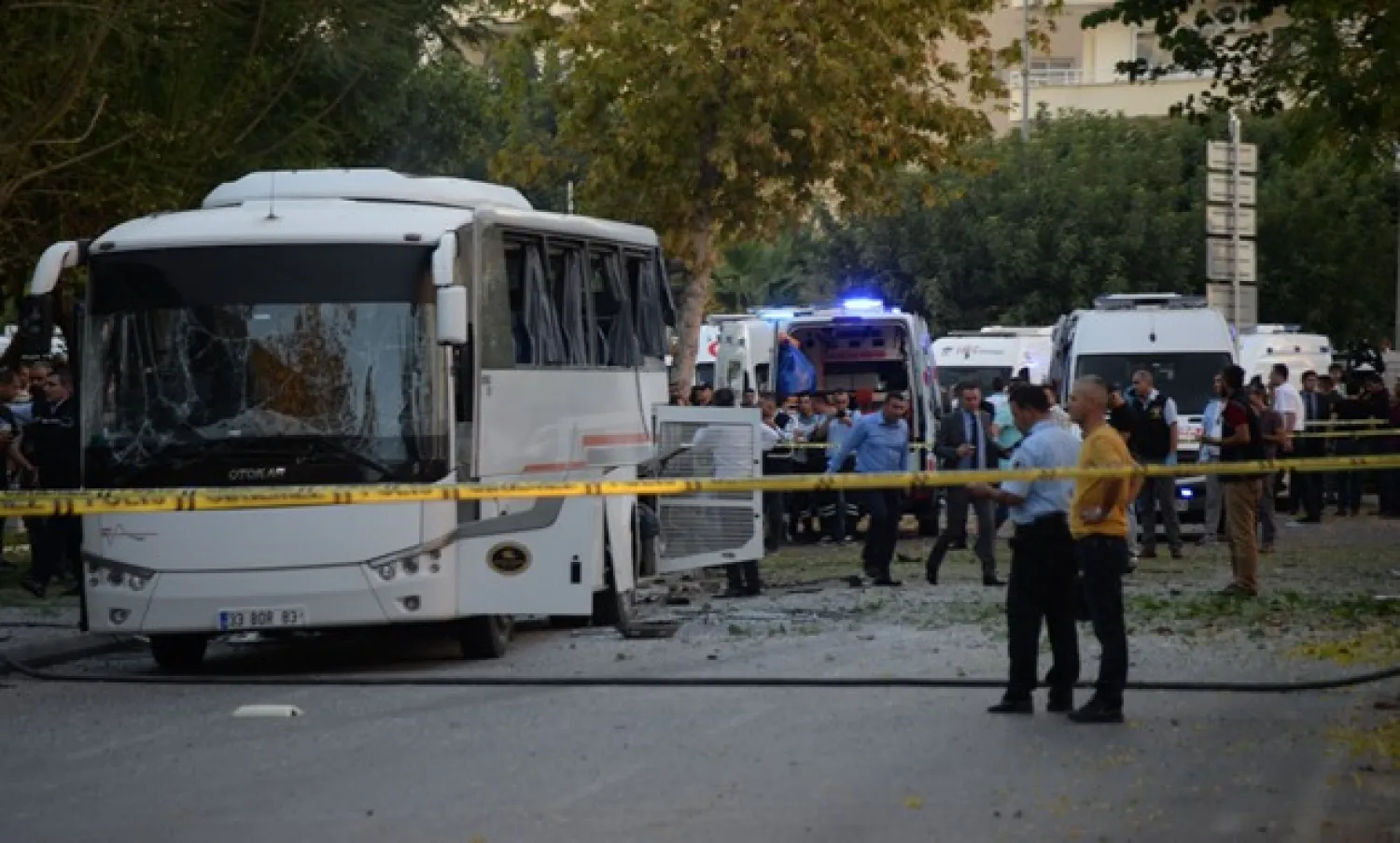

Eighteen Injured in Bomb Attack on Police Vehicle in Turkey's Mersin

Plainclothes police officers stand after a bomb hit a bus carrying police officers in Mersin, Turkey, October 17, 2017. REUTERS
TT

Eighteen Injured in Bomb Attack on Police Vehicle in Turkey's Mersin

Plainclothes police officers stand after a bomb hit a bus carrying police officers in Mersin, Turkey, October 17, 2017. REUTERS

A bomb blast wrecked a bus carrying police officers on Tuesday in the southern Turkish province of Mersin.

According to the report cited by Reuters, the blast injured 18 people in an attack that security sources blamed on Kurdish militants.

Seventeen of those hurt were police officers, Deputy Prime Minister and government spokesman Bekir Bozdag told parliament, branding it a terrorist attack.

“Turkey’s battle against terror will continue under any circumstances in a strong and determined way,” Bozdag said.

Security sources said militants of the outlawed Kurdistan Workers Party (PKK) were believed to have carried out the attack. They also said that none of those wounded were in a critical condition.

No one immediately claimed responsibility for the bombing.

Local mayor Burhanettin Kocamaz told broadcaster Haberturk the attack took place on a street where the local governor’s office was located and had hit the police vehicle as it passed.

Images from NTV showed smoke billowing from the area, in Mersin’s Yenisehir district. Ambulances, police and fire trucks were sent to the site of the attack, security sources said.

Turkey is battling a three-decade insurgency in its mainly Kurdish southeast. The PKK frequently carries out bomb attacks on security forces in the southeast and elsewhere.

The PKK is considered a terrorist organization by the United States and the European Union as well as by Turkey. More than 40,000 people, most of them Kurds, have died since it first took up arms against the state in 1984.



Paris Urges Baghdad to Avoid Being Dragged in Regional Escalation

 Iraqi Foreign Minister Fuad Hussein (R) shake hands as he receives French Foreign Minister Jean-Noel Barrot (L) upon his arrival for an official visit to Baghdad on February 5, 2026. (AFP)
Iraqi Foreign Minister Fuad Hussein (R) shake hands as he receives French Foreign Minister Jean-Noel Barrot (L) upon his arrival for an official visit to Baghdad on February 5, 2026. (AFP)
TT

Paris Urges Baghdad to Avoid Being Dragged in Regional Escalation

 Iraqi Foreign Minister Fuad Hussein (R) shake hands as he receives French Foreign Minister Jean-Noel Barrot (L) upon his arrival for an official visit to Baghdad on February 5, 2026. (AFP)
Iraqi Foreign Minister Fuad Hussein (R) shake hands as he receives French Foreign Minister Jean-Noel Barrot (L) upon his arrival for an official visit to Baghdad on February 5, 2026. (AFP)

French diplomatic sources said Paris has warned of the risks posed by the involvement of Iraqi armed factions in any potential regional escalation, stressing that Iraq should not be drawn into conflicts that do not serve its national interests at a time of mounting regional tensions.

The sources told Asharq Al-Awsat on Friday that the warning was among the messages delivered by French Foreign Minister Jean-Noel Barrot during his visit to Baghdad on Thursday, where he held talks with Prime Minister Mohammed Shia al-Sudani and Foreign Minister Fuad Hussein. The trip marked Barrot’s second official visit to Iraq in less than a year.

According to the sources, the French minister underscored that the stability and security achieved in Iraq “with great patience and effort” should not be jeopardized under any circumstances.

He cautioned that the involvement of non-state armed groups in regional confrontations could undermine Iraq’s recovery and threaten the security of both the country and the wider region.

The stance echoed remarks Barrot made to news agencies in Baghdad on Thursday, in which he said France’s priority in the region remains the fight against ISIS and preventing its resurgence.

Any security deterioration, whether in Iraq or in camps and prisons in northeastern Syria, would benefit the group, he warned.

Barrot said France is working with its partners to ensure continued security at these sites, adding that a collapse there “would not serve anyone’s interests.”

He praised Iraq’s efforts to receive detainees linked to ISIS, calling it a crucial step in international efforts to address one of the most sensitive post-conflict files.

For his part, Hussein reiterated Baghdad’s commitment to continued cooperation with the international coalition against terrorism, emphasizing Iraq’s determination to safeguard internal stability and steer clear of regional power struggles.

Iraqi foreign policy is based on balance and building relations with all partners to shield the country from regional tensions, he stressed.

The talks also addressed Iran, amid fears of escalation and its potential repercussions for Iraq.

Barrot urged the need for Tehran to respond to a US proposal for negotiations and to make substantive concessions on its nuclear program, ballistic arsenal, and destabilizing regional activities, while ending repressive policies.

Iraq, he said, must stay out of any regional confrontation.

Paris and Baghdad are also aligned on Syria, supporting a peaceful, inclusive political transition involving all components of Syrian society, alongside continued efforts to combat ISIS and prevent its return to liberated areas, he added.

French sources said Paris’ core message was to shield Iraq from being pulled into any regional escalation and to preserve its stability.


Clintons Call for Their Epstein Testimony to Be Public

Images of former US President Bill Clinton are on display as Chairman of the House Oversight Committee James Comer (R-KY) speaks during a meeting to vote on whether to hold Clinton and former Secretary of State Hillary Clinton in contempt of Congress for defying subpoenas to testify in the panel's investigation of the late convicted offender Jeffrey Epstein, on Capitol Hill in Washington, D.C., US, January 21, 2026. REUTERS/Kevin Lamarque
TT

Clintons Call for Their Epstein Testimony to Be Public

Images of former US President Bill Clinton are on display as Chairman of the House Oversight Committee James Comer (R-KY) speaks during a meeting to vote on whether to hold Clinton and former Secretary of State Hillary Clinton in contempt of Congress for defying subpoenas to testify in the panel's investigation of the late convicted offender Jeffrey Epstein, on Capitol Hill in Washington, D.C., US, January 21, 2026. REUTERS/Kevin Lamarque

Former US president Bill Clinton and his wife Hillary are calling for their congressional testimony on ties to convicted sex trafficker Jeffrey Epstein to be held publicly, to prevent Republicans from politicizing the issue.

Both Clintons had been ordered to give closed-door depositions before the House Oversight Committee, which is probing the deceased financier's connections to powerful figures and how information about his crimes was handled, said AFP.

Democrats say the probe is being weaponized to attack political opponents of President Donald Trump -- himself a longtime Epstein associate who has not been called to testify -- rather than to conduct legitimate oversight.

House Republicans had previously threatened a contempt vote if the Democratic power couple did not show up to testify, which they have since agreed to do.

But holding the deposition behind closed doors, Bill Clinton said Friday, would be akin to being tried at a "kangaroo court."

"Let's stop the games & do this the right way: in a public hearing," the former Democratic president said on X.

Hillary Clinton, former secretary of state, said the couple had already told the Republican-led Oversight Committee "what we know."

"If you want this fight...let's have it in public," she said Thursday.

The Justice Department last week released the latest cache of so-called Epstein files -- more than three million documents, photos and videos related to its investigation into Epstein, who died from what was determined to be suicide while in custody in 2019.

Bill Clinton features regularly in the files, but no evidence has come to light implicating either Clinton in criminal activity.

The former president has acknowledged flying on Epstein's plane in the early 2000s for Clinton Foundation-related humanitarian work, but said he never visited Epstein's private island.

Hillary Clinton, who ran against Trump for president in 2016, said she had no meaningful interactions with Epstein, never flew on his plane and never visited his island.


Damascus Moves to Implement SDF Deal amid Regional and International Backing

Fighters from the Syrian Democratic Forces welcome a convoy of the Syrian Ministry of Interior heading to Qamishli in northeastern Syria. (AP)
TT

Damascus Moves to Implement SDF Deal amid Regional and International Backing

Fighters from the Syrian Democratic Forces welcome a convoy of the Syrian Ministry of Interior heading to Qamishli in northeastern Syria. (AP)

Damascus is pressing ahead with steps to implement its agreement with the Syrian Democratic Forces (SDF) on the gradual integration of its fighters, redeployment in northeastern Syria, and the return of key facilities to state control.

The deal is receiving regional and international support and is being framed as an opportunity to integrate Syria’s Kurds into state institutions and help build a “new Syria.”

On Friday, a delegation from the Syrian Ministry of Defense was in Hasakah to discuss practical measures for incorporating SDF personnel into the national military, said the ministry’s Media and Communications Directorate.

The move is in line with the agreement announced on Jan. 29 between the Syrian government and the SDF. The accord includes a ceasefire, the gradual integration of Kurdish military and administrative structures into state institutions, and the restoration of government control over vital installations in the province.

Interior Ministry spokesman Nour al-Din al-Baba said the deployment of Internal Security Forces in Qamishli, in northeastern Syria, is proceeding under a clear timeline and operational plan to complete the agreement’s implementation.

This includes taking over and managing strategic facilities such as border crossings, Qamishli International Airport, and oil fields, with the aim of reactivating them “in service of the Syrian people,” he said in statements carried by state television Al-Ikhbariya.

Al-Baba added that the deployment is being carried out “in coordination with the other side in the city,” referring to the SDF, following a similar security deployment in Hasakah.

The agreement is also expected to address the issue of foreign fighters and to integrate the local Kurdish internal security force, known as the Asayish, into the Interior Ministry.

Al-Baba stressed that the ministry welcomes “all Syrian national cadres who serve the people.”

French support

French diplomatic sources told Asharq Al-Awsat that French Foreign Minister Jean-Noel Barrot informed SDF commander Mazloum Abdi that Paris wants to the January 29 agreement implemented “clause by clause” over the long term.

Barrot, who visited Iraq, Syria and Lebanon this week, described the deal as a “historic opportunity” for Syria’s Kurds to take part in building a new Syria alongside other components of society, the sources said.

The FM also discussed developments in Syria with leaders of Iraq’s Kurdistan Region, acknowledging their role in securing the ceasefire between Damascus and the SDF and agreeing to maintain close coordination to ensure the agreement’s success.

On Friday, Kurdistan Democratic Party leader Masoud Barzani met with Abdi and urged both the Syrian government and SDF to commit to the agreement.

A statement from Barzani’s office said the talks focused on conditions in northeastern Syria and underlined coordination among all parties to safeguard Kurdish rights within the country’s constitutional framework.