


Gunmen Kill 12 Niger Gendarmes Near Mali Border

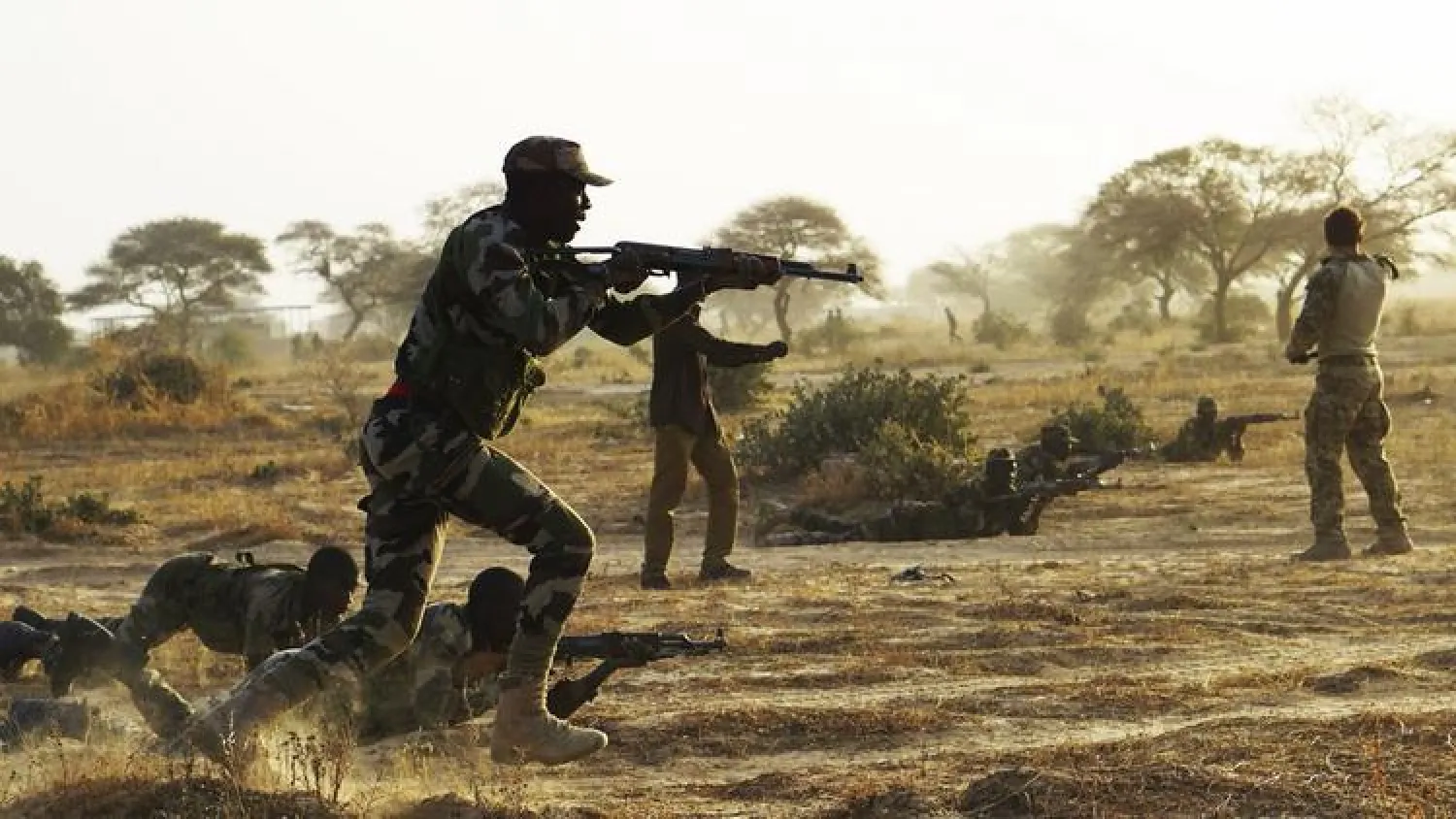
A file photo made available by the US Army shows Nigerien service members reacting to contact during Exercise Flintlock 2017 in Diffa, Niger, March 3, 2017.
TT

Gunmen Kill 12 Niger Gendarmes Near Mali Border

A file photo made available by the US Army shows Nigerien service members reacting to contact during Exercise Flintlock 2017 in Diffa, Niger, March 3, 2017.

Gunmen mounted on pick-up trucks and motorcycles killed 12 paramilitary police and wounded several in an attack on their base in restive southwest Niger, near the Mali border, on Saturday, two security sources said.

The village is a few dozen kilometers from where militants killed four US soldiers in an ambush on Oct. 4 that has thrown a spotlight on the US counter-terrorism mission in Niger, which straddles a large expanse of the Sahara.

The gunmen crossed over the border from Mali and drove up to the village of Ayorou, before launching their attack, the security sources said.

"They were heavily armed. They had rocket launchers and machine guns. They came in four vehicles each with about seven fighters," said a security source on the scene.

One of the attackers was killed in an exchange of fire, he added. A spokesman for Niger's military said he could not confirm any details of the attack.

Several militant groups and well-armed ethnic militia are known to operate in the area near the border with Mali, and there have been at least 46 attacks recorded there since early least year.

However, security officials suspect a relatively new militant group called ISIS in the Greater Sahara to have been behind many of them, including the ambush on the joint US-Niger patrol.

Meanwhile, members of Congress are demanding answers to the killing of the four US soldiers.

Among the unresolved inquiries: Why were the Americans apparently caught by surprise? Why did it take two additional days to recover one of the four bodies after the shooting stopped? Was ISIS responsible?

The confusion over what happened in a remote corner of Niger, where few Americans travel, has increasingly dogged President Donald Trump, who was silent about the deaths for more than a week.



Venezuela's Machado Says Ally 'Kidnapped' after His Release

Venezuelan political leader Juan Pablo Guanipa gestures after their release outside Zona 7 prison in Caracas on February 8, 2026.  (Photo by Juan BARRETO / AFP)
Venezuelan political leader Juan Pablo Guanipa gestures after their release outside Zona 7 prison in Caracas on February 8, 2026. (Photo by Juan BARRETO / AFP)
TT

Venezuela's Machado Says Ally 'Kidnapped' after His Release

Venezuelan political leader Juan Pablo Guanipa gestures after their release outside Zona 7 prison in Caracas on February 8, 2026.  (Photo by Juan BARRETO / AFP)
Venezuelan political leader Juan Pablo Guanipa gestures after their release outside Zona 7 prison in Caracas on February 8, 2026. (Photo by Juan BARRETO / AFP)

Venezuela's Nobel peace laureate Maria Corina Machado said on Monday that armed men "kidnapped" a close ally shortly after his release by authorities, following ex-leader Nicolas Maduro's capture.

The country's Public Prosecutor's Office confirmed later that same day that former National Assembly vice president Juan Pablo Guanipa, 61, was again taken into custody and to be put under house arrest, arguing that he violated the conditions of his release.

Guanipa would be placed under house arrest "in order to safeguard the criminal process," the office said in a statement on Monday. The conditions of Guanipa's release have yet to be made public.

Machado claimed that her close ally had been "kidnapped" in the capital Caracas by armed men "dressed in civilian clothes" who took him away by force.

"We demand his immediate release," she wrote on social media platform X.

The arrest came after his release from prison on Sunday along with two other opposition figures, and as lawmakers prepared to vote Tuesday on a historic amnesty law covering charges used to lock up dissidents in almost three decades of socialist rule, reported AFP.

Shortly after his release, Guanipa visited several detention centers in Caracas, where he met with relatives of political prisoners and spoke to the press.

Guanipa had appeared earlier Sunday in a video posted on his X account, showing what looked like his release papers.

"Here we are, being released," Guanipa said in the video, adding that he had spent "10 months in hiding, almost nine months detained here" in Caracas.

- 'Let's go to an electoral process' -

Speaking to AFP later on Sunday, he had called on the government to respect the 2024 presidential election, which opposition candidate Edmundo Gonzalez Urrutia was widely considered to have won. Maduro claimed victory and remained in power till January.

"Let's respect it. That's the basic thing, that's the logical thing. Oh, you don't want to respect it? Then let's go to an electoral process," Guanipa said.

The opposition ally of Machado was arrested in May 2025, in connection with an alleged conspiracy to undermine legislative and regional elections that were boycotted by the opposition.

He was charged with terrorism, money laundering and incitement to violence and hatred.

Guanipa had been in hiding prior to his arrest. He was last seen in public in January 2025, when he accompanied Machado to an anti-Maduro rally.

Following Maduro's capture by US special forces on January 3, authorities have started to slowly release political prisoners. Rights groups estimate that around 700 people are still waiting to be freed.

A former Machado legal advisor, Perkins Rocha, was also freed on Sunday. So was Freddy Superlano, who once won a gubernatorial election in Barinas, a city that is the home turf of the iconic late socialist leader Hugo Chavez.

"We hugged at home," Rocha's wife Maria Constanza Cipriani wrote on X, with a photo of them.

Machado, who was awarded the 2025 Nobel Peace Prize for her efforts to advance democracy in Venezuela, had initially celebrated Guanipa's release.

"My dear Juan Pablo, counting down the minutes until I can hug you! You are a hero, and history will ALWAYS recognize it. Freedom for ALL political prisoners!!" she wrote on X on Sunday.

NGO Foro Penal said it had confirmed the release of 35 prisoners on Sunday. It said that since January 8 nearly 400 people arrested for political reasons have been freed thus far.

Lawmakers gave their initial backing to a draft amnesty last week which covered the types of crimes used to lock up dissidents during 27 years of socialist rule.

But Venezuela's largest opposition coalition denounced "serious omissions" in the proposed amnesty measures on Friday.

Meanwhile, relatives of prisoners are growing increasingly impatient for their loved ones to be freed.

Acting president Delcy Rodriguez, who was Maduro's vice president, is pushing the amnesty bill as a milestone on the path to reconciliation.

Rodriguez took power in Venezuela with the blessing of US President Donald Trump, who is eyeing American access to what are the world's largest proven oil reserves.

As part of its reforms, Rodriguez's government has taken steps towards opening up the oil industry and restoring diplomatic ties with Washington, which were severed by Maduro in 2019.


SKorea Grounds Aging Attack Choppers after Fatal Training Crash

South Korean military officials secure the site where an AH-1S Cobra attack helicopter crashed in Gapyeong, South Korea, February 9, 2026. Yonhap via REUTERS
TT

SKorea Grounds Aging Attack Choppers after Fatal Training Crash

South Korean military officials secure the site where an AH-1S Cobra attack helicopter crashed in Gapyeong, South Korea, February 9, 2026. Yonhap via REUTERS

South Korea grounded an aging fleet of military helicopters on Monday after a chopper crashed during a training exercise and killed two people on board.

The AH-1S Cobra was training for emergency landings when it "crashed due to an unidentified cause" in Gapyeong county west of Seoul, the army said in a statement.

Two service members were taken to hospital and later pronounced dead, AFP reported.

Photos in local media showed the helicopter's crumpled fuselage lying on a rocky river bank.

"Following the accident, the Army has suspended operations of all aircraft of the same model" and is investigating the cause, the forces said.

The AH-1S Cobra is a US-made, single-engine anti-tank attack helicopter.

Some of those used by South Korea's military are more than 30 years old. It is not clear how many are currently in service.

The country's defense acquisition agency said in 2022 that the Army's Cobra helicopters were "scheduled to be retired" as domestically developed light-armed choppers started flying.


Japan Restarts World's Biggest Nuclear Plant Again

Participants demonstrate in front of Tokyo Electric Power Company's headquarters against the restart of the Kashiwazaki-Kariwa Nuclear Power Plant, in Tokyo on February 9, 2026. (Photo by Kazuhiro NOGI / AFP)
TT

Japan Restarts World's Biggest Nuclear Plant Again

Participants demonstrate in front of Tokyo Electric Power Company's headquarters against the restart of the Kashiwazaki-Kariwa Nuclear Power Plant, in Tokyo on February 9, 2026. (Photo by Kazuhiro NOGI / AFP)

Japan switched on the world's biggest nuclear power plant again on Monday, its operator said, after an earlier attempt was quickly suspended due to a minor glitch.

The Kashiwazaki-Kariwa plant in the Niigata region restarted at 2:00 pm (0500 GMT), AFP quoted the Tokyo Electric Power Company (TEPCO) as saying in a statement.

A glitch with an alarm in January forced the suspension of its first restart since the 2011 Fukushima disaster.

The facility had been offline since Japan pulled the plug on nuclear power after a colossal earthquake and tsunami sent three reactors at the Fukushima atomic plant into meltdown.

But now Japan is turning to atomic energy to reduce its reliance on fossil fuels, achieve carbon neutrality by 2050 and meet growing energy needs from artificial intelligence.

Conservative Prime Minister Sanae Takaichi, who pulled off a thumping election victory on Sunday, has promoted nuclear power to energize the Asian economic giant.

TEPCO initially moved to start one of seven reactors at the Kashiwazaki-Kariwa plant on January 21 but shut it off the following day after an alarm from the monitoring system sounded.

The alarm had picked up slight changes to the electrical current in one cable even though these were still within a range considered safe, TEPCO officials told a press conference last week.

The firm has changed the alarm's settings as the reactor is safe to operate.
The commercial operation will commence on or after March 18 after another comprehensive inspection, according to TEPCO officials.