

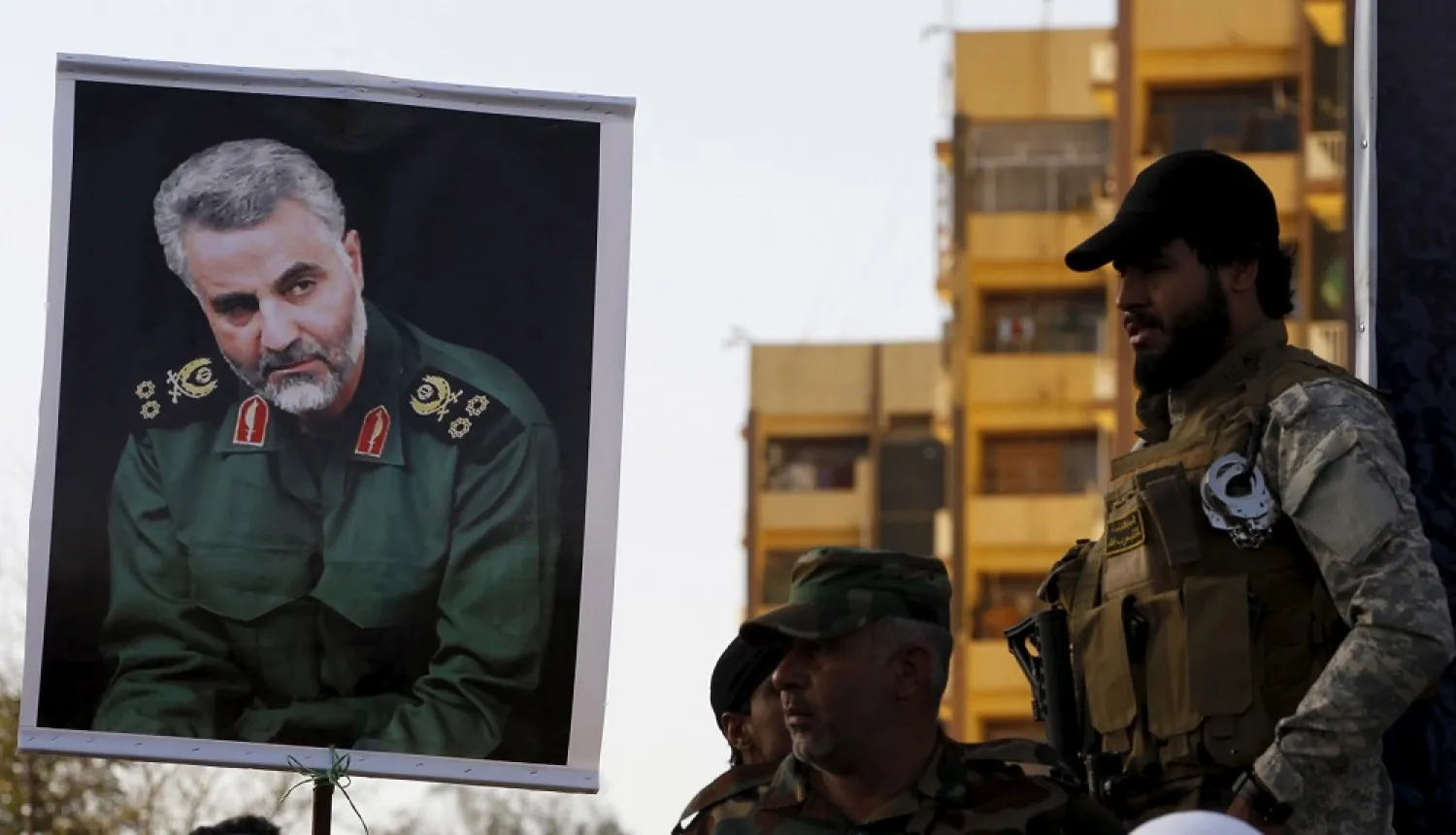

Soleimani Gave Military ‘Guidance’ from Kirkuk Prior to Iraqi Offensive

Members from Iraq’s Popular Mobilization Units hold a portrait of Iranian commander Major General Qassem Soleimani during a demonstration in Baghdad March 31, 2015. (Reuters)
TT

Soleimani Gave Military ‘Guidance’ from Kirkuk Prior to Iraqi Offensive

Members from Iraq’s Popular Mobilization Units hold a portrait of Iranian commander Major General Qassem Soleimani during a demonstration in Baghdad March 31, 2015. (Reuters)

Iranian military commander Qassem Soleimani had made repeated warnings to Kurdish leaders in northern Iraq, asking them to withdraw from oil-rich Kirkuk or face a fierce Iraqi government offensive.

Soleimani, who is commander of foreign operations for Iran’s Revolutionary Guards, had met leaders from the Patriotic Union of Kurdistan (PUK) in the city of Sulaimania the day before Iraqi Prime Minister Haidar al-Abadi ordered his forces to advance on Kirkuk, according to a PUK lawmaker briefed on the meeting.

His message was clear, either withdraw or lose Iran as a strategic ally, said the lawmaker according to Reuters.

The Iranian official had paid at least three visits to the Iraqi Kurdistan Region in October before the launch of the Iraqi government’s lightening operation in the North to regain regions that Kurds had seized during their fight against ISIS over the past three years.

“Abadi has all the regional powers and the West behind him and nothing will stop him from forcing you to return back to the mountains if he decides so,” the lawmaker quoted Soleimani as telling the PUK leadership.

The Iranian general evoked late Iraqi president Saddam Hussein’s massive attack on a Kurdish rebellion in 1991, when almost the entire Kurdish population fled northern Iraq to the mountains, the PUK lawmaker said.

“Soleimani’s visit ... was to give a last-minute chance for the decision-makers not to commit a fatal mistake,” said the lawmaker, who like others interviewed in this story declined to be identified because of the sensitivity of the issue.

Commanders of the Kurdish Peshmerga forces have accused Iran of orchestrating the Shi‘ite-led Iraqi central government’s push into areas under their control, a charge senior Iranian officials have denied.

But Iran has made no secret of its presence in Iraq.

“Tehran’s military help is not a secret anymore. You can find General Soleimani’s pictures in Iraq everywhere,” said an official close to Iranian President Hassan Rouhani.

“Now, beside political issues, Kirkuk’s oil is a very key element for Iran, which is an OPEC member. Control of those oil fields by Iran’s enemies would be disastrous for us. Why should we let them enter the oil market?”

Kirkuk fell to Iraqi government forces on Monday. Their offensive followed a referendum last month in which the semi-autonomous Kurdistan region voted to secede from Iraq against Baghdad’s wishes.

But Iraq’s two main Kurdish parties have been at odds over both the referendum and the approach to the crisis in Kirkuk, which the Kurds consider to be the heart of their homeland.

The PUK, a close ally of Iran, accused its rival, the Kurdistan Democratic Party (KDP), of putting the Kurds at risk of military intervention and isolation by pushing hard for the vote, which won wide approval for independence. The KDP is headed by President Masoud Barzani.

Soleimani has been allied to the PUK for years, but the referendum has drawn him even closer to Kurdish politics and expanded Iran’s reach in Iraq beyond the Baghdad government.

The Iranian general is no stranger to conflicts in Iraq, which fought an eight-year war with Iran in the 1980s. He has often been seen in footage from the frontlines, and Iran has long helped Baghdad to carry out its military strategy through paramilitary Shi‘ite militias which it funds and arms.

Before the referendum, Soleimani suggested to Kurdish leaders that holding a vote on secession -- which Iran feared would encourage its own Kurdish population to agitate for greater autonomy -- would be risky.

“The Iranians were very clear. They have been very clear that there will be conflict, that these territories will be lost,” said one prominent Iraqi Kurdish politician who met Soleimani ahead of the September 25 referendum.

On October 6, barely a week after the vote, Soleimani attended the funeral of PUK leader Jalal Talabani. Again, he wanted to make sure even his closest Kurdish allies understood the dangers of not withdrawing from Kirkuk, officials said.

A senior Iranian diplomat in Iraq and an official in Iran close to Supreme Leader Ali Khamenei’s office said Soleimani met with Kurdish leaders after Talibani’s funeral and urged them to withdraw from Kirkuk and in exchange Tehran would protect their interests.

Soleimani met with one of Talabani’s sons, Bafel, a few days after his father was buried, one of the PUK officials said.

“Soleimani said Abadi should be taken very seriously. You should understand this,” the official said.

An Iranian source in Iraq said Soleimani was in Kirkuk two nights before the Iraqi government offensive for “a couple of hours to give military guidance.” Iraqi intelligence sources said Tehran sent a clear signal to the PUK.

“We understand from our sources on the ground that neighboring Iran played a decisive role in making the PUK chose the right course with Baghdad,” one Iraqi intelligence official told Reuters.

Tensions over the referendum and Kirkuk have deepened divisions between the two main political parties in northern Iraq. The KDP accused the PUK of betraying the Kurdish cause by capitulating to Iran and striking a deal to withdraw.

“The Talabani clan were behind the offensive on Kirkuk. They asked Qassem (Soleimani) for help and his troops were there on the ground,” said a source close to Massoud Barzani, president of the Kurdistan Regional Government and head of the KDP.

“It is becoming clear that Iran is directing the operations to destroy the KDP.”

The PUK strongly denies this. Talabani’s son Bafel accused the KDP of missing a zero-hour chance to avoid losing Kirkuk by failing to reach a deal over a military base which Iraqi government forces had demanded to take back.

“Unfortunately we reacted too slowly. And we find ourselves where we are today,” Bafel told Reuters.

Two other Kurdish political sources gave a similar account.

Iran and Soleimani offered early assistance to northern Iraq’s Kurds in the fight against ISIS, a rallying point for the Kurdish community. But after the devastating loss of Kirkuk, Iraqi Kurds have been left disillusioned.

“They (both PUK and KDP leaders) just make decisions on their own and play with people’s lives. In the end, we pay the price,” said pensioner Abdullah Ahmed in Sulaimania. “This is a disaster for everyone. Everyone was united against Daesh (Islamic State). Now they are back just looking out for themselves.”



Top Trump Iran Negotiator Says Visits US Aircraft Carrier in Middle East

US Special Envoy Steve Witkoff delivers a press conference upon the signing of the declaration on deploying post-ceasefire force in Ukraine, during the so-called "Coalition of the Willing" summit, at the Elysee Palace in Paris, France, January 6, 2026. (Reuters)
TT

Top Trump Iran Negotiator Says Visits US Aircraft Carrier in Middle East

US Special Envoy Steve Witkoff delivers a press conference upon the signing of the declaration on deploying post-ceasefire force in Ukraine, during the so-called "Coalition of the Willing" summit, at the Elysee Palace in Paris, France, January 6, 2026. (Reuters)

US President Donald Trump's lead Iran negotiator Steve Witkoff on Saturday said he visited the USS Abraham Lincoln aircraft carrier currently in the Arabian Sea, with Washington and Tehran due to hold further talks soon.

"Today, Adm. Brad Cooper, Commander of US Naval Forces Central Command, Jared Kushner, and I met with the brave sailors and Marines aboard the USS Abraham Lincoln, her strike group, and Carrier Air Wing 9 who are keeping us safe and upholding President Trump's message of peace through strength," said Witkoff in a social media post.

Iranian Foreign Minister Abbas Araghchi said on Saturday he hoped talks with the United States would resume soon, while reiterating Tehran's red lines and warning against any American attack.


Israel’s Netanyahu Expected to Meet Trump in US on Wednesday and Discuss Iran

Israeli Prime Minister Benjamin Netanyahu delivers a speech during a special session to mark the 77th anniversary of the Knesset's establishment and the 60th anniversary of the dedication of the current building at the Knesset, the Israeli parliament, in Jerusalem, 02 February 2026. (EPA)
TT

Israel’s Netanyahu Expected to Meet Trump in US on Wednesday and Discuss Iran

Israeli Prime Minister Benjamin Netanyahu delivers a speech during a special session to mark the 77th anniversary of the Knesset's establishment and the 60th anniversary of the dedication of the current building at the Knesset, the Israeli parliament, in Jerusalem, 02 February 2026. (EPA)

Israeli Prime Minister Benjamin Netanyahu is expected to meet US President Donald Trump on Wednesday in Washington, where they will discuss negotiations with Iran, Netanyahu's office said on Saturday.

Iranian and US officials held indirect nuclear ‌talks in the ‌Omani capital ‌Muscat ⁠on Friday. ‌Both sides said more talks were expected to be held again soon.

A regional diplomat briefed by Tehran on the talks told Reuters Iran insisted ⁠on its "right to enrich uranium" ‌during the negotiations with ‍the US, ‍and that Tehran's missile capabilities ‍were not raised in the discussions.

Iranian officials have ruled out putting Iran's missiles - one of the largest such arsenals in the region - up ⁠for discussion, and have said Tehran wants recognition of its right to enrich uranium.

"The Prime Minister believes that any negotiations must include limiting ballistic missiles and halting support for the Iranian axis," Netanyahu's office said in a ‌statement.


Italy FM Rules Out Joining Trump’s ‘Board of Peace’

Italy's Minister for Foreign Affairs Antonio Tajani speaks to the press during the EPP Leaders’ meeting, in Zagreb, Croatia, 30 January 2026. (EPA)
TT

Italy FM Rules Out Joining Trump’s ‘Board of Peace’

Italy's Minister for Foreign Affairs Antonio Tajani speaks to the press during the EPP Leaders’ meeting, in Zagreb, Croatia, 30 January 2026. (EPA)

Italy will not take part in US President Donald Trump's "Board of Peace", Italian Foreign Minister Antonio Tajani said Saturday, citing "insurmountable" constitutional issues.

Trump launched his "Board of Peace" at the World Economic Forum in Davos in January and some 19 countries have signed its founding charter.

But Italy's constitution bars the country from joining an organization led by a single foreign leader.

Prime Minister Giorgia Meloni, a Trump ally, last month noted "constitutional problems" with joining, but suggested Trump could perhaps reopen the framework "to meet the needs not only of Italy, but also of other European countries".

Tajani appeared Saturday to rule that out.

"We cannot participate in the Board of Peace because there is a constitutional limit," he told the ANSA news agency.

"This is insurmountable from a legal standpoint," he said, the day after meeting US Secretary of State Marco Rubio and US Vice President JD Vance at the Olympics in Milan.

Although originally meant to oversee Gaza's rebuilding, the board's charter does not limit its role to the Palestinian territory and appears to want to rival the United Nations.