

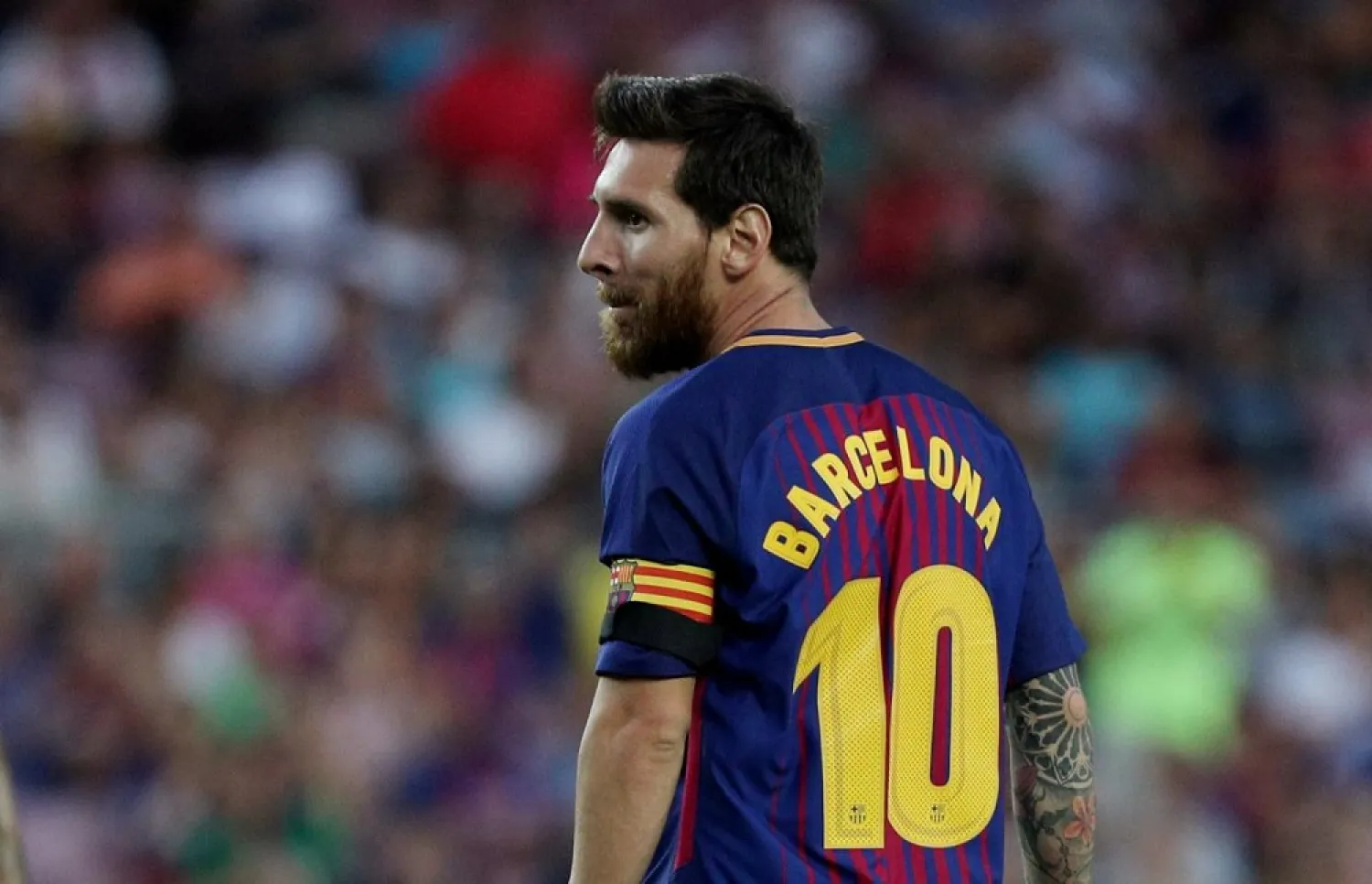

The Good Ship Lionel Messi Feels too Massive to Be Moved

Barcelona's Lionel Messi. (Reuters)
TT

The Good Ship Lionel Messi Feels too Massive to Be Moved

Barcelona's Lionel Messi. (Reuters)

We all have our favorite Victorian engineering folly. Mine is the SS Great Eastern, Isambard Kingdom Brunel’s super-ship powered by a hundred furnaces, a vessel so vast it could carry 10,000 passengers, so vast it became a symbol of grandiose, stovepipe-hatted ambition, and so vast that it turned out it couldn’t actually sail anywhere.

Completed in November 1857, the Great Eastern stayed moored at Millwall on the Thames for two months, unable to move because of its own mind-boggling size. Several times a launch was attempted and then abandoned. Eventually the Great Eastern left its dock with the help of an unusually powerful tide and from there set off on its ill-fated shortened lifespan.

Too huge to be any real use as a passenger vessel, Brunel’s mega-ship ended up seeing out its days as a floating funfair in Liverpool before being junked in 1889. One of its masts was salvaged by Everton Football Club and erected at their then-home Anfield, an emblem of human ambition and avarice, something too cumbersome to function, too costly and famous to be ignored. And yes, insert your own Wayne Rooney joke here.

The Great Eastern is a powerful metaphor for many things. Even, it turns out, for Lionel Messi, or at least the surrounding industrial machinery of Messi, at the end of a week when the greatest club footballer of the modern age produced another dreamy display of attacking craft at home to Olympiakos in the Champions League.

Messi started at inside-right at the Camp Nou. In the first half he made a chance for Luis Suárez by hurdling a challenge and hanging in mid-air, adjusting his feet – dancing off the beat – to nudge the perfect instant through pass into Suárez’s path. It looks just about plausible at full speed. Rewind a few times and you realize it is actually impossible.

Just past the hour Messi made the third Barcelona goal from a position by the goalline, not only dribbling past Leonardo Koutris but making him vanish, disappearing him with a shimmy and a skip. A few minutes earlier Messi had scored with a free-kick, his 50th goal of 2017. All things considered, it seems safe to say he’s still got it.

What Messi doesn’t have, though, despite the assurances of the club president, Josep Maria Bartomeu, is a new contract at Barcelona. This isn’t exactly news. The Messi non-renewal saga has already been endlessly dissected. One theory is Messi still wants to see how the season goes. Another says he doesn’t want to give Bartomeu the kudos of announcing his renewal and is willing to wait.

The final possibility, a more distant one, is that some part of him really does want to go. The fact remains – no matter how entrenched he might seem – that Messi will be free to negotiate with other clubs 10 weeks from now, sparking in the process the most overwhelmingly portentous, dizzyingly vast transfer in footballing history.

It is this side of the Messi non-renewal that has yet to be quantified, a place where ideas of stasis and scale start to loom, the notion of being too vast, too bound up in your own potential energy to move in the normal way. This isn’t tittle-tattle or transfer-mongering. It is simply a reminder that nothing quite like this has ever really happened in football.

In the past players of similar status – Johan Cruyff, Diego Maradona and Alfredo Di Stéfano – could simply move on, take a fat pay cheque, expand their horizons, thrill some other sporting public, moving still as individuals rather than the fountainhead of some mini-industry. But this is Big Football and this is Messi, a divine footballer whose talent has been weaponized by the machinery around him, an athlete who could transform a club, a league, a national leisure economy simply by lending his presence.

No footballer has ever been so publicly shared, consumed, connected, venerated, coveted and monetized. No other footballer has ever brought with him such commercial gravity and sweep. Thundering in its dock, hull scraping the gravel, The SS Messi looks around itself and ponders its maiden launch, which hopeful, lustful, doe-eyed continent to colonize and Messify.

The fact is wherever Messi goes it is automatically colored and loaded. There is too much power here, too much to covet. Manchester City and Paris Saint-Germain would cut off their own arms, and more likely each other’s, to get hold of Messi right now. Qatar and the Emirates have been in a state of conflict, on and off, since the 1800s, a local spat that has now become a gaudy global PR assault. A move to either would put Messi on that spectrum of things beyond sport. Keep politics out of football.

On a sporting level Messi to PSG would also be horrendous, another state-funded move in the ongoing strangulation of elite football. This would be a footballing equivalent of the bit in Charlie and the Chocolate Factory where Veruca Salt’s dad tries to buy the oompa-loompas from Willy Wonka. Except in this version Wonka says yeah, fine, whatever, hands over the keys and shuts the factory in return for £150m and three years living inside a chinchilla fur-lined hotel suite.

Manchester City would make a bit more sense on a sporting level, with its Pep-reunion shtick. But signing Messi would also ruin the best bit of City, the fact Guardiola is still trying to build a reputation-staking team around three attackers under the age of 23 and Kyle Walker and Fabian Delph in the role of world-class barnstorming wing-back. For all the money spent this is still an act of team-building faith. Whereas signing Messi would be a victory. A Messi-led City would become interesting if they lost. Right now they’re still interesting when they win.

What else do we have? Manchester United have the money but this again would be a corporate power-play, with ideas of colony and expansion in mind. Imagine the graphs, the projections, the noodle partner uplift strategies. Imagine the terrible, terrible meetings.

Real Madrid could afford him but that would also mean having to end football immediately, for ever. Bayern Munich have never paid more than £38m for a player. This is Germany. They prefer a process. Otherwise you’re looking at some kind of Chinese escapade, which isn’t going to happen right now.

At the end of which Messi is in the bizarre position of holding all the power but also being bizarrely zugzwanged, a chess term where to move anywhere at all is to have negative consequences, to carry its own uncertainties. He is too big, too confusing, our own grand, energetically constructed folly. Wherever he ends up, even staying and extending his late-career prime into another Barcelona rebuild will be fascinating; but also violent, fraught with competing interests and unlike anything else that has preceded it.

The Guardian Sport


Late Guirassy Goal Seals Win as Dortmund Cuts Bayern’s Bundesliga Lead to 3 Points

07 February 2026, Lower Saxony, Wolfsburg: Borussia Dortmund's Serhou Guirassy celebrates scoring his side's second goal during the German Bundesliga soccer match between VfL Wolfsburg and Borussia Dortmund at Volkswagen Arena. (dpa)
TT

Late Guirassy Goal Seals Win as Dortmund Cuts Bayern’s Bundesliga Lead to 3 Points

07 February 2026, Lower Saxony, Wolfsburg: Borussia Dortmund's Serhou Guirassy celebrates scoring his side's second goal during the German Bundesliga soccer match between VfL Wolfsburg and Borussia Dortmund at Volkswagen Arena. (dpa)

Serhou Guirassy scored late for Borussia Dortmund to cut Bayern Munich’s Bundesliga lead to three points on Saturday with a 2-1 win at Wolfsburg.

Wolfsburg dominated the second half with Mohamed Amoura missing several good chances and Maximilian Arnold striking the crossbar.

Dortmund’s Maximilian Beier hit the underside of the bar with a deflected shot in the first half, when Julian Brandt opened the scoring with a header from Julian Ryerson’s corner in the 38th for the visitors.

Konstantinos Koulierakis replied in similar fashion after the break with a header from Arnold’s free kick, but Wolfsburg was to rue not taking its chances to score more.

Guirassy pounced for the winner in the 87th after good play between Fábio Silva and Felix Nmecha.

“That’s part of football,” Dortmund coach Niko Kovač said of his team’s scrappy win. “But then to decide it with one action is also a quality.”

Eighteen-year-old Italian defender Luca Reggiani went on late for Dortmund for his Bundesliga debut.

American winger Kevin Paredes made his first Wolfsburg start since April 25 after recovering from two operations on his right foot.

Bayern, which failed to win its last two games, can restore its six-point lead with a win over high-flying Hoffenheim on Sunday.

Borussia Mönchengladbach was hosting Bayer Leverkusen later.

Bremen loses on coach's debut

Werder Bremen’s coaching change did little to alter its fortunes as the team lost 1-0 in Freiburg on Daniel Thioune’s debut.

Jan-Niklas Beste let fly and found the top far corner in the 13th for Freiburg, which had Johan Manzambi sent off early in the second half for a foul on Bremen’s Olivier Deman.

Thioune’s team was unable to capitalize on the extra player and is now 11 league games without a win. Bremen faces a visit from Bayern next weekend.

Welcome win for St. Pauli

St. Pauli boosted its survival hopes with a hard-fought 2-1 win over Stuttgart.

The Hamburg-based team remained second-from-bottom, but it opened a four-point gap on bottom side Heidenheim, which lost 2-0 at home to Hamburger SV. Bremen's defeat means St. Pauli is just two points from the relegation playoff place.

Mainz keeps winning

Nadiem Amiri scored two penalties, one in each half, for Mainz to beat Augsburg 2-0 for its third straight win.

Amiri ripped off his distinctive carnival-inspired jersey as he celebrated the second one to seal the win. The thoughtful Lee Jae-sung picked it up so he could resume when the celebrations died down.

Mainz next visits Dortmund.


Man United Wins Again to Make It Four in a Row for New Coach Michael Carrick

Bruno Fernandes of Manchester United scores the 2-0 goal during the English Premier League match between Manchester United and Tottenham Hotspur, in Manchester, Britain, 07 February 2026. (EPA)
TT

Man United Wins Again to Make It Four in a Row for New Coach Michael Carrick

Bruno Fernandes of Manchester United scores the 2-0 goal during the English Premier League match between Manchester United and Tottenham Hotspur, in Manchester, Britain, 07 February 2026. (EPA)

It's four Premier League wins in a row for Manchester United under Michael Carrick and a season that was unraveling just weeks ago now looks full of promise.

A 2-0 victory against Tottenham on Saturday extended Carrick's 100% start as head coach and will further strengthen his case to be given the job on a long-term basis.

“Michael has won everything here and he knows what it means for these fans, what it means for the club to win and how much is needed to win in this football. I think that adds something special to the team,” United captain Bruno Fernandes told TNT Sports.

It was the first time in two years that United has won four straight league games and boosted its hopes of a return to the lucrative Champions League after missing out for the last two years.

Bryan Mbeumo and Fernandes scored in each half at Old Trafford in a game that saw Spurs reduced to 10 men after captain Cristian Romero was sent off in the 29th minute.

Carrick has transformed United's fortunes since he was parachuted in to replace the fired Ruben Amorim last month. Initially given a contract until the end of the season — having previously had a three-game interim spell in 2021 — his impressive impact will likely put him in serious contention to keep the job as the club's hierarchy consider its long-term plans.

“I think Michael came in with the right ideas of giving the players the responsibility, but some freedom to take the responsibility on the pitch, doing the decisions that were needed,” said Fernandes. “He's very good with the words.

“I think he still remembers what I told him the last time he was our manager for our last game. I was sure that Michael could be a great manager, and he’s just showing it.”

United is fourth and after moving up to 44 points, the 20-time English champion has already exceeded last season's total of 42 points for the entire campaign.

Fernandes’ goal, with a controlled finish off his shin in the 81st, was his 200th goal involvement since joining United in 2020.

It sealed victory after Mbeumo had given United the lead in the 38th when firing low from a corner to score his 10th goal of his debut season at the club.

While United's captain was inspirational, Tottenham's Romero did his team no favors with his sending off in the first half.

Having described as “disgraceful” the fact that Spurs were reduced to 11 fit players for the draw with Manchester City last weekend, Romero hardly helped his team’s cause with his red card for a dangerous tackle on Casemiro.

The league's stats partner Opta said it was Romero's sixth sending off since joining the club in 2021 — more than any other Premier League player in that time.


Protesters in Milan Denounce Impact of Games on Environment

 A protester sets off fireworks during a protest against the environmental, economic and social impact of the Milano-Cortina 2026 Winter Olympics, near the Olympic Village in Milan, Italy, February 7, 2026. (Reuters)
A protester sets off fireworks during a protest against the environmental, economic and social impact of the Milano-Cortina 2026 Winter Olympics, near the Olympic Village in Milan, Italy, February 7, 2026. (Reuters)
TT

Protesters in Milan Denounce Impact of Games on Environment

 A protester sets off fireworks during a protest against the environmental, economic and social impact of the Milano-Cortina 2026 Winter Olympics, near the Olympic Village in Milan, Italy, February 7, 2026. (Reuters)
A protester sets off fireworks during a protest against the environmental, economic and social impact of the Milano-Cortina 2026 Winter Olympics, near the Olympic Village in Milan, Italy, February 7, 2026. (Reuters)

Thousands of people took to the streets of Milan on Saturday in a protest over housing costs and environmental concerns on the first full day of the Milano Cortina Winter Olympics.

The march, organized by grassroots unions, housing-rights groups and social center community activists, is seeking to highlight what activists call an increasingly unsustainable city model marked by soaring rents and deepening inequality.

The Olympics cap a decade in which Milan has seen a property boom following the 2015 World Expo, with locals ‌squeezed by soaring ‌living costs as an Italian tax scheme for ‌wealthy ⁠new residents, ‌alongside Brexit, draws professionals to the financial capital.

Some groups also argue that the Olympics are a waste of public money and resources pointing to infrastructure projects they say have damaged the environment in mountain communities.

A banner stretched across the street read: "Let's take back the cities, let's free the mountains."

CARDBOARD TREES SYMBOLIZE DESTRUCTION

"I’m here because these Olympics are unsustainable — economically, socially, and environmentally," said 71-year-old Stefano Nutini, standing beneath a Communist ⁠Refoundation Party flag.

He argued that Olympic infrastructure had placed a heavy burden on mountain towns hosting events ‌in the first widely dispersed edition of the Winter ‍Games.

The International Olympic Committee (IOC) points out ‍that the Games are largely using existing facilities, making them more sustainable.

At ‍the head of the procession, about 50 people carried stylized cardboard trees to represent the larches they said were felled to build a new bobsleigh track in Cortina d'Ampezzo.

"Century-old trees, survivors of two wars...sacrificed for 90 seconds of competition on a bobsleigh track costing 124 million (euros)," read another banner.

MARCH TAKES PLACE UNDER TIGHT SECURITY

According to police estimates, more than 5,000 people were taking part in the ⁠march.

Protesters set off from the Medaglie d'Oro central square to cover nearly four kilometers (2.5 miles) to end in Milan's south-eastern quadrant of Corvetto, a historically working-class district.

A rally last weekend by the hard-left in the city of Turin turned violent, with more than 100 police officers injured and nearly 30 protesters arrested, according to an interior ministry tally.

Saturday's protest follows a series of actions in the run-up to the Games, including rallies on the eve of the opening ceremony that denounced the presence in Italy of US ICE agents and what activists describe as the social and economic burdens of the Olympic project.

The march is taking place under tight security ‌as Milan hosts world leaders, athletes and thousands of visitors for the global sport event, including US Vice President JD Vance.
