


How Fans were Betrayed as Premier League Club Owners Made Fortunes

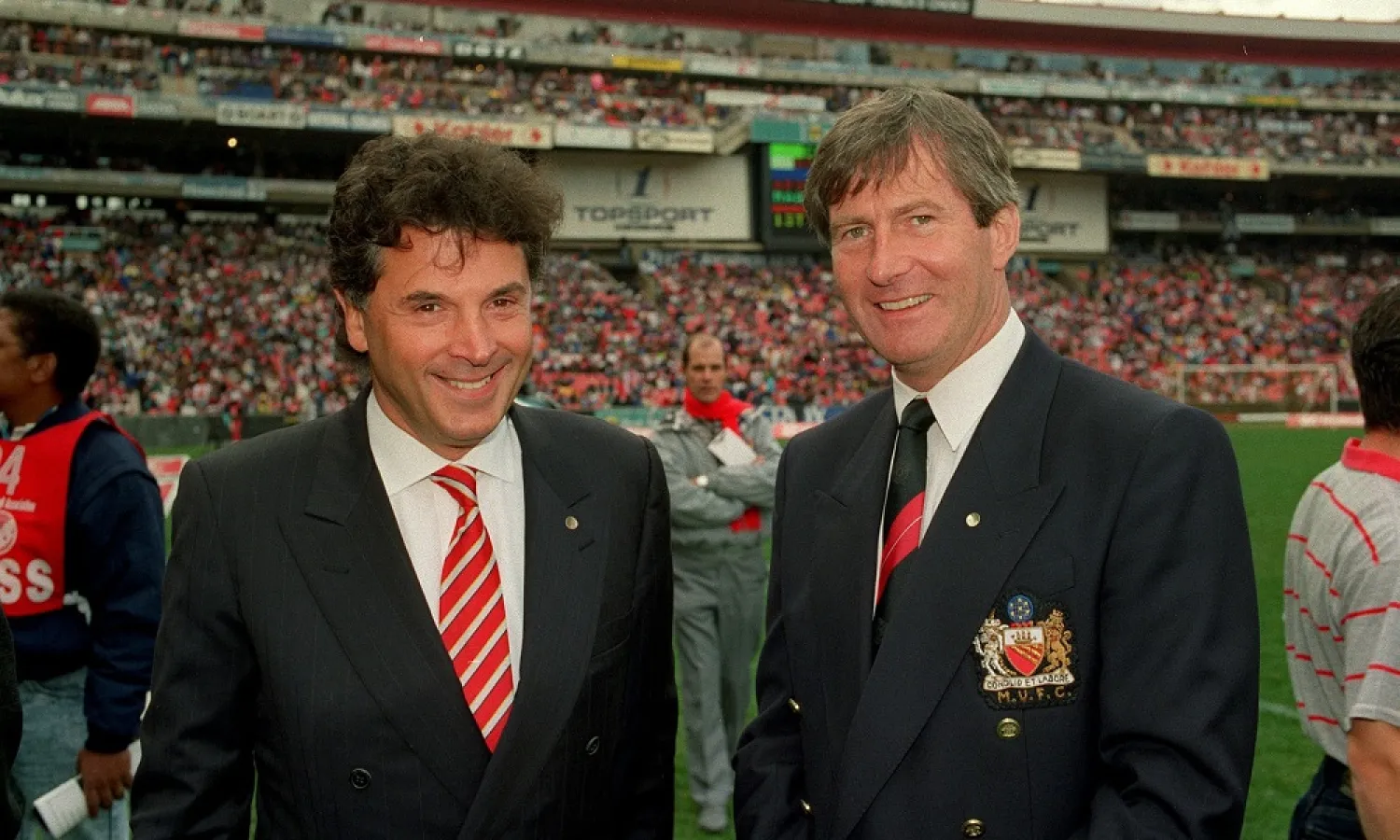
David Dein, left, who made £75m selling his Arsenal shares, at a 1993 friendly with then Manchester United chairman Martin Edwards. (Getty Images)
TT

How Fans were Betrayed as Premier League Club Owners Made Fortunes

David Dein, left, who made £75m selling his Arsenal shares, at a 1993 friendly with then Manchester United chairman Martin Edwards. (Getty Images)

In the Football Association brochure that sanctioned the breakaway Premier League 25 years ago at the dawn of the first pay-TV deal, no mention was made of the personal fortunes it would make for the owners of the bigger clubs. Led by the self-appointed “Big Five” of Manchester United, Arsenal, Liverpool, Everton and Tottenham Hotspur, the First Division clubs had angled and threatened throughout the 1980s to leave the century-old Football League, so as not to share the new TV millions with the clubs in the three lower divisions. The FA’s culture had narrowed and curdled through that decade, which ended in 96 people being unlawfully killed at the 1989 FA Cup semi-final which the governing body itself had commissioned at Hillsborough.

The FA produced its “Blueprint for the Future of Football” just two years later, its woolly pages little more than padding for the booby trap at the heart of it: to decapitate the Football League by allowing the First Division to break away. Reflecting on this ruse years later as a profound historic mistake, Graham Kelly, the FA’s then chief executive, said the plan had been for the FA to run the new top league, just as it did the FA Cup. The club owners – referred to as chairmen then, when the game was more coy about the reality that the clubs are commercial companies with shareholders – immediately stripped the FA of that notion and went off to make their billions.

The plight of the Hillsborough families and survivors, suffering a repeating nightmare through the legal system with no support from the FA or the newly super-rich clubs, has presented a terrible contrast throughout with the Premier League’s 25 years of Sky-fuelled windfalls.

The outrage is thumped home by this coincidence of timing: that the Premier League has reached its quarter century, now wallowing in £2.8bn annual television deals, with clubs spending £50m on right-backs, in the same year that the authorities have finally brought criminal charges for those deaths 28 years ago.

The first official report by Lord Justice Taylor identified the causes of the disaster, but the families were still somehow consigned to a 27-year campaign for the truth to be legally established by the new inquests verdicts in April 2016. It was Taylor’s second, final report into safety at sport generally which condemned the governance of football, the state of the grounds, the self-interest and greed of owners and directors, and the dismissive attitudes to supporters who stayed loyal throughout.

The clubs accepted Taylor’s recommendation for grounds to be compulsorily all-seater, which was never willed or agreed by supporters organizations who are still arguing for safe standing.

At the same time, the clubs managed to persuade the government they did not have the money to rebuild their grounds and secured grants of £200m public money, with the new millions from Sky TV’s desperate search for subscribers just over the horizon.

Taylor had argued against the supporters that seats need not necessarily mean higher prices – citing the then £6 cost of a ticket at Rangers’ Ibrox, which was virtually all seats – but the clubs wholly jettisoned that part of his report and multiplied the price of tickets 1,000 percent.

At the heart of the Hillsborough tragedy was the youth of so many who were killed – 37 were teenagers, many attending their first away match – because to stand on that benighted terracing cost only £6, to watch one of the greatest ever Liverpool teams play an FA Cup semi-final against Brian Clough’s Nottingham Forest. It has been another betrayal of supporters and the Taylor Report that through the Premier League’s 25 years, in grounds made safe by law because the FA and clubs themselves were no longer trusted to do it themselves, young people have largely been priced out.

Football is still as coy now as the FA was in its blueprint about how much money the lucky owners have pocketed personally, and the old myth somehow lingers that mostly they lose their fortunes. Of the original “Big Five”, Martin Edwards made £94m from his directorships and sale of shares in Manchester United, David Moores £90m selling his inherited Liverpool stake to Tom Hicks and George Gillett, David Dein £75m selling the Arsenal stake he bought cheaply in the 1980s to Alisher Usmanov. With no blueprint or planning by executive chairman Richard Scudamore or anybody else, the Premier League is now a spectrum of owners from overseas, attracted by the investment value of English football.

Successive governments since Labor's Football Task Force of 1997 have nibbled at this corporate carve-up while being dazzled by football’s media rehabilitation and magnetic appeal abroad. The pledge by the Premier League in 1999 to contribute just 5 percent of its ballooning TV income to improving squalid grassroots facilities was given in return for the government supporting the 20 top clubs’ exceptional right to maximize their deals by negotiating as a collective league.

Currently the Premier League contribution to facilities and community programs is £100m, just 3.6 percent of the galactic TV deals.

When the sports minister Tracey Crouch appeared in front of yet another select committee inquiry into football’s governance, she asked to be congratulated for securing this figure. Like the FA, football’s sadly compromised governing body, and all her predecessors, she has let the top clubs and their owners get away with it.

The Guardian Sport


Injured Aubameyang to Miss International Swansong with Gabon

 Gabon's forward #09 Pierre-Emerick Aubameyang scores a goal in front of Mozambique's defender #17 Edson Sitoe during the Africa Cup of Nations (CAN) Group F football match between Gabon and Mozambique at Grand Stadium in Agadir on December 28, 2025. (AFP)
Gabon's forward #09 Pierre-Emerick Aubameyang scores a goal in front of Mozambique's defender #17 Edson Sitoe during the Africa Cup of Nations (CAN) Group F football match between Gabon and Mozambique at Grand Stadium in Agadir on December 28, 2025. (AFP)
TT

Injured Aubameyang to Miss International Swansong with Gabon

 Gabon's forward #09 Pierre-Emerick Aubameyang scores a goal in front of Mozambique's defender #17 Edson Sitoe during the Africa Cup of Nations (CAN) Group F football match between Gabon and Mozambique at Grand Stadium in Agadir on December 28, 2025. (AFP)
Gabon's forward #09 Pierre-Emerick Aubameyang scores a goal in front of Mozambique's defender #17 Edson Sitoe during the Africa Cup of Nations (CAN) Group F football match between Gabon and Mozambique at Grand Stadium in Agadir on December 28, 2025. (AFP)

Pierre-Emerick Aubameyang’s international career looks to have ended with a whimper as he headed back to France on Tuesday and will miss Gabon’s last game at the Africa Cup of Nations ​finals.

After losing their opening two matches in Group F to Cameroon and Mozambique, Gabon have been eliminated with one match left to play against holders Ivory Coast in Marrakech on Wednesday.

At the age of 36, it was expected the clash against the Ivorians would bring down the curtain on his 16-year international career, but he will skip the last group game as he returns to his club ‌Olympique de Marseille. ‌

A thigh injury on the eve of ‌the ⁠tournament ​in Morocco ‌meant his participation was in doubt, but he came on after 30 minutes against Cameroon in Gabon’s opening game on Christmas Eve and played the full game against Mozambique on Sunday, scoring in the 3-2 defeat.

“Following the established medical protocol between Marseille and Gabon medical staff regarding Pierre-Emerick Aubameyang, clinical examinations were conducted daily,” said a statement on Tuesday from the ⁠Gabon football federation.

“The most recent examination confirmed the discomfort he experienced in his left thigh ‌the day after the Gabon-Mozambique match. Given the ‍disappointing results, which cut short ‍Gabon’s participation, the medical staff, in consultation with his club, agreed to ‍protect the player's physical well-being by exempting him from the final, inconsequential match."

GABON’S LONG TIME TALISMAN

Aubameyang has long been Gabon’s talisman, electing to play for the team his father had captained, even after playing for France, where he ​was born, at junior level.

He made his debut for Gabon in 2009, scoring against Morocco in a World Cup qualifier, ⁠and went on to win 82 caps and score 39 goals.

Aubameyang helped Gabon reach the Cup of Nations quarter-final when they hosted the tournament in 2012 but was the only player to fail to convert his penalty in a post-match shootout loss to Mali.

The tournament in Morocco was Aubameyang’s sixth Cup of Nations finals appearance. He was African Footballer of the Year in 2015.

Earlier this year, he helped Gabon finish as one of the four best runners-up in the World Cup qualifiers, including four goals in the game against Gambia in October.

Gabon, however, lost in ‌last month’s Africa playoffs, ending hopes of qualifying for a first-ever World Cup finals appearance in North America next June.


Hosts Morocco Cruise as South Africa Reach Cup of Nations Last 16

Ayoub El Kaabi is mobbed by teammates after scoring his second goal in Morocco's 3-0 win over Zambia. Gabriel BOUYS / AFP
TT

Hosts Morocco Cruise as South Africa Reach Cup of Nations Last 16

Ayoub El Kaabi is mobbed by teammates after scoring his second goal in Morocco's 3-0 win over Zambia. Gabriel BOUYS / AFP

Ayoub El Kaabi's brace helped Morocco to a 3-0 win over Zambia on Monday as the Africa Cup of Nations hosts cruised into the last 16 while South Africa beat Zimbabwe 3-2 to also secure a berth in the knockout phase.

African player of the year Achraf Hakimi made his comeback from almost two months out injured for Morocco as Mali also qualified for the next round and Mohamed Salah was rested for Egypt's 0-0 draw against Angola.

Morocco are the tournament favorites as the host nation and Africa's top-ranked team but they were booed off by supporters following a 1-1 draw against Mali in their last outing.

Nevertheless, Walid Regragui's team knew a win against Zambia at the Prince Moulay Abdellah Stadium in capital Rabat would guarantee their progress to the next round in first place in Group A and they outclassed their opponents.

Olympiakos striker El Kaabi nodded in an early opener and scored an overhead kick shortly after half-time, with both of his goals set up by the outstanding Azzedine Ounahi.

In between, Real Madrid attacking midfielder Brahim Diaz swept home Morocco's second goal on 27 minutes at the end of a fine team move, again involving Ounahi.

Diaz has found the net in all three of Morocco's games so far and he and El Kaabi join Algeria captain Riyad Mahrez on three goals at the top of the Cup of Nations scoring charts.

Captain Hakimi came off the bench in the 64th minute for his first appearance since suffering an ankle injury in action for Paris Saint-Germain at the beginning of November.

Morocco will stay in Rabat for a last-16 tie in the same stadium on Sunday against one of the best third-place finishers.

"Scoring early on changes everything," said Regragui. "We need to continue like this but not get carried away and keep our feet on the ground."

Zambia go out and have now failed to win any of their 12 AFCON matches across four tournament appearances since lifting the trophy in 2012.

Mali go through in second place after a 0-0 draw with Comoros in Casablanca, a game they ended with 10 men after Amadou Haidara was sent off.

It was a third stalemate in as many matches for the Eagles, who will remain in Morocco's largest city for a last-16 tie on Saturday.

Salah rested by Egypt

Earlier, Oswin Appollis converted a late penalty to give South Africa victory against Zimbabwe in Marrakesh as Bafana Bafana qualified for the knockout stage.

Rising star Tshepang Moremi gave South Africa an early lead with a deflected effort.

However, falling behind motivated Zimbabwe and they deservedly levelled on 19 minutes thanks to the individual brilliance of Tawanda Maswanhise from Scottish Premiership club Motherwell.

Maswanhise gained possession inside the South African half, dribbled past two opponents and fired the ball wide of goalkeeper Ronwen Williams into the far corner.

South Africa began the second period aggressively and regained the lead on 50 minutes through Burnley striker Lyle Foster, for whom it was a second goal of the tournament.

Zimbabwe brought it back to 2-2 on 73 minutes when Aubrey Modiba conceded an own goal, but Appollis then netted from an 82nd-minute penalty to give Bafana the lead for the third time, which they retained.

"Once again we fell asleep after a good start. We continuously lost possession," said 73-year-old South Africa coach Hugo Broos.

"Our passing was bad at times and we should have concentrated on retaining possession in the closing minutes instead of seeking a fourth goal. We have to work on controlling games."

Egypt, who rested stars like captain Salah with first place already assured, topped Group B with seven points after their draw against Angola in Agadir. South Africa finished with six points, Angola two and Zimbabwe one.

The last round of group games continues on Tuesday, with Tanzania playing Tunisia and Nigeria facing Uganda in Group C. Senegal take on Benin and the Democratic Republic of Congo play Botswana in Group D.


Japan Great Miura, 58, Joins New Club to 'Make History'

This picture taken on December 1, 2016 shows Japanese football player Kazuyoshi Miura speaking to journalists in Tokyo. (AFP)
TT

Japan Great Miura, 58, Joins New Club to 'Make History'

This picture taken on December 1, 2016 shows Japanese football player Kazuyoshi Miura speaking to journalists in Tokyo. (AFP)

Japanese soccer great Kazuyoshi Miura, 58, has signed a new loan deal with the Japanese third division ​side Fukushima United, setting him up for his 41st season as a professional footballer.

Miura, known as "King Kazu", will also be playing his first season in five years in the top three divisions of Japanese ‌football.

"My passion ‌for football hasn't changed, ‌no ⁠matter ​how ‌old I get," Miura, who turns 59 in February, said.

"I'm very grateful to be given this opportunity. I promise I will play with everything I have to make a contribution."

"Let's make ⁠history together."

The forward, who started his professional career ‌for Brazilian club Santos ‍in 1986, also ‍competed at several European clubs across ‍Italy (Genoa), Croatia (Dinamo Zagreb) and Portugal (Oliveirense) throughout his career.

This will be his fourth loan spell since 2022 from J2 League side ​Yokohama FC.

He went goalless last season, playing a total of 69 ⁠minutes across seven games at fourth-tier club Atletico Suzuka, while his side was relegated to Japan's regional leagues.

Miura scored 55 goals in 89 appearances for Japan after making his debut in 1990, but was famously dropped from the side for their first World Cup appearance in 1998, before he retired ‌from international football in 2000.
