
Boom in American Liquefied Natural Gas Is Shaking Up the Energy World

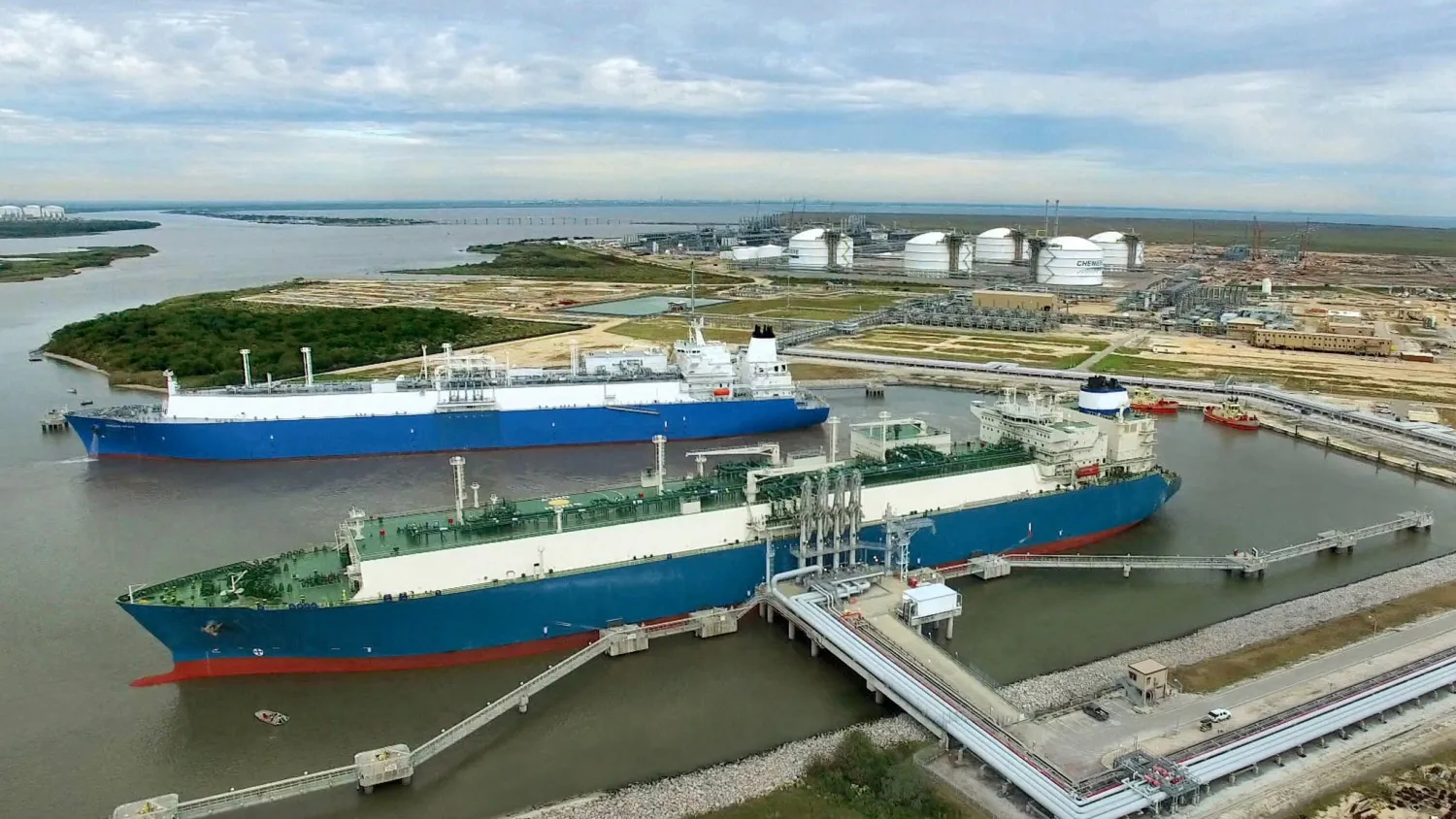
Ships at Cheniere Energy’s Sabine Pass terminal being loaded with liquefied natural gas. Credit Cheniere
TT

Boom in American Liquefied Natural Gas Is Shaking Up the Energy World

Ships at Cheniere Energy’s Sabine Pass terminal being loaded with liquefied natural gas. Credit Cheniere

A shale gas drilling boom over the last decade has propelled the United States from energy importer to exporter, taking the country a giant leap toward the goal of energy independence declared by presidents for half a century.

Now the upheaval of the domestic energy sector is going global. A swell of gas in liquefied form shipped from Texas and Louisiana is descending on global markets, producing a broader glut and lower energy prices.

The United States was supposed to be a big L.N.G. importer, not a world class exporter. The frenzy of drilling in shale gas fields across the country changed that over the last decade, creating a glut far larger than domestic demand could possibly consume. Companies that spent billions of dollars to build import platforms suddenly had useless facilities until they spent billions more to convert them for export.

The switch will remake the global gas market for decades to come. Energy experts are predicting that the transformation will weaken Russia’s dominance over European power markets, help clean the air in cities across China and India by replacing the burning of coal and eventually provide cheaper and cleaner fuel to African villages.

The full dimensions of the wave over the next four or five years, including its impact on the environment and climate change, are hard to predict, in part because they will depend on the policies adopted by many governments. But as several American multibillion-dollar export terminals come on line, few doubt that the influence of more gas, as the cleanest burning fossil fuel, will be consequential for powerful and poor countries alike.

Mexico Could Be a Model

Experts point to Mexico as an example of how transformative gas can be in a matter of only a few years. As the American shale boom accelerated, producing more gas than its northern neighbor could consume, Mexico decided to import as much cheap gas as possible. Mexico replaced its dirtier burning coal and petroleum products, and now more than a quarter of the country’s electricity is powered by American gas.

Four additional cross-border pipelines are to be completed over the next two years, and many more are in the planning phase. The gas imports have improved air quality, helped Mexico reach goals to reduce its carbon footprint to meet Paris climate agreement targets and freed capital to invest in more exploration and production of oil, which is more valuable on world markets.

Because Mexico has a border close to Texas oil and gas fields, pipelines have made the transformation relatively easy. Exporting and importing liquefied gas is more complicated. Gas is expensive to ship overseas because it must be cooled to minus 260 degrees, condensing it to what is called liquefied natural gas, or L.N.G., to be shipped in giant tankers. The importing country then has to turn the liquid back into gas so it can be transported by pipelines. But even though liquefied gas is usually more expensive than piped gas or even coal, demand and supplies are growing fast.

“This bulge of L.N.G. is going to completely upset the apple cart of world energy politics and the global competition of fuels that is still hard for people to comprehend,” said Amy Myers Jaffe, an energy security expert at the Council on Foreign Relations. “Russia will be the loser. We can already see their leverage on the gas market in Europe and the leverage they are trying to create over China dissipating.”

Enough L.N.G. export capacity is under construction to catapult it from 33 percent to nearly 40 percent of the total international gas trade by 2022, even while piped gas shipments are also growing globally.

Roughly 60 percent of the new L.N.G. export capacity is being built in the United States, which only began exporting large supplies last year, giving Washington a new tool for its foreign policy toolbox and raising the country to the top tier of exporters, which includes Qatar, Australia and Russia.

Lithuania became the first former Soviet republic to import a shipment of American natural gas in August, a symbolic move that came as Washington pledged to reduce the dependency of Europe on Russia, which has been known to use gas as a political weapon.

The Lithuania shipment came only a month after Poland became the first Eastern European country to import American gas. Russia has already been forced to lower its gas prices to Europe in an attempt to diminish European thirst for American gas. That effort has cost Russian companies revenues and made expansion of L.N.G. facilities in the Arctic less economically feasible.

Russia has gained European market share, in large part because North Sea and Dutch production are declining. But energy experts say that the United States will surely cut into Russian market share with its new L.N.G. exports because Europe is alarmed by President Vladimir Putin’s aggression against Ukraine and interference in the elections of several Western democracies. There are few ways to punish Russia more than reducing its energy revenues, which account for nearly half of the Kremlin’s budget and spreads political benefits to President Putin’s powerful cronies.

“Forcing Russia to compete in a more competitive gas market in Europe and giving European consumers alternative sources of supply significantly weakens Russia’s geopolitical influence in Europe,” said Jason Bordoff, who was a senior energy adviser to President Obama and is now director of Columbia University’s Center on Global Energy Policy. “The transition of the U.S. to one of the world’s largest gas exporters has very significant economic, environmental and geopolitical implications.”

L.N.G. Skeptics in Europe

Europeans tend to be suspicious of hydrocarbons like gas, and especially the hydraulic fracturing methods that coax gas from hard shale rock, much preferring renewables. Many skeptics in Europe and the United States note that the production and transport of gas can leak methane, a powerful greenhouse gas, making it less reliable as an environmental solution.

Natural gas consumption in Europe had been declining in recent years as the continent moved strongly to renewables and as some countries also burned more cheap coal to replace nuclear. But demand for gas rebounded in 2015 and 2016, principally at the expense of coal.

The United Kingdom may be leading the way, with carbon pricing and other policies designed to phase out coal power by 2025, thus giving gas a big opening. For most of the other big economies, gas is a supplement, especially in France when its nuclear plant fleet needs repairs as it did in 2016. German gas-fired power plants that were dormant in 2015 have come back on.

Oil company executives with a stake in natural gas say gas is a perfect complement to Europe’s push for renewable energy, by maintaining power when the sun does not shine or the wind does not blow.

“Increasingly, European countries are seeing that they do need gas-fired power generation to balance out renewables,” said Tor Martin, senior vice president for marketing and supply at Statoil, the Norwegian oil and gas company that is also investing in offshore wind power.

The biggest increase in demand for liquefied natural gas will come from China and India, as their growing middle classes demand more power and as their industries grow.

The International Energy Agency estimates an annual growth rate of 8.7 percent in Chinese gas consumption through 2022.

Gas is more expensive than coal in China, but the government is phasing out coal-fired boilers and switching to gas-fired ones, principally to help relieve air contamination in Beijing and other cities. The government is aiming to replace coal in textile factories.

Under the country’s five-year economic plan, through 2020, gas is the only fossil fuel that is supposed to increase its share in the energy consumption mix for heating, cooling and even commercial truck fleets — from 6 percent to up to 10 percent by 2020. Cheaper L.N.G. could also offset China’s future dependence on piped Russian gas and force Russian companies to lower prices to stay competitive.

In India, the energy agency projects an average growth of 6 percent annually of gas through 2022, in part driven by cheaper L.N.G. deliveries. Demand for it could increase by 11 percent annually.

“In many cases the increased use of gas, particularly in some of the importing markets in Asia, has the potential to displace coal, so it can play a very positive role in mitigating the growth of emissions,” said Tim Gould, a senior energy analyst at the energy agency.

L.N.G. Importers Grow Rapidly

Only 15 countries imported liquefied gas in 2005. Twelve years later it has more than tripled, with such major economies as Pakistan, Thailand, Jordan, Egypt, Poland and Colombia becoming importers in the last few years.

Bahrain, Bangladesh, Ghana, Haiti, Namibia, Panama, the Philippines and Uruguay are building import terminals, according to the International Energy Agency.

At the same time, gas demand for public transport is growing in Iran, Pakistan and Argentina.

Germany has largely given up on nuclear power, and it needs natural gas without Russian strings to replace some of the lost power. African countries are beginning to deploy offshore modular terminals to import gas, which should help deliver power to rural villages, although the lack of pipelines will slow the process.

Even Saudi Arabia is looking to invest in export terminals around the world to import gas to replace some of the oil the country burns for power.

Such an investment, which could come with the initial public offering of Saudi Aramco planned for next year, could free significantly more oil on global markets.

Many countries see the replacement by gas of coal and heating oil as a relatively painless way to reduce their carbon footprint, especially if potential methane leakage can be addressed. But many environmentalists say gas is only useful as a bridge fuel to a new age of renewables, if the bridge is short.

Major oil companies are understandably bullish on gas in the hope that it extends their economic sustainability as the world moves to new, cleaner energy.

“In the near term, gas will replace coal, in the medium term it will partner with renewables,” said Maarten Wetselaar, director of integrated gas and new energies at Royal Dutch Shell, “and in the long term it will take care of those parts of energy demand that cannot be electrified,” such as ships and aircraft.

(The New York Times)


Saudi Arabia’s flynas, Syrian Civil Aviation Authority Partner to Launch 'flynas Syria'

The new airline will operate commercial air transport services in accordance with approved regulations and standards (flynas)
TT

Saudi Arabia’s flynas, Syrian Civil Aviation Authority Partner to Launch 'flynas Syria'

The new airline will operate commercial air transport services in accordance with approved regulations and standards (flynas)

Saudi budget carrier flynas has signed an agreement with the Syrian General Authority of Civil Aviation and Air Transport to establish a new commercial airline under the name "flynas Syria," with operations scheduled to begin in the fourth quarter of 2026.

Saturday’s agreement comes within the framework of bilateral cooperation between Saudi Arabia and Syria, as well as the strategic investment agreements between the two countries, coordinated with the Saudi Ministry of Investment and the Syrian General Authority of Civil Aviation and Air Transport.

The new airline will operate commercial air transport services in accordance with approved regulations and standards, meeting the highest safety and aviation security requirements. All licensing and operational procedures will be completed in coordination with the relevant authorities.

The carrier will be established as a joint venture, with 51% ownership held by the Syrian General Authority of Civil Aviation and Air Transport and 49% by flynas.

The new airline will operate flights to several destinations across the Middle East, Africa, and Europe. This expansion aims to bolster air traffic to and from Syria, enhance regional and international connectivity, and meet growing demand for air travel.

"This step is part of our commitment to supporting high-quality cross-border investments. The aviation sector is a key enabler of economic development, and the establishment of 'flynas Syria' serves as a model for constructive investment cooperation,” said Saudi Minister of Investment Khalid Al-Falih.

“This partnership enhances economic integration and market connectivity and supports development goals by advancing air transport infrastructure, ultimately serving the mutual interests of both nations and promoting regional economic stability,” he added.

President of the Syrian General Authority of Civil Aviation and Air Transport Omar Hosari also stated that the establishment of flynas Syria represents a strategic step within a comprehensive national vision aimed at rebuilding and developing Syria's civil aviation sector on modern economic and regulatory foundations.

“This will be achieved while balancing safety requirements, operational sustainability, investment stimulation, and passenger services. The partnership reflects the state's orientation toward smart cooperation models with trusted regional partners, ensuring the transfer of expertise, the development of national capabilities, and the enhancement of Syria's air connectivity with regional and international destinations, in line with global best practices in the air transport industry."

flynas Chairman Ayed Al-Jeaid stated that the company continues to pursue strategies aimed at growth and international expansion, describing the agreement as a historic milestone in the company's journey and a promising investment model in partnership with Syria.

flynas CEO Bander Al-mohanna said the step represents a qualitative leap in the company's strategy and financial performance, highlighting the transfer of the company's low-cost aviation experience to the Syrian market to support regional and international air connectivity.

flynas currently operates 23 weekly flights from Riyadh, Jeddah, and Dammam to Damascus, including two daily direct flights from Riyadh, one daily flight from Jeddah, and two weekly flights from Dammam.

The airline made history on June 5, 2025, by adding the Syrian capital to its network, becoming the first Saudi carrier to resume scheduled flights to Damascus.


Egypt to Establish Middle East’s 1st Sodium Cyanide Plant for Gold Extraction

CEO of the General Authority for Investment and Free Zones (GAFI) Mohamed el-Gawsaky, received a delegation from DrasChem Specialty Chemicals (Egyptian Cabinet)
TT

Egypt to Establish Middle East’s 1st Sodium Cyanide Plant for Gold Extraction

CEO of the General Authority for Investment and Free Zones (GAFI) Mohamed el-Gawsaky, received a delegation from DrasChem Specialty Chemicals (Egyptian Cabinet)

The Egyptian government has announced the establishment of the first sodium cyanide production plant in the Middle East in Alexandria Governorate on the Mediterranean coast, with an annual production capacity of 50,000 tons and investments of $200 million in the first phase.

In a statement, the cabinet said on Saturday that CEO of the General Authority for Investment and Free Zones (GAFI) Mohamed el-Gawsaky met with a delegation from DrasChem Specialty Chemicals, a Private Free Zone company, to discuss the steps required to establish the company’s sodium cyanide production facility at the Sidi Kerir Petrochemicals Complex in Alexandria.

The DrasChem project plans to begin production in 2028 following the completion of the facility’s first phase, with initial investments estimated at $200 million. This phase targets the production and export of 50,000 tons of sodium cyanide annually, a key input in gold extraction.

The second phase will focus on either doubling production capacity or manufacturing additional sodium cyanide derivatives, while a third phase will target the production of sodium-ion battery components.

El-Gawsaky said the project aligns with the country’s developmental priorities, particularly those related to increasing exports, transferring and localizing advanced technology, deepening local manufacturing and creating sustainable job opportunities.

The CEO also noted that the plant would benefit from the results of Egypt's economic reform program, which has caused significant improvements in investment, trade, and logistics indicators.

El-Gawsaky urged Egyptian companies, including DrasChem, to adopt integrated, export-oriented industrial strategies, with a particular focus on African markets.

He said the Ministry of Investment and Foreign Trade aims to increase exports by $4 billion. The focus will be on sectors with high competitive advantages, particularly the chemicals sector.

He also highlighted that DrasChem’s sodium cyanide products are of strategic importance to gold mines in Africa, which account for about a quarter of global gold production.

Bassem El-Shemmy, Vice President for Strategic Partnerships at Austria-based Petrochemical Holding GmbH, the largest shareholder in DrasChem, said project partner Draslovka of the Czech Republic will, for the first time, transfer its proprietary technology - developed at its facilities in the US - to Africa and the Middle East.

This move, he said, will help position Egypt as a regional hub for gold extraction technologies and sodium-ion battery manufacturing, a more sustainable and cost-effective alternative to lithium-ion batteries.

For his part, Andrey Yurkevich, Deputy Managing Director for Strategy and Business Development at Petrochemical Holding GmbH, said the DrasChem facility will create up to 500 direct jobs and generate approximately $120 million in annual foreign-currency revenues.

He said that the project will enhance the stability and sustainability of local supply chains and strengthen Egypt’s regional standing as home to the first sodium cyanide production facility in both Egypt and the Middle East.


Türkiye Says to Maintain Tight Monetary Policy, Fiscal Discipline

FILE PHOTO: People shop at a green market in Istanbul, Türkiye, October 22, 2025. REUTERS/Dilara Senkaya/File Photo
TT

Türkiye Says to Maintain Tight Monetary Policy, Fiscal Discipline

FILE PHOTO: People shop at a green market in Istanbul, Türkiye, October 22, 2025. REUTERS/Dilara Senkaya/File Photo

Türkiye will maintain its tight monetary policy and keep fiscal discipline in order to further lower inflation, Vice President Cevdet Yilmaz said on Saturday.

Turkish consumer price inflation leapt to a higher-than-expected 4.84% month-on-month in January, official data showed on Tuesday, driven in part by new year price adjustments and a jump in food and non-alcoholic drinks prices. Annual inflation dipped to 30.65%.

Speaking at an event in the southeastern province of Siirt, Yilmaz said ⁠the 45-point fall in inflation since May 2024 was not enough, adding the government was on a path to further lower consumer prices.

"We will maintain our tight monetary policy, we will keep our disciplined fiscal policies, we are determined to do this. But ⁠these are not enough either. On the other hand, we have to contribute to our battle with inflation through our supply-side policies," he added, according to Reuters.

Last month, Türkiye's central bank lowered its key interest rate by a less-than-expected 100 basis points to 37%, citing firming inflation, pricing behavior and expectations that threaten the disinflation process.

After a brief policy reversal early last year due to political turmoil, the bank's ⁠rate-cutting cycle resumed in July with a 300-basis-point cut, followed by more subsequent cuts.

The bank has eased by 1,300 points since 2024, when it held rates at 50% for most of the year to wrestle down inflation expectations.

Last month, the head of the Turkish Exporters Assembly told reporters late that Türkiye's extended period of tight economic policies had hurt manufacturers, with high interest rates and costs posing risks to the country's official $282 billion export target.