
Tottenham’s Defeat of Real Madrid is a Warning to Europe’s Super-Clubs

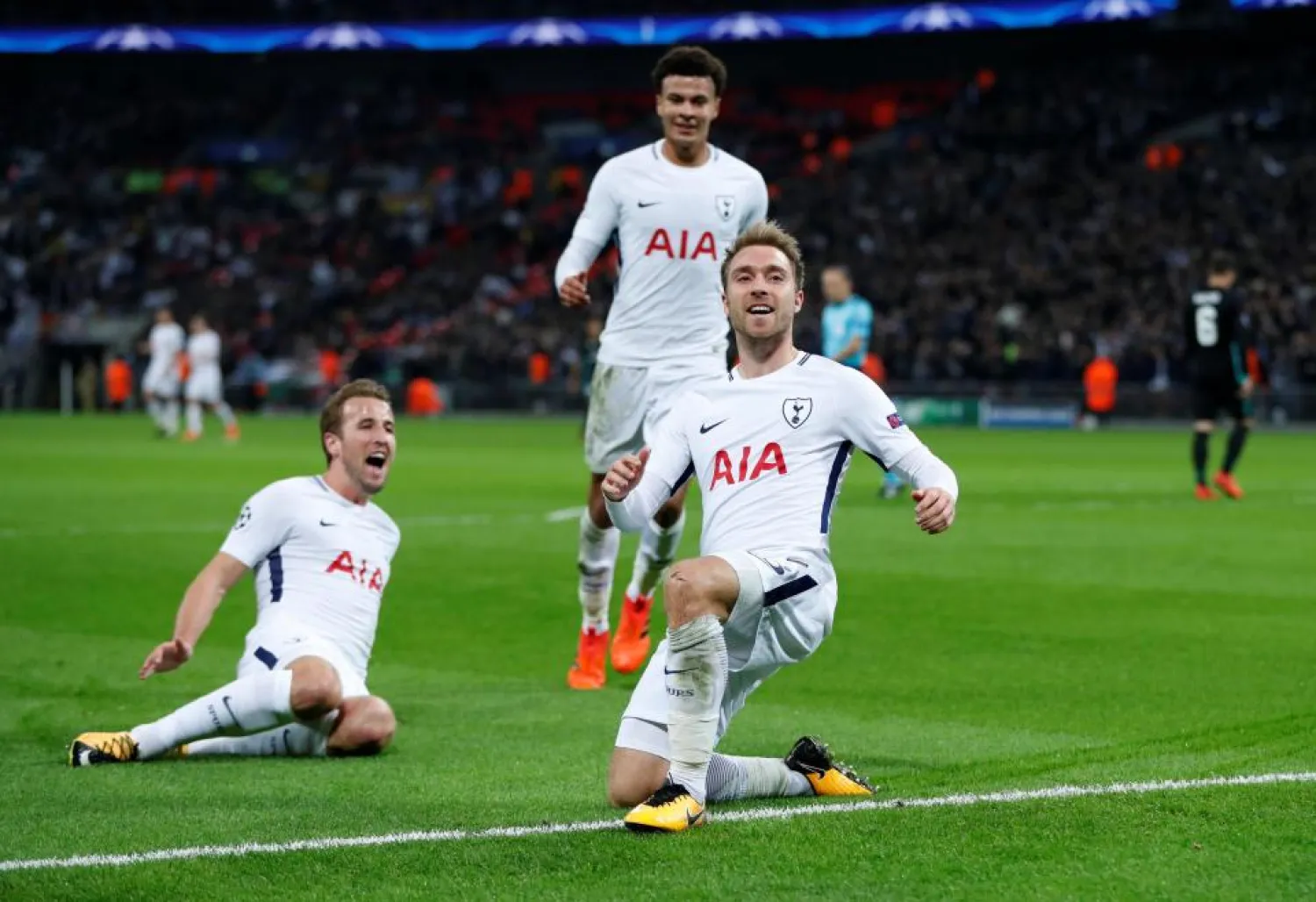
Christian Eriksen celebrates after helping Tottenham produce an historic win over Real Madrid. (Reuters)
TT

Tottenham’s Defeat of Real Madrid is a Warning to Europe’s Super-Clubs

Christian Eriksen celebrates after helping Tottenham produce an historic win over Real Madrid. (Reuters)

It was one of the greatest nights in Tottenham’s history. It was better than beating Internazionale 3-1, probably the equal of those fraught nights in 1983-84 when Bayern Munich, Austria Vienna, Hajduk Split and Anderlecht were overcome on the way to the Uefa Cup. Almost whatever happens over the next three decades, it is safe to assume that in 2050 Christian Eriksen’s goal will still be included in the pre-match White Hart Lane montage as Danny Blanchflower’s voice, the crackle of time even more pronounced, explains once again that the game is about glory.

And this was glorious. The European champions were humbled. As Eriksen pointed out, if Spurs had shown a little more composure, they would have had more. If Harry Kane had been fully fit, perhaps, they would have had more. If Spurs had been able to believe quite what was happening, they would have had more. Dele Alli admitted he was astonished by the amount of space Madrid had allowed them.

That hints at a wider point, which is that Madrid were weirdly terrible. That is not to diminish Tottenham’s performance, and it is hugely to their credit that they have adapted their game this season to such an extent their best three performances – against Borussia Dortmund, Liverpool and Madrid – have come when they had only around a third of possession, but it is to ask questions about Zinedine Zidane and, perhaps, the nature of elite football in general.

Nine years ago the former Liverpool midfielder Igor Biscan spoke about the problem clubs such as Dinamo Zagreb have, explaining how they dominated to such an extent domestically that they wilted as soon as they meet a side of even vaguely comparable quality in Europe. They had forgotten how to defend and they had forgotten how to fight.

Football became for their players an exhibition, the sense that you might have to struggle before you could express yourself was gone.

Since then, the economics of football have meant more and more teams have found themselves succumbing to the Biscan Principle. Bayern are now laughably dominant in the Bundesliga. Juventus may be facing more of a challenge this season than in recent years but they have won Serie A six times in a row. PSG were so upset when their run of four successive French league titles came to an end last season that they went and arranged the two most expensive transfers in history; their only rival, meanwhile, lost four key players. Barcelona and Real Madrid dwarf the rest in Spain.

The result is a decadence among many of the leading sides, a focus on only one part of the game. As Tony Evans pointed out on the Second Captains podcast this week, fans have come to expect and demand entertainment and for some that has become a surrogate for winning. In practical terms, on the pitch, what it means is that elite sides have softer underbellies than they have ever had before. Genuine opposition is such a rarity that when they meet it they have no idea how to react.

That is why so many games between ostensibly well-matched elite sides end up with a surprisingly large margin of victory. The Barcelona-PSG last-16 tie last season – 4-0 to PSG in the first leg; 6-1 to Barça in the second – was the perfect example of that. It was thrilling but it was essentially two big men taking it in turns to hit a blancmange with an ax. Barcelona, it will be remembered, rapidly succumbed to a better-balanced Juventus in the following round.

In the past eight seasons, 21 games at the quarter-final stage or later of the Champions League have been won by a three-goal margin; in the eight seasons before that, there were only eight. Top sides, the elite who reach those stages of the competition, may be better than their forebears at attacking but the art of defending is being forgotten. There is too much attention on the glitter of glory and not enough on the guts.

The one major league that is not – yet – subject to the Biscan Principle, is the Premier League. It is not just that six sides began this season with at least vaguely realistic title ambitions, it is that the bottom sides are still wealthy enough to compete – which is why the attempts of the Big Six to hive off more of the overseas television rights must continue to be resisted.

For the past few years, English under-performance in Europe has been blamed on that competitiveness, on, as Louis van Gaal had it, the “rat race” of the English game. This season, although it is still early, the signs are that Premier League sides may be benefiting. Premier League sides have lost only one of 20 Champions League games this season, have collected 40 percent more coefficient points than any other league and, perhaps most impressively, have shown an intelligence and a tactical flexibility perhaps lacking in the past.

Mauricio Pochettino tweaked again, shifting from the 3-5-2 he had used in the Bernabéu to a 3-4-2-1. Madrid’s 4-3-1-2 shape demands the full-backs get forward to offer attacking width; Tottenham were merciless in exposing that, leading directly to the opening goal.

Madrid were limp, lazy and disorganized, still a threat going forward but a rabble at the back. Perhaps they were infected by the realization they will almost certainly qualify anyway and that they won the competition after going through in second last season. But after their sluggish start to the domestic season there is reason for serious concern.

After successive defeats, Tottenham sides of the past might have wilted but not this one. Mentally they were tougher than Madrid and tactically they were smarter. Wednesday was a night that will live always in Tottenham’s history but it should also be a warning to Madrid and perhaps also the other super-clubs.

The Guardian Sport


Hospital: Vonn Had Surgery on Broken Leg from Olympics Crash

This handout video grab from IOC/OBS shows US Lindsey Vonn crashing during the women's downhill event at the Milano Cortina 2026 Winter Olympic Games on February 8, 2026. (Photo by Handout / various sources / AFP)
TT

Hospital: Vonn Had Surgery on Broken Leg from Olympics Crash

This handout video grab from IOC/OBS shows US Lindsey Vonn crashing during the women's downhill event at the Milano Cortina 2026 Winter Olympic Games on February 8, 2026. (Photo by Handout / various sources / AFP)

Lindsey Vonn had surgery on a fracture of her left leg following the American's heavy fall in the Winter Olympics downhill, the hospital said in a statement given to Italian media on Sunday.

"In the afternoon, (Vonn) underwent orthopedic surgery to stabilize a fracture of the left leg," the Ca' Foncello hospital in Treviso said.

Vonn, 41, was flown to Treviso after she was strapped into a medical stretcher and winched off the sunlit Olimpia delle Tofane piste in Cortina d'Ampezzo.

Vonn, whose battle to reach the start line despite the serious injury to her left knee dominated the opening days of the Milano Cortina Olympics, saw her unlikely quest halted in screaming agony on the snow.

Wearing bib number 13 and with a brace on the left knee she ⁠injured in a crash at Crans Montana on January 30, Vonn looked pumped up at the start gate.

She tapped her ski poles before setting off in typically aggressive fashion down one of her favorite pistes on a mountain that has rewarded her in the past.

The 2010 gold medalist, the second most successful female World Cup skier of all time with 84 wins, appeared to clip the fourth gate with her shoulder, losing control and being launched into the air.

She then barreled off the course at high speed before coming to rest in a crumpled heap.

Vonn could be heard screaming on television coverage as fans and teammates gasped in horror before a shocked hush fell on the packed finish area.

She was quickly surrounded by several medics and officials before a yellow Falco 2 ⁠Alpine rescue helicopter arrived and winched her away on an orange stretcher.


Meloni Condemns 'Enemies of Italy' after Clashes in Olympics Host City Milan

Demonstrators hold smoke flares during a protest against the environmental, economic and social impact of the Milano-Cortina 2026 Winter Olympics in Milan, Italy, February 7, 2026. REUTERS/Kevin Coombs
TT

Meloni Condemns 'Enemies of Italy' after Clashes in Olympics Host City Milan

Demonstrators hold smoke flares during a protest against the environmental, economic and social impact of the Milano-Cortina 2026 Winter Olympics in Milan, Italy, February 7, 2026. REUTERS/Kevin Coombs

Italian Prime Minister Giorgia Meloni has condemned anti-Olympics protesters as "enemies of Italy" after violence on the fringes of a demonstration in Milan on Saturday night and sabotage attacks on the national rail network.

The incidents happened on the first full day of competition in the Winter Games that Milan, Italy's financial capital, is hosting with the Alpine town of Cortina d'Ampezzo.

Meloni praised the thousands of Italians who she said were working to make the Games run smoothly and present a positive face of Italy.

"Then ⁠there are those who are enemies of Italy and Italians, demonstrating 'against the Olympics' and ensuring that these images are broadcast on television screens around the world. After others cut the railway cables to prevent trains from departing," she wrote on Instagram on Sunday.

A group of around 100 protesters ⁠threw firecrackers, smoke bombs and bottles at police after breaking away from the main body of a demonstration in Milan.

An estimated 10,000 people had taken to the city's streets in a protest over housing costs and environmental concerns linked to the Games.

Police used water cannon to restore order and detained six people.

Also on Saturday, authorities said saboteurs had damaged rail infrastructure near the northern Italian city of Bologna, disrupting train journeys.

Police reported three separate ⁠incidents at different locations, which caused delays of up to 2-1/2 hours for high-speed, Intercity and regional services.

No one has claimed responsibility for the damage.

"Once again, solidarity with the police, the city of Milan, and all those who will see their work undermined by these gangs of criminals," added Meloni, who heads a right-wing coalition.

The Italian police have been given new arrest powers after violence last weekend at a protest by the hard-left in the city of Turin, in which more than 100 police officers were injured.


Liverpool New Signing Jacquet Suffers 'Serious' Injury

Soccer Football - Ligue 1 - RC Lens v Stade Rennes - Stade Bollaert-Delelis, Lens, France - February 7, 2026  Stade Rennes' Jeremy Jacquet in action REUTERS/Benoit Tessier
Soccer Football - Ligue 1 - RC Lens v Stade Rennes - Stade Bollaert-Delelis, Lens, France - February 7, 2026 Stade Rennes' Jeremy Jacquet in action REUTERS/Benoit Tessier
TT

Liverpool New Signing Jacquet Suffers 'Serious' Injury

Soccer Football - Ligue 1 - RC Lens v Stade Rennes - Stade Bollaert-Delelis, Lens, France - February 7, 2026  Stade Rennes' Jeremy Jacquet in action REUTERS/Benoit Tessier
Soccer Football - Ligue 1 - RC Lens v Stade Rennes - Stade Bollaert-Delelis, Lens, France - February 7, 2026 Stade Rennes' Jeremy Jacquet in action REUTERS/Benoit Tessier

Liverpool's new signing Jeremy Jacquet suffered a "serious" shoulder injury while playing for Rennes in their 3-1 Ligue 1 defeat at RC Lens on Saturday, casting doubt over the defender’s availability ahead of his summer move to Anfield.

Jacquet fell awkwardly in the second half of the ⁠French league match and appeared in agony as he left the pitch.

"For Jeremy, it's his shoulder, and for Abdelhamid (Ait Boudlal, another Rennes player injured in the ⁠same match) it's muscular," Rennes head coach Habib Beye told reporters after the match.

"We'll have time to see, but it's definitely quite serious for both of them."
Liverpool agreed a 60-million-pound ($80-million) deal for Jacquet on Monday, but the 20-year-old defender will stay with ⁠the French club until the end of the season.

Liverpool, provisionally sixth in the Premier League table, will face Manchester City on Sunday with four defenders - Giovanni Leoni, Joe Gomez, Jeremie Frimpong and Conor Bradley - sidelined due to injuries.