
Khamenei Replaces Army Commanders as Defense Budget Tightens

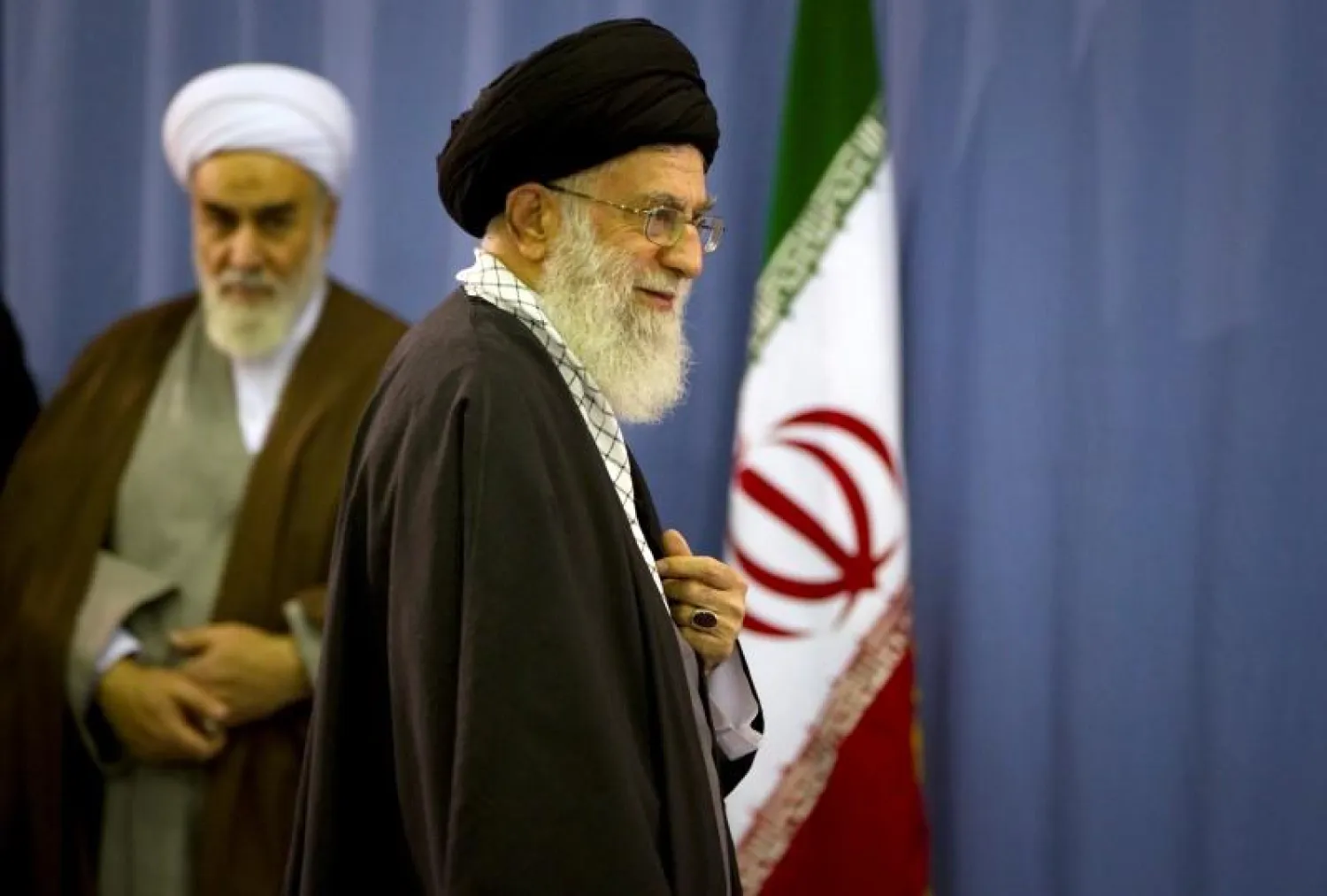
Iran's Supreme Leader Ayatollah Ali Khamenei departs after casting his ballot in the parliamentary election in Tehran March 2, 2012. REUTERS/Caren Firouz
TT

Khamenei Replaces Army Commanders as Defense Budget Tightens

Iran's Supreme Leader Ayatollah Ali Khamenei departs after casting his ballot in the parliamentary election in Tehran March 2, 2012. REUTERS/Caren Firouz

Iran’s Supreme Leader Ali Khamenei ordered on Sunday replacing three senior Iranian army officials after budget challenges arose. The decree was released during a meeting that joined re-elected President Hassan Rouhani and top army commanders.

In sweeping change, Khamenei sacked deputy army commander Brigadier General Reza Pourdastan, only a year after he was appointed to his post.

Pourdastan was replaced with Brigadier General Mohammad Hossein Dadras, moving him up the hierarchy after serving as deputy commander of ground forces.

Kamenei’s decrees also appointed Rear Admiral Hossein Khanzadi in charge of the Navy, replacing the former long-serving Navy commander, Rear Admiral Habibollah Sayyari.

Well- informed sources told Asharq Al-Awsat that the move came after army commanders were disgruntled by the newly announced budget for the armed forces, days before its submission to the Shura (parliament).

According to those sources, the defense share was slashed in order to pressure the military institution to abandon its air force fleets in favor of the Revolutionary Guard, which is a parallel army in Iran which answers to Khamenei exclusively.

On Monday, Rouhani held consultations with senior military leaders to persuade them to accept the new budget and promised them to update and develop the army's capabilities.

Iran’s Revolutionary Guard shares with the national army ballistic missiles, defense systems, cruise missiles and marines. But the national military enjoys the privilege of controlling the national air force, including warplanes, rocket launchers and combat helicopters.

Sources said that economic pressures may push the Iranian army to abandon the air force, and become a pawn to Revolutionary Guards policy, giving the latter leverage should clashes between the two forces arise.

Rouhani met with army commanders, in the presence of Chief of Staff of the Iranian Armed Forces Major General Mohammad Bagheri and Khamenei's representative in the army.

In a statement published at the government’s official website, Rouhani promised to modernize the Iranian army capacities.

"The armed forces must be nonpartisan," Rohani said.


North Korea Says Xi’s Visit Produced ‘Far-Reaching Blueprint’ for Ties

This picture taken on June 9, 2026 and released by North Korea's official Korean Central News Agency (KCNA) on June 10, 2026 shows North Korean leader Kim Jong Un (L) seeing off China's President Xi Jinping (R) during the latter's departure from Pyongyang International Airport. (KCNA via KNS / AFP)
TT

North Korea Says Xi’s Visit Produced ‘Far-Reaching Blueprint’ for Ties

This picture taken on June 9, 2026 and released by North Korea's official Korean Central News Agency (KCNA) on June 10, 2026 shows North Korean leader Kim Jong Un (L) seeing off China's President Xi Jinping (R) during the latter's departure from Pyongyang International Airport. (KCNA via KNS / AFP)

The leaders of North Korea and China adopted a "far-reaching blueprint" for bilateral ties during Xi Jinping's recent visit to Pyongyang, the state-run Korean Central News Agency (KCNA) said on Wednesday.

China's president made a rare visit to diplomatically isolated North Korea on Monday after hosting a series of world leaders, including US President Donald Trump and Russian leader Vladimir Putin, in Beijing.

The trip also came at a time of unusually warm relations between North Korea and Russia, where Pyongyang has sent soldiers and munitions to assist Moscow's invasion of Ukraine.

Kim and Xi "expressed satisfaction and deep emotion over the fact that they provided a far-reaching blueprint for the development of the relations", KCNA reported.

During the two-day trip, "the countries further deepened the revolutionary friendship and close comradely relationship and affirmed their steadfast will to develop the traditional DPRK-China friendly ties into a model of the most powerful and strategic relations", it added.

Xi and Kim toured the Central Cadres Training School of the Workers' Party, where they discussed the training of party officials and planted a commemorative tree, before visiting the Friendship Tower memorial honoring Chinese soldiers who fought in the Korean War.

Xi was afforded a lavish welcome on the trip, which he took with his wife and other senior officials.

Afterwards, he thanked Kim in a letter, saying the leaders had "made an in-depth exchange of views on the issues of mutual interest and achieved a series of important common understanding", according to KCNA.

The talks "showed the firm determination of both sides to add luster to the traditional friendship, promote development and prosperity together and defend peace and stability in the region and the rest of the world", Xi reportedly wrote.

On Tuesday, China's state-run Xinhua news agency reported Xi as saying he had reached "an important consensus with Kim on developing China-DPRK relations in the new era", using North Korea's official acronym.

Xi pushed to strengthen diplomatic, law enforcement and military ties, according to Beijing's state media.

By sharing information in the military sector, China appears to want to "directly assess technological changes within the North Korean military and the status of Russian technology transfer", said Hong Min, an analyst at the Korea Institute for National Unification.

China may also hope to "collect intelligence for the purpose of monitoring trends in pro-Russian and pro-Chinese human networks within the North Korean military", he added.

- Nuclear silence -

Xi's trip came after last month's talks with Trump, during which the White House said the leaders "confirmed their shared goal to denuclearize North Korea".

But official media reports from both China and North Korea made no mention of denuclearization in their coverage of the Xi-Kim summit.

Analysts said that suggested Beijing was tacitly accepting Pyongyang's status as a nuclear-armed state.

Kim has repeatedly vowed never to give up his nuclear arsenal, and his powerful sister said before Xi's visit that the program was Pyongyang's "line of no retreat".

Despite being historically highly reliant on political and economic support from China, Kim has drawn North Korea closer to Russia in recent years.

He has boosted an alliance with Putin by sending troops to fight alongside Russian forces against Ukraine.

Still, Beijing remains an economic anchor for North Korea, whose economy has been hobbled for years by international sanctions over its nuclear program.

China accounted for $2.6 billion of North Korea's foreign trade -- nearly 98 percent of the total -- in 2024, according to South Korea's Ministry of Economy and Finance.


Alleged Bondi Beach Gunman Charged with 19 More Offenses over Mass Shooting

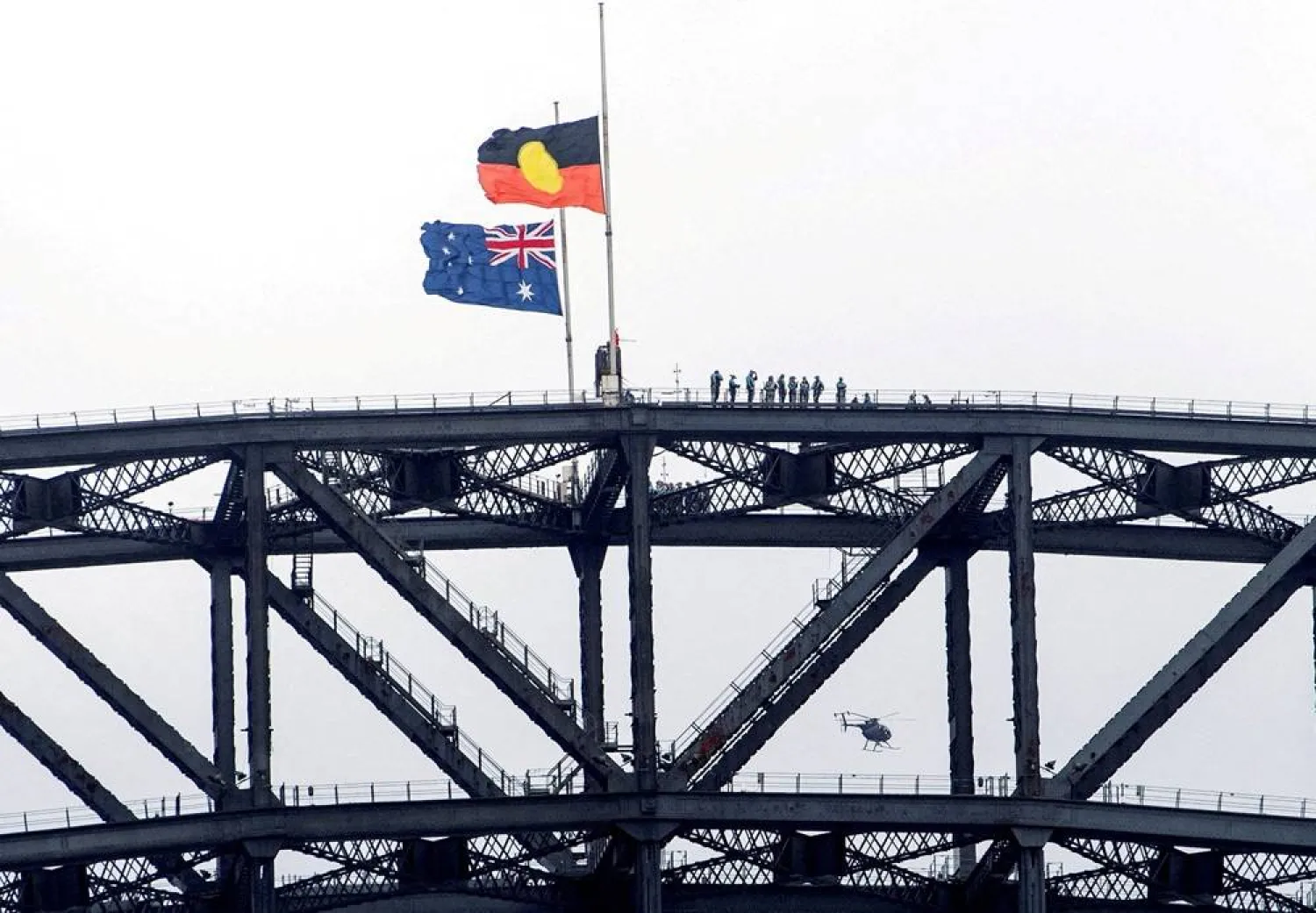
Australia's national flag and the Aboriginal flag flutter at half mast on the Sydney Harbor Bridge during Australia's National Day of Mourning for the victims of the December 14, 2025, mass shooting at a Jewish Hanukkah celebration at Bondi Beach, in Sydney, Australia, January 22, 2026. (Reuters)
TT

Alleged Bondi Beach Gunman Charged with 19 More Offenses over Mass Shooting

Australia's national flag and the Aboriginal flag flutter at half mast on the Sydney Harbor Bridge during Australia's National Day of Mourning for the victims of the December 14, 2025, mass shooting at a Jewish Hanukkah celebration at Bondi Beach, in Sydney, Australia, January 22, 2026. (Reuters)

A ‌man accused of committing one of Australia's worst mass shootings, at Sydney's famed Bondi Beach last December, has been charged with 19 additional offenses.

Police say the attack that killed 15 people at a Hanukkah celebration was inspired by the ISIS. They initially charged Naveed Akram with 59 offenses in the ‌days following the shooting, ‌including 15 counts of ‌murder, ⁠40 counts of wounding ⁠with intent to murder and a terror offense.

Akram's lawyer, Leonie Gittani, told a court in Sydney on Wednesday that 19 additional charges had been filed, according to reports in ⁠local media.

Court records showed the ‌new charges ‌included 10 counts of shooting with intent to ‌murder, six counts of discharging ‌a firearm with intent to resist arrest and three counts of causing wounding or grievous bodily harm with intent to murder.

Akram, ‌24, has yet to enter a plea. His father, Sajid Akram, ⁠50, ⁠whom authorities also accused of carrying out the shooting, was shot dead by police at the scene.

The attack stunned a nation known for its strict gun laws, prompting renewed calls for tighter controls and more decisive action to combat antisemitism.

Australia has also launched a government-backed inquiry into antisemitism and social cohesion and the findings are due by December.


China, Taiwan Spar Over Legality of Coast Guard Patrols East of Island

 A Taiwanese Army M109A2 self-propelled howitzer fires during a live-fire training exercise in Taichung on June 9, 2026. (AFP)
A Taiwanese Army M109A2 self-propelled howitzer fires during a live-fire training exercise in Taichung on June 9, 2026. (AFP)
TT

China, Taiwan Spar Over Legality of Coast Guard Patrols East of Island

 A Taiwanese Army M109A2 self-propelled howitzer fires during a live-fire training exercise in Taichung on June 9, 2026. (AFP)
A Taiwanese Army M109A2 self-propelled howitzer fires during a live-fire training exercise in Taichung on June 9, 2026. (AFP)

China and Taiwan sparred on Wednesday over the legality of Chinese coast guard patrols to the east of the island, after the government in Taipei said merchant ships had been "harassed" close to its waters.

China, which views democratically governed Taiwan as its own territory, was angered after Japan and the Philippines said last month they would begin formal talks on their maritime boundaries, viewing that as involving waters off Taiwan.

Late on Saturday, ‌Chinese state ‌media reported ships had been sent to ‌carry ⁠out a "special maritime ⁠traffic law-enforcement operation" in the waters east of Taiwan in response to the Japanese and Philippine announcement.

Taiwan said those ships had in recent days been "harassing" commercial shipping by asking them for information about their point of origin and destination and claiming jurisdiction.

"The relevant mainland authorities' ⁠law-enforcement patrols in the relevant waters are a ‌just act to safeguard ‌national sovereignty and maritime rights and interests," Zhang Han, a spokesperson ‌for China's Taiwan Affairs Office, said in Beijing.

The ‌Chinese coast guard is conducting "law-enforcement patrols" in the waters east of Taiwan in accordance with the law, and China will continue to strengthen its control over those waters, she said.

The patrols ‌have angered Taiwan's government, which rejects Beijing's sovereignty claims, saying only the Taiwanese ⁠people can decide ⁠their future.

Speaking to reporters in Taipei on Wednesday, Taiwan Foreign Minister Lin Chia-lung said China was "using so-called 'law enforcement' as a pretext to pursue expansion".

"The Chinese communists have no right to intervene in matters concerning the waters east of Taiwan, whether they involve Taiwan's sovereignty or jurisdiction," he said.

China is a "trouble-maker that is damaging the status quo," Lin said.

Beijing recognizes no claims of sovereignty by Taiwan's government and has rejected multiple offers of talks by President Lai Ching-te, saying he is a "separatist."