


Washington Calls for International Action against Iran for Providing Houthis with Missiles

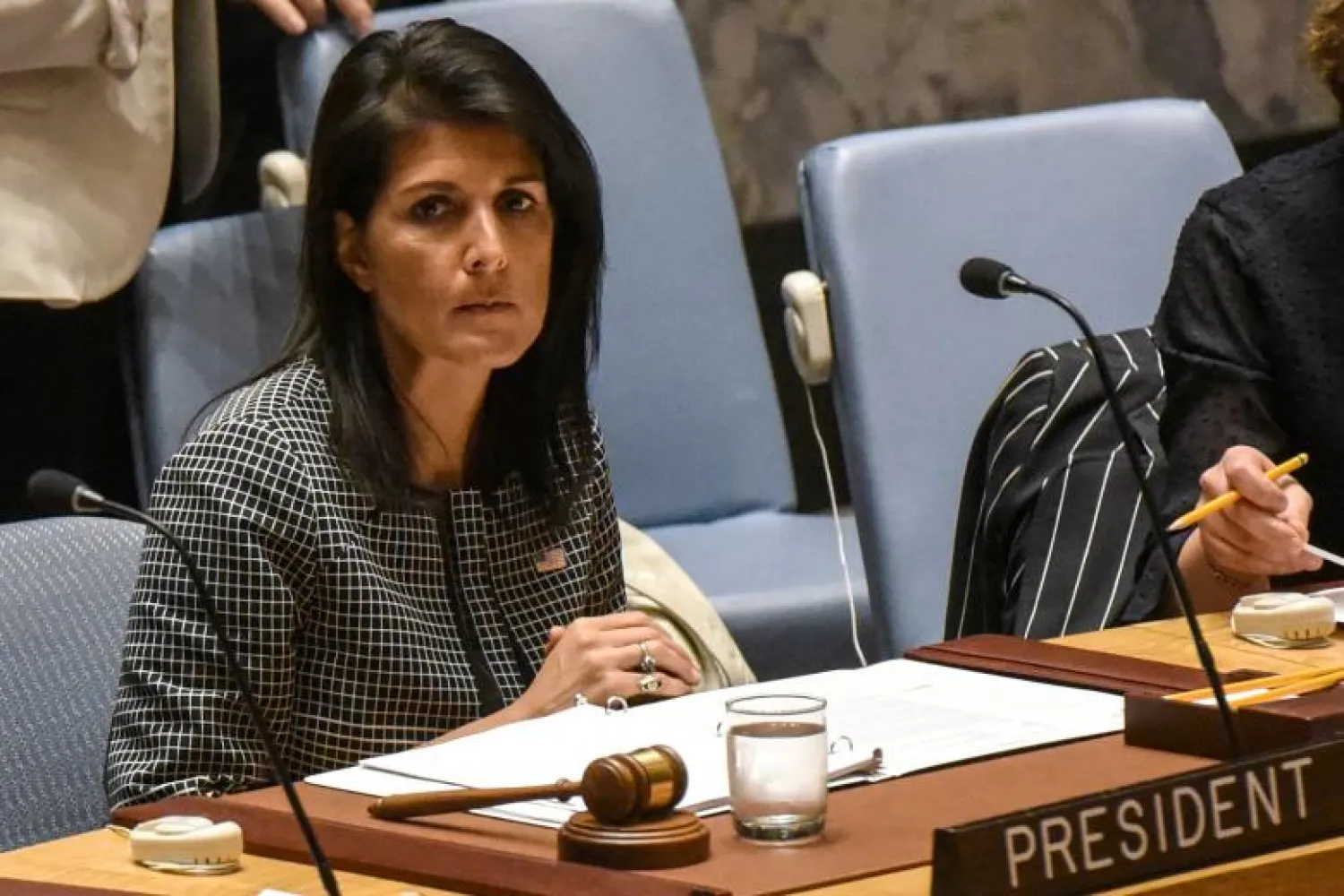
US Ambassador to the U.N. Nikki Haley prepares to speak at a Security Council meeting on the situation in Syria at the United Nations Headquarters in New York, April 12, 2017. REUTERS/Stephanie Keith
TT

Washington Calls for International Action against Iran for Providing Houthis with Missiles

US Ambassador to the U.N. Nikki Haley prepares to speak at a Security Council meeting on the situation in Syria at the United Nations Headquarters in New York, April 12, 2017. REUTERS/Stephanie Keith

The United States on Tuesday called for a UN action against Iran for providing Houthi rebels with missiles and violating the relevant UN resolutions.

US Ambassador to the UN Nikki Haley said that Iran’s Revolutionary Guard Corp‎s had violated two UN resolutions on Yemen by providing weapons to the Houthis.

She added that information released by Saudi Arabia showed the missile fired in July was an Iranian Qiam, which she described as “a type of weapon that had not been present in Yemen before the conflict.”

“We encourage the United Nations and international partners to take necessary action to hold the Iranian regime accountable for these violations,” Haley said.

The two international resolutions (2216 and 2231) referred to by the US ambassador prohibit Tehran from supplying, selling or transferring weapons outside the country without a prior approval by the Security Council. The second resolution prohibits the supply of arms to Houthi leader Abdul Malik al-Houthi, former Yemeni President Ali Abdullah Saleh and his son, and those who act in their name or under their direction.

The US call for action against Iran came after Saudi Arabia announced that its forces intercepted last Saturday over Riyadh airport a ballistic missile launched by the Houthis, which led to the fall of shrapnel over the airport. The missile is the first to reach the Saudi capital.

The Coalition for the Support of Legitimacy in Yemen stressed, on Monday, that Saudi Arabia “retains the right to respond to Iran at the right time and form.”

The coalition has also decided to temporarily close Yemen's air, sea and land ports, as well as preventing the entry of aid under UN supervision despite appeals by the United Nations.

Iran on Tuesday denied Saudi accusations of supplying Houthis with missiles. Iranian Foreign Minister Mohammad Javad Zarif said in a telephone conversation with his British counterpart, Boris Johnson, that “the allegations by Saudi officials were contrary to reality and dangerous”, according to Iran’s foreign ministry spokesman, who was quoted by AFP.

Zarif also slammed “provocative actions by the Saudi government in the region,” the spokesman added.



Iraq's Parliament Elects Al-Halbousi as Its New Speaker

 The new speaker of parliament Haibet Al-Halbousi, center, looks on before the start of their first legislative session in Baghdad, Iraq, Monday, Dec. 29, 2025. (AP Photo/Hadi Mizban)
The new speaker of parliament Haibet Al-Halbousi, center, looks on before the start of their first legislative session in Baghdad, Iraq, Monday, Dec. 29, 2025. (AP Photo/Hadi Mizban)
TT

Iraq's Parliament Elects Al-Halbousi as Its New Speaker

 The new speaker of parliament Haibet Al-Halbousi, center, looks on before the start of their first legislative session in Baghdad, Iraq, Monday, Dec. 29, 2025. (AP Photo/Hadi Mizban)
The new speaker of parliament Haibet Al-Halbousi, center, looks on before the start of their first legislative session in Baghdad, Iraq, Monday, Dec. 29, 2025. (AP Photo/Hadi Mizban)

Iraq's parliament on Monday elected a new speaker following overnight talks to break a political deadlock.

Haibet Al-Halbousi received 208 votes from the 309 legislators who attended, according to The AP news. He is a member of the Takadum, or Progress, party led by ousted speaker and relative Mohammed al-Halbousi. Twenty legislators did not attend the session.

Iraq held parliamentary elections in November but didn’t produce a bloc with a decisive majority. By convention, Iraq’s president is always Kurdish, while the more powerful prime minister is Shiite and the parliamentary speaker is Sunni.

The new speaker must address a much-debated bill that would have the Hashd al-Shaabi, or Popular Mobilization Units become a formal security institution under the state. Iran-backed armed groups have growing political influence.

Al-Halbousi also must tackle Iraq’s mounting public debt of tens of billions of dollars as well as widespread corruption.

Babel Governor Adnan Feyhan was elected first deputy speaker with 177 votes, a development that might concern Washington. Feyhan is a member of the Asaib Ahl al-Haq, or League of the Righteous, a US-sanctioned, Iran-backed group with an armed wing led by Qais al-Khazali, also sanctioned by Washington.


Hamas Armed Wing Confirms Spokesman Killed by Israel in August

FILE Photo of Hamas now late spokesperson Abu Ubaida. (Screengrab from al-Qassam brigades video)
TT

Hamas Armed Wing Confirms Spokesman Killed by Israel in August

FILE Photo of Hamas now late spokesperson Abu Ubaida. (Screengrab from al-Qassam brigades video)

Hamas' armed wing confirmed on Monday the death of its spokesperson, Abu Obeida, months after Israel announced that he had been killed in an air strike in Gaza.

Ezzedine Al-Qassam Brigades released a video statement on its Telegram channel, saying: "We pause in reverence before... the masked man loved by millions... the great martyred commander and spokesperson of the Qassam Brigades, Abu Obeida", AFP reported.

Israel had announced it had killed Abu Obeida in a strike on Gaza on August 30.

Born on February 11, 1985, and raised in the Jabalia refugee camp in northern Gaza, Abu Obeida joined Hamas at an early age before becoming a member of the Ezzedine al-Qassam Brigades.

He later became the group's sole spokesman, delivering video statements in military uniform with his face consistently concealed by a red keffiyeh. He had been the target of multiple Israeli assassination attempts.

According to Hamas officials, Abu Obeida embodied what they describe as "resistance" and was known for fiery and impactful speeches, many of which included threats against Israel or announcements of military operations.

"For many years, only a very small circle of Hamas officials knew his true identity," a Hamas official told AFP.

Israel has decimated Hamas's leadership, saying it seeks to eradicate the group following Hamas's October 7, 2023 attack on Israel, which triggered the war.

The video announcing Abu Obeida's death was delivered by a masked man dressed in the former spokesperson's distinctive style, who said he would adopt his predecessor's name for future statements.

In the same video, he also announced the deaths of four other Hamas commanders in Israeli attacks during the war.


Iraq’s Newly Elected Parliament Holds First Session

A view of the Iraqi Parliament building in Baghdad, Iraq, Monday, Dec. 29, 2025. (AP)
TT

Iraq’s Newly Elected Parliament Holds First Session

A view of the Iraqi Parliament building in Baghdad, Iraq, Monday, Dec. 29, 2025. (AP)

Iraq's newly elected parliament convened ​on Monday for its first session since the November national election, opening the ‌way for ‌lawmakers ‌to begin ⁠the ​process ‌of forming a new government.

Parliament is due to elect a speaker and ⁠two deputies ‌during its first meeting. ‍

Lawmakers ‍must then ‍choose a new president by within 30 days of ​the first session.

The president will subsequently ⁠ask the largest bloc in parliament to form a government, a process that in Iraq typically drags on for ‌months.