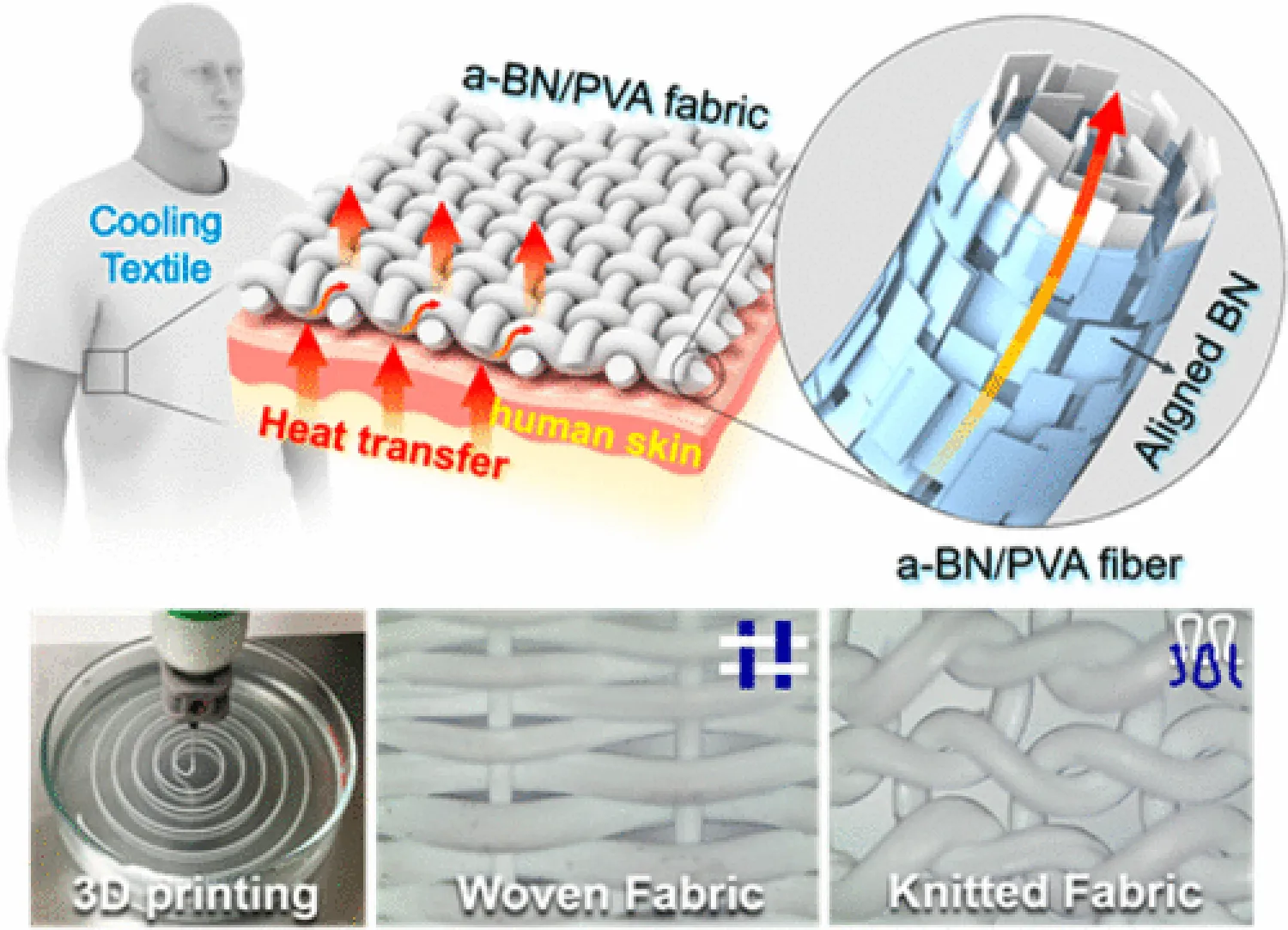
A team of researchers at the University of Maryland in the US has now developed a thermally conductive and strong textile from fibers of aligned boron nitride nanosheets embedded in a polymer matrix that can cool a person down by up to 2°. The textile is easy to make using a simple, fast and scalable 3D printing method and has a thermal conductivity that is 55% higher than commercial cotton.
Researchers recently fabricated a mid-infrared transparent nanoporous polyethylene fiber for making clothing and face masks that lowers body temperature by radiative cooling. They have also developed glass-polymer hybrid metamaterials that work on the same principle.
Building on such work, a team led by Liangbing Hu of the Department of Materials Science and Engineering at the University of Maryland has now designed a thermally conductive textile that directly conducts heat away from the body. The material is based on boron nitride nanosheets (BNNSs) and poly(vinvyl alcohol) (PVA) composite fibres. BNNSs have a high in-plane thermal conductivity of up to 2000 W/(mK) and Hu and colleagues made sure they were able to exploit this property by aligning the BNN sheets in a highly ordered way. They did this by first printing the BN/PVA fibres and then hot-drawing them into aligned structures. The fibers were then weaved or knitted into a textile.
“The hot drawing process creates energetic pathways along which phonons (vibrations of the crystal lattice) can travel,” explains Hu, “and highly oriented BNNSs can effectively enhance the thermal performance of the BN/PVA composite fibre by providing numerous thermally conductive pathways along the aligned and interconnected BNNSs. Indeed, we measured the thermal conductivity of the finished material to be as high as 0.078 W/(mK).”
It also has a high tensile strength of around 355 MPa, he adds.
The material might be used in summer clothing for wearing indoors, nanotechweb.org reported Hu as saying, and we estimate that it can cool a person down by up to 2°.
The researchers, reporting their work in ACS Nano DOI: 10.1021/acsnano.7b06295, say that they will now be further improving the cooling capacity of their thermal regulation textile. “We will also be looking into manufacturing it on a large scale, and then commercializing it,” says Hu.
Israel Tests Nabatieh Defenses, Seeks to Isolate the City in South Lebanonhttps://english.aawsat.com/arab-world/5277854-israel-tests-nabatieh-defenses-seeks-isolate-city-south-lebanon
Israel Tests Nabatieh Defenses, Seeks to Isolate the City in South Lebanon
Smoke rises from Beaufort Castle following strikes, as seen from Marjayoun, southern Lebanon, May 27, 2026. REUTERS/Stringer
The Israeli army made on Wednesday further incursions around the southern Lebanese city of Nabatieh beyond the Israeli-declared "yellow line” while increasing airstrikes up to 20 kilometers from the border and forcing the full evacuation of towns around the city.
The advance followed Israeli threats to expand beyond the yellow line and coincided with what Israel’s Channel 14 described as the widespread, systematic destruction of more than 10,000 buildings in southern Lebanese border villages, about 70% of the structures Israel plans to demolish in the area.
“We are expanding our operations in Lebanon to deepen the scale of the damage we are inflicting on Hezbollah,” Israeli army Chief of Staff Eyal Zamir said on Wednesday.
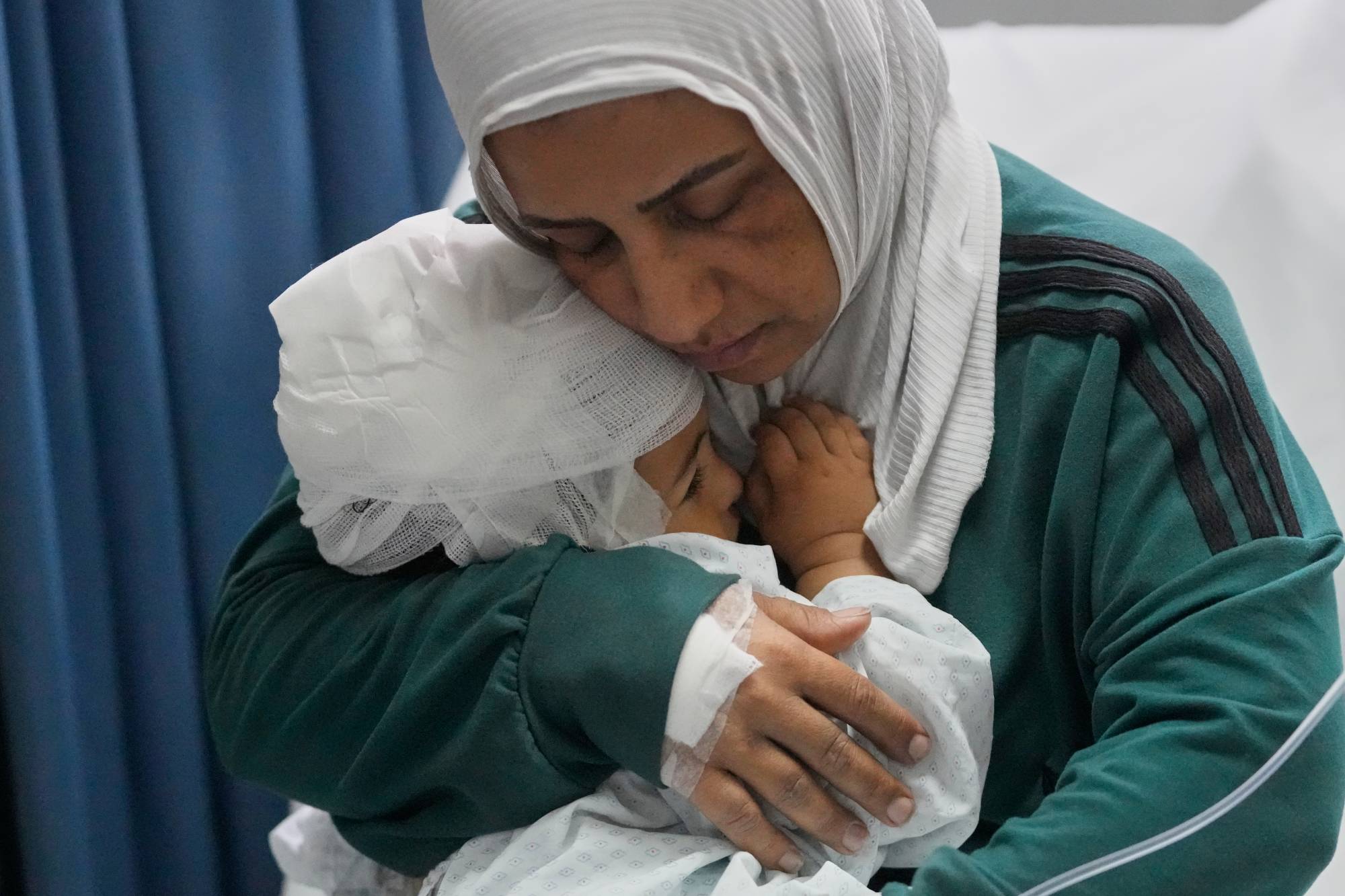
Hayat Al-Aqleh embraces her 18-month-old son Ali at Jabal Amel Hospital in the southern port city of Tyre, Lebanon, Wednesday, May 27, 2026, after he underwent head surgery for injuries sustained in an Israeli airstrike a day earlier in the village of Charnay near Tyre. (AP Photo/Mohammad Zaatari)
New push north of the river
Israeli forces entered eastern Zawtar, a town on the northern bank of the Litani, advancing on its outskirts as they sought to reach the strategic Beaufort Castle east of Nabatieh.
The castle overlooks, from the east, Lebanese towns under Israeli occupation, as well as northern Israeli settlements less than 10 kilometers away. Israel has placed the castle and the towns of Zawtar, Arnoun and Yohmor al-Shaqif within the yellow line, although they lie north of the Litani.
Local sources in southern Lebanon told Asharq Al-Awsat that Israeli forces sent unmanned vehicles deep into an area near Mayfadoun to probe defenses and reconnaissance capabilities.
They said the move pointed to attempts to push toward the hills south of Nabatieh, especially Mayfadoun and Shawkin, to isolate the city, which was placed under a full evacuation warning on Wednesday for a second day in a row.
The sources said airstrikes intensified on Beaufort Castle and nearby Yohmor, Kfar Tebnit and Arnoun, areas overlooking Nabatieh from the east.
The Israeli army gave no details on the fighting.
In a statement sent in response to a question from Agence France Presse and attributed to a military official, the army said it was operating in a targeted manner beyond the forward defense line to eliminate direct threats to the citizens of the State of Israel and to soldiers ... in accordance with directives from the political leadership.
Specific details regarding the locations of soldiers cannot be provided, the official said.
Clashes at point-blank range
In a statement Wednesday, Hezbollah said its fighters "clashed with the enemy forces at point-blank range" with light and medium weapons in the town of Zawtar al-Sharqiyah.
Since dawn on Tuesday, Hezbollah had said it targeted Israeli forces trying to enter the town with rocket-propelled grenades and explosive drones. It later said its fighters fired rockets and drones at Israeli forces on the town’s outskirts and near its entrance by the riverbed.
Al-Manar, Hezbollah’s television channel, said Israeli forces were moving along three axes on the outskirts of Zawtar al-Sharqiyah from the Hamra side. It said clashes were underway at three points, but denied that Israeli forces had advanced toward Mayfadoun or the inner neighborhoods of Zawtar al-Sharqiyah.
The town’s position north of the Litani gives it strategic significance due to its proximity to Nabatieh, southern Lebanon’s largest city. Israel accuses Hezbollah of violating the ceasefire.
Zawtar al-Sharqiyah lies next to the yellow line that the Israeli army drew last month in southern Lebanon. The line runs around 10 kilometers deep inside Lebanese territory and where residents have been warned not to return.
The advance into the town coincided with an Israeli army statement on Tuesday saying it was “operating in a targeted manner beyond the forward defense line to eliminate direct threats to the citizens of the State of Israel and to soldiers.”
Emptying Nabatieh’s surroundings
As it tries to advance, Israel is also working to isolate Nabatieh and its surroundings by expanding the fire-enforced buffer zone to nearly 20 kilometers from the border.
Field sources in southern Lebanon told Asharq Al-Awsat that the line of fire had been cleared to Doueir, where no one can now enter, including ambulances, which need permission from the so-called mechanism - an internationally brokered monitoring committee established to oversee the ceasefire - to access the town.
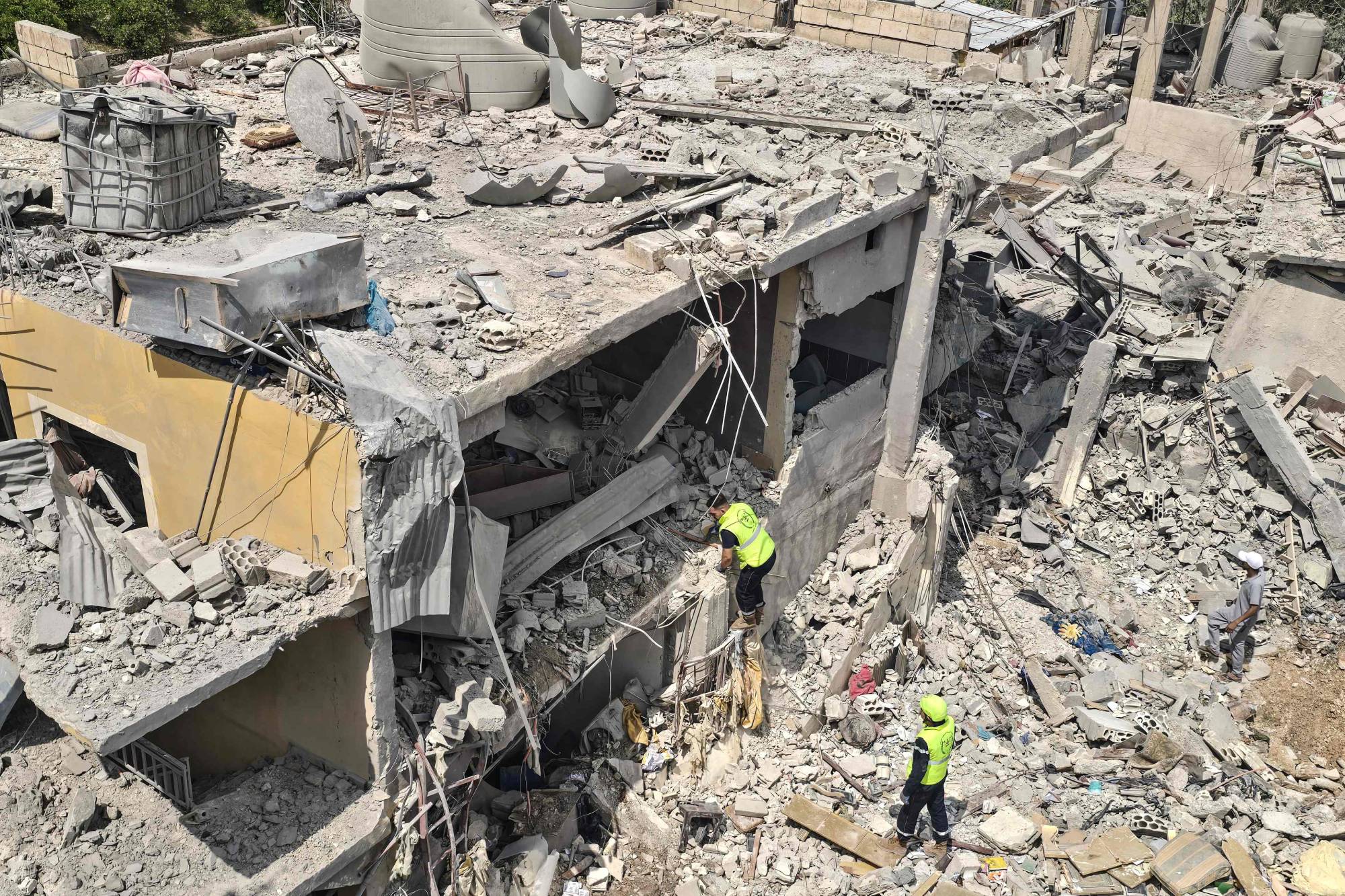
Civil defense members search for victims in the rubble of a residential building hit the previous day by an Israeli strike near the southern town of Burj al-Shamali, on the outskirts of Tyre, on May 27, 2026.(Photo by KAWNAT HAJU / AFP)
The sources said the evacuation sweep covered Doueir, Harouf, Jebchit, Zebdine, Toul, Kfar Jouz, Deir al-Zahrani, Habboush, Kfar Roummane, Mayfadoun and Shawkin. It also included towns north of the river, southwest of Nabatieh, overlooking the Litani’s bank.
The developments came hours after evacuation warnings on Tuesday covered about 50 Lebanese villages and towns, including all towns in the districts of Bint Jbeil, Marjayoun and Tyre, as well as a large part of the Nabatieh district.
The Israeli army carried out about 150 airstrikes on Tuesday, killing 31 people and wounding 40, according to Lebanon’s Health Ministry. The ministry said 14 people were killed in Burj al-Shamali near Tyre.
On Wednesday, the bombing expanded into the Zahrani district, hitting Tafahta, as well as large parts of villages around Nabatieh. Lebanon’s official National News Agency said a strike near Nabih Berri Governmental Hospital caused “major damage to hospital wards.”
Gaza Marks Third Eid Asking: What Joy Remains?https://english.aawsat.com/arab-world/5277847-gaza-marks-third-eid-asking-what-joy-remains
Palestinians wait to receive donated food at a distribution center in Khan Younis, Gaza Strip, Wednesday, May 27, 2026. (AP Photo/Abdel Kareem Hana)
For the third year in a row, Gaza residents marked Eid al-Adha with the same bitter question, “In what state have you returned, Eid?”
Joy was again absent from the Gaza Strip, replaced by fear over the security situation, assassinations, and Israeli escalation, as fighter jets flew heavily overhead and carried out strikes.
That mood shaped the first day of Eid al-Adha on Wednesday. Residents moved cautiously, and family visits were limited by fears of renewed Israeli bombardment, which had intensified on Tuesday, the Day of Arafat, killing more than 15 Palestinians.
The latest developments overshadowed the third consecutive Eid to pass under harsh conditions in Gaza, amid war and continued escalation following the ceasefire that took effect on Oct. 10, 2025.
Remote greetings
Nabil Tareq, 41, a Gaza resident from the Jabalia refugee camp in the north, who is displaced west of Gaza City, settled for calling his sister and cousins to greet them on Eid al-Adha.
He had decided not to travel to the central Gaza Strip because of the security situation and the sudden Israeli strikes Gaza has seen in recent days.
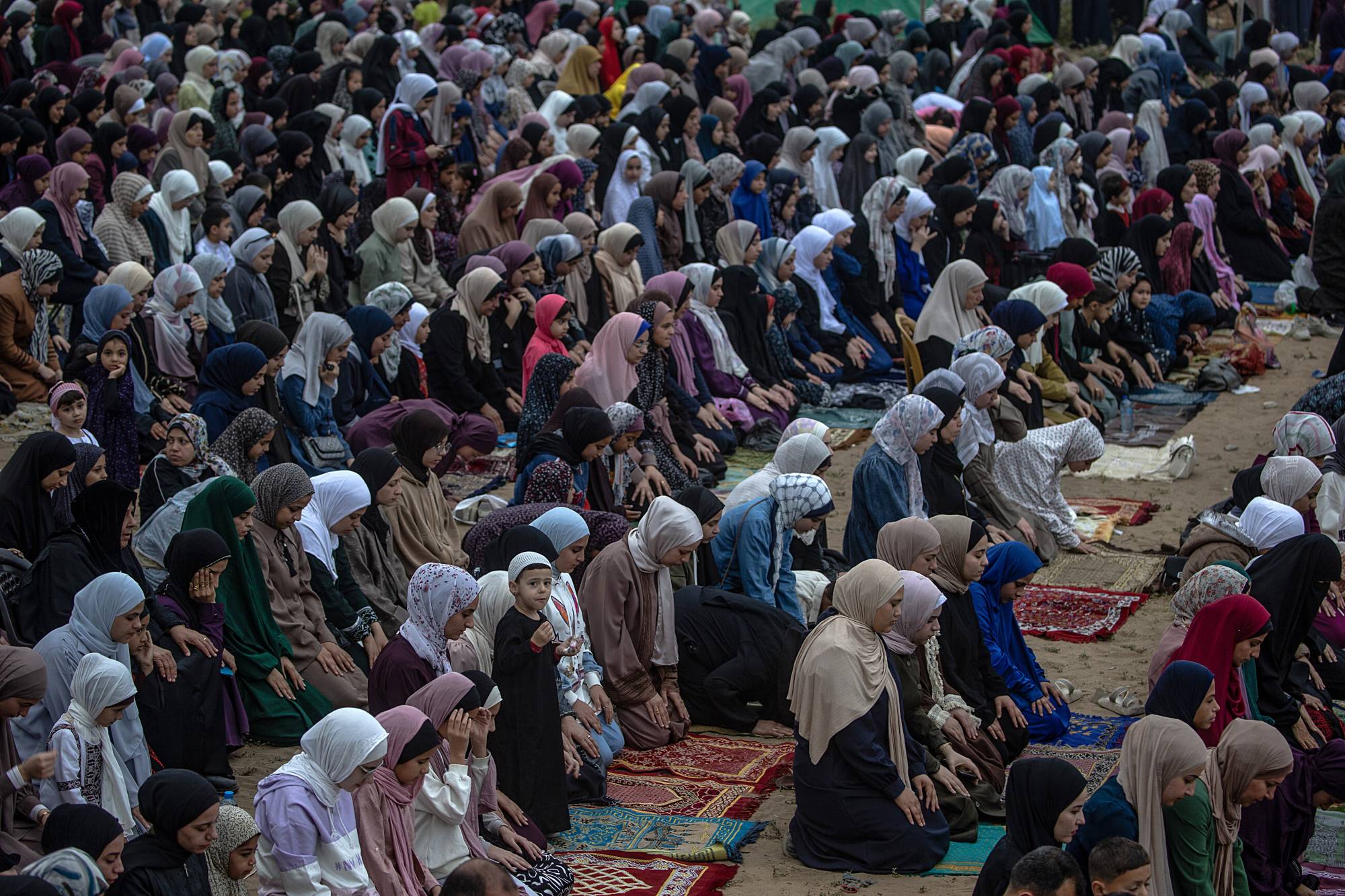
Internally displaced Palestinian women attend Eid al-Adha prayer in Gaza City, 27 May 2026. EPA/MOHAMMED SABER
Tareq told Asharq Al-Awsat that he only visited his brothers and relatives in western Gaza. The visit was brief, he said, so he could return to the tent where he is displaced and remain with his family, fearing for his life and theirs.
He said the security situation and the transport crisis kept him from visiting relatives in more distant areas.
Trying to adapt
Sama Hamdan, 23, from Gaza City and displaced to Nuseirat camp in the central Gaza Strip, traveled to her hometown in a rundown vehicle to see her uncles and greet them for Eid.
She was accompanied by her young brothers, who had been longing to play with their cousins.
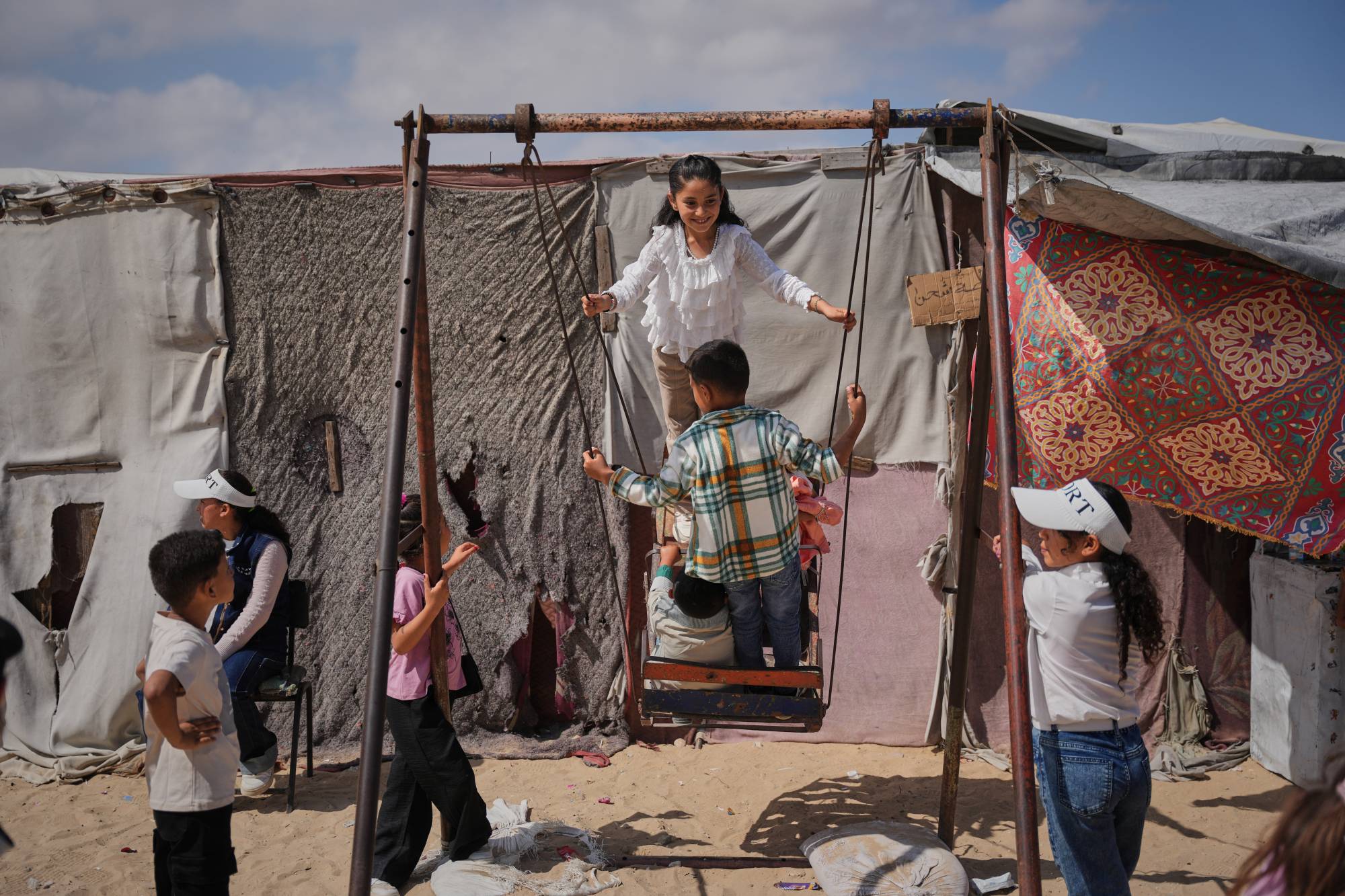
Displaced Palestinian children play on a swing at a tent camp during the Muslim holiday of Eid al-Adha in Khan Younis, southern Gaza Strip, Wednesday, May 27, 2026. (AP Photo/Abdel Kareem Hana)
Hamdan said she made the trip to ease the burden on her uncles, especially the elderly, amid Gaza’s harsh conditions, particularly the shortage of transport and high fares.
“Our lives have changed since the war, and no longer have meaning. All the conditions are discouraging and impose a state of despair on us, but we are trying to adapt to the new reality as much as possible despite the ongoing war by the occupation, which has not stopped bombing and destroying despite claims that there is a truce in Gaza,” Hamdan said.
An ongoing war
In a vehicle carrying several Gazans from the Rimal neighborhood to Sheikh Radwan in northern Gaza City, residents spoke of Israeli bombardment, the targeting of homes and the return of assassinations.
Saed Abu Safiya, 23, who started the conversation in the vehicle where Asharq Al-Awsat’s correspondent was present, said Israel would not halt its raids until Palestinian factions surrendered their weapons.
Salman Abu Khuwayter, a Gaza resident from Jabalia who is displaced in Sheikh Radwan, disagreed. He said the war would not stop even if Hamas and the factions handed over their weapons.
He said Israeli Prime Minister Benjamin Netanyahu and Israel aimed to displace Gaza’s population, pressure the factions and strip them not only of their weapons, but also eliminate all their members or move them out of the enclave.
Funerals on Eid
As family visits remained limited across Gaza, Palestinian families buried relatives killed in a series of strikes on Tuesday.
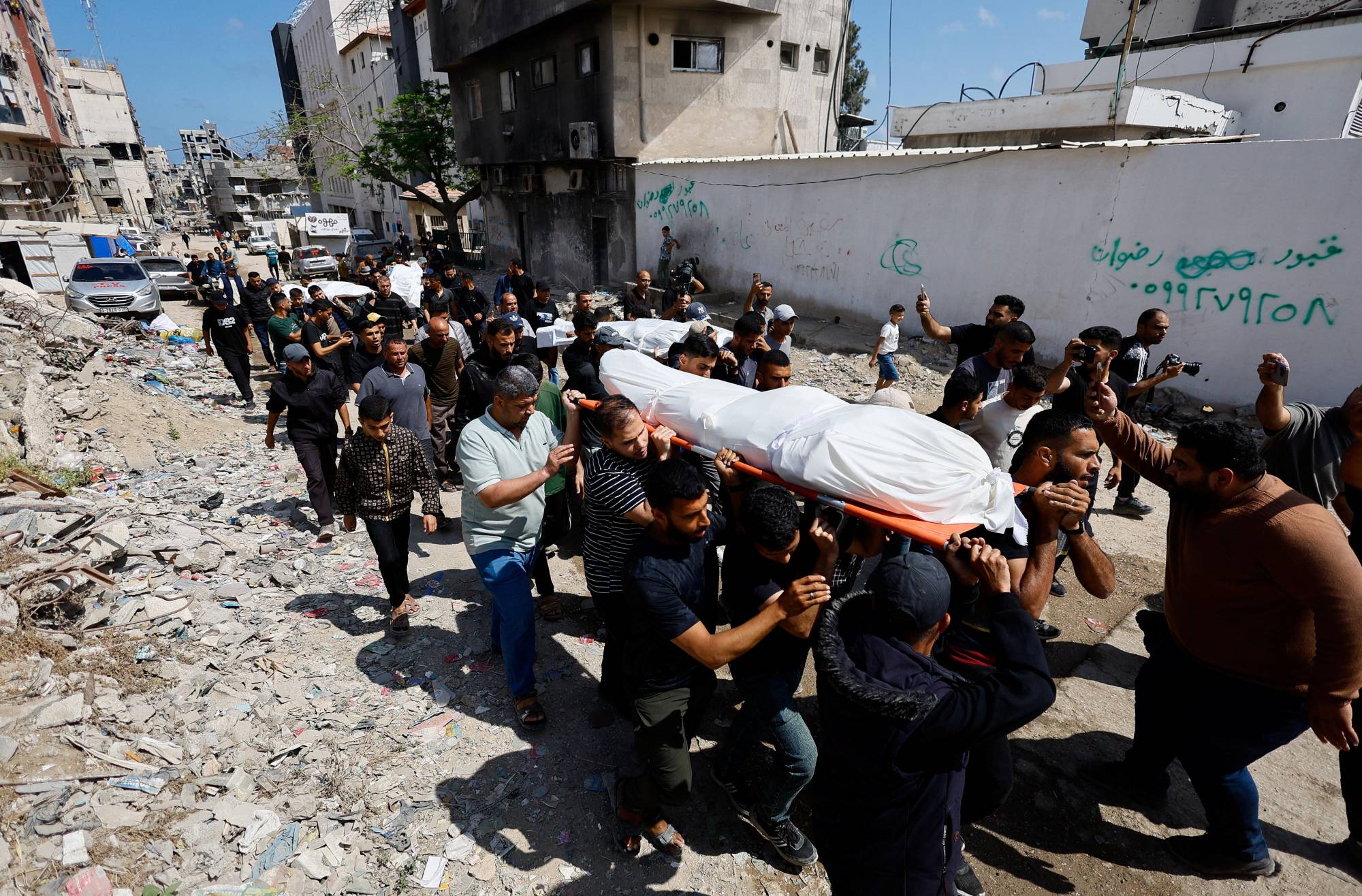
People carry bodies identified by mourners as Hamas' military wing commander Mohammad Odeh, who was killed in an Israeli strike on Tuesday, and his wife and children, during a funeral, in Gaza City, May 27, 2026. REUTERS/Mahmoud Issa
About 15 people were killed, including Mohammad Odeh, a commander in the Qassam Brigades, the armed wing of Hamas, his wife and three members of his family.
Grief marked the funerals held across southern, central and northern Gaza. Crowds joined processions that set out from different hospitals across the enclave.
At Odeh’s funeral, mourners chanted angry slogans demanding revenge for him and for all those killed in the escalating Israeli attacks on Gaza.
The number of Palestinian victims since the ceasefire has risen to more than 910.
The first day of Eid al-Adha was not quiet. Drones, warplanes, and helicopters kept flying over different parts of the enclave.
Explosions were heard in Khan Younis in southern Gaza and were later found to have been caused by mock raids off the city’s coast.
Shortly before Wednesday afternoon, a drone struck three Palestinians, wounding them. One injury was described as serious.
Gucci to Become Title Partner of Renault's Alpine F1 Team from 2027https://english.aawsat.com/sports/5277845-gucci-become-title-partner-renaults-alpine-f1-team-2027
FILE PHOTO: Formula One F1 - Miami Grand Prix - Miami International Autodrome, Miami, Florida, United States - May 3, 2026 Alpine team principal Flavio Briatore in the paddock ahead of the grand prix REUTERS/Brian Snyder/File Photo
Gucci to Become Title Partner of Renault's Alpine F1 Team from 2027
FILE PHOTO: Formula One F1 - Miami Grand Prix - Miami International Autodrome, Miami, Florida, United States - May 3, 2026 Alpine team principal Flavio Briatore in the paddock ahead of the grand prix REUTERS/Brian Snyder/File Photo
Gucci will become title partner to Renault's Alpine Formula One team from the 2027 season, the Italian luxury brand said on Wednesday.
Alpine, whose current title partner is Austrian water treatment company BWT, will race as Gucci Racing Alpine Formula One Team.
The announcement is Gucci's latest in a string of high-profile moves to boost its visibility and revive sales after years of decline. Earlier this month, it staged a major runway show in New York's Times Square to grab global attention.
The collaboration will be part of Gucci Racing, which Gucci says will be "a new business and experiential platform built around the values of performance, precision, discipline, and excellence at the intersection of luxury and sport."
For luxury brands confronted with falling global demand for their prized handbags and dresses, exclusive events, such as Formula One racing, have emerged as a major new playing field.
In 2024, Liberty Media-owned Formula One clinched a multi-year deal with French luxury giant LVMH valued at over $100 million.
The Gucci deal, for which no financials were disclosed, will make the brand the first luxury fashion house to lend its name to a racing team, Reuters quoted the company as saying.
The tie-up also brings the brand closer to the world of Luca de Meo, the CEO of Gucci's French parent company Kering, who previously served as Renault's chief executive.
"Formula One has evolved far beyond sport to become one of the world's most powerful premium content platforms, reaching over 1.5 billion people each season and inspiring a rapidly expanding, younger and increasingly female audience," said de Meo.
"We see it as a unique platform for a luxury brand to push boundaries, spark meaningful connections and build long-term value and brand desirability, while delivering measurable and lasting impact."
Alpine's team is run by Italian businessman Flavio Briatore, a friend and longtime ally of de Meo, who first entered Formula One with the Benetton team in 1990.
Briatore was described early in his F1 career as a "T-shirt salesman" but is now known for far more expensive tastes as an operator of high-end nightclubs and restaurants and owner of the "Billionaire" brand.
Briatore said he was incredibly proud of the deal.
"Not only that, but I am also excited about the possibilities the partnership with Gucci brings and the great things we can achieve together at a global level," he said.
"The Enstone Team has a history of doing things differently to others and has previously shown that fashion can finish first in Formula One," Briatore said, referring to Alpine's Oxfordshire base.
As Benetton, the team won titles with Michael Schumacher in 1994 and 1995 and then as Renault with Fernando Alonso in 2005 and 2006.
Alpine were last of all the teams in 2025 but have started 2026 strongly and are fifth of 11 after five rounds.
لم تشترك بعد
انشئ حساباً خاصاً بك لتحصل على أخبار مخصصة لك ولتتمتع بخاصية حفظ المقالات وتتلقى نشراتنا البريدية المتنوعة