


Hundreds Killed as 7.3-Magnitude Quake Rocks Iraq, Iran

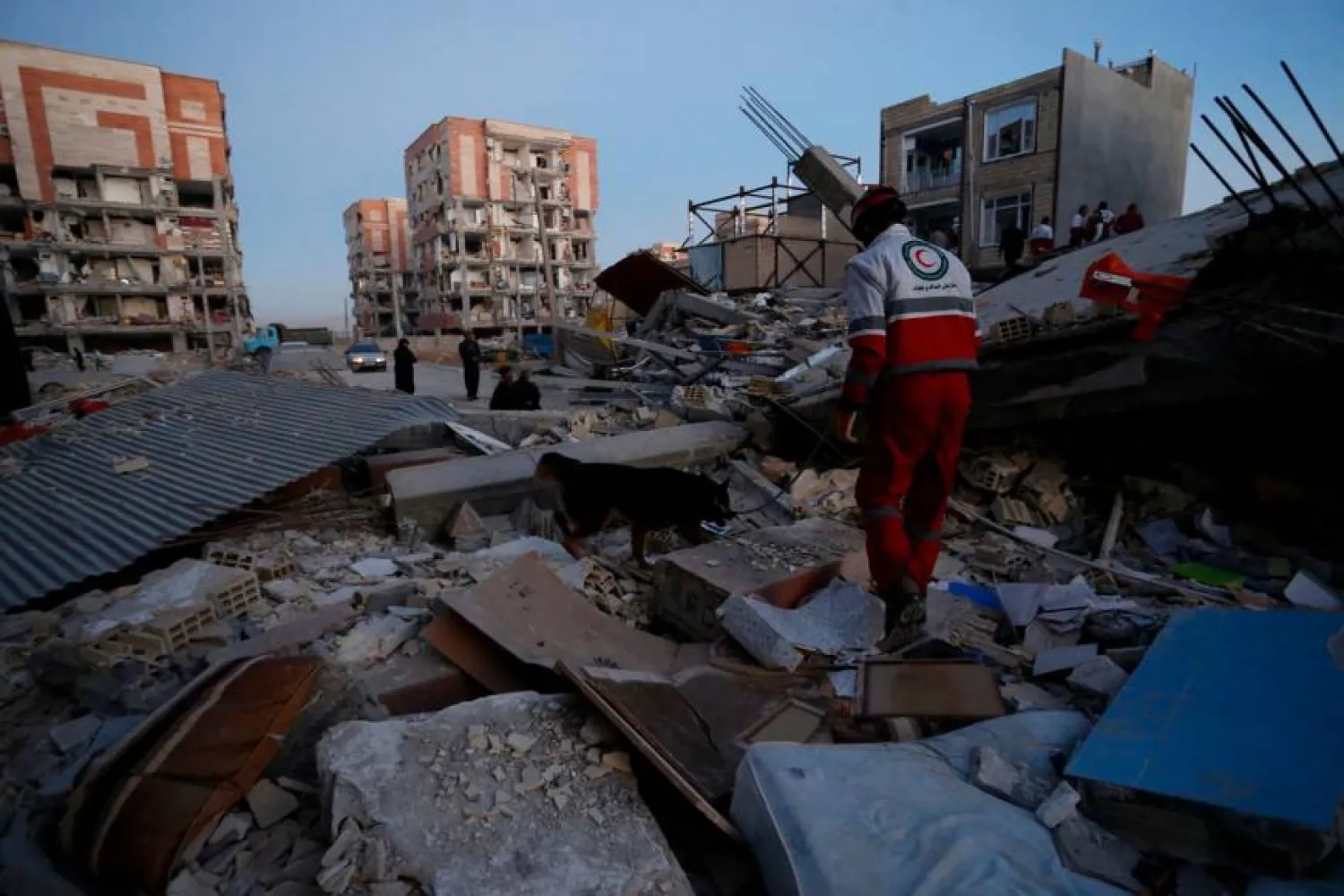
Rescue personnel conduct hunt for survivors following a 7.3-magnitude earthquake at Sarpol-e Zahab in Iran's Kermanshah province on Monday. (AFP)
TT

Hundreds Killed as 7.3-Magnitude Quake Rocks Iraq, Iran

Rescue personnel conduct hunt for survivors following a 7.3-magnitude earthquake at Sarpol-e Zahab in Iran's Kermanshah province on Monday. (AFP)

At least 300 people were killed and thousands injured in a strong earthquake that struck the Iraq-Iran border on Sunday night.

The 7.3 magnitude quake hit 30 kilometers (19 miles) southwest of Halabja in Iraqi Kurdistan at around 9.20 pm (1820 GMT) on Sunday, when many people would have been at home, the US Geological Survey said.

Iran's state-run news agency put the country's death toll in the quake at 341 people killed. IRNA's report on Monday afternoon also raised the number of injured, to 5,953.

Local officials told state TV that the death toll would rise as search and rescue teams reached remote areas of Iran. Only seven were reported killed on the Iraq side of the border, said the country’s Interior Ministry. Some 307 people were wounded.

The mountainous nature of Iran-Iraq border triggered landslides that hindered rescue efforts, officials said Monday.

The earthquake was felt in several western provinces of Iran but the hardest hit province was Kermanshah, which announced three days of mourning. More than 142 of the victims were in Sarpol-e Zahab county in Kermanshah province, about 15 km (10 miles) from the Iraq border.

State television said the quake had caused heavy damages in some villages where houses were made of earthen bricks. Rescuers were laboring to find survivors trapped under collapsed buildings.

Iran's emergency services chief Pir Hossein Koolivand said it was "difficult to send rescue teams to the villages because the roads have been cut off... there have been landslides".

IRNA said 30 Red Cross teams had been sent to the quake zone, parts of which had experienced power cuts.

President Hassan Rouhani is due to visit the areas damaged by the earthquake on Tuesday.

In Iraq, footage posted on Twitter showed panicked people fleeing a building in Sulaimaniyah, as windows shattered at the moment the quake struck, while images from the nearby town of Darbandikhan showed major walls and concrete structures had collapsed.

In Sulaimaniyah, residents ran out onto the streets and some damage to property was reported, an AFP reporter there said.

"Four people were killed by the earthquake" in Darbandikhan, the town's mayor Nasseh Moulla Hassan told AFP.

A child and an elderly person were killed in Kalar, according to the director of the hospital in the town about 70 kilometers (40 miles) south of Darbandikhan, and 105 people injured.

The quake, which struck at a relatively shallow depth of 25 kilometers, was felt for about 20 seconds in Baghdad, and for longer in other provinces of Iraq, AFP journalists said.

"I was sitting with my kids having dinner and suddenly the building was just dancing in the air," said Majida Ameer, who ran out of her building in the capital's Salihiya district with her three children. "I thought at first that it was a huge bomb.

Similar scenes unfolded in Irbil, the capital of the Kurdistan Region, and across other cities in northern Iraq, close to the quake's epicenter.

In Halabja, local officials said a 12-year-old boy died of an electric shock from a falling electric cable.

Iraq's meteorology center advised people to stay away from buildings and not to use elevators, in case of aftershocks.

Electricity was cut off in several Iranian and Iraqi cities, and fears of aftershocks sent thousands of people in both countries out onto the streets and parks in cold weather.

The Iranian seismological center registered around 118 aftershocks and said more were expected. The head of Iranian Red Crescent said more than 70,000 people were in need of emergency shelter.

On the Iranian side of the border, the tremor shook several cities in the west of the country including Tabriz.

Iran's police, the elite Revolutionary Guards and its affiliated Basij militia forces were dispatched to the quake-hit areas overnight, state TV reported.

Iranian Interior Minister Abdolreza Rahmani Fazli said some roads were blocked and authorities were worried about casualties in remote villages. An Iranian oil official said pipelines and refineries in the area remained intact.

The quake was also felt in southeastern Turkey, "from Malatya to Van", an AFP correspondent said. In the town of Diyarbakir, residents were reported to have fled their homes.

Turkish Red Crescent Chairman Kerem Kinik told broadcaster NTV that Red Crescent teams in Irbil were preparing to go to the site of the earthquake and that Turkey’s national disaster management agency, AFAD, and National Medical Rescue Teams (UMKE) were also preparing to head into Iraq. AFAD’s chairman said the organization was waiting for a reply to its offer for help.

Sunday’s quake struck along a 1,500 kilometer fault line between the Arabian and Eurasian tectonic plates, a belt extending through western Iran and into northeastern Iraq.

The area sees frequent seismic activity.

In 1990, a 7.4-magnitude quake near the Caspian sea in northern Iran killed 40,000 people and left 300,000 more injured and half a million homeless. Within seconds the quake reduced dozens of towns and nearly 2,000 villages to rubble.

Thirteen years later, a catastrophic quake struck the ancient southeast Iranian city of Bam, famed for its mud brick buildings, killing at least 31,000 people and flattening swathes of the city.

Since then, Iran has experienced at least two major quake disasters, one in 2005 that killed more than 600 and another in 2012 that left some 300 dead.

More recently, a 5.7-magnitude earthquake near Iran's border with Turkmenistan in May killed two people, injured hundreds and caused widespread damage.


Iranian Traders and Shopkeepers Protest as Currency Hits Record Low

 People shop at Tajrish Bazaar in the Iranian capital Tehran on December 29, 2025. (AFP)
People shop at Tajrish Bazaar in the Iranian capital Tehran on December 29, 2025. (AFP)
TT

Iranian Traders and Shopkeepers Protest as Currency Hits Record Low

 People shop at Tajrish Bazaar in the Iranian capital Tehran on December 29, 2025. (AFP)
People shop at Tajrish Bazaar in the Iranian capital Tehran on December 29, 2025. (AFP)

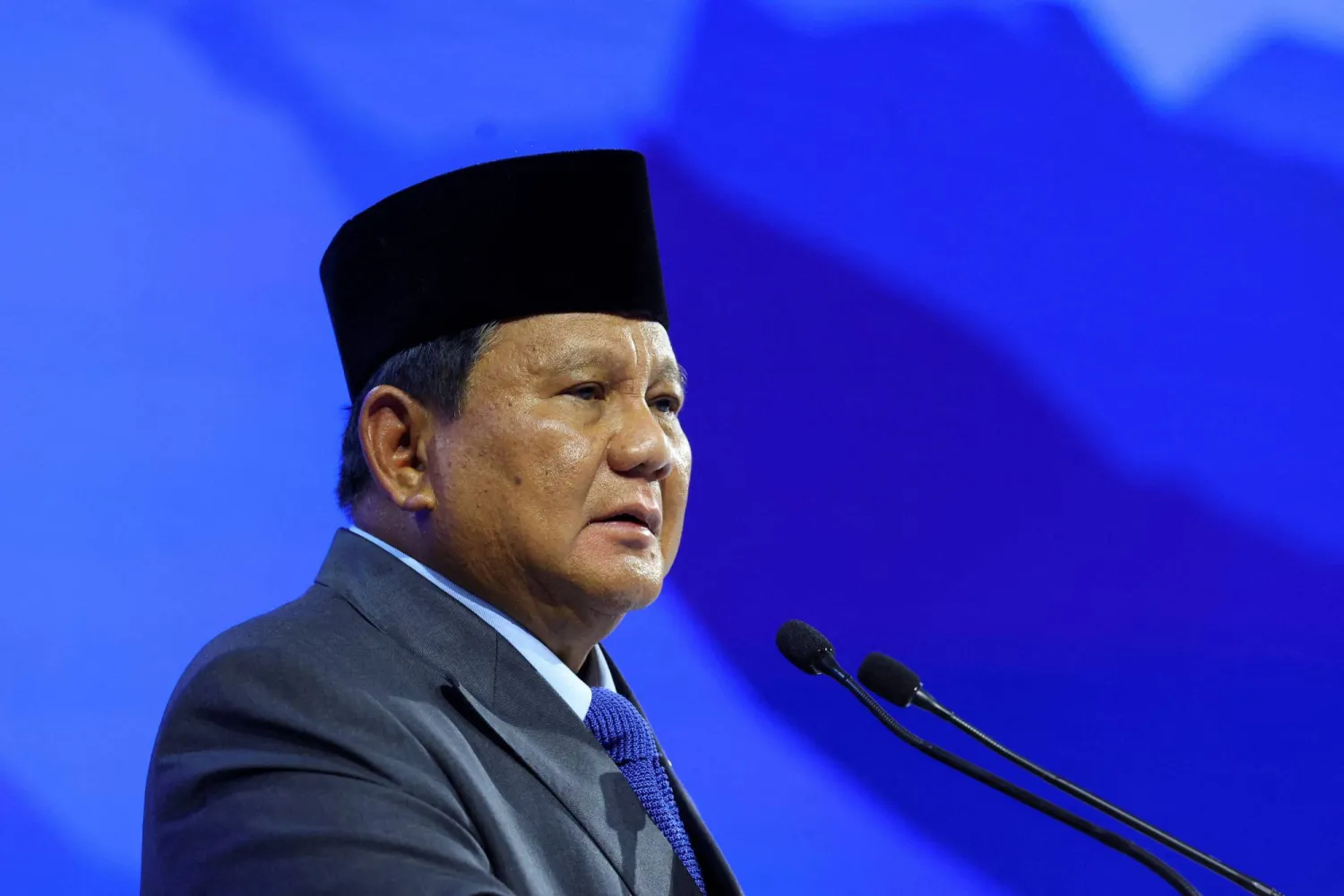
Iranian traders and shopkeepers staged a second day of protests Monday after the country’s currency plummeted to a new record low against the US dollar.

Videos on social media showed hundreds taking part in rallies in Saadi Street in downtown Tehran, as well as in the Shush neighborhood near Tehran's main Grand Bazaar, which played a crucial role in the 1979 revolution that ousted the monarchy and brought clerics to power.

Witnesses told The Associated Press that traders shut their shops and asked others to do the same. The semiofficial ILNA news agency said many businesses and merchants stopped trading even though some kept their shops open.

There was no reports of police raids though security was tight at the protests, according to witnesses.

On Sunday, protest gatherings were limited to two major mobile market in downtown Tehran, where the demonstrators chanted anti-government slogans.

Iran's rial on Sunday plunged to 1.42 million to the dollar. On Monday, it traded at 1.38 million rials to the dollar.

The rapid depreciation is compounding inflationary pressure, pushing up prices of food and other daily necessities and further straining household budgets, a trend that could worsen by a gasoline price change introduced in recent days.

According to the state statistics center, inflation rate in December rose to 42.2% from the same period last year, and is 1.8% higher than in November. Foodstuff prices rose 72% and health and medical items were up 50% from December last year, according to the statistics center. Many critics see the rate a sign of an approaching hyperinflation.

Reports in official Iranian media said that the government plans to increase taxes in the Iranian new year that begins March 21 have caused more concern.

Iran’s currency was trading at 32,000 rials to the dollar at the time of the 2015 nuclear accord that lifted international sanctions in exchange for tight controls on Iran’s nuclear program. That deal unraveled after US President Donald Trump unilaterally withdrew the United States from it in 2018.

There is also uncertainty over the risk of renewed conflict following June’s 12-day war involving Iran and Israel. Many Iranians also fear the possibility of a broader confrontation that could draw in the United States, adding to market anxiety.

In September, the United Nations reimposed nuclear-related sanctions on Iran through what diplomats described as the “snapback” mechanism. Those measures once again froze Iranian assets abroad, halted arms transactions with Tehran and imposed penalties tied to Iran’s ballistic missile program.


Israel’s Supreme Court Suspends Govt Move to Shut Army Radio

Israeli troops during a military operation in the Palestinian village of Qabatiya, near the West Bank city of Jenin, 27 December 2025. (EPA)
TT

Israel’s Supreme Court Suspends Govt Move to Shut Army Radio

Israeli troops during a military operation in the Palestinian village of Qabatiya, near the West Bank city of Jenin, 27 December 2025. (EPA)

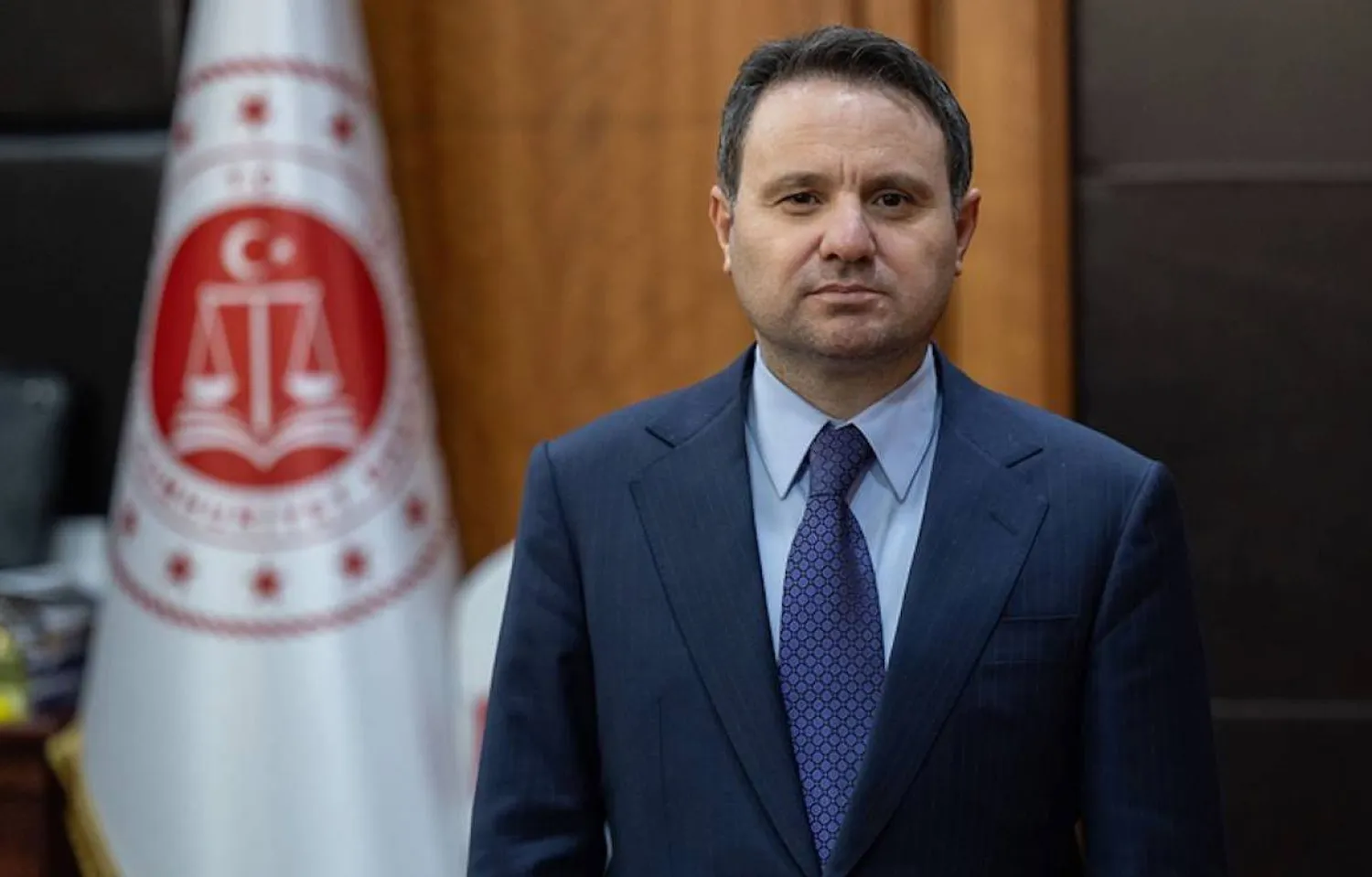
Israel's Supreme Court has issued an interim order suspending a government decision to shut down Galei Tsahal, the country's decades-old and widely listened-to military radio station.

In a ruling issued late Sunday, Supreme Court President Isaac Amit said the suspension was partly because the government "did not provide a clear commitment not to take irreversible steps before the court reaches a final decision".

He added that Attorney General Gali Baharav-Miara supported the suspension.

The cabinet last week approved the closure of Galei Tsahal, with the shutdown scheduled to take effect before March 1, 2026.

Founded in 1950, Galei Tsahal is widely known for its flagship news programs and has long been followed by both domestic and foreign correspondents.

A government audience survey ranks it as Israel's third most listened-to radio station, with a market share of 17.7 percent.

Prime Minister Benjamin Netanyahu had urged ministers to back the closure, saying there had been repeated proposals over the years to remove the station from the military, abolish it or privatize it.

But Baharav-Miara, who also serves as the government's legal adviser and is facing dismissal proceedings initiated by the premier, has warned that closing the station raised "concerns about possible political interference in public broadcasting".

She added that it "poses questions regarding an infringement on freedom of expression and of the press".

Defense Minister Israel Katz said last week that Galei Tsahal broadcasts "political and divisive content" that does not align with military values.

He said soldiers, civilians and bereaved families had complained that the station did not represent them and undermined morale and the war effort.

Katz also argued that a military-run radio station serving the general public is an anomaly in democratic countries.

Opposition leader Yair Lapid had condemned the closure decision, calling it part of the government's effort to suppress freedom of expression ahead of elections.

Israel is due to hold parliamentary elections in 2026, and Netanyahu has said he will seek another term as prime minister.


Thai Army Accuses Cambodia of Violating Truce with over 250 Drones

Displaced residents rest in a bunker in Thailand's Surin province on December 11, 2025, amid clashes along the Thai-Cambodia border. (AFP)
TT

Thai Army Accuses Cambodia of Violating Truce with over 250 Drones

Displaced residents rest in a bunker in Thailand's Surin province on December 11, 2025, amid clashes along the Thai-Cambodia border. (AFP)

Thailand's army on Monday accused Cambodia of violating a newly signed ceasefire agreement, reached after weeks of deadly border clashes, by flying more than 250 drones over its territory.

The Thai army said "more than 250 unmanned aerial vehicles (UAVs) were detected flying from the Cambodian side, intruding into Thailand's sovereign territory" on Sunday night, according to a statement.

"Such actions constitute provocation and a violation of measures aimed at reducing tensions, which are inconsistent with the Joint Statement agreed" during a bilateral border committee meeting on Saturday, it added.

Cambodian Foreign Minister Prak Sokhonn said in remarks aired on state television on Monday that the two sides had discussed the incident and agreed to investigate and "resolve it immediately".

Prak Sokhonn described it as "a small issue related to flying drones seen by both sides along the border line".

Thailand and Cambodia agreed to the "immediate" ceasefire on Saturday, pledging to end renewed border clashes that killed dozens of people and displaced more than a million this month.

The reignited fighting spread to nearly every border province on both sides, shattering an earlier truce for which US President Donald Trump took credit.

Under the agreement signed on Saturday, the Southeast Asian neighbors agreed to cease fire, freeze troop movements and cooperate on demining efforts and combatting cybercrime.