

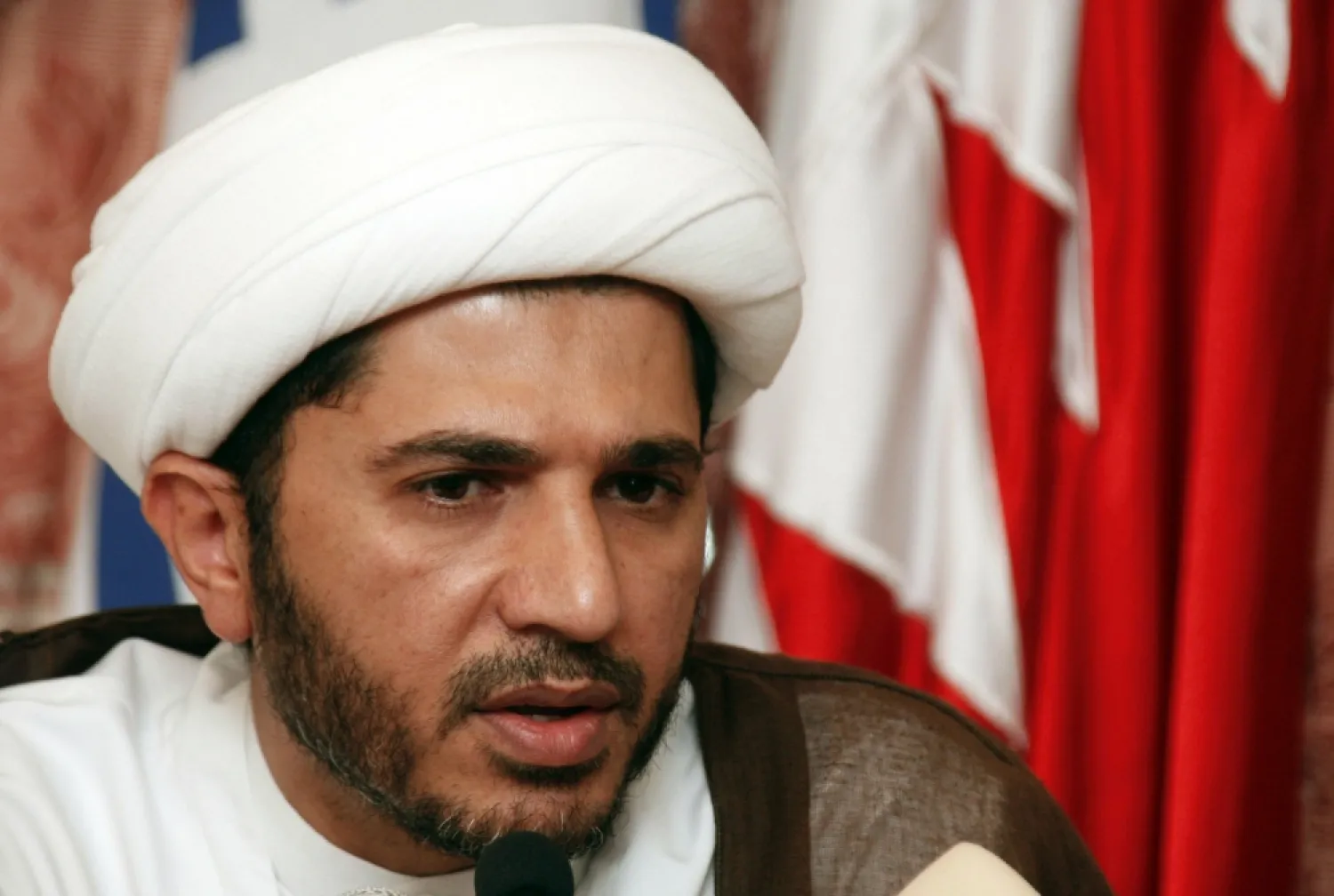

Bahrain Begins Ali Salman's Trial for Intelligence Connections with Qatar

Ali Salman, Sec-Gen of dissolved al-Wefaq, April 12, 2009. (File Photo/Reuters)
TT

Bahrain Begins Ali Salman's Trial for Intelligence Connections with Qatar

Ali Salman, Sec-Gen of dissolved al-Wefaq, April 12, 2009. (File Photo/Reuters)

Bahraini Public Prosecution referred the case of the dissolved al-Wefaq Association Sec-Gen Ali Salman and two others to the High Criminal Court on charges of intelligence connections with Qatar with the purpose of overthrowing the Bahraini regime.

The suspects, coordinated their intelligence ties with Qatar, carried out hostile activities against the Kingdom’s national interest and tasked a communications officer to contact Qatari officials.

Salman and the two other suspects, Hasan al-Sultan and Ali al-Aswad, were charged with establishing foreign intelligence links to commit subversive acts against Bahrain and undermine its political, economic position and national interest, announced Advocate General in the Public Prosecution, Ahmed al-Hammadi.

Qatar’s involvement in the activities aimed to undermine Arab countries, especially Bahrain, evidenced by the Qatari media’s hostile campaign against the kingdom and communicating with anti-state elements, including the suspects in this case.

The charges also included revealing national defense secrets to a foreign country and receiving financial sums from a foreign country to supply it with military secrets and information pertaining to Bahrain’s internal affairs. They deliberately spread false rumors aimed at weakening the financial confidence in Bahrain to damage its national sovereignty and financial reputation abroad.

Investigations confirmed the validity of these charges and revealed recorded phone conversations between Ali Salman and Hasan al-Sultan and Qatari officials. The two sides agreed to carry out hostile activities to undermine Bahrain’s status and conveyed information about military mobilizations in Bahrain during the 2011 crisis.

The suspects conducted several interviews through the Qatari media spreading false stories and rumors about Bahrain's internal situation aimed to spread strife, jeopardize Bahrain’s military, political and economic position, and to tarnish its reputation abroad.

The suspects, as part of their agreement with Doha, provided Qatar with secret information about the mobilizations of Bahrain Defense Force, National Guard, Public Security, and the Gulf Cooperation Council (GCC)’s Peninsula Shield Joint Force.

The Prosecution ordered the arrest of both fugitives Hasan al-Sultan and Ali al-Aswad, ahead of referring them to the High Criminal Court.



President of Yemeni Presidential Leadership Council Nullifies Joint Defense Agreement with UAE

Dr. Rashad Al-Alimi during his interview with Asharq Al-Awsat (Yemeni Presidency)
TT

President of Yemeni Presidential Leadership Council Nullifies Joint Defense Agreement with UAE

Dr. Rashad Al-Alimi during his interview with Asharq Al-Awsat (Yemeni Presidency)

President of the Presidential Leadership Council of the Republic of Yemen Dr. Rashad Mohammed Al-Alimi issued a presidential decree on Tuesday nullifying the joint defense agreement with the United Arab Emirates, based on the Constitution of the Republic of Yemen, the Gulf Cooperation Council Initiative and its implementation mechanism, the decision on the transfer of power, the formation of the Presidential Leadership Council, and the powers granted to it under the constitution, according to the Yemen News Agency (Saba).

Article Two of the decree mandates that all UAE forces and personnel withdraw from Yemeni territory within 24 hours, according to SPA.

Article Three instructs the Homeland Shield forces to assume control of all military camps in Hadramout and Al-Mahara governorates.


Yemeni Government Commends Saudi Historic Stance and Its Leadership of the Coalition to Restore Legitimacy

File photo of the Saudi flag/AAWSAT
TT

Yemeni Government Commends Saudi Historic Stance and Its Leadership of the Coalition to Restore Legitimacy

File photo of the Saudi flag/AAWSAT

The Yemeni government commended the Kingdom of Saudi Arabia's historic and steadfast stances, highlighting its crucial role in ensuring Yemen's security and stability.

The government acknowledged Saudi Arabia's leadership of the Coalition to Restore Legitimacy and its ongoing commitment to protecting civilians, de-escalating tensions, and preventing the eastern governorates from being drawn into conflicts that serve hostile agendas, SPA reported.

In an official statement, the government called on the Southern Transitional Council to withdraw immediately and unconditionally from the governorates of Hadramout and Al-Mahara. It urged the council to hand over all locations and camps to the Homeland Shield Forces and local authorities in these governorates, to adhere to the terms of reference of the transitional phase, and to cease all military or escalatory actions that threaten local security and undermine de-escalation efforts.

The statement, which was reported by the Yemen News Agency (Saba), expressed the government's full support for the decisions made by President of the Presidential Leadership Council of the Republic of Yemen Dr. Rashad Mohammed Al-Alimi, who is also Supreme Commander of the Armed Forces.

This includes declaring a state of emergency across Yemen and taking necessary sovereign measures to protect local security, preserve the unity and sovereignty of the state, and maintain its legal status in light of the dangerous developments in Yemen's eastern governorates.

The government stated: "The declaration of a state of emergency is grounded in the constitution and the references of the transitional phase, based on the recommendations of the National Defense Council.

It is a legitimate constitutional measure necessitated by our national duty to confront armed rebellion, protect civil peace, and prevent a descent into chaos that could undermine state institutions."


Custodian of the Two Holy Mosques Receives Written Message from Russian President

Russian Ambassador to the Kingdom Sergey Kozlov and Saudi Vice Minister of Foreign Affairs Waleed Elkhereiji meet in Riyadh on Tuesday. (SPA)
TT

Custodian of the Two Holy Mosques Receives Written Message from Russian President

Russian Ambassador to the Kingdom Sergey Kozlov and Saudi Vice Minister of Foreign Affairs Waleed Elkhereiji meet in Riyadh on Tuesday. (SPA)

Custodian of the Two Holy Mosques King Salman bin Abdulaziz Al Saud received on Tuesday a written message from Russian President Vladimir Putin on bilateral ties between their countries.

Russian Ambassador to the Kingdom Sergey Kozlov delivered the message to Vice Minister of Foreign Affairs Waleed Elkhereiji at the ministry’s headquarters in Riyadh.

The officials reviewed the strong relations between Saudi Arabia and Russia and discussed the latest regional and international developments, as well as efforts exerted to address them.