

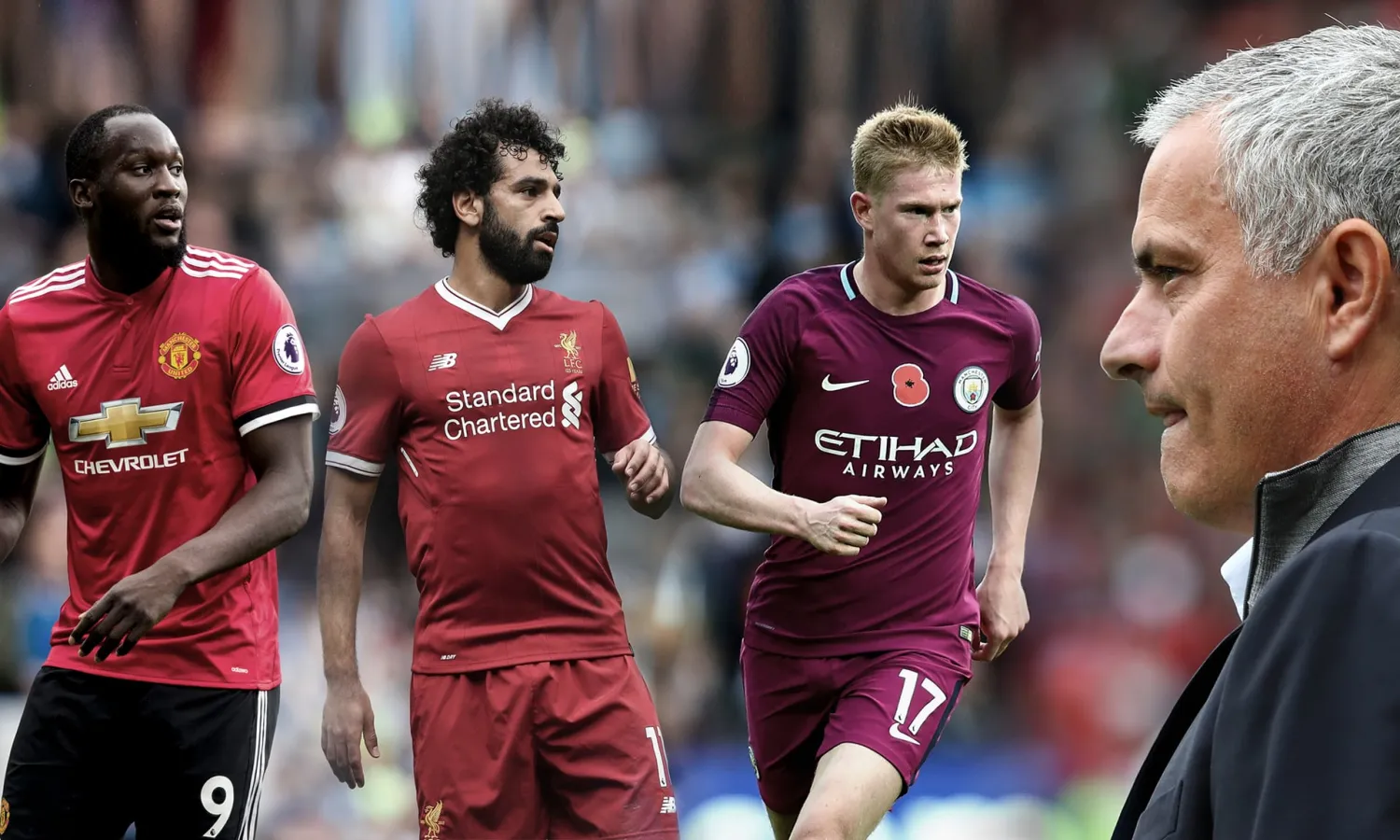

José Mourinho Mistakes with De Bruyne, Lukaku and Salah Haunt Chelsea

 Romelu Lukaku, Mohamed Salah, Kevin De Bruyne and José Mourinho. Photographs by Getty
Romelu Lukaku, Mohamed Salah, Kevin De Bruyne and José Mourinho. Photographs by Getty
TT

José Mourinho Mistakes with De Bruyne, Lukaku and Salah Haunt Chelsea

 Romelu Lukaku, Mohamed Salah, Kevin De Bruyne and José Mourinho. Photographs by Getty
Romelu Lukaku, Mohamed Salah, Kevin De Bruyne and José Mourinho. Photographs by Getty

Dick Rowe, the head of A&R at Decca Records in the 60s, was a kingmaker in the music industry. He signed the Rolling Stones in 1963, gave Van Morrison his break and launched the career of Tom Jones. But Rowe isn’t really known for any of these coups. He’s the idiot who rejected the Beatles. “We don’t like their sound,” it’s said that he told their manager, Brian Epstein. “And guitar music is on the way out.” Decca offered a contract to Brian Poole and the Tremeloes instead.

There are similar oversights in all creative industries. Sport is no exception: what, for example, if there was someone who managed to let the three best players in today’s Premier League slip through their fingers? A person who did the equivalent of rebuffing the Beatles, the Stones and the Kinks. That guy would be a world‑class buffoon, no? His name would be a punchline. Well, there is such a man. He’s called José Mourinho.

When Mourinho returned to Chelsea in June 2013, Kevin De Bruyne and Romelu Lukaku were already on the club’s books. In January 2014, they were joined by Mohamed Salah, apparently – like the signings of De Bruyne and Lukaku – on the instruction of Michael Emenalo, Chelsea’s technical director from 2011 until last Monday.

De Bruyne – the same De Bruyne who now gets compared, not ludicrously, to Lionel Messi and Cristiano Ronaldo – was assured by Mourinho that he was part of Chelsea’s plans and then, six months later, sold to Wolfsburg for £18m. This was a decent bit of business for the German club as, just 18 months later, his value had trebled, Manchester City paying £55m. It certainly bucks the current UK inflation rate of 2.9%.

Lukaku, rated in January 2014 by the Guardian as one of the 10 most promising young players in Europe, was sent on loan to Everton not long after Mourinho’s arrival. The deal was made permanent the following summer for a fee of £28m. This has also come to look like a steal: three years later, back in the summer, Lukaku moved again, to Manchester United for a fee rising to £90m. Again, this is more than three times what Chelsea received for him.

Salah, likewise, was never given a run of games by Mourinho, making just 13 league appearances before being packed off on loan. This would eventually lead to a £11m transfer to Roma in the summer of 2016. One year later Liverpool would pay up to £43.9m to bring the Egyptian back to England.

All of these three young footballers – De Bruyne is the oldest at 26 – have been unplayable at times this season. And you couldn’t exactly say it’s a shock they’ve turned into the players they’ve become. No wonder, then, that Mourinho received a cool reception when he returned with Manchester United to Stamford Bridge last Sunday. There was no repeat of March’s three‑fingered salute to Chelsea fans – the number of Premier League titles he won at the club during two stints – though he did very energetically acknowledge the United support when they sang his name.

But could you blame the Chelsea faithful for being annoyed with him? What a team they would have now if they had held on to De Bruyne, Lukaku and Salah. How much weaker their title rivals would be. It must be like the dipsy pater familias turning up to a family gathering where everyone knows he has frittered away their inheritance.

Of course, it’s a bit more complicated than that. Chelsea’s transfer strategy has, in recent times, been overseen by Emenalo, the director Marina Granovskaia and the chairman, Bruce Buck, to specifications and budgets set by the owner, Roman Abramovich. Both Mourinho and his successor Antonio Conte have been frustrated by it.

Advertisement

The counter to that, though, is that it was Mourinho’s choice alone not to pick De Bruyne, Lukaku or Salah. Abramovich hasn’t exerted leverage on team selection since the days of Andriy Shevchenko. And it was a lack of playing time that was the key factor in all three leaving.

So, how is Mourinho’s name not mud? How did he walk into the top job at the world’s richest and most popular club? Albeit that club being Manchester United, which itself made the most catastrophic financial bungle in football history: allowing Paul Pogba to leave for free in 2012, only to buy him back four years later for £93m.

Mourinho would point, as he always does, to his palmarès. In the 2014-15 season, Chelsea’s experienced squad lost only three matches and won the League Cup and the Premier League. Also, Mourinho is nothing if not a pragmatist. The average tenure of a manager in English football is around 1.3 years; Mourinho, famously, seems to work on a three-year cycle. He might have trusted De Bruyne, Lukaku and Salah, given them the 30-odd games a season that would have kept them happy and Chelsea could easily have won nothing. And there’s nothing worse, in Mourinho’s world view, than being “a specialist in failure”.

What does this matter, anyway? The players were not psychologically scarred by the experience, and neither was Mourinho; Chelsea returned to winning ways last season. Well, it’s relevant because England currently has perhaps the finest crop of young players in its history. In the past few months, the country became only the second nation (after Brazil in 2003) to win the Under-20 and Under-17 World Cups in the same year. How these players are brought through will be vital to the future success of the senior squad.

Most of these players come from the academies at a big Premier League club. What happens next to them will be instructive to watch. Chelsea, especially, have overseen the development of some of the most exciting young talents in English football right now: Tammy Abraham, 20, and Ruben Loftus-Cheek, 21, both current loanees from Stamford Bridge (at Swansea and Crystal Palace, respectively), were called up for England’s friendlies against Germany and Brazil. The versatile 22-year-old midfielder Nathaniel Chalobah was allowed to join Watford in July, around the same time Danny Drinkwater was coming in for £35m.

Surely Chelsea aren’t going to sit back and watch another talent drain? In the fast-return, results-now world of the Premier League, you couldn’t bet against it.

(The Guardian)


Sudan Dream of AFCON Glory as Conflict Rages at Home

 Sudan's players pose for the team picture before the Africa Cup of Nations group E soccer match between Algeria and Sudan in Rabat, Morocco, Wednesday, Dec. 24, 2025. (AP)
Sudan's players pose for the team picture before the Africa Cup of Nations group E soccer match between Algeria and Sudan in Rabat, Morocco, Wednesday, Dec. 24, 2025. (AP)
TT

Sudan Dream of AFCON Glory as Conflict Rages at Home

 Sudan's players pose for the team picture before the Africa Cup of Nations group E soccer match between Algeria and Sudan in Rabat, Morocco, Wednesday, Dec. 24, 2025. (AP)
Sudan's players pose for the team picture before the Africa Cup of Nations group E soccer match between Algeria and Sudan in Rabat, Morocco, Wednesday, Dec. 24, 2025. (AP)

When war broke out in Sudan in April 2023, Ammar Taifour was in a training camp with his club Al Merrikh in Khartoum.

"I just remember the surprise, the shock of the first gunshots. It was very surprising," the 28-year-old midfielder with the Sudan team at the Africa Cup of Nations tells AFP.

"Then in the days after that there were power cuts and constant gunshots. It was just unbelievable.

"I just pray for peace and for everyone who's in this situation to be safe and make it out."

Taifour, who was born in the United States, is among the lucky ones. He says he is "grateful and blessed" that family members in Sudan were able to leave the country.

Goalkeeper Mohamed Al Nour, meanwhile, had to deal with the anguish of his brother being taken prisoner by the paramilitary Rapid Support Forces.

"Luckily I have not lost any members of my family but my brother was taken prisoner for nine months by the RSF before being released," says Al Nour.

"We have experienced terror, people being killed. We just hope things improve."

The war that erupted close to three years ago between the country's army and its former allies the RSF has had a devastating impact on the population.

Tens of thousands of people have been killed and 11 million driven from their homes in what the UN has declared "the world's worst humanitarian disaster".

Despite that backdrop, Sudan's national football team qualified for the ongoing AFCON in Morocco and on Sunday they beat Equatorial Guinea 1-0 in Casablanca.

It was just their second win at the Cup of Nations in 18 matches across six tournament appearances since they lifted the trophy in 1970.

They play Burkina Faso in their final group game on Wednesday and do so with the pressure off because they are already assured of progressing to the last 16.

That is a remarkable achievement regardless of the current off-field context, given Sudan have only once made the knockout stages at an AFCON since 1970 -- they reached the quarter-finals in 2012.

- 'Big responsibility' -

"It's a big honor," says Taifour. "But also we have big expectations and we want to make it as far as possible and even to win the tournament, make our country happy."

"Obviously it's a big responsibility. I think each one of us as individuals, we know the situation that's going on, we all can relate to it, we all have someone involved.

"So whatever we can do to help, whatever we can do to bring some happiness, we try our best to do so."

Al Nour, also known by his nickname Abooja, adds: "Of course the team has been impacted. Everyone has just tried to get through this period but it has been difficult with the tension all over Sudan."

"In the end our results on the pitch are what make the people happy and boost their morale."

The impact of the conflict on Sudanese football has been enormous, leading to the domestic championship being halted and the country's two biggest clubs going into exile.

Al Hilal and Al Merrikh of Omdurman played in the Mauritanian league last season. A domestic elite league did make its return in July, but now the two rivals are playing in Rwanda.

Some players have moved to different countries like Taifour, who departed Al Merrikh for Libya and is now plying his trade in Tunisia.

Despite that the national team has flourished under Ghanaian coach Kwesi Appiah.

They qualified for the competition at the expense of Ghana and put in some good showings in their World Cup qualifying group, beating the Democratic Republic of Congo and drawing with Senegal en route to finishing third.

In August they got to the semi-finals of the African Nations Championship -- a competition for locally-based players -- and they also appeared at the recent FIFA Arab Cup in Qatar.

"We have tried to use every match as preparation and to build chemistry within the group," says Taifour.

Al Nour, meanwhile, describes Appiah as "an exceptional person. We have learned a lot thanks to him."

It has all led to this, with Sudan now building towards a Cup of Nations knockout tie this weekend and hoping to put smiles on the faces of supporters back home.


Prince Abdul Mohsin Airport Receives First Dakar Rally 2026 Arrivals

This comes as part of ongoing preparations to host the global sporting event - SPA
TT

Prince Abdul Mohsin Airport Receives First Dakar Rally 2026 Arrivals

This comes as part of ongoing preparations to host the global sporting event - SPA

Prince Abdul Mohsin bin Abdulaziz International Airport in Yanbu has received the first arrivals of competitors participating in the Dakar Rally 2026, as part of ongoing preparations to host the global sporting event.

Cluster2 Airports, the operator of Prince Abdul Mohsin bin Abdulaziz International Airport, stated that arrivals will continue from December 28 to December 31, with approximately 17 flights, both private and commercial, designated for the arrival of competitors and participating teams, SPA reported.

The process is being handled with a high level of operational readiness and full coordination among the relevant authorities.

Cluster2 Airports affirmed that operational and service preparations at the airports have been completed to ensure smooth passenger movement and the provision of high-quality services to participating delegations, reflecting the efficiency of the affiliated airports and their ability to accommodate major international events.


Knee Injury for Shaheen Shah Afridi Forces Early Exit from Big Bash League

Pakistan’s ODI’s team captain Shaheen Shah Afridi attends a press conference, in Rawalpindi, Pakistan, on Nov. 10, 2025. (AP Photo/Anjum Naveed, File)
TT

Knee Injury for Shaheen Shah Afridi Forces Early Exit from Big Bash League

Pakistan’s ODI’s team captain Shaheen Shah Afridi attends a press conference, in Rawalpindi, Pakistan, on Nov. 10, 2025. (AP Photo/Anjum Naveed, File)

A knee injury has forced fast bowler Shaheen Shah Afridi to return home after playing four games for Brisbane Heat in the Big Bash League.

“Due to an unexpected injury; I have been called back by the PCB and will have to take a rehab. Hopefully, I will be back in the fields soon,” Afridi wrote on X on Tuesday.

Afridi limped off the field when he picked up the injury on his right knee while bowling against Adelaide Strikers last Saturday, The AP news reported.

Apparently the Pakistan Cricket Board has called back Afridi as a precautionary step with T20 World Cup due to start from February 7.

“I’m massively thankful to the Brisbane Heat team and fans for showering me with immense love and support,” Aridi said, while adding: “Meanwhile, I will be cheering for the amazing team.”

Afridi had a challenging short stint at Brisbane Heat where he picked up just two wickets in four matches at an expensive economy rate of 11.19. In his first game of the season he was removed from the attack in the 18th over when he bowled to waist-high full tosses to Melbourne Renegades’ batters Tim Seifert and Oliver Peake.

It is not the first time that Afridi has hurt his right knee. He sustained an injury on that knee while fielding during a test match in Sri Lanka in 2022 that also ruled him out from the early stages of the T20 World Cup in Australia.

He returned at the later stages of the tournament, but again picked up injury on the same knee during the death overs of the final against England that let the title match slip away from Pakistan.

Pakistan didn’t name Afridi for next month’s three-match T20 series in Sri Lanka as a rotation policy, but he remains one of the key players for the T20 World Cup to be jointly hosted by Sri Lanka and India.
