



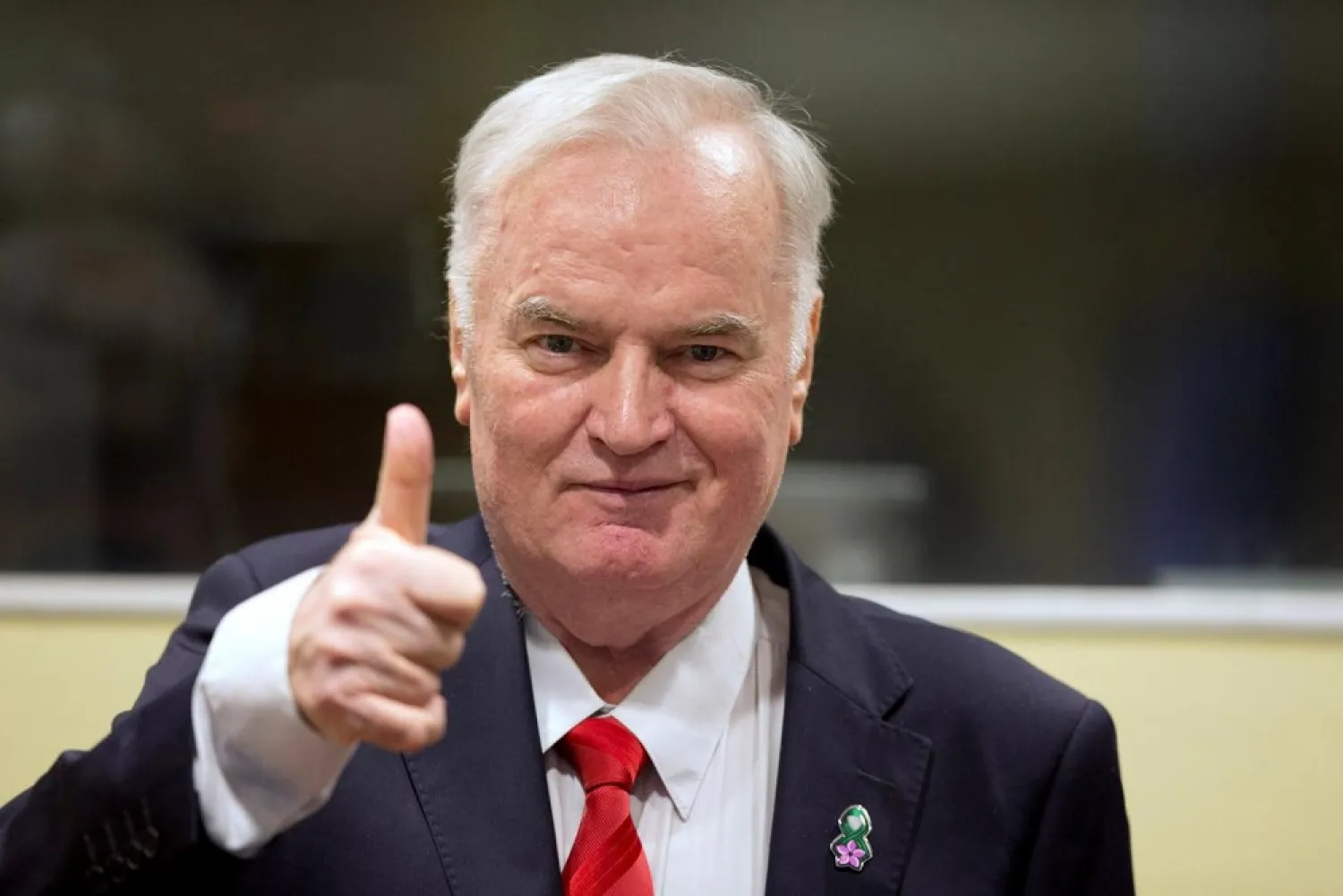

Former Bosnian Serb military commander Ratko Mladic was convicted by a United Nations tribunal on Wednesday of genocide and crimes against humanity for orchestrating massacres and ethnic cleansing during Bosnia’s war.
He was sentenced to life in prison.
The UN Criminal Tribunal for the Former Yugoslavia (ICTY) found Mladic guilty of 10 of 11 charges, including the slaughter of 8,000 Muslim men and boys at Srebrenica and the siege of the Bosnian capital Sarajevo, in which more than 11,000 civilians were killed by shelling and sniper fire over 43 months.
The killings in Srebrenica of men and boys after they were separated from women and taken away in buses or marched off to be shot amounted to Europe’s worst atrocity since World War II.
Mladic, 74, was hustled out of the court minutes before the verdict for screaming “this is all lies, you are all liars” after returning from what his son described as a blood pressure test which delayed the reading-out of the judgment.
“The crimes committed rank among the most heinous known to humankind, and include genocide and extermination as a crime against humanity,” Presiding Judge Alphons Orie said in reading out a summary of the judgment.
“Many of these men and boys were cursed, insulted, threatened, forced to sing Serb songs and beaten while awaiting their execution,” he said.
Mladic, the most notorious of the ICTY’s cases along with ex-Bosnian Serb political leader Radovan Karadzic and late Serbian President Slobodan Milosevic, had pleaded not guilty to all charges.
His defense lawyer later confirmed that he will appeal the conviction.
Mladic's son Darko Mladic accused the judges of obstructing his father's legal team in presenting evidence exculpating his father.
In its summary, the tribunal found Mladic “significantly contributed” to genocide committed in Srebrenica with the goal of destroying its Muslim population, “personally directed” the long bombardment of Sarajevo and was part of a “joint criminal enterprise” intending to purge Muslims and Croats from Bosnia.
In Geneva, UN human rights chief Zeid Ra‘ad al-Hussein called Mladic the “epitome of evil” and said his conviction after 16 years as an indicted fugitive and over four years of trial was a “momentous victory for justice”.
“The prosecution of Mladic is the epitome of what international justice is all about,” Zeid said in a statement.
He added: "Mladic presided over some of the darkest crimes to occur in Europe since World War II, bringing terror, death and destruction to thousands of victims, and sorrow, tragedy and trauma to countless more."
“Today’s verdict is a warning to the perpetrators of such crimes that they will not escape justice, no matter how powerful they may be nor how long it may take.”
Aleksandar Vucic, president of Serbia whose late nationalist strongman Milosevic was Mladic’s patron but died in a tribunal prison before the end of his trial, said Serbia “respects the victims” and called for a focus on the future.
Vucic alleges that the court has been biased against the Serbs and Serb war victims, but adds that "we should not justify the crimes committed" by the Serbs.
“I would like to call on everyone (in the region) to start looking into the future and not to drown in tears of the past... We need to look to the future...so we finally have a stable country,” Vucic told reporters when asked about the verdict.
“We are ready to accept our responsibility (for war crimes) while the others are not."
Serbia, once the most powerful Yugoslav republic, is now democratic and seeking ties to the European Union.
Bosnian Prime Minister Denis Zvizdic said he hoped that “those who still call for new divisions and conflicts will carefully read the verdict rendered today ...in case that they are still no ready to face their past”.
He was alluding to enduring separatism in post-war federal Bosnia’s autonomous Serb region.
Zvizdic said Mladic's life sentence "will not bring back to life thousands of killed innocent civilians nor will it bring comfort to their families, but it is of immense importance for the future of (the Balkans) as a deterrent to all those who dream of future wars and continue to stoke ethnic tensions."
In Lazarevo, a small Serbian village where Mladic was arrested in 2011, residents have dismissed the guilty verdict against him as biased.
Villagers said they do not recognize the ICTY, which they say has sought to solely blame Serbs for the crimes of the Yugoslav wars of the 1990s.
A villager Igor Topolic said he is "horrified and saddened.”
He added: "All this is a farce for me, he (Mladic) is a Serbian national hero."
Srebrenica, near Bosnia’s eastern border with Serbia, had been designated a “safe area” by the United Nations and was defended by lightly armed UN peacekeepers. But they quickly surrendered when Mladic’s forces stormed it on July 11, 1995.
The Dutch peacekeepers looked on helplessly as Serb forces separated men and boys from women, then sent them out of sight on buses or marched them away to be shot.
A bronzed and burly Mladic was filmed visiting a refugee camp in Srebrenica on July 12. “He was giving away chocolate and sweets to the children while the cameras were rolling, telling us nothing will happen and that we have no reason to be afraid,” recalled Munira Subasic of the Mothers of Srebrenica group.
“After the cameras left he gave an order to kill whoever could be killed, rape whoever could be raped and finally he ordered us all to be banished and chased out of Srebrenica, so he could make an ‘ethnically clean’ city,” she told Reuters.
The remains of Subasic’s son Nermin and husband Hilmo were both found in mass graves by International Commission of Missing Persons (ICMP) workers. The ICMP have identified some 6,900 remains of Srebrenica victims through DNA analysis.
Mladic’s lawyers argued that his responsibility for murder and ethnic cleansing of civilians by Serb forces and allied paramilitaries was never established beyond reasonable doubt and he should get no more than 15 years if convicted.
The “Butcher of Bosnia” to his enemies, Mladic is still seen as a national hero by some Serbs for presiding over the swift capture of 70 percent of Bosnia after its Serbs rose up against a Muslim-Croat declaration of independence from Yugoslavia.
Prosecutors said the ultimate plan pursued by Mladic, Bosnian Serb political leader Radovan Karadzic and Milosevic was to purge Bosnia of non-Serbs - a strategy that became known as “ethnic cleansing” - and carve out a “Greater Serbia” in the ashes of federal Yugoslavia’s disintegration.
Mladic was indicted along with Karadzic in 1995, shortly after the Srebrenica killings, but evaded capture until 2011.
His trial in The Hague took more than four years in part because of delays due to his poor health and will be the last case - barring appeals - to be heard by the ICTY.
Mladic has suffered several strokes, though ICTY judges rejected a flurry of last-minute attempts by defense lawyers to put off the verdict on medical grounds.
His lawyers faced an uphill battle, given a mountain of evidence of Serb atrocities produced in previous trials. Four of Mladic’s subordinates received life sentences. Karadzic was convicted in 2016 and sentenced to 40 years, and is appealing.
Mladic’s lawyers argued that Sarajevo was a legitimate military target as it was the main bastion of Muslim-led Bosnian government forces. They also asserted that Mladic left Srebrenica shortly before Serb fighters began executing Muslim detainees and was later shocked to find out they had occurred.
Prosecutors countered that under war crimes law, even if Mladic did not directly order the killings, he should have known what his subordinates were doing, and would be liable for failing to punish those who committed atrocities.
The ICTY indicted 161 people in all from Bosnia, Croatia, Serbia, Montenegro and Kosovo. It has convicted 83, more than 60 of them ethnic Serbs.


