


Sugar Industry Long Downplayed Potential Harms

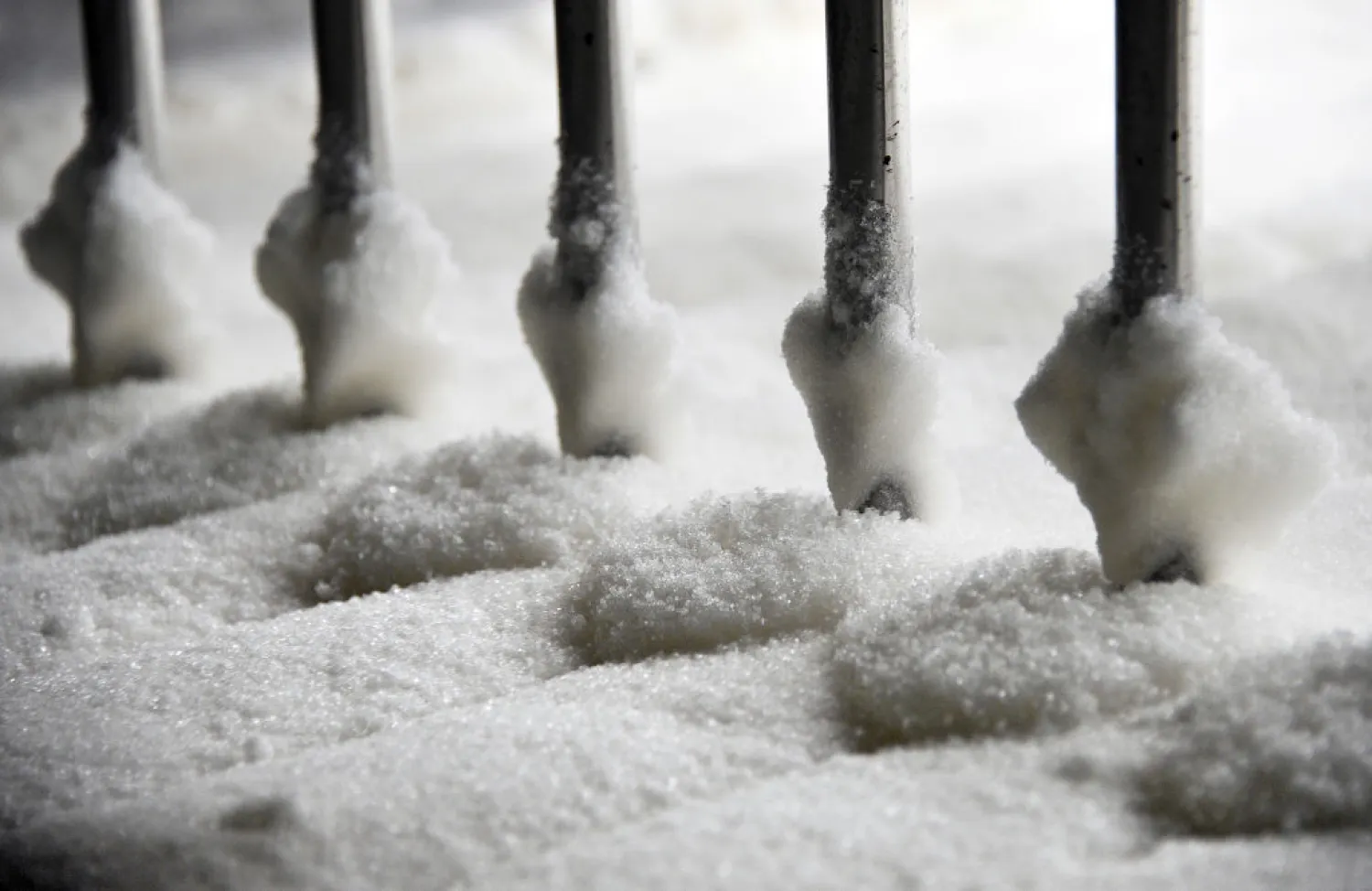
A picture taken on November 18, 2011 shows sugar obtained from sugar beets in French firm Tereos' sugar refinery in the French northern town of Lilliers. PHILIPPE HUGUEN/AFP
TT

Sugar Industry Long Downplayed Potential Harms

A picture taken on November 18, 2011 shows sugar obtained from sugar beets in French firm Tereos' sugar refinery in the French northern town of Lilliers. PHILIPPE HUGUEN/AFP

The sugar industry funded animal research in the 1960s that looked into the effects of sugar consumption on cardiovascular health — and then buried the data when it suggested that sugar could be harmful, according to newly released historical documents.

The internal industry documents were uncovered by researchers at the University of California, San Francisco, and described in a new report in the journal PLOS Biology on Tuesday. The report’s authors say it builds on evidence that the sugar industry has long tried to mislead the public and protect its economic interests by suppressing worrisome research, a tactic used by the tobacco industry.

The documents show that in 1968 a trade group called the Sugar Research Foundation, known today as the Sugar Association, funded a research project on animals to shed light on the connection between sugar and heart health. But when the research pointed to a mechanism by which sugar might promote not only heart disease but also bladder cancer, the industry group ended the study and never published the results.

The sugar industry has long insisted that sugar has no unique role in promoting obesity, diabetes or heart disease, though numerous studies by independent researchers have concluded otherwise. Stanton Glantz, a professor of medicine at U.C.S.F. and an author of the new report, said that even though the newly discovered documents are 50 years old, they are important because they point to a decades-long strategy to downplay the potential health effects of sugar consumption.

“This is continuing to build the case that the sugar industry has a long history of manipulating science,” Dr. Glantz said.

In a statement, the Sugar Association disputed the new report, calling it “a collection of speculations and assumptions about events that happened nearly five decades ago, conducted by a group of researchers and funded by individuals and organizations that are known critics of the sugar industry.” The current research was funded mainly by the National Institutes of Health and the Laura and John Arnold Foundation, a private foundation that has given money to support taxes on sugary beverages.

The statement said that sugar “consumed in moderation is part of a balanced lifestyle,” and it emphasized that the Sugar Association remained “committed to supporting research to further understand the role sugar plays in consumers’ evolving eating habits.”

The documents described in the new report are part of a cache of internal sugar industry communications that Cristin E. Kearns, an assistant professor at the U.C.S.F. School of Dentistry, discovered in recent years at library archives at several universities.

Last year, an article in The New York Times highlighted some of the previous documents that Dr. Kearns had uncovered, which showed that the sugar industry launched a campaign in the 1960s to counter “negative attitudes toward sugar” in part by funding sugar research that could produce favorable results. The campaign was orchestrated by John Hickson, a top executive at the sugar association who later joined the tobacco industry. As part of the sugar industry campaign, Mr. Hickson secretly paid two influential Harvard scientists to publish a major review paper in 1967 that minimized the link between sugar and heart health and shifted blame to saturated fat.

The new report on Tuesday revealed additional internal sugar industry documents from that era. They showed that Mr. Hickson was worried at the time about emerging studies indicating that calories from sugar were more detrimental to heart health than calories from starchy carbohydrates like grains, beans and potatoes. Mr. Hickson suspected this might be because microbes that reside in the gut, known collectively as the microbiota, metabolized sugar and starches differently.

In 1968, the sugar organization started what it called Project 259. The group recruited a researcher at the University of Birmingham in England, W.F.R. Pover, and paid him the equivalent of $187,000 in today’s dollars to conduct a laboratory study on animals. The goal of the experiment was to test whether “germ-free” rats and guinea pigs that lacked gut bacteria would respond differently to sugar and starches than normal animals.
The initial results, described in a 1969 internal industry report as “of particular interest,” raised a concern. The rats fed sucrose, the main component of cane sugar, had produced high levels of an enzyme called beta-glucuronidase, which three other studies published around that time had associated with hardened arteries and bladder cancer.

“This is one of the first demonstrations of a biological difference between sucrose and starch fed rats,” the internal industry report stated.

The documents show that Dr. Pover found something else “highly significant.” The initial phase of the research appeared to confirm that sugar’s adverse effects on cholesterol and triglycerides were a result of it being metabolized and fermented by gut bacteria. Dr. Pover said at the time that he was nearing completion of Project 259 but needed an extension to prove “conclusively” that the effects he was seeing were mediated by the microbiota.

But despite having granted him a previous extension, the sugar association decided to pull the plug on Project 259 and eliminate its funding. In an internal report in 1970, Mr. Hickson updated fellow sugar executives on studies that could “elicit useful and significant information” for the industry, and described the value of Project 259 as “nil.” The industry report suggested that Dr. Pover was disappointed, noting that he “expressed hopes of obtaining continuing support from other sources.”

He never succeeded. The research was never published, and it is not entirely clear why. Both Dr. Pover and Mr. Hickson are no longer alive.

A Sugar Association spokeswoman said that the group reviewed its research archives and determined that Dr. Pover’s study ended because it was delayed, over budget and had overlapped with an organizational restructuring.

“There were plans to continue the study with funding from the British Nutrition Foundation,” the statement said, “but for reasons unbeknown to us, this did not occur.”

But Marion Nestle, a professor of nutrition, food studies and public health at New York University, said the internal industry documents were striking because they provide rare evidence that the food industry suppressed research it did not like, a practice that has been documented among tobacco companies, drug companies and other industries.

“From what this paper says, the sugar industry was not interested in answering open-ended questions about whether sugar might be harmful to rats or, given preliminary suggestions of possible harm, doing further studies to find out one way or the other,” she said. “Instead, it stopped the research when the results looked unfavorable.”

The New York Times


Row Deepens Over Vanished River Wave in Munich

(FILES) Surfers ride the Eisbach (ice creek) wave during freezing conditions on the Isar River in the English Garden in Munich, southern Germany on January 4, 2017. (Photo by Mark RALSTON / AFP)
TT

Row Deepens Over Vanished River Wave in Munich

(FILES) Surfers ride the Eisbach (ice creek) wave during freezing conditions on the Isar River in the English Garden in Munich, southern Germany on January 4, 2017. (Photo by Mark RALSTON / AFP)

A row over the disappearance of a famous river surfing wave in Munich escalated on Sunday as authorities removed a beam inserted over Christmas to recreate the attraction.

The Eisbach wave on a side branch of the Isar River had been a landmark in the Bavarian city since the 1980s but it vanished in October after annual cleanup work along the riverbed.

Activists had placed a beam in the water early on December 25 to partially recreate the wave, according to German media reports, and hung a banner above the water that read "Merry Christmas".

But a spokesman for the Munich fire service told AFP the "installation was removed" on Sunday at the request of city authorities.

Activists have made several attempts to reinstate the wave in the city's Englischer Garten park since October -- only to see them reversed.

The local surfers' association IGSM on Thursday posted a statement on its website saying it had abandoned its campaign to save the wave, accusing city authorities of dragging their feet.

The Eisbach wave was considered the largest and most consistent river wave in the heart of a major city and had become a tourist attraction in Bavaria's state capital.

Franz Fasel, head of the IGSM, told AFP in July that 3,000 to 5,000 local surfers were using it.

Access to the wave was cut off for several months earlier this year after the death of a 33-year-old Munich woman who became trapped under the surface while surfing at night.


New York Subway Ends its MetroCard Era and Switches Fully to Tap-and-go Fares

Lev Radin, a MetroCard collector, shows his collection of Inaugural Limited Edition MetroCards, Dec. 10, 2025, in New York. (AP Photo/Yuki Iwamura)
TT

New York Subway Ends its MetroCard Era and Switches Fully to Tap-and-go Fares

Lev Radin, a MetroCard collector, shows his collection of Inaugural Limited Edition MetroCards, Dec. 10, 2025, in New York. (AP Photo/Yuki Iwamura)

When the MetroCard replaced the New York City subway token in 1994, the swipeable plastic card infused much-needed modernity into one of the world’s oldest and largest transit systems.

Now, more than three decades later, the gold-hued fare card and its notoriously finicky magnetic strip are following the token into retirement, The Associated Press reported.

The last day to buy or refill a MetroCard is Dec. 31, 2025, as the transit system fully transitions to OMNY, a contactless payment system that allows riders to tap their credit card, phone or other smart device to pay fares, much like they do for other everyday purchases.

Transit officials say more than 90% of subway and bus trips are now paid using the tap-and-go system, introduced in 2019.

Major cities around the world, including London and Singapore, have long used similar contactless systems. In the US, San Francisco launched a pay-go system earlier this year, joining Chicago and others.

MetroCards upended how New Yorkers commute The humble MetroCard may have outlasted its useful life, but in its day it was revolutionary, says Jodi Shapiro, curator at the New York Transit Museum in Brooklyn, which opened an exhibit earlier this month reflecting on the MetroCard’s legacy.

Before MetroCards, bus and subway riders relied on tokens, the brass-colored coins introduced in 1953 that were purchased from station booths. When the subway opened in 1904, paper tickets cost just a nickel, or about $1.82 in today’s dollars.

“There was a resistance to change from tokens to something else because tokens work,” Shapiro said on a recent visit to the museum, housed underground in a decommissioned subway station. “MetroCards introduced a whole other level of thinking for New Yorkers.”

The Metropolitan Transportation Authority launched public campaigns to teach commuters how to swipe the originally blue-colored cards correctly, hoping to avoid the dreaded error message or lost fares. Officials even briefly toyed with the idea of a quirky mascot, the Cardvaark, before coming to their senses.

The cards quickly became collectors items as the transit system rolled out special commemorative editions marking major events, such as the “Subway Series” between baseball’s New York Mets and the New York Yankees in the 2000 World Series. At the time, a fare cost $1.50.

Artists from David Bowie and Olivia Rodrigo to seminal New York hip hop acts, such as the Wu-Tang Clan, the Notorious B.I.G. and LL Cool J, have also graced the plastic card over the years, as have iconic New York shows like Seinfeld and Law & Order.

“For me, the most special cards are cards which present New York City to the world,” said Lev Radin, a collector in the Bronx. “Not only photos of landmarks, skylines, but also about people who live and make New York special.”

Perfecting the correct angle and velocity of the MetroCard swipe also became something of a point of pride separating real New Yorkers from those just visiting.

During her failed 2016 presidential campaign, Hillary Clinton, a former US Senator from New York, took an excruciating five swipes at a Bronx turnstile. In fairness, her chief Democratic opponent at the time, US Sen. Bernie Sanders of Vermont, a native Brooklynite, didn't even appear to realize tokens had been discontinued.

Cost savings and lingering concerns Unlike the MetroCard rollout, OMNY has required little adjustment.

Riders reluctant to use a credit card or smart device can purchase an OMNY card they can reload, similar to a MetroCard. Existing MetroCards will also continue to work into 2026, allowing riders to use remaining balances.

MTA spokespersons declined to comment, pointing instead to their many public statements as the deadline approaches.

The agency has said the changeover saves at least $20 million annually in MetroCard-related costs.

The new system also allows unlimited free rides within a seven-day period because the fare is capped after 12 rides. It'll max out at $35 a week once the fare rises to $3 in January.

Still, new changes come with tradeoffs, with some critics raising concerns about data collection and surveillance.

Near Times Square on a recent morning, Ronald Minor was among the dwindling group of "straphangers" still swiping MetroCards.

The 70-year-old Manhattan resident said he's sad to see them go. He has an OMNY card but found the vending machines to reload it more cumbersome.

“It’s hard for the elders,” Minor said as he caught a train to Brooklyn. “Don’t push us aside and make it like we don’t count. You push these machines away, you push us away.”

John Sacchetti, another MetroCard user at the Port Authority stop, said he likes being able to see his balance as he swipes through a turnstile so he knows how much he’s been spending on rides.

“It’s just like everything else, just something to get used to," he said as he headed uptown. "Once I get used to it, I think it’ll be okay.”


French Legend Brigitte Bardot Dead at 91

FILED - 01 April 1956, France, Cannes: Then French actress and singer Brigitte Bardot is photographed with a parrot in her hand on the beach during the Cannes Film Festival. Photo: -/AFP Intercontinentale/dpa
TT

French Legend Brigitte Bardot Dead at 91

FILED - 01 April 1956, France, Cannes: Then French actress and singer Brigitte Bardot is photographed with a parrot in her hand on the beach during the Cannes Film Festival. Photo: -/AFP Intercontinentale/dpa

French film legend Brigitte Bardot, a cinema icon of the 1950s and sixties who walked away from global stardom to become an animal rights protector, has died aged 91, her foundation said Sunday.

Bardot had rarely been seen in public in recent months but was hospitalized in October and in November released a statement denying rumors that she had died. The foundation did not say when or where she died.

"The Brigitte Bardot Foundation announces with immense sadness the death of its founder and president, Madame Brigitte Bardot, a world-renowned actress and singer, who chose to abandon her prestigious career to dedicate her life and energy to animal welfare and her foundation," it said in a statement sent to AFP.

Bardot became a global star after appearing in "And God created Woman" in 1956, and went on to appear in about 50 more movies before giving up acting.

She retired from film to settle permanently near the Riviera resort of Saint-Tropez where she devoted herself to fighting for animals.

Her calling apparently came when she encountered a goat on the set of her final film, "The Edifying and Joyous Story of Colinot.”

To save it from being killed, she bought the animal and kept it in her hotel room.
