

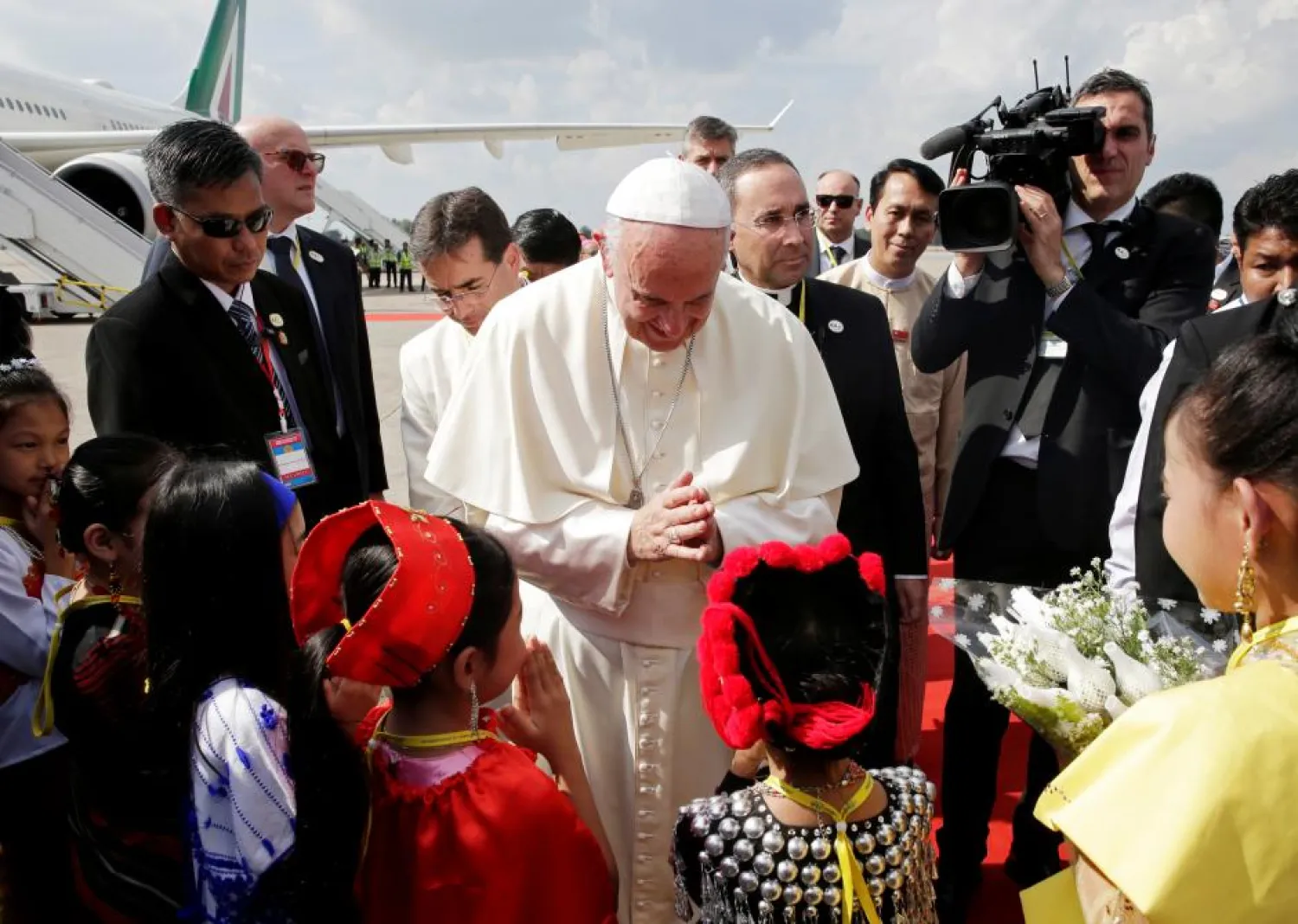

Pope Francis Meets Powerful Myanmar Military Chief amid Rohingya Crisis

Pope Francis is welcomed as he arrives at Yangon International Airport, Myanmar November 27, 2017. (Reuters)
TT

Pope Francis Meets Powerful Myanmar Military Chief amid Rohingya Crisis

Pope Francis is welcomed as he arrives at Yangon International Airport, Myanmar November 27, 2017. (Reuters)

Prop Francis kicked off on Monday a visit to Myanmar by holding talks with its powerful military chief as the country fends off international criticism of its handling of the Muslim Rohingya crisis and United States accusations that it has committed ethnic cleansing against the persecuted minority.

The pope's first meeting in Yangon was with military commander Senior General Min Aung Hlaing in St. Mary's Cathedral in the heart of the Southeast Asian nation's largest city.

The general is in charge of the security operations in Rakhine state, where a military crackdown against the Muslim minority has sent more than 620,000 Rohingya into neighboring Bangladesh.

"They discussed the great responsibility of authorities of the country in this time of transition," Vatican spokesman Greg Burke said after the 15 minutes of talks, which were followed by an exchange of gifts.

Francis presented the general with a commemorative medal of his visit, and Min Aung Hlaing gave the pope a harp in the shape of a boat and an ornate rice bowl, Burke said.

Members of ethnic minority groups in traditional dress welcomed Francis at Yangon airport, and children presented him with flowers as he stepped off his plane.

He waved through an open window at dozens of children waving Vatican and Myanmar flags and wearing T-shirts with the motto of the trip - "love and peace" - as he set off in a car.

Only about 700,000 of Myanmar's 51 million people are Roman Catholic. Thousands of them traveled by train and bus to Yangon, and they joined crowds at several roadside points along the way from the airport to catch a glimpse of the pope.

The Pope will also visit Bangladesh, where the Rohingya have fled to escape what Amnesty International has dubbed "crimes against humanity".

Myanmar's army has denied accusations of murder, rape, torture and forced displacement that have been made against it.

Large numbers of riot police were mobilized in Yangon but there were no signs of any protests.

The trip is so delicate that some papal advisers have warned Francis against even saying the word "Rohingya", lest he set off a diplomatic incident that could turn the country's military and government against minority Christians.

The Rohingya exodus from Rakhine state to Bangladesh's southern tip began at the end of August, when Rohingya attacked security posts and the Myanmar army launched a counter-offensive.

US Secretary of State Rex Tillerson last week called the military operation "ethnic cleansing" and threatened targeted sanctions for "horrendous atrocities".

Myanmar's government has denied most of the accusations made against it, and the army says its own investigation found no evidence of wrongdoing by troops.

Myanmar does not recognize the Rohingya as citizens nor as members of a distinct ethnic group with their own identity, and it even rejects the term "Rohingya" and its use.

Many people in Myanmar instead refer to members of the Muslim minority in Rakhine state as illegal migrants from Bangladesh.

He will greet a delegation of Rohingya Muslims and meet with Bangladesh's political and religious leadership in Dhaka. Masses for the Catholic faithful and meetings with the local church hierarchy round out the itinerary in each country.

In the Kutupalong refugee camp in southern Bangladesh, Senu Ara, 35, welcomed Francis' arrival for what he might be able to do for the refugees.

"He might help us get the peace that we are desperately searching for," she said. "Even if we stay here he will make our situation better. If he decides to send us back, he will do so in a peaceful way."

The most tense moments of his Myanmar visit were expected to be the private meeting with the army chief and, separately, with civilian leader Aung San Suu Kyi on Tuesday.

Suu Kyi's reputation as a Nobel Peace Prize laureate has been tarnished because she has expressed doubts about the reports of rights abuses against the Rohingya and failed to condemn the military.

The pope has already used the word Rohingya in two appeals from the Vatican this year.

Asked if he would say it in Myanmar, Burke said Francis was taking the advice he had been given seriously, but added: "We will find out together during the trip ... it is not a forbidden word".

A hardline group of Buddhist monks, previously known as Ma Ba Tha, said it welcomed the pope's visit but warned, without elaborating, of "a response" if he spoke openly about the Rohingya.

"I hope he doesn't touch on sensitive issues that Myanmar people couldn't accept," said Tawparka, a spokesman for the group, who goes by a single name. "There's no problem if he talks about Islam, but it's unacceptable if he speaks about Rohingya and extreme terrorists."

Days before the pope's visit, Myanmar and Bangladesh inked a deal vowing to begin repatriating Rohingya refugees in two months.

But details of the agreement -- including the use of temporary shelters for returnees, many of whose homes have been burned to the ground -- raise questions for Rohingya fearful of coming back without guarantees of basic rights.



Israeli Air Force Deploys First Laser Interception System

FILED - 26 March 2024, Israel, Jerusalem: Israel Katz attends a meeting at a hotel in Jerusalem. Photo: Christoph Soeder/dpa
TT

Israeli Air Force Deploys First Laser Interception System

FILED - 26 March 2024, Israel, Jerusalem: Israel Katz attends a meeting at a hotel in Jerusalem. Photo: Christoph Soeder/dpa

Israel's defense ministry said on Sunday it had deployed a new "Iron Beam" laser system for the air force to intercept aerial threats.

The laser system's main developers, the ministry's research and development department and defense contractor Rafael, delivered it to the air force at a ceremony in northern Israel.

"For the first time globally, a high-power laser interception system has achieved full operational maturity, successfully executing multiple interceptions," Defense Minister Israel Katz said at the ceremony, according to a statement.

"This monumental achievement... delivers a critical message to our enemies, near and far alike: do not challenge us, or face severe consequences," AFP quoted him as saying.

The handover marks a major milestone in a project more than a decade old.
"Israel has become the first country in the world to field an operational laser system for the interception of aerial threats, including rockets and missiles," said Yuval Steinitz, chairman of Rafael.

The laser system seeks to enhance and slash the cost of Israel's interception of projectiles, and will supplement other aerial defense capacities such as the more well-known Iron Dome.

Iron Dome offers short-range protection against missiles and rockets. The David's Sling system and successive generations of Arrow missiles are Israeli-American technology built to bring down ballistic missiles.

The defense ministry announced in early December that the laser system was complete, and would be deployed by the end of the month.

During the 12-day war launched by Israel against Iran in June, the country's missile defense system failed to intercept all the projectiles fired by Tehran toward Israeli territory.

Israel has since acknowledged being hit by more than 50 missiles during the war with Iran, resulting in 28 deaths.


Trump Says Had 'Productive' Call with Putin Ahead of Zelensky Meeting

US President Donald Trump takes part in a Christmas Eve dinner in the ballroom of his Mar-a-Lago club in Palm Beach, Florida, US, December 24, 2025. REUTERS/Jessica Koscielniak
TT

Trump Says Had 'Productive' Call with Putin Ahead of Zelensky Meeting

US President Donald Trump takes part in a Christmas Eve dinner in the ballroom of his Mar-a-Lago club in Palm Beach, Florida, US, December 24, 2025. REUTERS/Jessica Koscielniak

US President Donald Trump said he had a productive telephone call with his Russian counterpart Vladimir Putin on Sunday ahead of a planned meeting in Florida with Ukraine's leader Volodymyr Zelensky.

"I just had a very good and productive telephone call with President Putin of Russia" before the planned talks with Zelensky at Trump's Florida estate at 1:00 pm local time (1800 GMT), the US leader said on Truth Social.

Putin said Ukraine was in no hurry for peace and if it did not want to resolve their conflict peacefully, Moscow would accomplish all its goals by force.

Putin's remarks on Saturday, carried by state news agency TASS, followed a vast Russian drone and missile attack that prompted Zelensky to say Russia was demonstrating its wish to continue the war while Kyiv wanted peace.


Russia Sends 3 Iranian Satellites into Orbit, Report Says

In this photo released by Roscosmos space corporation on Thursday, Feb. 29, 2024, the Soyuz-2.1b rocket blasts off at the Vostochny cosmodrome outside the city of Tsiolkovsky, about 200 kilometers (125 miles) from the city of Blagoveshchensk in the far eastern Amur region, Russia. A Russian Soyuz rocket successfully put an Iranian satellite into orbit along with 18 Russian satellites on Thursday. (Roscosmos space corporation via AP)
TT

Russia Sends 3 Iranian Satellites into Orbit, Report Says

In this photo released by Roscosmos space corporation on Thursday, Feb. 29, 2024, the Soyuz-2.1b rocket blasts off at the Vostochny cosmodrome outside the city of Tsiolkovsky, about 200 kilometers (125 miles) from the city of Blagoveshchensk in the far eastern Amur region, Russia. A Russian Soyuz rocket successfully put an Iranian satellite into orbit along with 18 Russian satellites on Thursday. (Roscosmos space corporation via AP)

Russia on Sunday sent three Iranian communications satellites into orbit, the second such launch since July, Iranian state television reported.

The report said that a Russian rocket sent the satellites to circle the Earth on a 500-kilometer (310-mile) orbit from the Vostochny launchpad in eastern Russia. The three satellites are dubbed Paya, Kowsar and Zafar-2.

The report said that Paya, weighing 150 kilograms (330 pounds), is the heaviest satellite that Iran has ever deployed into orbit. Kowsar weighs 35 kilograms (77 pounds), but the report didn't specify how heavy Zafar-2 is.

The satellites feature up to 3-meter resolution images, applicable in the management of water resources, agriculture and the environment. Their life span is up to five years.

Russia occasionally sends Iran's satellites into orbit, highlighting the strong ties between the two countries. In July, a Russian rocket sent Iranian communications satellite Nahid-2 into orbit.

Russia, which signed a “strategic partnership” treaty with Iran in January, strongly condemned the Israeli and US strikes on Iran that came during a 12-day air war in June and killed nearly 1,100 Iranians, including military commanders and nuclear scientists. Retaliatory missile barrages by Iran killed 28 people in Israel.

As a long-standing project, Iran from time-to-time launches satellite carriers to send its satellites into space.

The United States has said that Iran’s satellite launches defy a UN Security Council resolution and called on Tehran to undertake no activity involving ballistic missiles capable of delivering nuclear weapons. UN sanctions related to Iran’s ballistic missile program expired in 2023.