Abidjan Summit Begins amid Questions about African-European Partnership

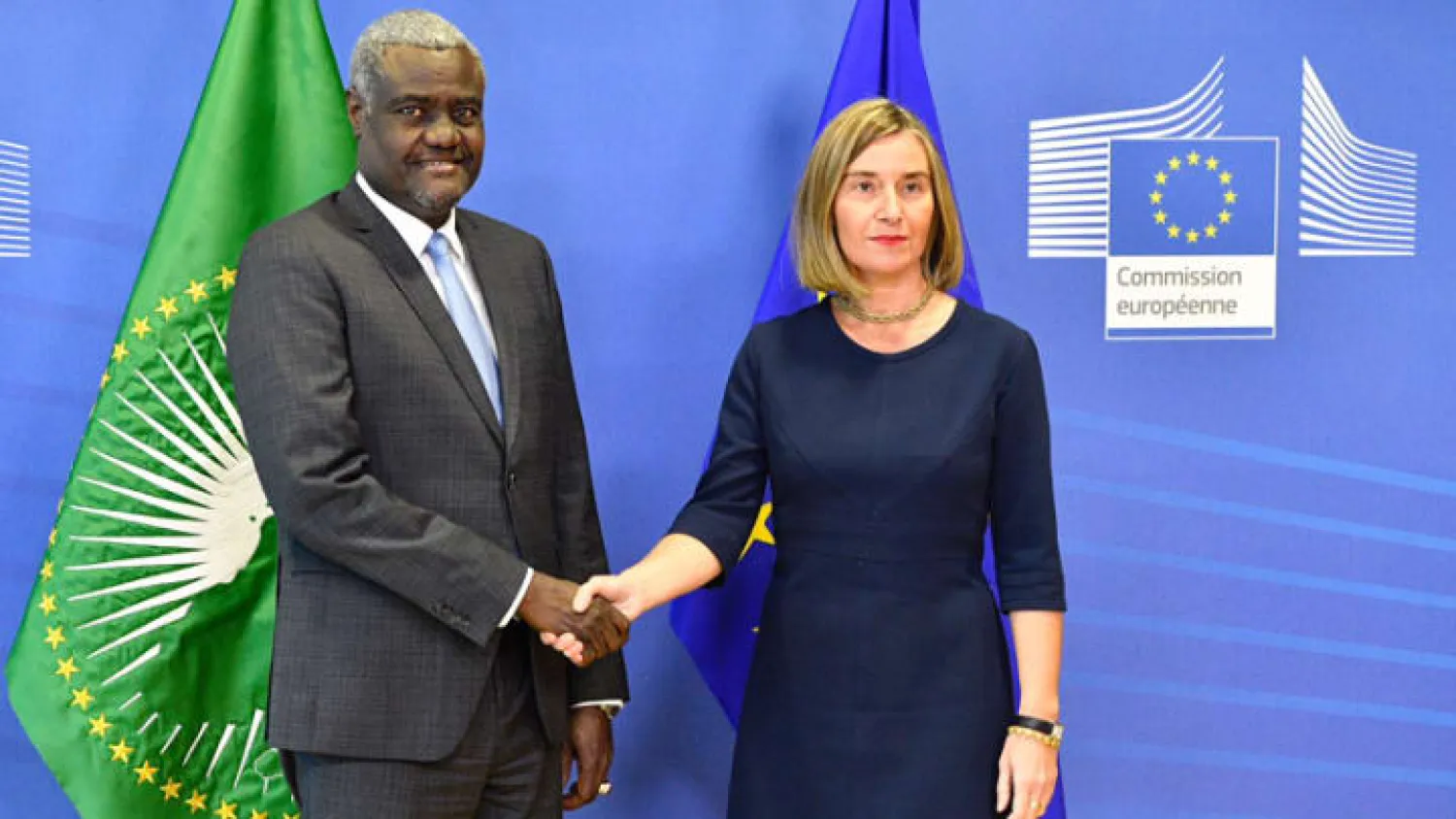
Federica Mogherini, EU high representative for foreign affairs and security policy and vice-president of the European Commission, receives Moussa Faki Mahamat, chairperson of the African Union Commission. (Photo: EU)
TT

Abidjan Summit Begins amid Questions about African-European Partnership

Federica Mogherini, EU high representative for foreign affairs and security policy and vice-president of the European Commission, receives Moussa Faki Mahamat, chairperson of the African Union Commission. (Photo: EU)

The ministerial meeting of the 5th African Union-European Union Summit was held on Tuesday and focused on joining forces to face common challenges at the security, economic and social levels.

The 5th AU-EU Summit will kick-off on Wednesday in Abidjan, Cote d'Ivoire, under the theme, “Investing in youth for a sustainable future”, amid fears that the partnership envisaged between the African Union and the European Union remains hostage to situational circumstances.

African and European heads of state and government representing 80 countries will gather to discuss current challenges, in the presence of the President of the European Council, the President of the European Commission, the President of the African Union and the Chairperson of the African Union Commission.

Speaking on condition of anonymity, an African foreign minister told Asharq ِAl-Awsat: “Partnership between the two sides cannot depend on the situation.”

He pointed out that the African-European partnership suffered from quantitative issues, in the sense that partnership cannot be made with 80 countries, wondering whether there were agreements within African countries or within European countries to achieve the envisioned objectives.

Contrary to the prevailing belief that terrorism issues would take the lead in the Abidjan summit, African diplomatic sources told Asharq Al-Awsat that terrorism would not be extensively discussed on the table.

According to the same sources, the Southern African Development Committee (SADC) was dominant in the African Union agenda, and had no interest in the matter, since terrorism has not affected their countries, but only threatened West Africa, the Sahel and North Africa.

In a speech at the opening session, Ivorian Foreign Minister Marcel Amon Tanoh said that Africa and Europe were asked to raise common challenges of a security, economic and social nature, noting that the youth, the main theme of the summit, should contribute to addressing these challenges.

EU High Representative for Foreign Affairs and Security Policy and Vice President of the European Commission Federica Mogherini underlined the need for the two unions to meet on a regular basis to ensure the implementation of the decisions taken during the summits.


CENTCOM to Iran: We Will Not Tolerate Unsafe IRGC Actions

This handout image from the US Navy shows Capt. Daniel Keeler, the commanding officer of the Nimitz-class aircraft carrier USS Abraham Lincoln, as he prepares to fly an MH-60R Sea Hawk helicopter in the Indian Ocean on Jan. 23, 2026. (Mass Communication Specialist Seaman Daniel Kimmelman/US Navy via AP)
TT

CENTCOM to Iran: We Will Not Tolerate Unsafe IRGC Actions

This handout image from the US Navy shows Capt. Daniel Keeler, the commanding officer of the Nimitz-class aircraft carrier USS Abraham Lincoln, as he prepares to fly an MH-60R Sea Hawk helicopter in the Indian Ocean on Jan. 23, 2026. (Mass Communication Specialist Seaman Daniel Kimmelman/US Navy via AP)

US Central Command (CENTCOM) has warned Iran’s Revolutionary Guard (IRGC) not to make any “unsafe” behavior near American forces in the Strait of Hormuz.

Iran is conducting a two-day live-fire naval exercise in the Strait scheduled to begin on Sunday.

“CENTCOM urges the IRGC to conduct the announced naval exercise in a manner that is safe, professional and avoids unnecessary risk to freedom of navigation for international maritime traffic,” it said in a statement on Friday.

“The Strait of Hormuz is an international sea passage and an essential trade corridor that supports regional economic prosperity. On any given day, roughly 100 of the world’s merchant vessels transit the narrow strait,” it said.

While acknowledging Iran’s right to operate professionally in international airspace and waters, it said that “any unsafe and unprofessional behavior near US forces, regional partners or commercial vessels increases risks of collision, escalation, and destabilization.”

CENTCOM also stressed that it “will not tolerate unsafe IRGC actions including overflight of US military vessels engaged in flight operations, low-altitude or armed overflight of US military assets when intentions are unclear, highspeed boat approaches on a collision course with US military vessels, or weapons trained at US forces.”


Trump Says Iran Wants Deal, US ‘Armada’ Larger Than in Venezuela Raid

US President Donald Trump signs executive orders in the Oval Office at the White House, Washington, DC, USA, 30 January 2026. (EPA)
TT

Trump Says Iran Wants Deal, US ‘Armada’ Larger Than in Venezuela Raid

US President Donald Trump signs executive orders in the Oval Office at the White House, Washington, DC, USA, 30 January 2026. (EPA)

President Donald Trump said Thursday he believed Tehran wanted to make a deal to avoid military action, adding that the US "armada" near Iran was bigger than the one he dispatched to topple Venezuela's leader.

"We have a large armada, flotilla, call it whatever you want, heading toward Iran right now, even larger than what we had in Venezuela," the Republican president told reporters in the Oval Office.

"Hopefully we'll make a deal. If we do make a deal, that's good. If we don't make a deal, we'll see what happens."

Asked if he had given Iran a deadline to make a deal on its nuclear program, ballistic missiles and other issues, Trump said "yeah I have" but added that "only they know for sure" what it was.

Trump, however, cited what he said was Iran's decision to halt executions of protesters -- after a crackdown in which rights groups say more than 6,000 people were killed -- as evidence to show Tehran was ready to comply.

"I can say this, they do want to make a deal," Trump said.

Trump declined to say whether, if Iran did not reach a deal, he planned a repeat of the dramatic operation in Venezuela in which US forces captured president Nicolas Maduro.

"I don't want to talk about anything having to do with what I'm doing militarily," he said.


‘He Probably Would’ve Survived’: Iran Targeting Hospitals in Crackdown

A bus burned during protests on a street in Tehran, Iran, January 16, 2026. Majid Asgaripour/WANA (West Asia News Agency) via Reuters
TT

‘He Probably Would’ve Survived’: Iran Targeting Hospitals in Crackdown

A bus burned during protests on a street in Tehran, Iran, January 16, 2026. Majid Asgaripour/WANA (West Asia News Agency) via Reuters

Hospitals are no longer places of safety as Iran's crackdown on anti-government protests impacts all aspects of life, rights groups say, with authorities arresting wounded protesters and even the medics who treat them.

Activists accuse security forces of killing thousands of people and wounding more by directly firing on protests, often with birdshot that can leave metal pellets lodged in the body until hygienically extracted by a professional.

But rights groups say authorities have raided hospitals searching for people with wounds that suggest they were involved in protests. At least five doctors have meanwhile been arrested for treating them, according to the World Health Organization.

Amnesty International said security forces had "arrested protesters receiving treatment in hospitals", adding it had received information that medical staff in central Isfahan province had been ordered to notify authorities about patients with injuries from gunshots and shotgun pellets.

The New York-based Center for Human Rights in Iran (CHRI) said it "has documented cases in which security forces raided hospitals to identify and arrest protesters injured during demonstrations".

In apparent response to the charges, Iran's health ministry this week urged those injured in the protests to go to hospital.

"Our advice to the public is that if they suffer any kind of injury, they should not try to treat it at home, and they should not worry about going to medical centers," the health ministry said, in a statement carried by state television.

- 'Raiding medical facilities' -

Sajad Rahimi, 36, from Iran's Gulf island of Qeshm, was badly wounded after security forces shot at him when he joined a protest in the southern province of Fars at the peak of the movement on January 9, according to Norway-based NGO Iran Human Rights.

But fearing he could be shot dead by security forces in a "coup de grace", he asked friends not to take him directly to hospital, said IHR, which has investigated this and several other cases and spoke to the man's brother.

Eventually, the family transferred him to hospital, but he died as a result of a deep wound caused by live ammunition and severe bleeding.

"The doctor said that if he had arrived at the hospital just ten minutes earlier, he would probably have survived," his brother told IHR.

The group said it had reports of "security forces raiding certain medical facilities and informal shelters for the wounded in order to arrest medical staff and volunteer first responders".

The Hengaw rights group, also based in Norway, highlighted the case of Dr Ali Reza Golchni, a physician from the city of Qazvin, northwest of Tehran, who it said had been arrested "for providing medical care to injured protesters".

- 'Grave violations' -

World Health Organization director general Tedros Adhanom Ghebreyesus said he was "deeply concerned by multiple reports of health personnel and medical facilities in Iran being impacted by the recent insecurity, and prevented from delivering their essential services to people requiring care".

He said there were reports of "at least five doctors detained, while treating injured patients".

The World Medical Association (WMA) said it had received reports that security forces arrested injured protesters in both the Isfahan and the southwestern province of Chaharmahal-and-Bakhtiari.

"Hospital staff have also been instructed to report patients suffering gunfire injuries to security authorities, with non-compliance exposing them to prosecution and other reprisals," it said, citing information received by the WMA.

Hengaw also cited the case of Taher Malekshahi, a 12-year-old Kurdish-Iranian boy from Qorveh in western Iran who was severely injured after being shot in the face and eyes with pellet ammunition.

It said he lost one eye and suffered serious damage to the other, publishing a picture of his face with the boy's entire forehead pock-marked with pellet wounds.

It said while he was currently receiving intensive medical treatment in Tehran, "authorities have pressured his family to falsely claim he was wounded by 'terrorists' in exchange for state recognition as a war-disabled victim."