


Eye Contact with Your Baby Helps You Bond Better

Eye Contact with Your Baby Helps You Bond Better
TT

Eye Contact with Your Baby Helps You Bond Better

Eye Contact with Your Baby Helps You Bond Better

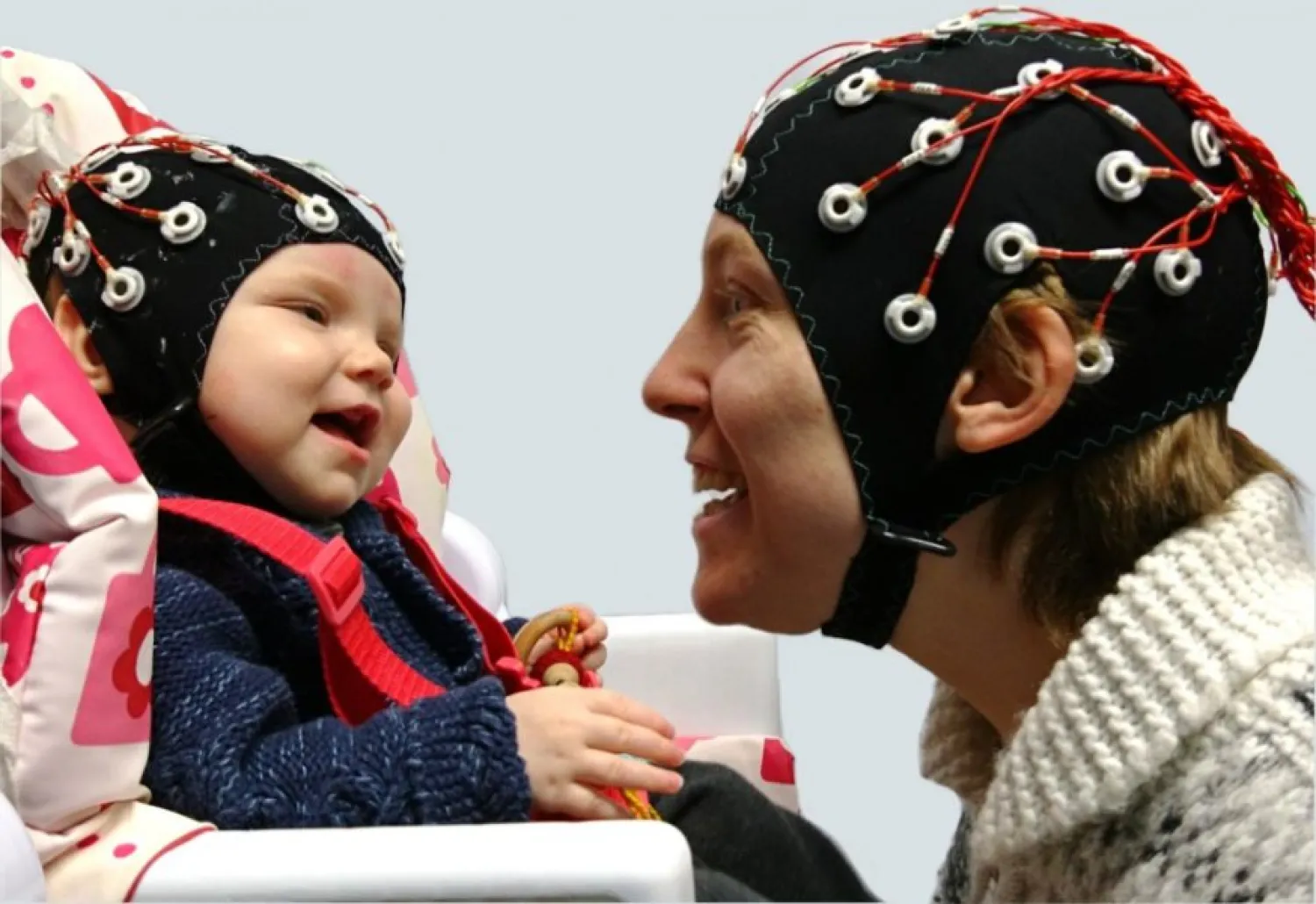
Making eye contact with an infant makes adults' and babies' brainwaves 'get in sync' with each other – which is likely to support communication and learning – according to researchers at the University of Cambridge.

Researchers at the Baby-LINC Lab at the University of Cambridge carried out a study to explore whether infants can synchronize their brainwaves to adults too and whether eye contact might influence this.

The team examined the brainwave patterns of 36 infants (17 in the first experiment and 19 in the second) using electroencephalography (EEG), which measures patterns of brain electrical activity via electrodes in a skullcap worn by the participants. They compared the infants' brain activity to that of the adult who was singing nursery rhymes to the infant.

As anticipated, the researchers found that infants' brainwaves were more synchronized to the adults' when the adult's gaze met the infant's, as compared to when her gaze was averted Interestingly, the greatest synchronizing effect occurred when the adults' head was turned away but her eyes still looked directly at the infant. The researchers say this may be because such a gaze appears highly deliberate, and so provides a stronger signal to the infant that the adult intends to communicate with her.

Dr. Victoria Leong, lead author on the study said: “When the adult and infant are looking at each other, they are signaling their availability and intention to communicate with each other.

"We found that both adult and infant brains respond to a gaze signal by becoming more in sync with their partner.

"This mechanism could prepare parents and babies to communicate, by synchronizing when to speak and when to listen, which would also make learning more effective.”




Saudi Arabia's Qassim National Park Records Third Consecutive Arabian Oryx Births

Saudi Arabia's Qassim National Park recorded the birth of an Arabian oryx for the third consecutive year. (SPA)
TT

Saudi Arabia's Qassim National Park Records Third Consecutive Arabian Oryx Births

Saudi Arabia's Qassim National Park recorded the birth of an Arabian oryx for the third consecutive year. (SPA)

Saudi Arabia's Qassim National Park in Buraidah recorded the birth of an Arabian oryx for the third consecutive year, reported the Saudi Press Agency on Monday.

The development is an important environmental milestone that reflect the ongoing success of release and reintroduction programs led by the National Center for Wildlife (NCW), which aims to preserve endangered wild species and boost biodiversity in their natural habitats.

The achievement exemplifies a pioneering collaboration between the NCW and the National Center for Vegetation Cover Development and Combating Desertification through initiatives such as vegetation enhancement, natural habitat rehabilitation, and the creation of suitable conditions for the breeding and sustainability of wild species.

Qassim National Park is one of several national parks implementing afforestation and environmental rehabilitation projects under the Saudi Green Initiative, strengthening the region’s ecological diversity and showcasing the role of national parks as models of successful environmental sustainability programs in the Kingdom.


Which Does More for Your Skin: Vitamin C or Vitamin E?

Vitamin C and vitamin E are essential for maintaining healthy, glowing skin. (University of Iowa)
TT

Which Does More for Your Skin: Vitamin C or Vitamin E?

Vitamin C and vitamin E are essential for maintaining healthy, glowing skin. (University of Iowa)

Walk down any skincare aisle, and you’ll see vitamin C and vitamin E everywhere—serums, oils, moisturizers, you name it. They’re both often credited for helping skin look its best, but when it comes to choosing vitamin C vs. vitamin E, which is better for your skin?

Dermatologists and nutritionists affirm the benefits of both vitamins. However, they said, each has a different role, and the best results are often obtained when they are used together, according to Prevention magazine.

One of the most obvious ways in which vitamin C is beneficial for skin is that it helps with the production of collagen.

“[Collagen] is important for skin structure, wound healing and firmness,” said Marissa Beck, MS, RDN, owner of REVV Health in Seattle, Washington. “It also helps protect against oxidative stress from UV light, and also pollution.”

Beyond those extremely necessary functions, there’s also evidence to suggest vitamin C may help reduce the appearance of wrinkles and raised scars, as well as assist with tightening up sagging skin.

Vitamin C also helps to brighten the skin and improve discoloration to even skin tone.

A recent study even suggested vitamin C might help reactivate genes related to skin growth and repair.

Unlike vitamin C, vitamin E is actually already produced by our body; it’s part of the sebum that serves as a barrier to help skin stay moisturized. This is also why you’ll often find vitamin E as an ingredient in popular moisturizing products. Vitamin E oil, in particular, might be useful for treating dry, flaky skin or improving symptoms of eczema.

“Vitamin E is a fat-soluble vitamin, and because of this, it works primarily within the cell membranes of the skin by helping reduce UV-induced free radical damage and supporting the skin barrier,” Beck explained. “It might also help with inflammation as an antioxidant.”

When it comes to ensuring you’re getting enough of each vitamin to support skin health, you can look to both diet and topical application.

For vitamin C, nutritionists recommend oranges, bell peppers, tomatoes, kiwi, strawberries and broccoli. To increase vitamin E intake, they suggests looking to plant-based oils such as wheat germ oil, nuts, seeds, and avocados.

Experts conclude that the two vitamins will serve best working in tandem, while keeping all the other important aspects of skin health in mind.

Of course, eating a balanced diet is important for overall health, but adding vitamin C or vitamin E-infused products to skincare routine has its own benefits.


The Moon and Sun Figure Big in the New Year’s Lineup of Cosmic Wonders

A Boeing 737 Max 8-200 aircraft of Irish budget airline Ryanair flies past the Waxing crescent moon in Frankfurt am Main, western Germany on December 27, 2025. (AFP)
TT

The Moon and Sun Figure Big in the New Year’s Lineup of Cosmic Wonders

A Boeing 737 Max 8-200 aircraft of Irish budget airline Ryanair flies past the Waxing crescent moon in Frankfurt am Main, western Germany on December 27, 2025. (AFP)

The moon and sun share top billing in 2026.

Kicking off the year’s cosmic wonders is the moon, drawing the first astronauts to visit in more than 50 years as well as a caravan of robotic lunar landers including Jeff Bezos’ new supersized Blue Moon. A supermoon looms on Jan. 3 and an astronomical blue moon is on the books for May.

The sun will also generate buzz with a ring-of-fire eclipse at the bottom of the world in February and a total solar eclipse at the top of the world in August. Expect more auroras in unexpected places, though perhaps not as frequently as the past couple years.

And that comet that strayed into our turf from another star? While still visible with powerful backyard telescopes, the recently discovered comet known as 3I/Atlas is fading by the day after swinging past Earth in December. Jupiter is next on its dance card in March. Once the icy outsider departs our solar system a decade from now, it will be back where it belongs in interstellar space.

It’s our third known interstellar visitor. Scientists anticipate more.

“I can’t believe it’s taken this long to find three,” said NASA’s Paul Chodas, who’s been on the lookout since the 1980s. And with ever better technology, “the chance of catching another interstellar visitor will increase.”

Here’s a rundown on what the universe has in store for us in 2026:

Next stop, moon

NASA’s upcoming moonshot commander Reid Wiseman said there’s a good chance he and his crew will be the first to lay eyeballs on large swaths of the lunar far side that were missed by the Apollo astronauts a half-century ago. Their observations could be a boon for geologists, he noted, and other experts picking future landing sites.

Launching early in the year, the three Americans and one Canadian will zip past the moon, do a U-turn behind it, then hustle straight back to Earth to close out their 10-day mission. No stopping for a moonwalk — the boot prints will be left by the next crew in NASA’s Artemis lunar exploration program.

More robotic moon landings are on the books by China as well as US companies. Early in the year, Amazon founder Bezos is looking for his Blue Origin rocket company to launch a prototype of the lunar lander it’s designing for NASA’s astronauts. This Blue Moon demo will stand 26 feet (8 meters), taller than what delivered Apollo’s 12 moonwalkers to the lunar surface. The Blue Moon version for crew will be almost double that height.

Back for another stab at the moon, Astrobotic Technology and Intuitive Machines are also targeting 2026 landings with scientific gear. The only private entity to nail a lunar landing, Firefly Aerospace, will aim for the moon’s far side in 2026.

China is targeting the south polar region in the new year, sending a rover as well as a so-called hopper to jump into permanently shadowed craters in search of ice.

Eclipses

The cosmos pulls out all the stops with a total solar eclipse on Aug. 12 that will begin in the Arctic and cross over Greenland, Iceland and Spain. Totality will last two minutes and 18 seconds as the moon moves directly between Earth and the sun to blot out the latter. By contrast, the total solar eclipse in 2027 will offer a whopping 6 1/2 minutes of totality and pass over more countries.

For 2026, the warm-up act will be a ring-of-fire eclipse in the Antarctic on Feb. 17, with only a few research stations in prime viewing position. South Africa and southernmost Chile and Argentina will have partial viewing. A total lunar eclipse will follow two weeks after February’s ring of fire, with a partial lunar eclipse closing out the action at the end of August.

Parading planets

Six of the solar system’s eight planets will prance across the sky in a must-see lineup around Feb. 28. A nearly full moon is even getting into the act, appearing alongside Jupiter. Uranus and Neptune will require binoculars or telescopes. But Mercury, Venus, Jupiter and Saturn should be visible with the naked eye shortly after sunset, weather permitting, though Mercury and Venus will be low on the horizon.

Mars will be the lone no-show. The good news is that the red planet will join a six-planet parade in August, with Venus the holdout.

Supermoons

Three supermoons will lighten up the night skies in 2026, the stunning result when a full moon inches closer to Earth than usual as it orbits in a not-quite-perfect circle. Appearing bigger and brighter, supermoons are a perennial crowd pleaser requiring no equipment, only your eyes.

The year's first supermoon in January coincides with a meteor shower, but the moonlight likely will obscure the dimmer fireballs. The second supermoon of 2026 won’t occur until Nov. 24, with the third — the year’s final and closest supermoon — occurring the night of Dec. 23 into Dec. 24. This Christmas Eve supermoon will pass within 221,668 miles (356,740 kilometers) of Earth.

Northern and southern lights

The sun is expected to churn out more eruptions in 2026 that could lead to geomagnetic storms here on Earth, giving rise to stunning aurora. Solar action should start to ease, however, with the 11-year solar cycle finally on the downslide.

Space weather forecasters like Rob Steenburgh at the National Oceanic and Atmospheric Administration can’t wait to tap into all the solar wind measurements coming soon from an observatory launched in the fall.

“2026 will be an exciting year for space weather enthusiasts,” he said in an email, with this new spacecraft and others helping scientists “better understand our nearest star and forecast its impacts.”